Situated right in the core zone of the “Three Parallel Rivers of Yunnan Protected Areas” (三江並流) UNESCO World Natural Heritage site, Potatso National Park (also known as Pudacuo – 普达措国家公园) spans a total area of approximately 1,313 km², rising as a unique ecological paradise and the very first national park in mainland China planned and built according to strict international conservation management standards. The name “Pudacuo” originates from ancient Tibetan (藏语: phu-mda’ mtsho), which translates into Chinese as “Pudacuo Lake” (普托湖). In the spiritual consciousness of local residents, this name embodies the profound philosophy of a “Lake Blessed by the Deities” and a “Boat Bridge of Universal Salvation” that shelters and ferries all sentient beings across the sea of illusion.
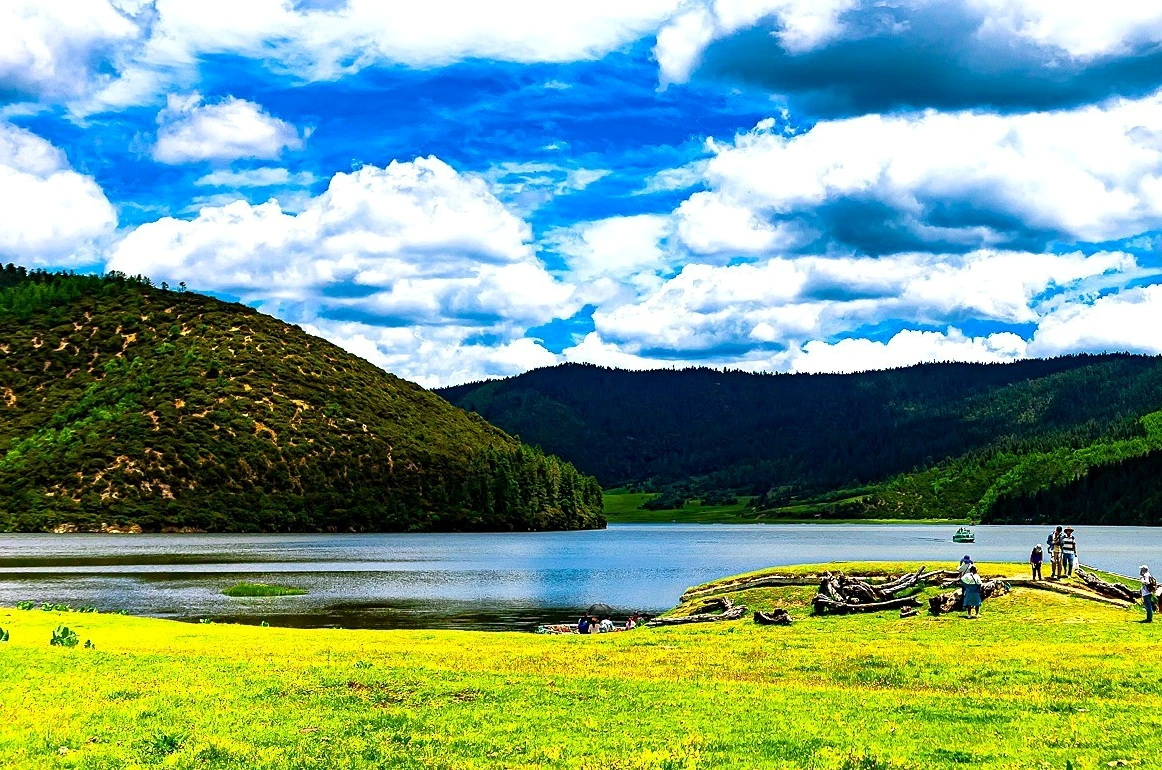
Tracing history back to the Tang Dynasty, when cultural and political exchanges between the Tibetan Empire and the Nanzhao Kingdom flourished, this region served as a strategic grazing pasture flanking the rugged Yunnan-Tibet Tea Horse Road, as well as a secluded pilgrimage sanctuary for monks and devotees. In the “Terma” (hidden treasure) texts of Bon—the oldest indigenous spiritual tradition of the snowy highlands—the two central lakes, Bitahai (碧塔海) and Shuduhu (属都湖), are revered as the “Convergence of Dragon Deities and Earth Spirits,” a sacred nexus where guardian spirits protect the mortal realm. Beyond its Tibetan heritage, the Dongba scriptures of the Naxi people also praised the primeval forests of Potatso under the name “Miguozong,” signifying the “origin of sacred medicinal mountains and spiritual bronze drums.”
Throughout the Qing Dynasty and into the Republican era, the Potatso plateau functioned as a “summer pasture”—a lush seasonal grazing ground managed by the Zhongdian Tibetan Chieftaincy and allied nomadic tribes. The historic turning point that brought this hidden realm into global consciousness occurred between 1922 and 1935. Renowned American botanist and anthropologist Joseph Rock embarked on a series of arduous expeditions deep into the heart of Diqing. His vivid chronicles, invaluable collections of biological specimens, and timeless photojournalism published in National Geographic portrayed a breathtaking, untouched wonderland, laying the foundation for the concept of the “Last Shangri-La on Earth” in the minds of Western readers.
Developments at the dawn of the 21st century elevated Potatso from an untouched heritage area into a national icon of modern ecological conservation. Between 2006 and 2007, the Yunnan Provincial Government and the Diqing Tibetan Autonomous Prefecture carried out a large-scale integration: merging the Bitahai Provincial Nature Reserve and the Shuduhu Provincial Scenic Area. This unification of premier natural resources culminated on June 21, 2007, when Potatso National Park was officially inaugurated, earning the distinction of becoming the first international-standard national park model in China. Having evolved over millennia from a sacred land in Tibetan legend to a stopover for wilderness explorers, Potatso today preserves its majestic historical undercurrents in seamless harmony with its serene natural beauty.
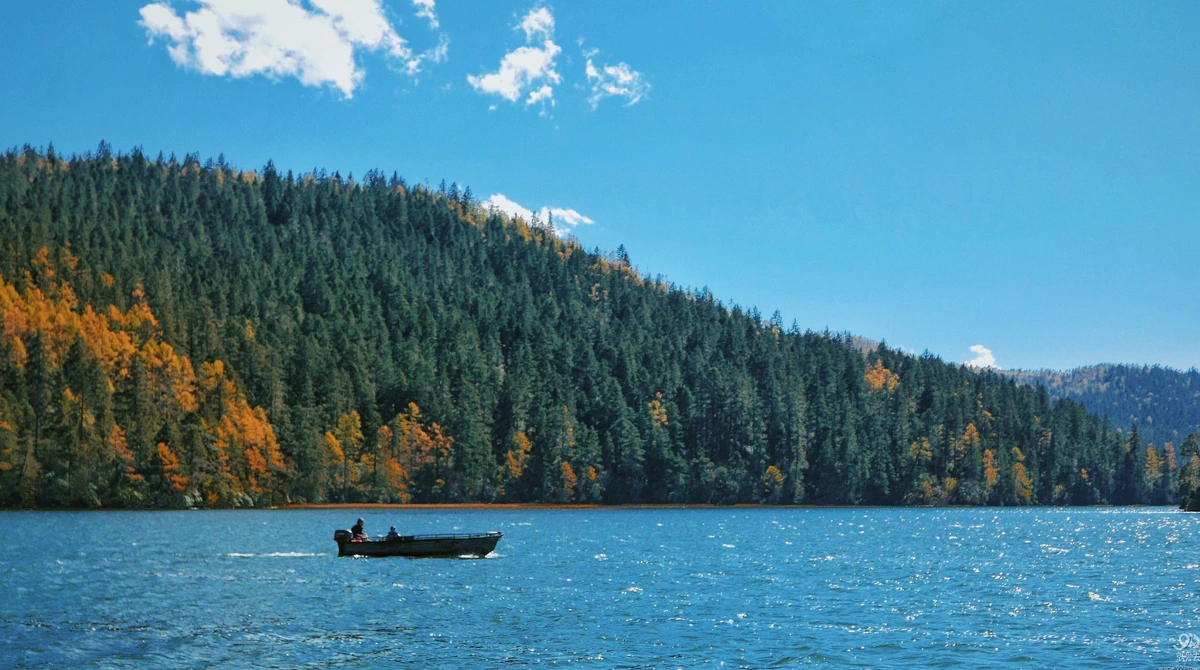
Rising impressively along the southeastern margin of the majestic Qinghai-Tibet Plateau and straddling the southern section of the Shaluli Range within the Hengduan Mountains, Potatso National Park (普达措国家公园) sits at altitudes ranging from 3,500 meters to 4,159 meters above sea level. In the philosophical worldview of Tibetans and the teachings of Bon, the topography here exemplifies traditional Tibetan geomancy known as Sa-dpyad (sa dpyad)—an ancient body of knowledge concerning sacred geography. This landscape embodies the ideal model of “round heaven and square earth, mountains embracing and waters surrounding, deities and humans coexisting.” The surrounding perpetual snow-capped peaks act as guardian deities (Sacred Mountains), cradling the lush, deep-green basin to form a mystical microcosm. Potatso’s terrain is not merely a geological formation; it is naturally arranged like a living mandala, where the boundary between the sacred realm and earthly life merges beneath the mist-shrouded highland sky.
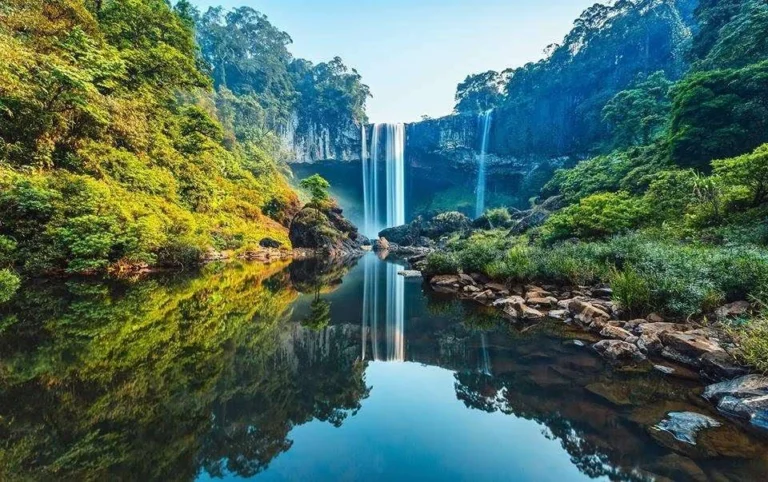
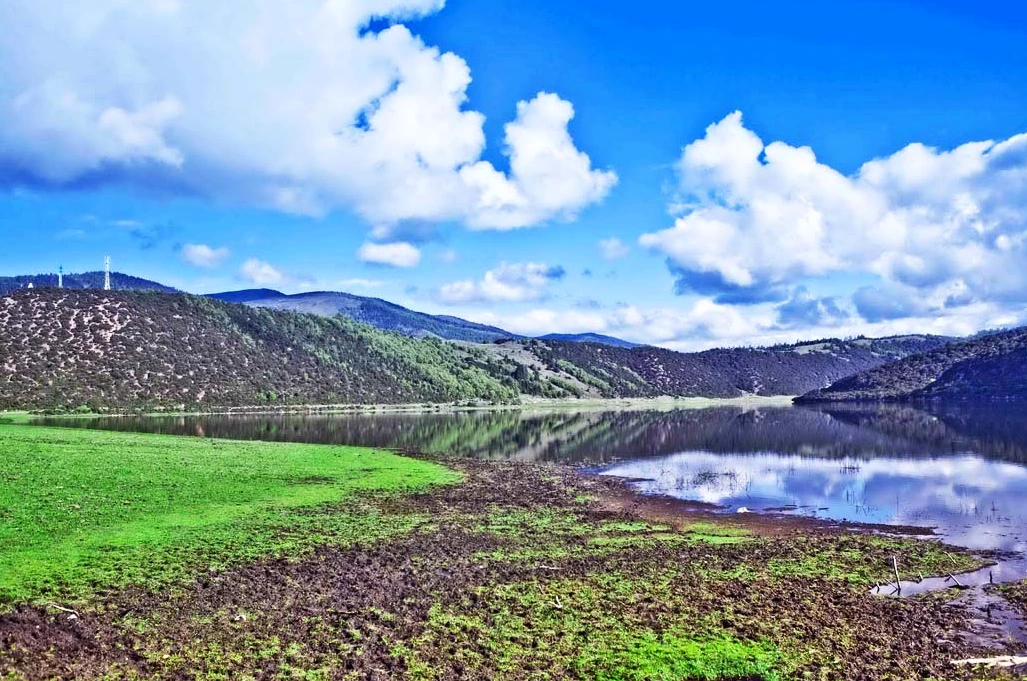
From the perspective of geology and natural landform configuration, Potatso features a remarkably unique composite structure comprising “alpine gorge valleys, tectonic fault basins, and ancient glacial relics.” The underlying strata are dominated by expansive granite batholiths dating from the Indosinian to the Yanshanian orogenies, interspersed with Triassic sedimentary limestone and sandy shale. Intense tectonic movements over millions of years forged a distinctive hydrological system belonging to the Jinsha River basin—a vital upper tributary of the mighty Yangtze River. Within this system, the Shudugang and Luorong rivers wind like silk ribbons through the gorges, feeding the two famed tectonic lakes of Bita Lake (Bita Hai) and Shudu Lake (Shudu Hu). While Bita Lake is a geological formation born from deep subterranean fault subsidence, Shudu Lake bears the imprint of ancient glacial moraine damming, holding mirror-calm, jade-green waters amid the surrounding wilderness.
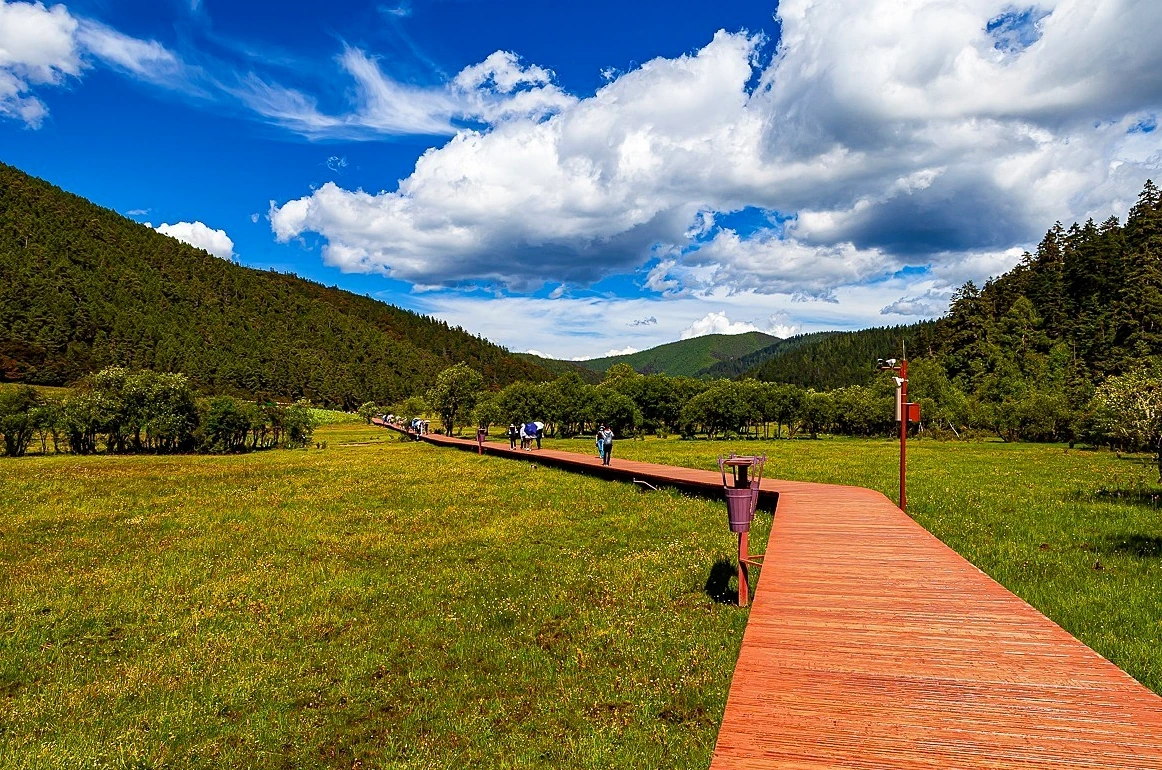
This pronounced vertical relief combined with fault-valley structures has endowed Potatso with a remarkably complete and pristine vertical ecological spectrum, stretching from cold-temperate coniferous forests to harsh alpine tundra vegetation on the highest peaks. The primeval coniferous forest system includes endemic ancient species such as Spruce, Fir, and Larch standing tall, forming a colossal green wall encircling the entire basin. The landscape stratifies along elevation tiers: at the lowest basin floor lie wetlands and velvety wet meadows; ascending higher are dense coniferous forests draped in beard lichens hanging like wisps of mist; and at the summit sit windswept tundra slopes carpeted in hardy alpine grasses. The intact preservation of this ecological gradient from lowest to highest tiers transforms Potatso into a living geological and biological museum—a global biodiversity hotspot where nature’s design reaches the pinnacle of balance and beauty.
Sprawling across the tranquil Diqing Plateau, the spatial planning of Potatso National Park is an architectural masterpiece rooted in absolute reverence for nature. From an infrastructure standpoint, the entire project strictly adheres to three core principles: “Conservation first, minimal intervention, and borrowed scenery.” Every spatial element here avoids dominating or overpowering nature, serving instead as a transparent lens through which visitors can observe the grandeur of the highland ecosystem. Spanning hundreds of square kilometers, the park is clearly zoned into strict conservation areas and eco-experience zones, where visitor footsteps are guided along closed-loop routes that preserve the primeval wilderness intact.
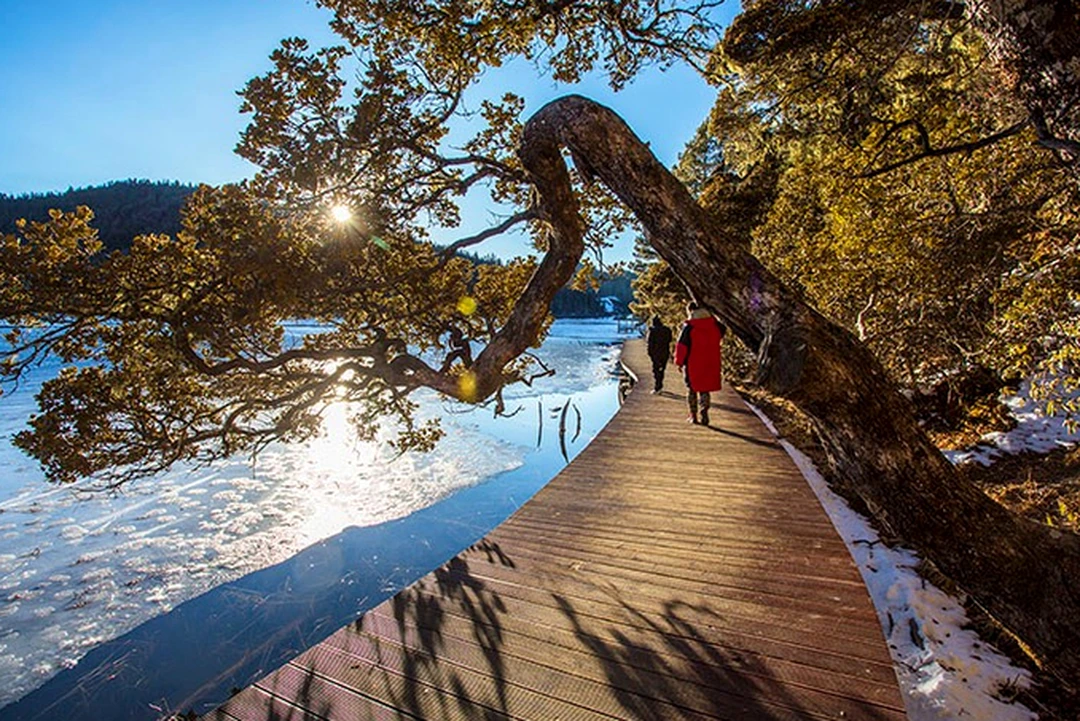
The breakthrough engineering highlight in Potatso’s spatial design is its elevated wooden boardwalk corridor system spanning dozens of kilometers. To completely eliminate the risk of foot traffic compacting the soil and destroying the delicate root systems of alpine meadows and waterlogged marshes, engineers implemented advanced micropile foundation solutions. Helical piles or steel micropiles were drilled directly into the ground without large-scale excavation or earthmoving. The boardwalk decking and longitudinal structural beams utilize high-grade imported Scots pine or locally sourced rot-resistant timber treated with specialized anti-corrosion pressure preservatives. All mechanical joints are fabricated from high-strength hot-dip galvanized structural steel, ensuring resilient endurance against intense ultraviolet radiation, howling mountain gales, and continuous freeze-thaw cycles at elevations above 3,300 meters.
The architecture of rest stops and the visitor reception center at Potatso represents a seamless fusion of Tibetan cultural heritage and modern green architectural thinking. These structures emulate the essence of traditional Tibetan “Bengke” (崩確) dwellings—a building technique combining interlocking timber frames with thick exterior stone walls. The buildings feature sturdy facades with thick natural stone walls that store heat and provide insulation, alongside deeply recessed windows designed to minimize exposure to dry, frigid highland winds. Roofs are stylized after traditional Tibetan flat roofs or gently sloped gable roofs clad in local materials that blend effortlessly into the surrounding pine forests and mountain clouds. Inside, interiors optimize natural daylight through skylights and insulated glass walls, preserving the mystical silhouette of Tibetan architecture while meeting rigorous international green energy standards.
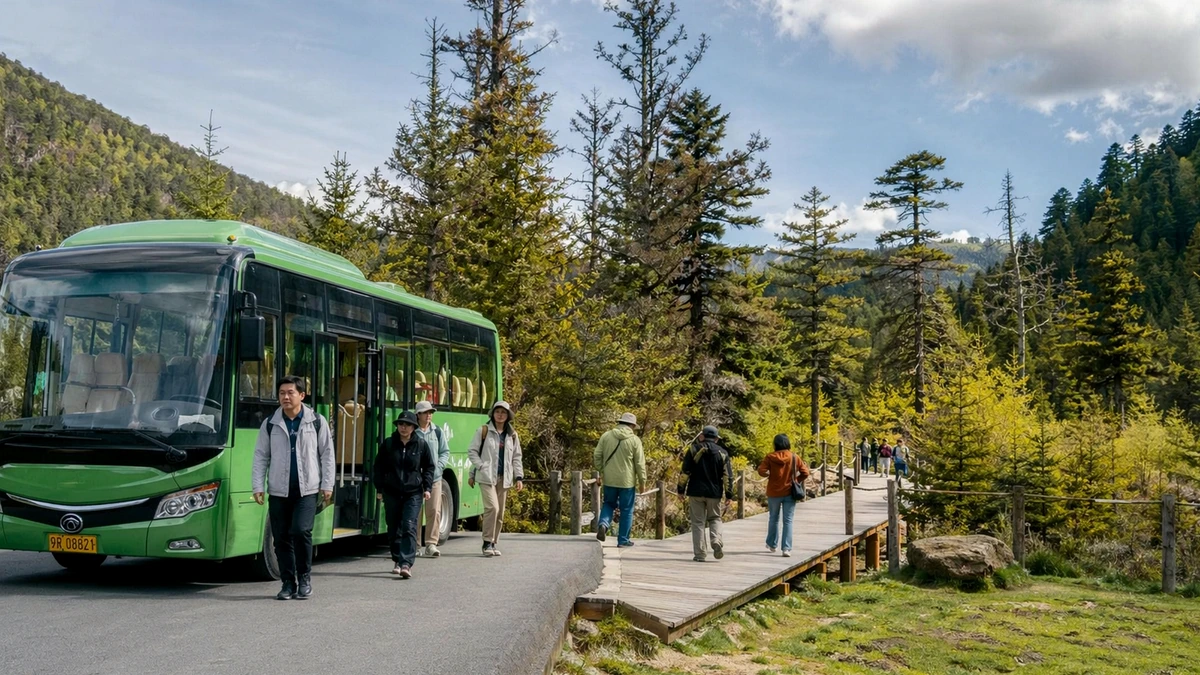
To complete its sustainable internal transit network, passenger transport within Potatso operates exclusively on eco-friendly vehicles meeting strict European Union (EU) standards. A fleet of zero-emission, all-electric sightseeing buses glides quietly along dedicated roadways, completely eliminating internal combustion engine noise and exhaust fumes that could harm local flora and fauna. Across the expansive alpine lake surfaces, tour boats utilize advanced hybrid propulsion systems that minimize underwater vibration and prevent fuel leakage. This synchronized integration of elevated wooden boardwalks, low-floor electric buses, and green watercraft creates a refined, “tiptoe” tourism infrastructure model where continuous human movement leaves a near-zero geophysical footprint on Shangri-La’s vegetation and waterways.
Standing in stark contrast to modern tourism urbanization—where scenic destinations are routinely illuminated by dazzling digital light installations or grand live-action outdoor spectacles—Potatso National Park embraces a completely opposite philosophy: the philosophy of stillness and natural darkness. As the strict core conservation zone of Shangri-La’s highland ecosystem, Potatso firmly says no to industrial light-art projects, stages no nightly live-action shows, and strictly prohibits night markets or high-intensity nocturnal sightseeing products. This decision is not an absence of tourism infrastructure, but a steadfast ecological commitment to returning pure, untamed space to the wilderness once dusk falls.
The scientific and legal rationale behind this tourism restraint stems from the invaluable biodiversity of the Bitahai (碧塔海) and Shuduhu (属都湖) basins. These two major lakes and their surrounding wetlands serve as critical habitats and breeding grounds for the Black-necked Crane (Grus nigricollis – 黑颈鹤)—a rare Class I nationally protected species—alongside the Bar-headed Goose (Anser indicus – 斑头雁) and dozens of other Class I and Class II protected wildlife species. Ecological studies have demonstrated that artificial light pollution and high-frequency nighttime noise severely disrupt natural circadian rhythms, interfere with winter migration routes, and negatively impact the mating and reproductive behaviors of highland wildlife.
Consequently, the only “light art” permitted within Potatso is the primordial illumination of the cosmos itself: the natural transition between pale golden sunlight bathing the alpine meadows by day and the glittering Milky Way reflected across placid waters by night. Nighttime rhythm in Potatso unfolds entirely within the silence of the primeval forest, where the whisper of wind through cypress and pine groves and the gentle lapping of waves along the lakeshore form the sole symphony. Foregoing nocturnal tourism activities simultaneously minimizes the human carbon footprint and preserves an undisturbed sanctuary for indigenous wildlife.
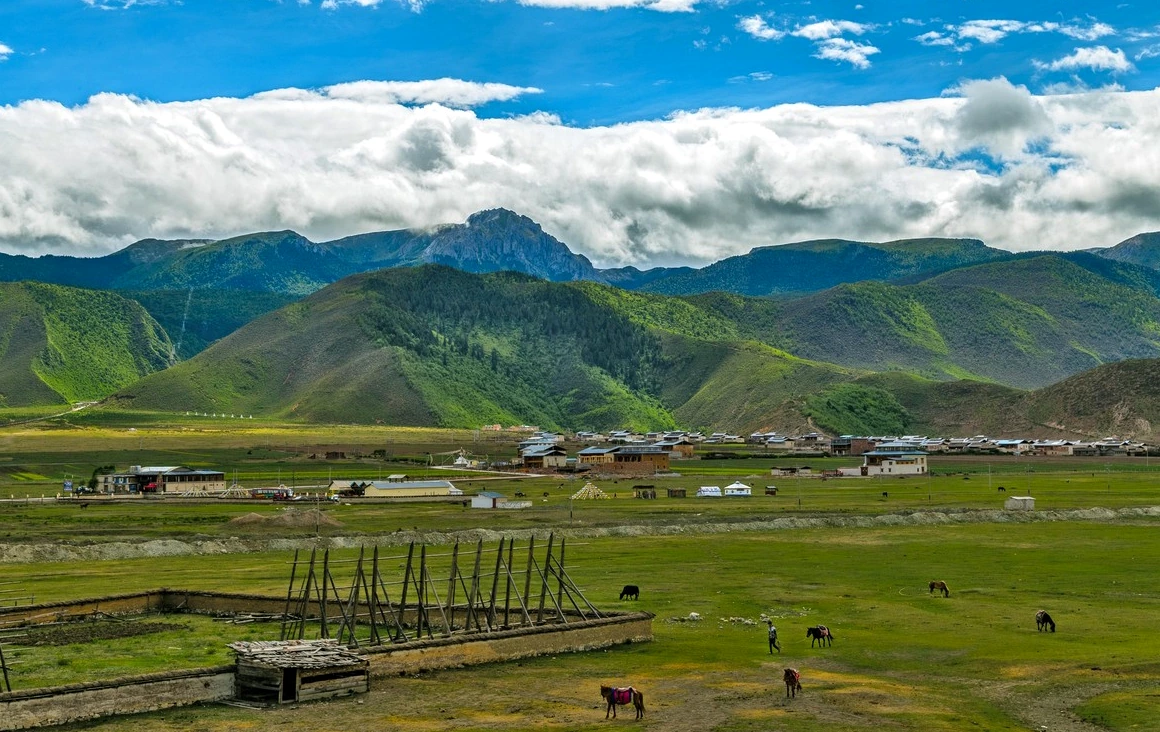
While bustling nighttime entertainment is absent, cultural appreciation at Potatso is thoughtfully channeled into daytime hours, closely woven into the daily rhythm of Tibetan communities. Rather than being commercialized into artificially lit stages, living heritage is preserved authentically around the Visitor Center and in traditional buffer-zone villages, most notably Xiage Village (霞给村). Here, visitors connect with the depth of Tibetan culture through genuine, intimate experiences that fully respect natural ecological cycles.
During the day, local Tibetans offer visitors the opportunity to experience deeply authentic folk performing arts. Vigorous yet earthy Guozhuang dances (锅庄舞) and graceful Xuanzi dances (弦子舞) accompanied by the melodious strains of the Tibetan fiddle are performed entirely acoustically, with zero high-frequency amplification equipment. Alongside these dances are vibrant showcases of meticulously hand-woven traditional Tibetan attire. Restraining the use of industrial sound technology not only preserves the raw essence of authentic folk artistry, but also ensures zero acoustic disturbance along the perimeter of the surrounding old-growth forest.
Nestled at the crossroads of harsh alpine grasslands and the dramatic gorge systems of northwestern Yunnan, the culinary culture surrounding Potatso National Park embodies survival wisdom accumulated by Tibetans over millennia. Every dish and beverage here reflects a remarkable harmony between humans and an unforgiving environment, prioritizing calorie-dense nutrition, long-term preservability, and restorative properties. Shangri-La’s cuisine is far more than mere sustenance; it is a living chronicle of heritage, where the purity of high-altitude ingredients merges with culinary techniques passed down through generations.
Beginning a culinary journey across this snowy realm, one cannot overlook butter tea, known in Tibetan as Ja-sbrus. To craft an authentic cup of butter tea, locals churn rich, fresh butter derived from highland yak milk together with strong brick tea and a pinch of mineral salt. All ingredients are placed inside a traditional wooden tea churn called a sdong-mo, where the maker vigorously pumps the plunger vertically to fully emulsify the butter and tea. The resulting brew is creamy golden, richly aromatic, and savory-rich with a subtle bitterness that gives way to a lingering sweet finish. Butter tea not only wards off the bone-chilling cold of Potatso, but also serves as a traditional remedy to alleviate symptoms of altitude sickness. Paired alongside butter tea is rtsam-pa, commonly known as Tsampa—the quintessential staple food of the Tibetan people. Highland barley, once washed, roasted, and ground into fine flour, is mixed directly with hot butter tea, a touch of dried qula cheese, and white sugar. Diners use their fingers to knead the mixture into small bite-sized balls, chewing slowly to savor the nutty richness and earthy aroma of grain matured in highland sun and wind.
The ultimate warmth of a Shangri-La winter evening is captured inside the legendary black clay pot—an intangible cultural heritage item showcasing the region’s celebrated artisanal pottery craft. Black clay pot yak beef and Tibetan pork hotpot is a culinary masterpiece uniting deep-forest delicacies with ancestral earthenware craftsmanship. Forged from high-altitude clay, the black ceramic pot retains heat persistently and distributes thermal energy evenly, locking in the full nutrients of air-dried yak beef and free-range Tibetan pork ribs. The broth is slow-simmered for hours alongside prized mushrooms foraged from Potatso’s primeval forests, such as matsutake and boletus. As the hotpot bubbles gently, the deep, savory richness of firm, flavorful meat melds with the delicate, pine-scented aroma of wild mushrooms, creating a hearty symphony of flavors that warms the soul amid the highland mist.

Concluding this heritage feast is the gentle sweetness of Nas-chang barley wine, a traditional libation indispensable at Tibetan festivals and welcoming ceremonies for honored guests. Naturally fermented from highland barley grains, this wine carries a mild alcohol content of around 10% to 15%, offering a crisp sweet-and-sour profile with a smooth finish reminiscent of glacial meltwater. Within the cozy warmth beside the hearth of a traditional Tibetan wooden home, a cup of Nas-chang is presented alongside a pure white khata ceremonial scarf, acting as a spiritual bridge conveying blessings of good fortune, auspiciousness, and heartfelt hospitality from the people of Potatso to travelers journeying back to nature’s origins.
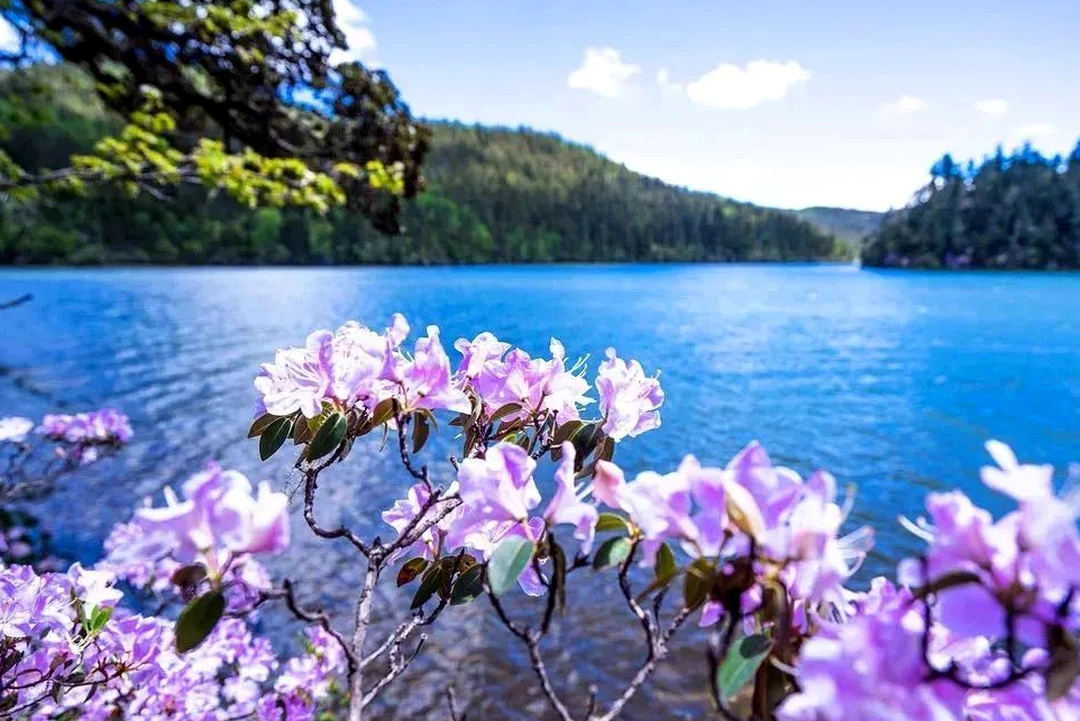
Exploring Potatso National Park requires careful seasonal planning to fully experience the natural pulse of the Tibetan Plateau. The reserve is open daily from 08:00 to 16:00. The two most ideal windows for visiting are late spring to early summer (May to June) and golden autumn (September to October). In early summer, ancient rhododendron forests burst into vibrant bloom, creating the fascinating phenomenon known as “rhododendron-intoxicated fish,” wherein fallen blossoms drifting onto the surface of Bita Lake leave native fish mildly dizzy after nibbling the petals. Meanwhile, autumn blankets the entire landscape in the fiery crimson of Stellera chamaejasme (langdu flowers) and the brilliant gold of larch forests reflected in crystal-clear lake waters.
Regarding transportation, travelers can fly into Diqing Shangri-La Airport (DIG) or take the Lijiang–Shangri-La Railway to Shangri-La Station. From the city center, Potatso National Park lies approximately 22 km to the northeast. Since there is no direct public bus service, the most common ways to reach the park are renting a self-drive car, chartering a private vehicle, or joining organized guided tours. Upon arriving at the Visitor Reception Center at the entrance, all private vehicles must park; visitors are required to transfer onto the eco-friendly sightseeing shuttle buses operated uniformly by park management to safeguard the fragile ecosystem.
Ticketing currently operates via an online real-name reservation system across the entire park, with admission fees bundling both park entry and internal eco-shuttle transfers. The classic sightseeing route is designed as a closed loop to maximize scenic vistas while minimizing impact on vegetation: departing from the Visitor Center, shuttles first take guests to Shudu Lake, where visitors stroll along a lakeside wooden boardwalk stretching roughly 3.3 km; the route then continues past the Mulangcuo stop and enters the Bita Lake area for a walk beneath the canopy of ancient primeval forests. Completing the standard sightseeing circuit typically takes between 4 and 6 hours.
Because Potatso sits serenely at an average elevation exceeding 3,500 meters above sea level, the thin atmosphere brings intense ultraviolet radiation and sudden drops in temperature. Even during summer months, visitors must pack an insulated windproof jacket, UV-blocking sunglasses, a wide-brimmed hat, and sunscreen rated SPF 50+ or higher. To prevent altitude sickness, maintain a slow, steady pace, avoid sudden strenuous exertion, carry portable oxygen canisters, and consider taking Rhodiola rosea herbal supplements prior to your trip to support your body’s oxygen acclimatization.
Finally, upholding ecotourism discipline and respecting indigenous spiritual beliefs are paramount principles when entering this sacred land. Visitors must never feed wild animals, pick flowers or break branches, and are strictly prohibited from bringing open flames into the conservation forest. When passing Tibetan sacred structures such as Mani stone piles or Lungta prayer-flag stupas, visitors should maintain a respectful demeanor and always walk around them clockwise to wish for peace and blessings. For a seamless and well-curated highland journey, travelers can explore the detailed itinerary in our 6D5N Lijiang – Dali – Shangri-La Tour.