Across the coastal plains of Abu Dhabi, where endless expanses of Arabian sand once stretched unbroken, the Sheikh Zayed Grand Mosque rises as an enduring anthem to faith and enlightened vision. The genesis of this architectural masterpiece is deeply intertwined with the founding destiny of the United Arab Emirates (UAE) and the monumental personal legacy of Sheikh Zayed bin Sultan Al Nahyan. From the early 1990s, as this Gulf nation underwent rapid transformation fueled by its fossil energy wealth, the late Founding President nurtured a heartfelt aspiration to create a house of worship that transcended purely religious boundaries. It was envisioned not merely as a sanctuary where the faithful bow before Almighty Allah, but as a spiritual emblem of compassion, humility, and the philosophy of tolerance among human civilizations.
Examined through its etymological roots and local heritage, the mosque’s name carries a profound layer of classical Arabic philosophy. The name Sheikh Zayed derives from the ancient Arabic verb “zada,” signifying flourishing growth, boundless generosity, and unceasing giving. This spirit harmonizes seamlessly with the indigenous Arabic title “Al-Jami”—a sacred designation referring to a central congregational mosque capable of uniting the entire community. Far more than a gathering place for fellow believers on sacred Fridays, Abu Dhabi’s “Al-Jami” was conceived as a global cultural crossroads, bringing to life the dream of uniting ethnicities, architectural traditions, and social strata beneath a single canopy of peace.
The journey to transform preliminary blueprints into a monument of white marble began in late 1996, unfolding through years of meticulous land reclamation and foundation engineering across the coastal salt flats. Yet the currents of history inevitably weave moments of solemn stillness into tales of triumph. In late 2004, while the majestic colonnades and domes were still undergoing their finest finishing touches, Sheikh Zayed bin Sultan Al Nahyan passed away, bringing an illustrious era of leadership to a close. In accordance with the Founding Father’s final wishes, his body was laid to eternal rest in a serene mausoleum situated immediately adjacent to the mosque. Since that poignant historical moment, the continuous recitation of the Holy Quran by devoted scholars has echoed twenty-four hours a day without interruption, transforming the site into a sacred sanctuary safeguarding the soul and heritage of an entire nation.
Moving forward through the turning tides of time, construction continued under the patronage of the succeeding Al Nahyan dynasty with the world’s most exacting standards of precision and care. After more than a decade of dedicated craftsmanship, the mosque officially opened its doors to thousands of worshippers and travelers from afar during the holy month of Ramadan in 1428 AH according to the Islamic Hijri calendar, corresponding to December 2007. This landmark occasion not only celebrated the inauguration of a contemporary religious wonder of international stature, but also affirmed a poised cultural statement: the pinnacle of traditional Islamic architectural artistry can blend effortlessly with modern construction engineering to create a haven of reconciliation and fraternity amidst the blazing golden desert.
Commanding a strategic gateway position at the threshold of Abu Dhabi Island’s city center, the Sheikh Zayed Grand Mosque occupies a location of supreme urban planning and spatial significance. This magnificent spiritual complex sits gracefully in the buffer zone between two renowned arterial thoroughfares—the Mussafah Bridge and the Sheikh Zayed Bridge—which curve like ribbons across the sea. Thanks to this convergence of transport arteries, the mosque becomes the very first visual focal point, a towering landmark welcoming travelers arriving from Abu Dhabi International Airport or crossing the desert from neighboring emirates into the federal capital. From a master-planning perspective, this setting does far more than facilitate seamless connectivity; it stands as a resolute spiritual bastion, a tangible declaration of prosperity and hospitality right at the doorstep of the Arabian Gulf’s wealthiest emirate.
To establish an aura of solemn grandeur worthy of a central congregational mosque, structural engineers engineered and raised a massive artificial mound, elevating the entire foundation platform to 11 meters above mean sea level. This bespoke elevation produces an extraordinary visual effect: the pristine white domed complex appears to detach from the flat coastal sands, soaring straight into the azure sky with an imposing, untouchable poise whether viewed from kilometers away across the bay or from major expressways. Even more crucially, from a hydrological engineering standpoint, this 11-meter elevation acts as an impregnable natural levee, permanently protecting the foundation structures and subterranean levels from rising storm surges, desert coastal swells, and severe saltwater intrusion from groundwater tables along the Persian Gulf coast.
To preserve the mosque’s pure white brilliance against the harsh Arabian Peninsula environment, the technical engineering and installation of its exterior cladding were calculated with microscopic precision. Abu Dhabi lies at the intersection of two extreme climatic forces: the scorching heat of desert thermal winds where daytime temperatures can exceed 50°C, paired with heavy, salt-saturated sea humidity and abrasive sandstorms. Leading researchers and engineers implemented a multi-layered wall system incorporating state-of-the-art thermal insulation cavities, virtually eliminating localized thermal expansion and contraction that could fracture the marble cladding. Specialized concrete admixtures engineered to resist chloride ion penetration from marine salt mist were integrated deep into the bored piles and foundation beams, forming an invisible shield that protects the internal steel reinforcement from corrosion for centuries to come.
The surrounding landscape of the mosque is likewise a marvel of microclimatic regulation crafted through water features and greenery. Encircling all four sides of the outer walls is a series of tranquil reflecting pools lined with handcrafted dark glazed ceramic tiles, acting as vast mirrors that reflect the shimmering silhouettes of arches and gilded colonnades beneath the sunlight. Beyond elevating its sculptural aesthetics, this continuous aquatic system works in concert with lush date palm groves and manicured lawns to absorb ground-level solar radiation, lowering ambient temperatures around the perimeter by 3 to 5°C before gentle breezes drift through the open arcades into the prayer halls. Every natural element—from soil and sea breezes to water and sunlight—has been masterfully harmonized into a serene landscape ensemble that calms and purifies the visitor’s spirit before stepping into the sacred sanctuary.
Sprawling across an artificial plateau covering more than 40 acres—approximately 567,000 square meters—the Sheikh Zayed Grand Mosque stands as a proud spiritual oasis in the heart of Abu Dhabi. The core architectural structure alone commands an imposing footprint of 22,412 square meters, brought to life with a budget exceeding 2.7 billion UAE dirhams, or over 735 million USD. Rather than replicating a single regional idiom, the mosque’s architectural master plan weaves together the rich continuum of Islamic civilization. Here, scholars readily recognize the rigorous geometric symmetry and monumentality of Mamluk artistry from Egypt’s golden age, the expansive grace of soaring hemispherical domes characteristic of the Ottoman Empire in Turkey, and the refined, regal rhythmic motifs of the Fatimid dynasty that once reigned across North Africa.
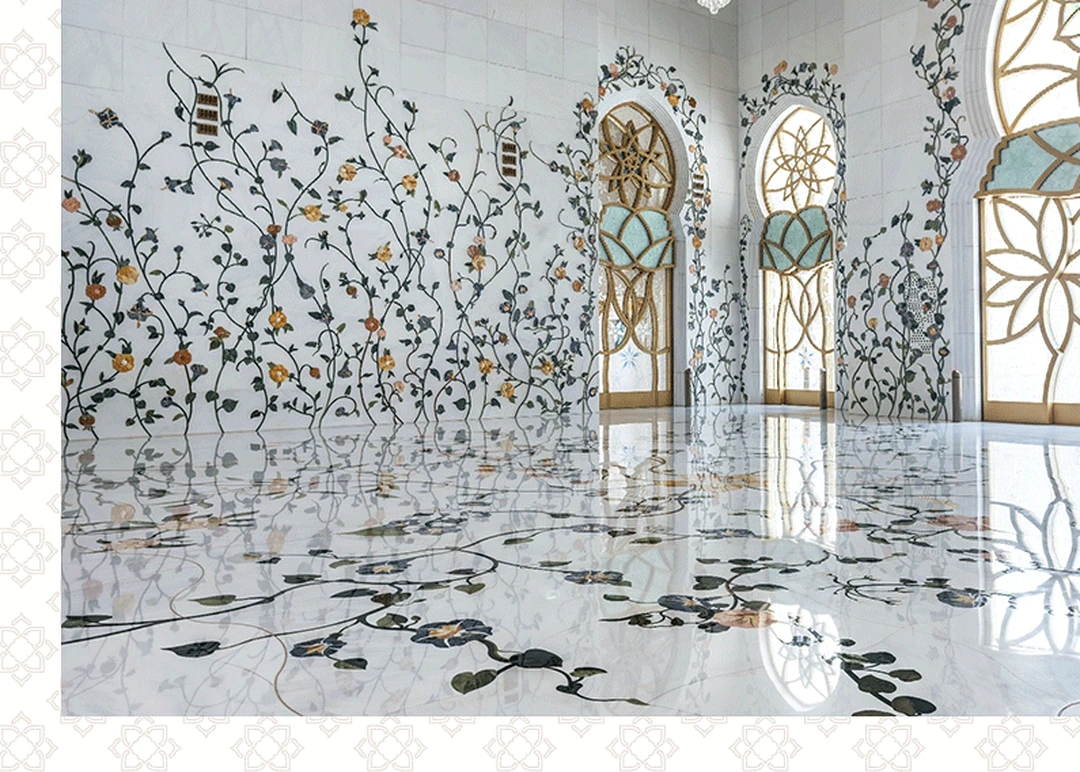
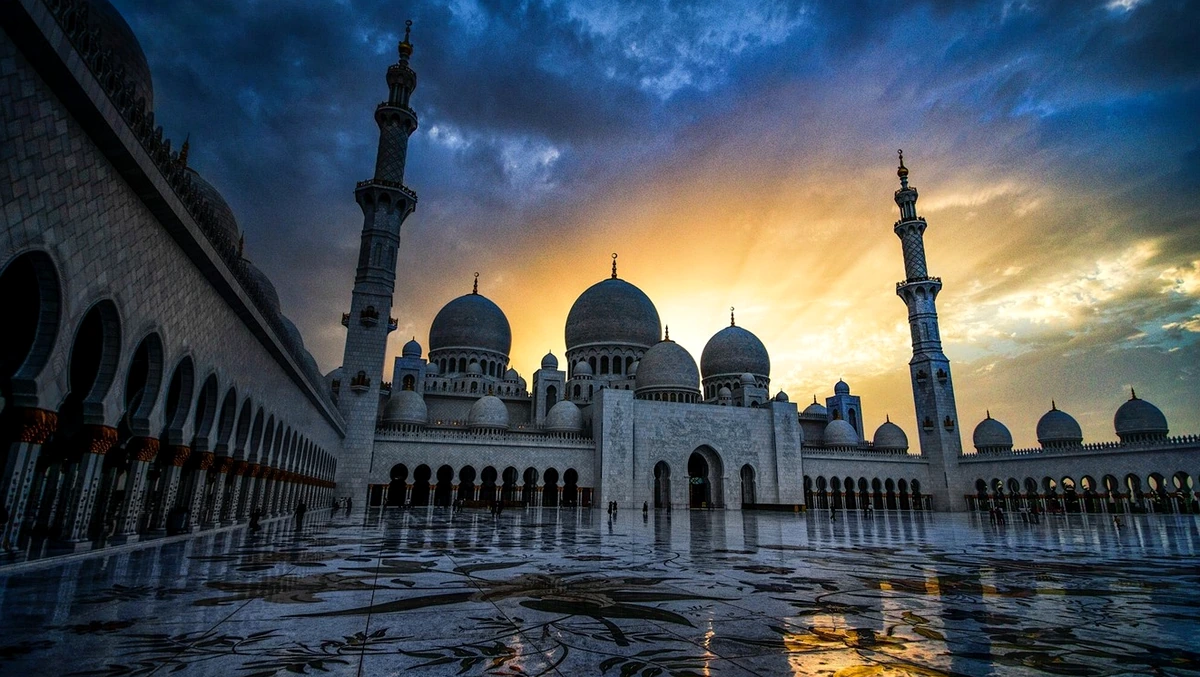
Gazing upward from the vast open courtyard, the visitor’s eyes are immediately captivated by an ensemble of 82 pure white domes of varying spans, undulating like desert sand dunes crystallized into pearls. Occupying the supreme position above the main prayer hall is the central dome, soaring to a height of 83 meters with an impressive diameter of 32.8 meters, supported by massive corner-clustered piers. Punctuating the four corners of the complex are four slender minarets rising 107 meters into the sky, seamlessly blending square Mamluk bases, octagonal Mamluk-Ottoman shafts, and circular Fatimid cupolas. Sheathing the entire exterior is more than 100,000 square meters of the world’s purest Sivec white marble, quarried and rigorously selected from the Prilep mines of North Macedonia. The immaculate whiteness of this stone reflects the intense Gulf sunlight with mesmerizing luminosity while providing an ideal canvas for exquisite Pietra Dura semi-precious stone inlay, where hand-carved lapis lazuli, amethyst, mother-of-pearl, and carnelian are pieced together into flowing floral vines winding up over a thousand stylized Corinthian columns.
Stepping deep inside the main prayer hall, the tranquil interior is instantly illuminated by a dazzling spectral symphony from seven magnificent chandeliers. Meticulously crafted by the master goldsmiths of Faustig in Germany, each fixture is a triumph of both mechanical engineering and fine artistry, featuring 24-carat gold-plated brass frames encrusted with millions of sparkling multicolored Swarovski crystals. Most breathtaking of all is the centerpiece chandelier suspended beneath the central dome, measuring 15 meters in height, 10 meters in diameter, and weighing nearly 12 tons. Resembling an inverted celestial palm blossom, it casts an enchanting, ethereal glow across the hallowed space, illuminating every intricate detail of traditional Arabic calligraphy sculpted in alabaster plaster along the walls.
Beneath the footsteps of thousands of worshippers and visitors lies the world’s largest hand-knotted Persian carpet, a record-breaking masterpiece spanning 5,637 square meters and weighing an astonishing 38 tons. This carpet represents the culmination of extraordinary artistry and patience from 1,200 skilled artisans in Iran’s Khorasan province, who labored tirelessly over two full years. Woven from an optimal blend of fine natural New Zealand wool and pure Iranian cotton, its surface contains over 2.2 billion precision hand-tied knots. The intricate motifs evoke classical Isfahan aesthetics in palettes of sage green, beige, and ripe pomegranate extracted entirely from natural botanical dyes. Remarkably, subtle raised woven ridges are cleverly integrated across the carpet’s surface to align rows of worshippers neatly as they kneel in unison facing Mecca, achieving a seamless union of liturgical functionality and the pinnacle of Eastern textile art.
As the fiery amber dusk of the Arabian desert fades beyond the Persian Gulf horizon, the Sheikh Zayed Grand Mosque does not retreat into darkness; instead, it undergoes a breathtaking metamorphosis, transforming the colossal marble complex into a living work of visual art beneath the Abu Dhabi night sky. Far removed from conventional, garish floodlighting, the nocturnal atmosphere here is a serene synthesis of modern optical engineering and profound Islamic philosophy. The celebrated lighting scheme designed by the masters at Speirs and Major Associates subtly links the soul of the monument to the rhythms of the cosmos through a dynamic illumination system that mirrors the complete 29.5-day lunar cycle of the Islamic Hijri calendar.
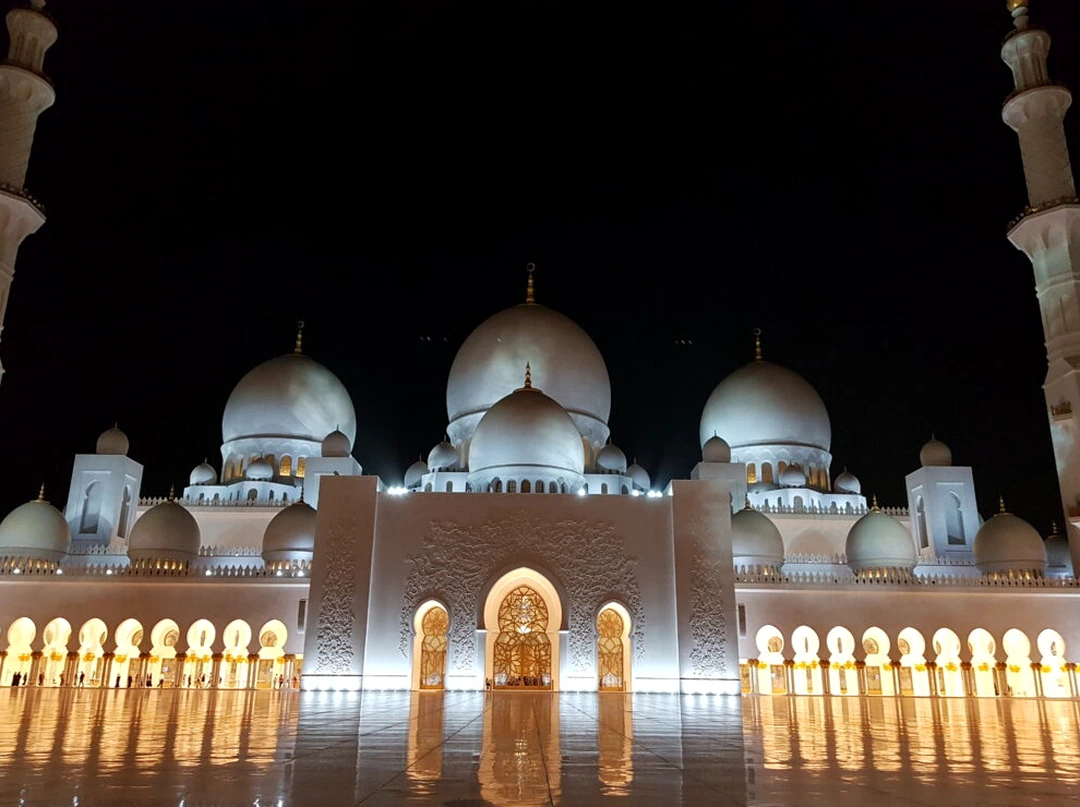
This architectural concept transforms the 82 pristine domes and grand colonnaded walls into an ethereal canvas reflecting the phases of the moon. On the opening nights of the lunar month when the slender crescent moon (Hilal) first emerges, a network of 22 concealed lighting towers bathes the entire monument in a soothing deep cobalt blue, interlaced with soft clouds of projected light drifting slowly from west to east like a breezy night sky. Night by night, as the moon waxes fuller overhead, this contemplative blue gradually shifts in hue, brightening into softer cerulean tones. By the night of the full moon (Badr), the mosque radiates in the pure, unadulterated ivory brilliance of its Sivec marble quarried from Greece and North Macedonia, before reversing the cycle back toward deep indigo as the moon wanes. This slow, seamless transition unfolds in complete silence, giving onlookers the sensation that the mosque is a living, breathing entity moving in harmony with the pulse of the cosmos.
At ground level, this nocturnal symphony of light is doubled by thousands of square meters of landscaped reflecting pools surrounding all four sides of the structure. Lined with glazed ceramic tiles in graduated shades of blue, the water captures reflections of columns inlaid with jasper, amethyst, and mother-of-pearl, creating an immense, shimmering liquid mirror. The sight of Moorish arches and the 107-meter minarets rippling across the glassy water produces a weightless visual illusion—like a crystal palace floating serenely upon a silent midnight sea, utterly detached from the bustle of the modern metropolis beyond.
Once night falls, the cultural atmosphere here unveils a captivating new dimension of contemplation. Visitors stroll in near-total tranquility, accompanied only by the whisper of wind gliding through arcades of 1,096 columns and the gentle murmur of water from graceful fountains. Inside the main prayer hall, precision lighting accentuates the crystalline clarity of the seven monumental gilded Swarovski chandeliers crafted by Faustig, while casting a luminous glow across the Qibla wall engraved with the 99 Beautiful Names of Allah using delicate fiber-optic illumination. In the semi-subterranean cultural galleries and library, exhibitions of Islamic art, rare ancient Quranic manuscripts, and classical Arabic calligraphy are displayed under soft, museum-grade lighting, offering a deeply moving spiritual experience where supreme visual artistry merges seamlessly with sacred reverence.
Stepping out from the radiant white marble sanctuary of the Sheikh Zayed Grand Mosque, exploring Abu Dhabi opens another rich cultural dimension through the lens of traditional Emirati cuisine. The history of this emirate is rooted in an intimate interplay between resilient nomadic desert life and the maritime spirit of Persian Gulf pearl-diving fleets. Every welcoming ritual among indigenous Arab families begins with the cherished tradition of hospitality known as Karam. From intricately engraved brass trays, steaming Dallah pots pour golden Gahwa coffee infused with warm, spicy cardamom and regal saffron, paired alongside platters of prized dates such as soft, molasses-rich Khalas or bountiful Dabbas harvested from the Liwa Oasis. The delicate natural sweetness of the dates balanced against the subtle bitterness and aromatic spice of the coffee not only awakens the senses after quiet contemplation, but serves as a graceful greeting connecting travelers to centuries-old Bedouin customs.
The soul defining Abu Dhabi’s culinary identity lies in its mastery of bespoke spice blending, exemplified by the time-honored Al-Bazar spice mix. Passed down through generations of home cooks and royal kitchens, Al-Bazar is an intricate harmony of coriander seeds, cumin, cinnamon bark, fennel, dried chilies, and turmeric, toasted in a cast-iron skillet before being ground into a fragrant powder. Alongside Al-Bazar, the true secret key unlocking Arabian Gulf flavor is Loomi—whole limes sun-dried in the desert until their rinds turn dark brown, shrivel, and concentrate a bright, intensely smoky tartness. Pierced and simmered slowly in rich broths, Loomi releases a signature citrus tang that cuts effortlessly through the richness of lamb, camel meat, or freshly caught Gulf seafood, weaving the unmistakable flavor profile of the Arabian Peninsula.
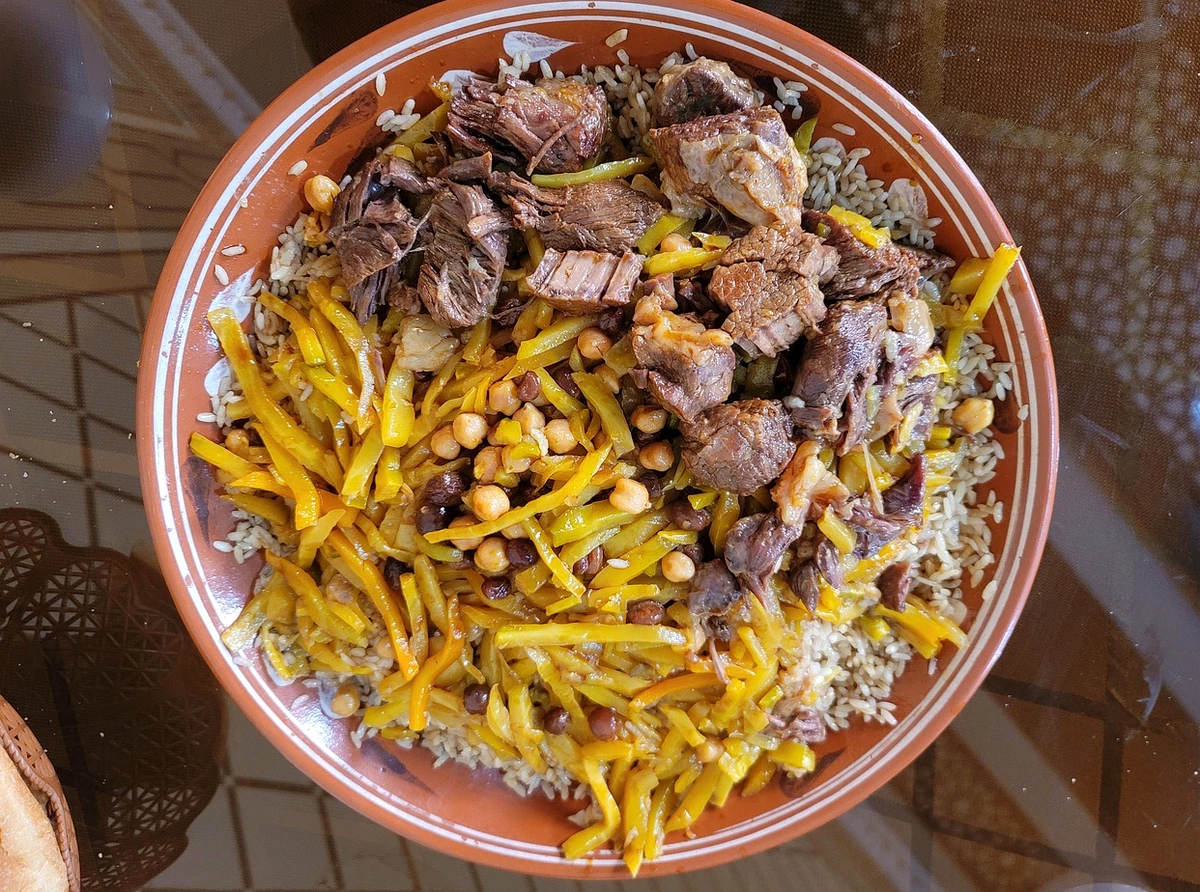
Among celebrated banquet dishes, the Emirati renditions of Al-Kabsa and Al-Biryani hold an unrivaled place of honor on traditional festive spreads. Long, slender grains of Basmati rice are soaked and steamed in rich poultry or lamb stock steeped with saffron, cloves, cinnamon sticks, and cracked cardamom pods. Through skillful heat control, every grain absorbs a golden essence, emerging fluffy yet distinct, intensely aromatic yet refined. Presented on a grand platter like a vibrant tapestry, the rice is garnished with crispy caramelized onions, plump sweet raisins, and golden toasted pine nuts. The deep savory richness of slow-braised meat falling effortlessly off the bone, paired with the nutty crunch of pine nuts and bursts of sweet-tart raisins, creates a regal symphony of flavors that captivates every discerning palate.
While Al-Kabsa embodies the opulence of aromatic spices, Al-Harees and Al-Thareed encapsulate the historical depth and boundless patience of the Emirati people. Originating centuries ago for Ramadan gatherings and royal celebrations, Al-Harees represents the pinnacle of slow cooking, where coarsely cracked whole wheat berries are simmered with lean meat for hours in earthenware pots or heavy copper cauldrons. The mixture is beaten continuously with a specialized wooden paddle until the meat fibers and wheat merge into a velvety, snow-white porridge, finished with a generous drizzle of fragrant clarified ghee. Alongside Al-Harees, Al-Thareed—a timeless symbol of abundance—delights with crisp, paper-thin raghag flatbread layered at the bottom of a deep bowl, soaking up a hearty stew of tender meat, potatoes, carrots, and zucchini, while Al-Jareesh offers a rustic comfort of crushed wheat simmered gently with tangy fermented yogurt and sweet sautéed onions.
Dining around Abu Dhabi’s heritage districts is far more than savoring elaborate delicacies; it is an immersion into the traditional Majlis social culture. Seated cross-legged on woven wool carpets patterned with classic Bedouin motifs and dining with the right hand in accordance with respectful Arab etiquette, visitors experience firsthand the spirit of sharing and generosity rooted in the desert sands. Meals conclude with a steaming cup of robust black tea steeped with fresh mint leaves or fragrant saffron, leaving a lingering, sweet finish on the palate—a fitting bridge uniting a journey through sacred architectural wonder and an endless culinary heritage.
To experience the full splendor of the Sheikh Zayed Grand Mosque smoothly, understanding the rhythm of local religious observances is an essential first step for every traveler. The mosque gates welcome the public from Saturday through Thursday between 9:00 AM and 10:00 PM. On Fridays—the holiest day of the week in the Islamic world featuring the congregational Jumu’ah prayer—the inner sanctuary is reserved exclusively for worshippers throughout the morning, opening to sightseers from 3:00 PM until 10:00 PM. Although the administration waives admission fees entirely for all international visitors to share its message of peace and cultural tolerance, guests are required to register in advance via the mosque’s official online portal to obtain a personal QR entry pass for crowd management and security screening.
Regarding transportation, the mosque stands prominently at a strategic gateway into Abu Dhabi, right alongside major highways connecting neighboring emirates. The most convenient and popular option is taking one of Abu Dhabi’s official silver metered taxis, which drop passengers directly at the subterranean visitor reception hall. Travelers preferring public transit can catch frequent city buses departing throughout the day from the central bus station. Today, visitor access is ingeniously routed underground beneath two modern glass domes shaped like crystal spheres, housing a retail concourse, security checkpoints, and air-conditioned travellators that glide directly into the heart of the complex completely sheltered from the desert heat outside.
Once across the security threshold, adherence to dress codes serves as the foremost expression of respect for this sacred Islamic landmark. Attire standards are strictly enforced: men must wear full-length trousers covering past the knees and sleeved shirts covering the shoulders, with sleeveless tops and shorts strictly prohibited; women must wear loose-fitting, non-form-fitting clothing that fully covers the ankles and wrists, along with a headscarf (Hijab) completely covering the hair, or wear a traditional Abaya robe. To assist guests who may not have arrived in attire meeting liturgical requirements, the mosque provides complimentary traditional garments at the entrance before proceeding through the main corridors. Additionally, before stepping onto the vast hand-knotted carpet inside the main prayer hall, all visitors must remove their footwear and place it in designated shoe racks.
Beyond dress codes, behavioral etiquette within the grounds must also be observed attentively. Smoking, bringing food or beverages into the main prayer hall, and overt public displays of affection such as hugging, kissing, or irreverent photo poses are strictly prohibited throughout the complex. The most magical time to visit is around 4:30 PM, when the amber glow of sunset bathes the white marble domes in warm gold just before the lunar-cycle lighting system awakens, washing the surrounding reflecting pools in an enchanting, ethereal cobalt blue.
Familiarizing yourself with local cultural etiquette and logistics will ensure a serene and deeply rewarding visit. For travelers looking to pair an unhurried exploration of this grand mosque with other iconic Arabian wonders without worrying about entry registrations or protocol details, booking an all-inclusive Dubai – Abu Dhabi tour package offers the ideal way to enjoy a seamless, thoughtfully curated, and unforgettable heritage journey.