It is unclear when it originated, but there is a popular folk saying: “Even after a hundred years of accumulating virtue and practicing, one has not truly achieved enlightenment until they have ascended Yen Tu.” So, where is Yen Tu Pagoda, and why does this saying exist? In the article below, we will introduce visitors to everything they need to know about Yen Tu Pagoda and the services available there.
See more: Top 9 most sacred pagodas in Quang Ninh
Where is Yen Tu Pagoda located?
Yen Tu Pagoda, or Yen Tu Temple, is the name commonly used by locals to refer to the Yen Tu scenic relic complex, located in Nam Mau village, Thuong Yen Cong commune, Uong Bi city, Quang Ninh province. This is a complex consisting of numerous pagodas, hermitages, and towers stretching from the foot of the mountain to the sacred peak of Yen Tu. Notable structures include Trinh Pagoda, Giai Oan Pagoda, Mot Mai Pagoda, Hoa Yen Pagoda, Lan Pagoda, Bao Sai Pagoda, Van Tieu Pagoda, and finally, the Dong (Bronze) Pagoda at the summit. Unlike Bai Dinh Pagoda (Ninh Binh) or Tam Truc Pagoda (Ha Nam)—which are massive complexes known for their record-breaking giant statues—Yen Tu Pagoda offers a beauty defined by its antiquity, its role as a cradle of spirituality, and the fresh mountain air combined with the sacred atmosphere of the Buddha land.
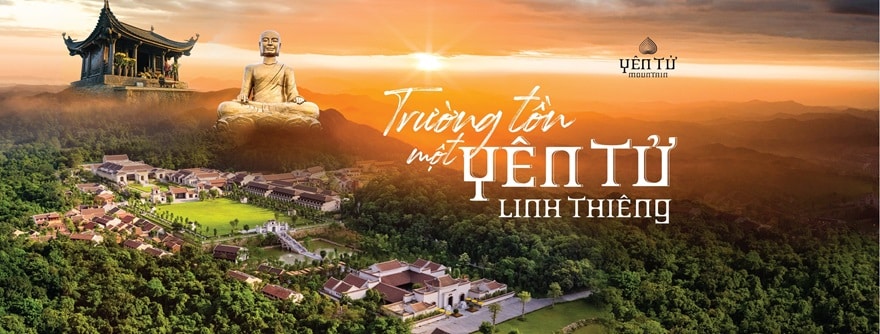
Yen Tu Pagoda
Yen Tu Pagoda is known as a sacred site in the hearts of generations of Vietnamese people and is considered the capital of Vietnamese Buddhism. This is where Emperor-Monk Tran Nhan Tong practiced, attained enlightenment, and founded the Truc Lam Zen sect, which carries a distinct Vietnamese identity and laid the foundation for the national Buddhism and the flourishing national spirit that persists to this day.
The history of Yen Tu Pagoda
Yen Tu Pagoda has a history spanning over 700 years, closely associated with the name of Emperor-Monk Tran Nhan Tong (1258 – 1308), the monarch who led the army and people of the Tran Dynasty to victory against the Yuan-Mongol invaders twice. After abdicating the throne to his son, Tran Anh Tong, he left the palace to seek the path of the Buddha. He chose Yen Tu Mountain as the place to practice and preach to monks, nuns, and the common people. Here, he founded the Truc Lam Yen Tu Zen sect, a unique school of Buddhism in Vietnam that combines Zen and Pure Land Buddhism with the spirit of “Zen in the mundane world, the mundane world in Zen.”
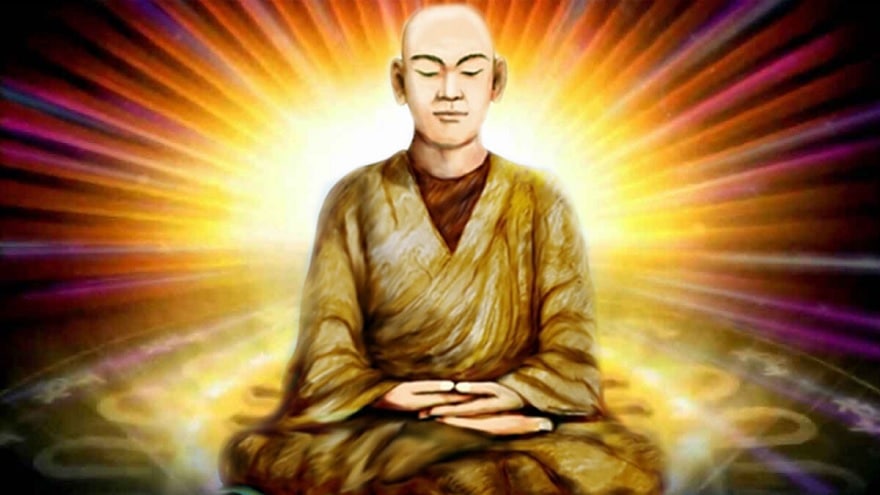
Tran Nhan Tong
After the passing of Emperor-Monk Tran Nhan Tong, during the time of Phap Loa, new pagodas were built, such as Van Yen (Hoa Yen), Van Tieu, Giai Oan, Long Dong, and the Quy Duc mausoleum with the Hue Quang tower. This was a period of large-scale architectural construction. By the end of the Tran Dynasty, the imperial court declined, Confucianism became the dominant ideology, overshadowing Buddhism. Furthermore, the Ming invaders occupied our country and implemented a policy of ethnic assimilation, leading to the complete destruction of many of Yen Tu’s magnificent architectural structures.
In the 18th century, under the Le Dynasty and the Trinh Lords, the Truc Lam Zen sect was restored, and Yen Tu Pagoda was renovated. Especially under the reign of Le Thanh Tong, the pagodas, hermitages, and towers were restored to be spacious and beautiful. During this period, Yen Tu was somewhat influenced by the Linji (Lam Te) Zen sect from China, as archaeologists discovered evidence in the form of an ancient stone tower inscribed with the words: “True transmission of the Linji sect, Phu Lang branch.” By the Nguyen Dynasty, the Truc Lam Zen sect and Yen Tu Pagoda declined, and the structures fell into ruin.
Key landmarks and the experience of conquering Yen Tu Pagoda
In the past, the only way to reach the legendary peak of Phu Van on Yen Tu Mountain was by foot, winding along trails through vast stretches of grass, bamboo forests, and pine groves. Today, visitors have an additional option: the cable car. At the triple-gate entrance area, visitors can purchase a round-trip combo ticket for 300,000 VND per person. This cable car route spans over 1km, allowing visitors to enjoy panoramic views of the Yen Tu mountains during the journey. Afterward, they can continue on foot to visit other sites within the scenic area. Nevertheless, many still choose the traditional hiking route to explore the entire trail, as it allows them to slowly take in everything nature has created here. This path, stretching over 6km, has been reinforced with thousands of stone steps, making it very sturdy and convenient despite the significant incline.
1. Nuong Village
Located right at the foot of Yen Tu Mountain is Nuong Village. Legend has it that when King Tran Nhan Tong abdicated the throne to practice Buddhism at Yen Tu, many concubines followed him. Upon reaching Giai Oan Stream, the King issued a decree for them to return home, but many chose to stay at the foot of the mountain to live, establishing Nuong Village. Based on this legend, Nuong Village has been recreated with houses and streets reflecting the Tran Dynasty style, featuring ancient architectural details. The houses face nature, where the stream meets the forest, with the sound of flowing water and birdsong creating a meditative symphony of creation.
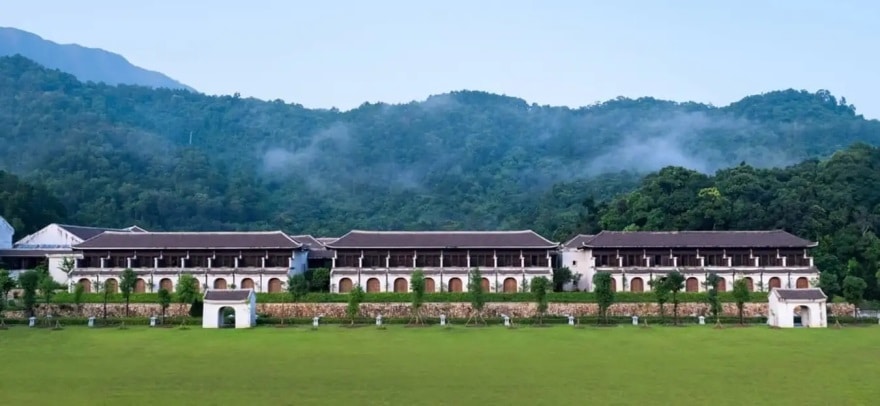
Yen Tu Nuong Village area
The houses are built with terracotta brick and earth walls, combined with a system of ironwood gates and doors. The highlight of Nuong Village is the communal house in the center, which stands two stories high and serves as a venue for Cheo, Xam, and Quan Ho singing performances for visitors.
2. Giai Oan Stream and Giai Oan Pagoda
Continuing from Nuong Village, visitors will reach Giai Oan Stream and Giai Oan Pagoda. Please note that those taking the cable car will not pass through this area. Giai Oan Stream originates from a tragic story of 100 court ladies who took their own lives here because they were not allowed to follow the King. Legend says that after twice defeating the Yuan-Mongol invaders, King Tran Nhan Tong abdicated to practice at Yen Tu and founded the Truc Lam Zen sect, turning this place into the Buddhist capital of Dai Viet. Not wanting the King to remain at Yen Tu, King Tran Anh Tong sent concubines and court ladies to persuade him to return. However, Tran Nhan Tong remained steadfast in his devotion and urged them to return home. To show their loyalty to the King, some of the ladies jumped into the stream to end their lives. The King, mourning their fate, held a ceremony to liberate their souls. The stream was subsequently renamed Giai Oan (Vindication) Stream, and the place where the King performed the rites was established as Giai Oan Pagoda. After centuries, the pagoda was destroyed and has since been rebuilt and expanded on its original foundation. Additionally, a very special feature is that among the pagodas on Yen Tu, Giai Oan Pagoda is the only one with a shrine dedicated to the Mother Goddess.
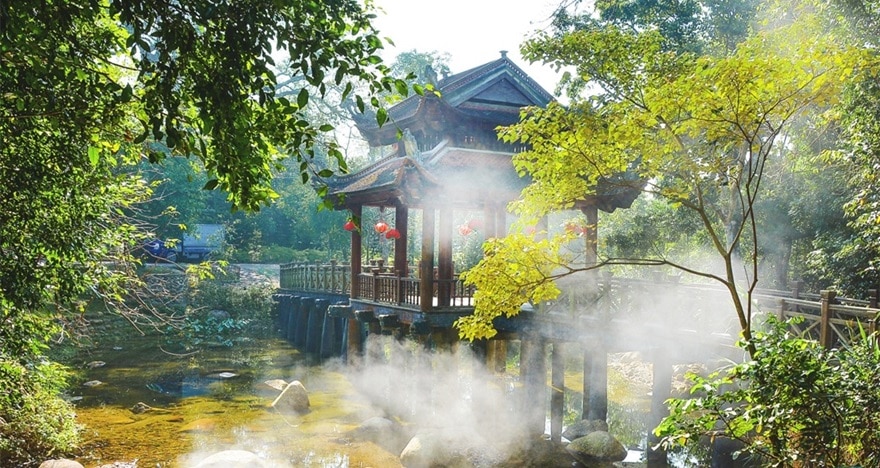
Yen Tu Giai Oan Stream area
3. The Ancestral Tower Garden
Just behind Giai Oan Pagoda, climbing about 400m and turning left for 50m, you will reach the Lo Ren (Blacksmith) Hermitage. It is said that when the Buddha-King Tran Nhan Tong arrived at Yen Tu, he built this hermitage to forge tools for the pagodas and local people. Past the Lo Ren Hermitage, visitors will encounter the massive Ancestral Tower Garden. Currently, this area contains 64 towers, 40 of which were restored in 2002. The most prominent is the Hue Quang Golden Tower, which houses the relics of the Great Dharma King, the First Patriarch of Truc Lam, Buddha-King Tran Nhan Tong. The tower is built on a square base of approximately 180m2, standing 10m high with 6 tiers assembled from blue stone slabs, positioned in the center of the garden. At the base of the tower stand two ancient trees that seem to embrace the entire Hue Quang Tower.
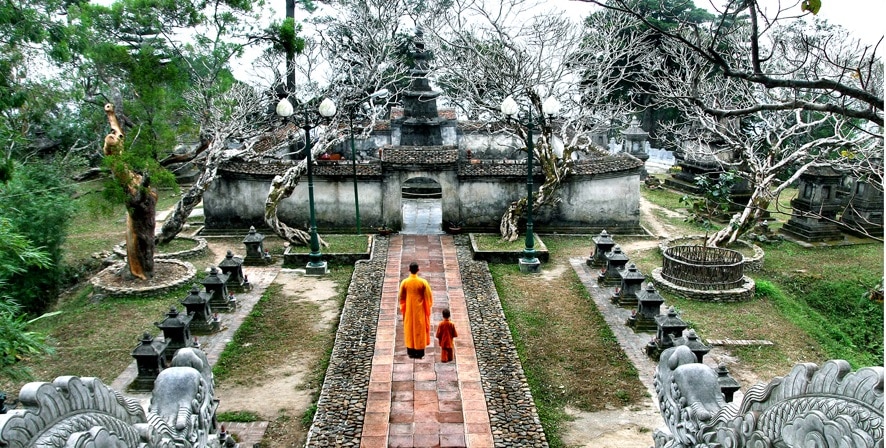
The Ancestral Tower Garden
4. Hoa Yen Pagoda
Continuing to hike up 200m of steep slope (136 stone steps) from the tower garden, visitors will reach Hoa Yen Pagoda. This path is paved with large square bricks imprinted with chrysanthemum patterns popular during the Tran Dynasty (84 of which remain today). It is worth noting that Tran Dynasty chrysanthemum bricks are only found at sites belonging to the imperial court or the Tran royal family, which highlights the prestigious status of the Yen Tu historical and scenic site.
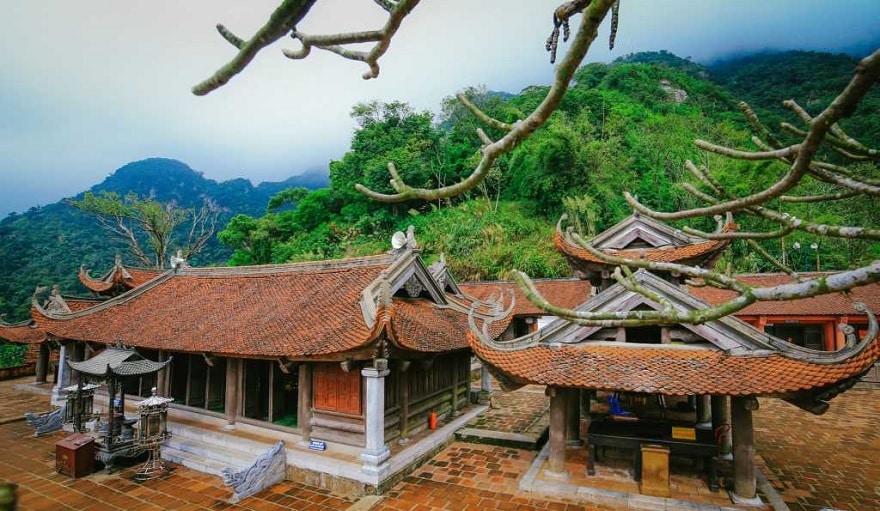
Hoa Yen Pagoda
Hoa Yen Pagoda, also known as Van Yen Pagoda, is referred to by locals by various names such as Ca Pagoda, Main Pagoda, or Yen Tu Pagoda. This is the largest and most beautiful pagoda in the Yen Tu complex. It witnessed the King of the Tran Dynasty renouncing the secular world to return to the path of Buddha. Hoa Yen Pagoda
lies at an altitude of 535m above sea level, founded by Zen Master Hien Quang over 700 years ago. In the past, the pagoda was just a small hermitage named Van Yen. During the Le Dynasty, when King Le Thanh Tong visited and saw the magnificent scenery where hundreds of flowers bloomed and clouds gathered like flowers in front of the pagoda, he renamed it Hoa Yen Pagoda. Notably, in front of the pagoda stand three ancient frangipani trees, each up to 700 years old; if visitors arrive when they are in bloom, they will witness a truly spectacular sight.
5. Mot Mai Pagoda
Continuing to walk 200m from Hoa Yen Pagoda, visitors will reach Mot Mai (One-Roof) Pagoda. Mot Mai Pagoda has a unique architecture with only one roof extending outward, and the entire structure is built against a sheer cliff. During the Tran Dynasty, the King often came here to read books and compose scriptures. The pagoda has many different names such as Bo Da, Ly Tran Hermitage, Ban Mai Pagoda, and Thanh Long (Green Dragon) Cave. After the King attained enlightenment, later generations built the pagoda here. The pagoda is shaped like the character “one” (nhất), consisting of 4 narrow bays, with statues and altar items made of white stone.
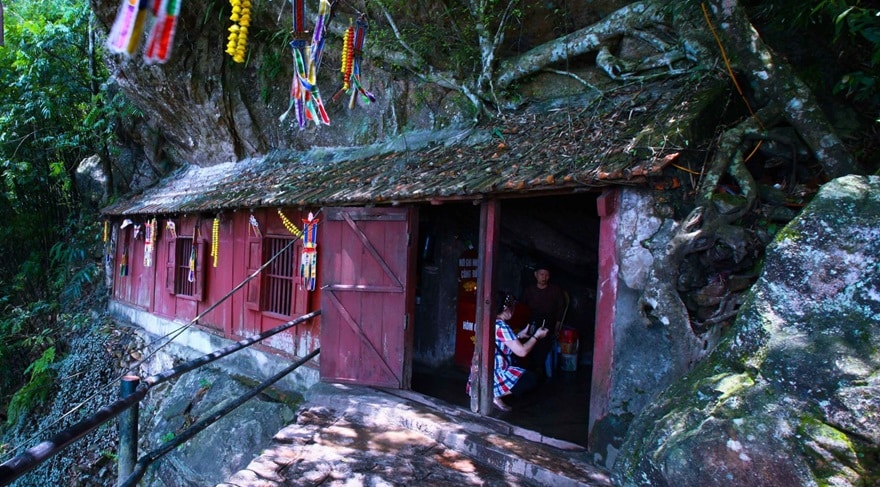
One-Roof Pagoda perched on the cliff
6. Ngoa Van Hermitage
Leaving the One-Roof Pagoda, follow the path winding along the mountainside to reach Ngoa Van Hermitage (the hermitage in the clouds). Before you lies the Tu Waterfall, cascading down a 10-meter rock ledge, bubbling through crevices before spilling over the path and plunging into the abyss. Ngoa Van Hermitage leans against the mountainside under the canopy of two large pine trees. Water vapor from the East Sea is carried by the wind into Yen Tu, where it meets the mountain’s cold air, transforming into a thin, silvery mist that drifts into the hermitage, lingering on the pine needles and floating through the bamboo forest. The mountain scenery dissolves into the light mist, only to slowly reappear in varying shades of light and dark, green and white, like a magnificent and magical natural landscape. In front of the Ngoa Van Hermitage, on the mountainside, are the Thung Hermitage (mortar hermitage) and the Duoc Hermitage (medicine-making hermitage).
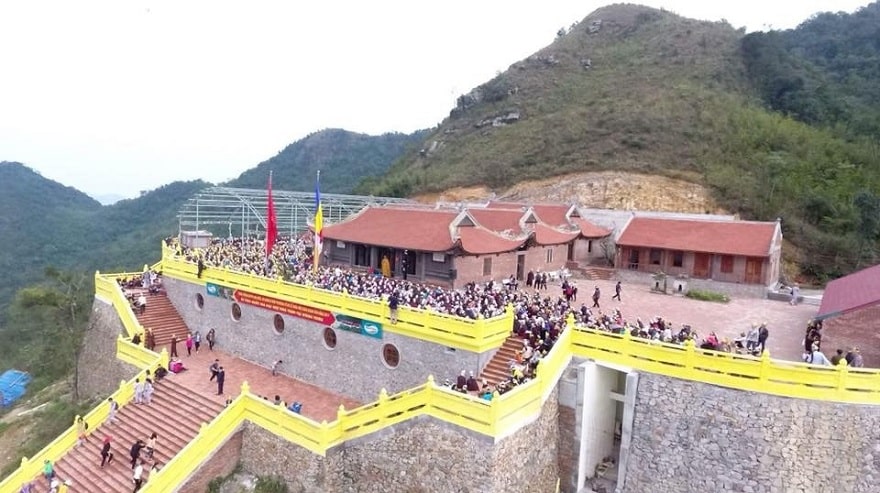
Architectural style of Ngoa Van Hermitage
According to legend, the Duoc Hermitage was where An Ky Sinh practiced medicine. When King Tran Nhan Tong came to Yen Tu to practice Buddhism, he transformed the hermitage into a medicine preparation workshop. Precious herbs from Yen Son and surrounding areas were carefully harvested and brought here to be processed into “Hong Ngoc Suong” (Ruby Dew) medicine. These precious pills were used to treat monks and the local people, especially the poor who could not afford medicine. Standing here, pilgrims can gaze out toward the sea, catching glimpses of Ha Long Bay while the cool, white clouds wrap around them, bringing an extraordinary sense of peace to the soul. Climbing a steep section of the path, visitors are rewarded with stunning natural scenery. A vast, lush green bamboo forest is occasionally blanketed by a light breeze carrying white clouds, creating a poetic scene and a vibrant color palette for the Yen Tu painting.
7. Bao Sai Pagoda
From Ngoa Van Hermitage, climbing the nearly vertical path, visitors will reach Bao Sai Pagoda; this temple is not accessible via the cable car route. Bao Sai Pagoda is perched precariously at an altitude of 724m above sea level, leaning against a towering cliff. During the time when Retired Emperor Tran Nhan Tong was practicing here, there was only a small hermitage in a cave called Ngo Ngu Vien. The First Patriarch’s most trusted disciple, Bao Sai, practiced here. Tran Nhan Tong entrusted Bao Sai with the task of editing and printing all the scriptures of the Truc Lam Zen sect, which were then distributed to pagodas to teach Zen Buddhism to followers across the country. After Zen Master Bao Sai passed away, Ngo Ngu Vien was expanded, and later generations named it Bao Sai Pagoda in his honor. The pagoda houses three large bronze statues of the Truc Lam Three Patriarchs, sitting cross-legged on bronze lotus pedestals painted in red and gold. Bao Sai Pagoda is both the name of the temple and the name of the chief disciple of the Truc Lam Buddha. “Bao Sai” means “water droplets flowing in tassels,” symbolizing the profound permeation of the miraculous Buddhist teachings into all sentient beings. Bao Sai Pagoda is a symbol of the deep-rooted faith of Buddhist followers.
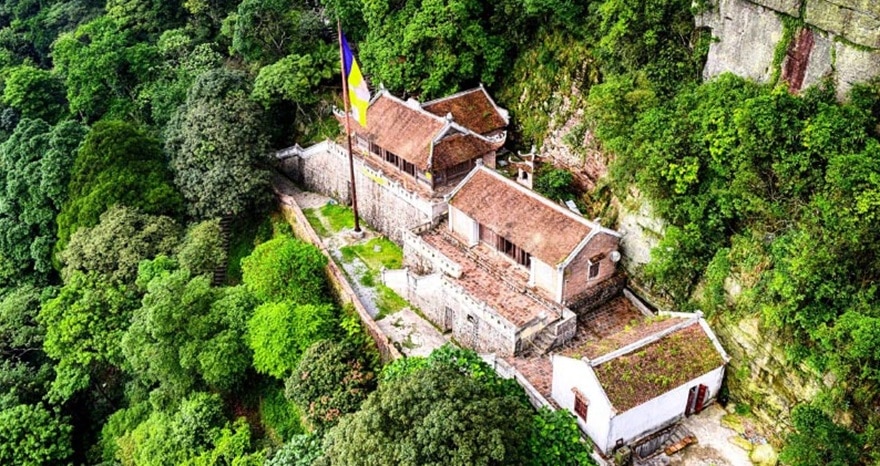
Bao Sai Pagoda viewed from above
8. Van Tieu Pagoda
Just a few hundred meters from Bao Sai Pagoda is Van Tieu Pagoda, or the “Pagoda in the Clouds.” Because the pagoda is located on a mountain range at an altitude of 724m above sea level, the range acts as a wall blocking the winds from the sea, causing water vapor to condense into layers of mist that cover the area year-round. When viewed from a distance, the pagoda appears and disappears amidst the clouds. In the past, it was only a small hermitage called Tu Tieu Hermitage. It was later rebuilt by the Second Patriarch, Phap Loa, into the large pagoda it is today.
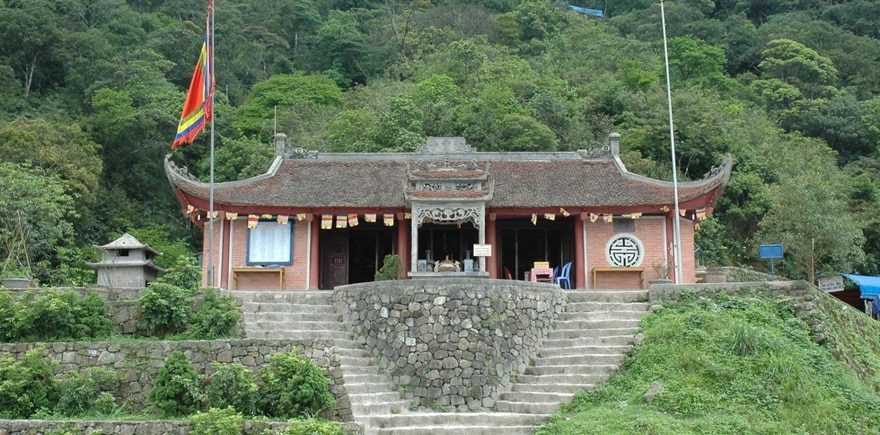
Van Tieu Pagoda
9. An Ky Sinh Statue
Located at an altitude of 900m, 569m from Van Tieu Pagoda, on a flat and wide area, stands a monk in a dark robe with his hands clasped in front of his chest, silently looking out at the path as if in prayer. It is a 3.5m high rock formation, rumored to be where An Ky Sinh attained enlightenment and transformed into a Buddha, merging into this stone. The unique An Ky Sinh statue looks both like a natural rock formation and a human-crafted masterpiece, standing tall on the mountain and creating a mystical atmosphere. Ancient stories tell that during the Qin Dynasty, in Phu Huong village, Lang Giang, there was a man named An Ky Sinh who often treated the poor in coastal areas. When Qin Shi Huang traveled east, he invited him to discuss medicine and offered him gifts. He left those gifts at the village communal house and went to find the elixir of immortality for the king. He traveled until he reached Bach Van Mountain, where he was captivated by the scenery and decided to stay, picking herbs and practicing alchemy to save lives. When he first arrived in Yen Tu, he built a medicine hermitage at the Duoc site, later moving to the area where the stone statue stands today before passing away.
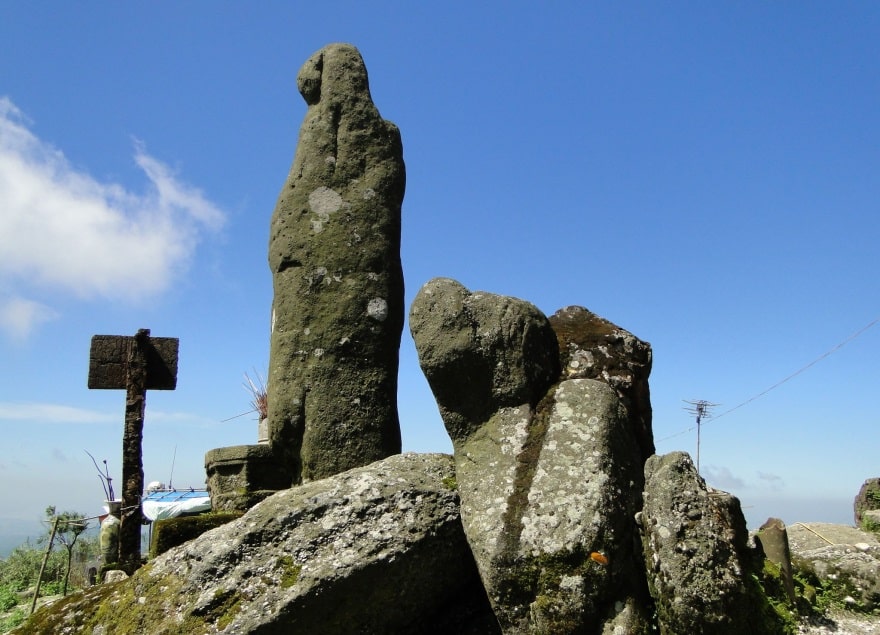
An Ky Sinh Statue
10. Dong Pagoda (Bronze Pagoda)
After climbing 8,900 steps, visitors will reach the sacred peak of Yen Tu, home to the Dong Pagoda, a destination every pilgrim wishes to reach. The Dong Pagoda, fully named Thien Truc Pagoda, is perched on the highest peak of the Yen Tu range at an altitude of 1,068m above sea level. The path to the peak is relatively rugged and can test the spirit of pilgrims; therefore, only after a long journey, a strenuous climb, and with strong determination can you reach this place. In return, visitors will be rewarded with
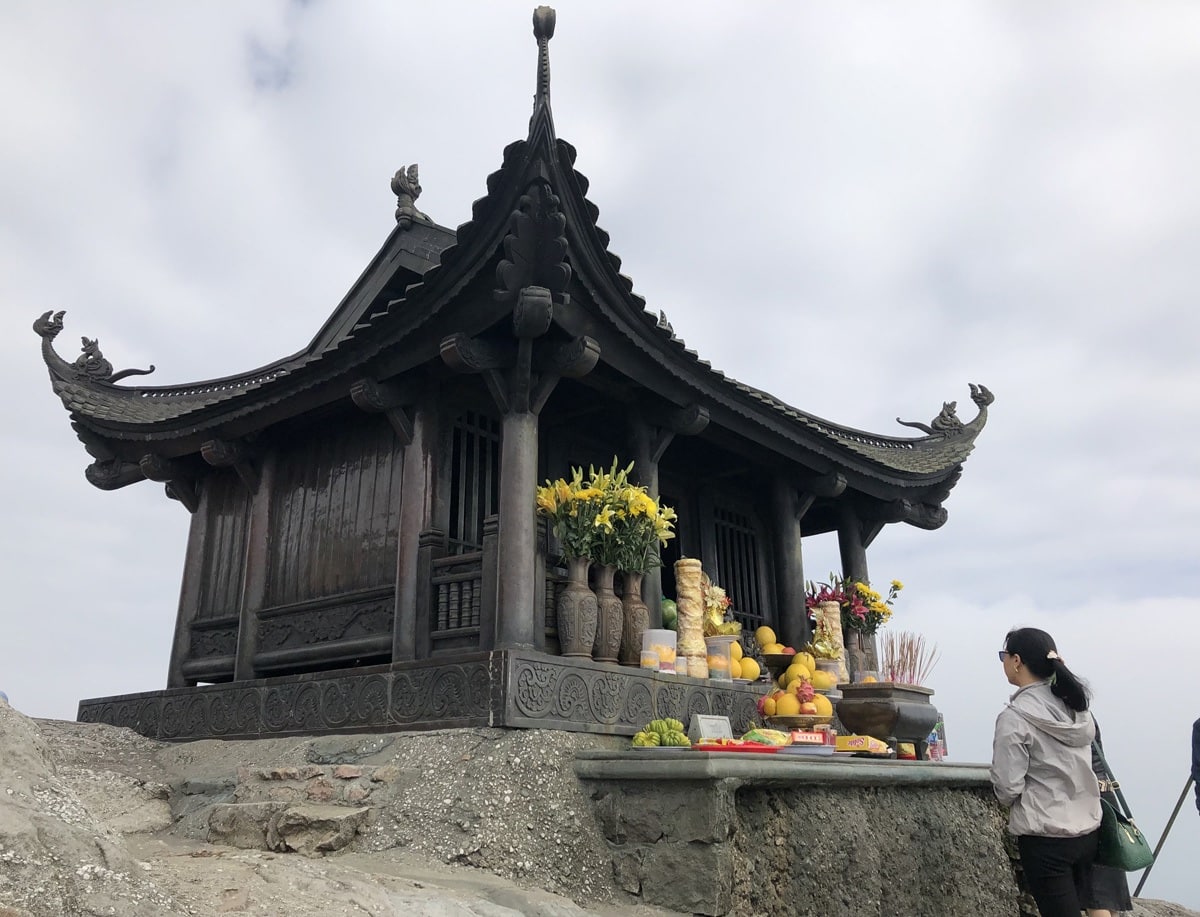
Dong Pagoda Yen Tu
Dong Pagoda is the highest pagoda in Vietnam, originally built during the Later Le Dynasty. After numerous restorations and renovations, the pagoda now boasts a completely new appearance. Modeled after the Dau Keo Pagoda in Thuan Thanh, Bac Ninh, Dong Pagoda covers an area of nearly 20m2, weighs 70 tons, and measures 4.6m in length, 3.6m in width, and 3.35m in height. Each bronze roof tile weighs approximately 4 kg, and each of the four pillars weighs 1 ton. The bronze bell and gong on either side weigh over 250kg combined. Inside the pagoda, there is a statue of Shakyamuni Buddha and three statues of the Truc Lam Zen Patriarchs: the First Patriarch Tran Nhan Tong, the Second Patriarch Phap Loa, and the Third Patriarch Huyen Quang.
Accommodation Services at Yen Tu Pagoda
There are currently two accommodation areas in the Yen Tu Pagoda complex for visitors wishing to stay overnight: Lang Nuong Yen Tu and Legacy Yen Tu. Lang Nuong offers much more affordable rates compared to the Legacy area. Below is some information and room pricing for these areas.
See more: Yen Tu Day Tour
1. Lang Nuong Yen Tu Room Rates
The Tran Dynasty cultural space is recreated at “Lang Nuong” (Nương Village) at the foot of the Yen Tu mountain range, the very place where King Tran Nhan Tong came to practice Buddhism over 700 years ago. Beyond immersing themselves in the architectural atmosphere, visitors to “Lang Nuong” can also enjoy local specialties from Quang Ninh province, such as black glutinous rice banh chung, steamed rice rolls (banh gio), and fermented pork rolls (nem chua)…
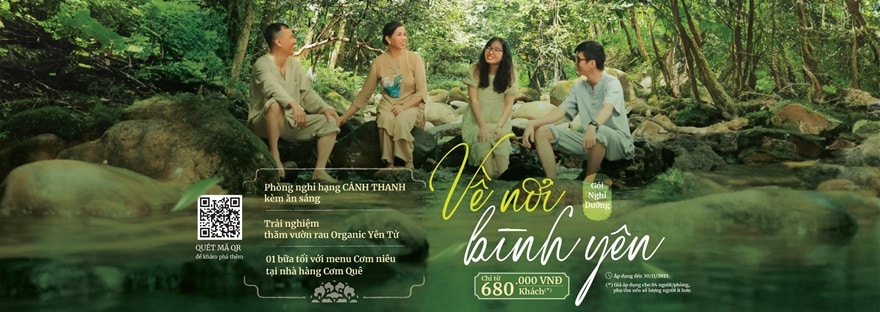
Lang Nuong Yen Tu accommodation services
-
t
- Room rates applicable from now until December 31, 2023
- There are 95 rooms. Each room includes 4 pod-style bunk beds. The 8-person room consists of two connecting 4-person rooms.
t
| Lang Nuong Yen Tu Price List | ||
| Room Type | Sun – Thu | Fri & Sat |
| Classic | 1,200,000 | 1,800,000 |
| Superior | 1,500,000 | 2,100,000 |
| Deluxe | 1,800,000 | 2,400,000 |
Room Amenities
-
t
- Rooms are equipped with two-way air conditioning.
- En-suite bathroom and toilet, tea table.
t
2. Legacy Yen Tu Room Rates
Legacy Yen Tu features 133 rooms, each adorned with handcrafted furniture made from materials produced using traditional methods, creating a space that harmonizes with the overall surroundings. A unique highlight in every room is the wooden inkstone used for calligraphy, and a living area that captures natural sunlight. These details create a distinction that cannot be found anywhere else but Legacy Yen Tu. The entire hotel is designed with a beauty that is both luxurious and simple, capturing the very essence of the heritage, culture, craftsmanship, and atmosphere of Yen Tu Mountain.
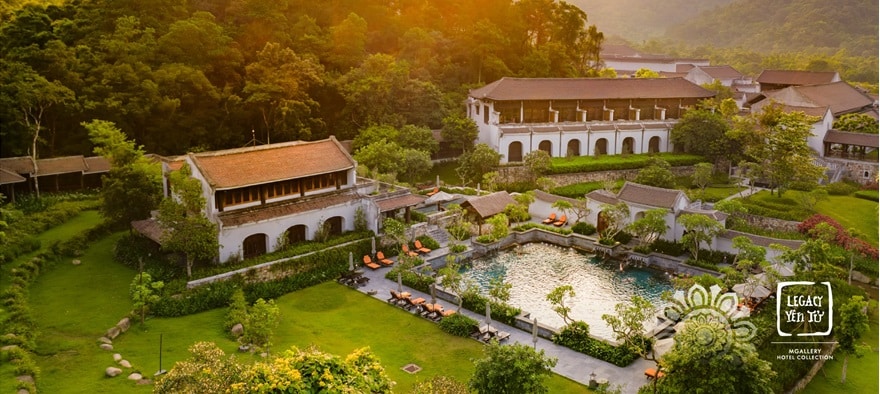
Legacy Yen Tu
-
t
- Rates applicable from now until December 31, 2023
- Check-in time: 14:00 | Check-out time: 12:00
t
| Legacy Yen Tu Room Rate Table | |||
|---|---|---|---|
| Room Type | Sun – Thu | Fri | Sat |
| SUPERIOR, 2 single beds | 2,600,000 | 2,900,000 | 3,800,000 |
| DELUXE, 1 King bed | 3,000,000 | 3,300,000 | 4,400,000 |
| DELUXE, 2 single beds | 3,000,000 | 3,300,000 | 4,400,000 |
| JUNIOR SUITE, 1 King bed | 3,600,000 | 4,000,000 | 5,200,000 |
| JUNIOR SUITE, 2 single beds | 3,600,000 | 4,000,000 | 5,200,000 |
| PRESIDENTIAL SUITE, 1 King bed | 9,000,000 | 19,500,000 | 23,000,000 |
Room Amenities
-
t
- Complimentary breakfast
- In-room food and beverages.
- Rain shower experience, private bathroom, accessible bathroom for guests with disabilities.
- Telephone, multimedia hub, radio.
- High-speed Internet.
- Services and equipment: shoe shine machine, iron, hairdryer, alarm clock, safe, air conditioning
t
t
t
t
t