Before specialized 4×4 safari wheels cut through the early morning mist across South Africa’s vast plains, this expansive land lived through turbulent, blood-stained, and dramatic chapters of history. The origin of modern nature conservation on the African continent did not begin with romanticism; it grew out of the brink of extinction facing large mammals under the barrels of colonial hunting rifles in the nineteenth century. Confronted with herds of elephants, rhinoceroses, and lions slaughtered unchecked for ivory, horn, and hides, on March 26, 1898, the President of the South African Republic at the time, Paul Kruger, signed a historic decree officially establishing the Sabi Reserve nestled between the Sabie and Crocodile rivers. This untamed geographic buffer zone is regarded as one of the first controlled wildlife protection areas in the world, erecting an early legal barrier to rescue primeval habitats from the expansion of mechanization.
The fierce historical upheaval of the Anglo-Boer War erupting shortly afterward interrupted every fledgling effort, turning wild plains into battlegrounds for power. When the gunfire quieted in 1902, an extraordinary figure emerged to permanently transform the land: Scottish naturalist Major James Stevenson-Hamilton. Appointed as Sabi’s first warden, he began a journey of reform marked by iron discipline and an endless passion for research. His resolute determination to stamp out poaching and clear out illegal hunting parties earned him the title “Skukuza” from the local Shangaan people, which in the vernacular means “he who sweeps clean.” Skukuza’s name became inseparable from the miraculous revival of wildlife, and was later honored by giving it to the main hub and largest rest camp across the entire Kruger wilderness.
The geopolitical turning point that shaped the scale of this conservation realm came in 1926. Under the strong push of Minister of Lands Piet Grobler, the South African Parliament passed the National Parks Act, Act No. 32. This landmark legal event merged the Sabi Reserve in the south with the wild Shingwedzi Reserve in the north, while incorporating a series of neighboring private farms to officially birth Kruger National Park. Act No. 32 not only expanded the natural boundary to nearly twenty thousand square kilometers, but also marked a fundamental shift in mindset: moving from a protected hunting ground to a national park belonging to all citizens, where conservation became supreme national policy alongside academic ecological research.
Within that historical current, the term “Big Five” underwent a profound semantic evolution. During the heyday of nineteenth-century hunting expeditions, seasoned white hunters grouped five animals—the African lion, leopard, savanna elephant, rhinoceros, and Cape buffalo—into a distinct category. This name was by no means based on sheer body size, but on extreme danger, ferocious retaliatory instincts, and the immense difficulty of confronting them directly on foot amid thorny bush and scrub. A wounded buffalo could ambush a pursuer in return, or a leopard concealed seamlessly in the shade of an acacia canopy could strike fatally in a split second. Entering the modern era, that gunsmoke-stained label was completely redefined by science and ecotourism, becoming a supreme symbol of tracking, wildlife photography, and a benchmark for the healthy balance of a thriving ecosystem.
South Africa’s journey of building wild sanctuaries recorded another unprecedented milestone in 1991 with the creation of the Madikwe Game Reserve along the Botswana border. There, Operation Phoenix was carried out, entering world conservation annals as the largest wildlife translocation ever undertaken. Depleted agricultural land was rewilded, paving the way for more than eight thousand large animals—including full representation of the Big Five—to be safely transported to their new habitat through a complex logistical network. Today, wildlife’s heroic historical imprint goes far beyond reserves, appearing formally on every Rand banknote issued by the South African Reserve Bank. Each denomination features one of the Big Five, turning natural heritage into an inviolable symbol of pride and cultural identity for the entire Rainbow Nation.
Viewed from traditional geography and natural landscape geomancy, the Kruger wilderness sanctuary stretches like a jade tapestry across the fertile Lowveld basin, encompassing the administrative spaces of Limpopo and Mpumalanga provinces. Covering a massive 19,485 square kilometers—equivalent to 7,523 square miles—this territory forms a regal layout in a near-rectangular structure running along a north-south meridian axis. That primeval expanse stretches roughly 360 kilometers long and averages 65 kilometers wide, creating a one-of-a-kind biosphere corridor on the African continent. Kruger’s natural terrain is sheltered and anchored by commanding geographic borders: the basalt rampart of the majestic Lebombo Mountains and the Mozambique frontier guarding the east, the age-old silt of the Limpopo River dividing the territory from Zimbabwe in the north, while the winding waters of the Crocodile River lock down the southern border. This enclosed yet spacious topography feels like a natural arc cradling abundant life force, shielding millions of creatures from the harsh swings of Africa’s climate.
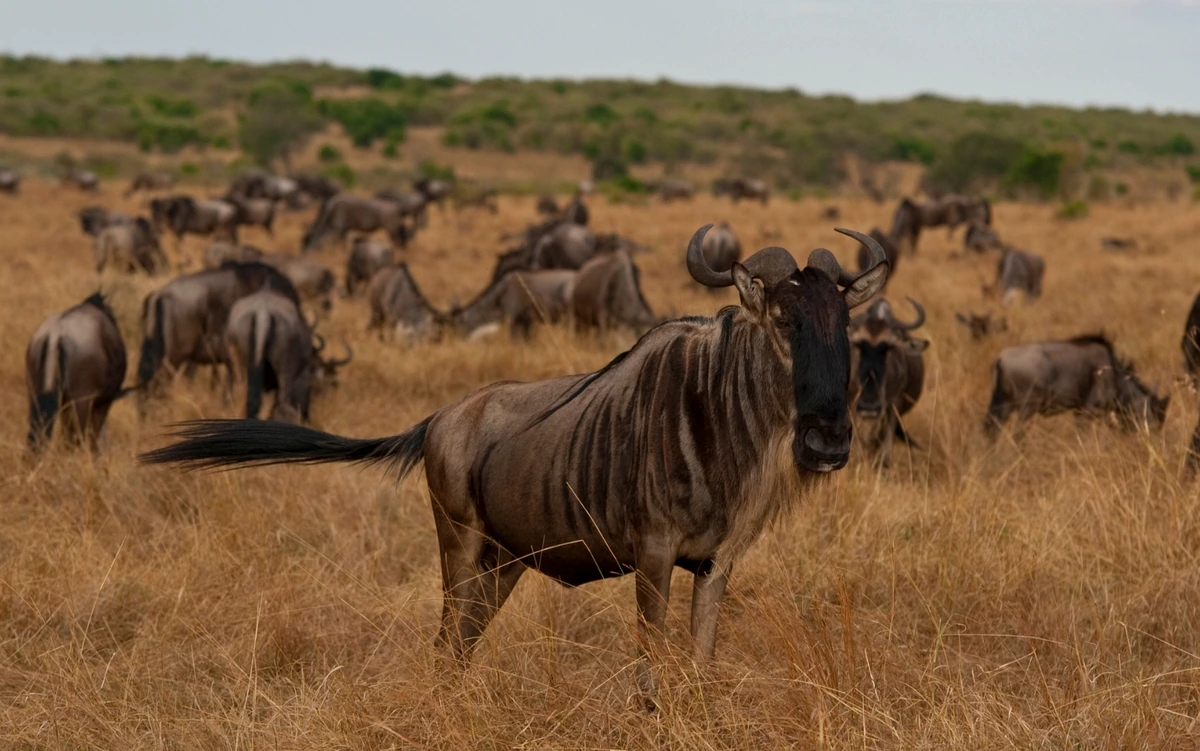
The secret behind this land’s fierce vitality and endless abundance lies in its grand geological divide, shaped by ancient fault lines millions of years ago. Kruger is distinctly split into two contrasting yet mutually supporting ecological worlds. West of the park lies a plateau formed from ancient granite, where long-term weathering created loose, fertile sandy-loam soils. This rich topsoil nurtures resilient red bushwillow (Combretum apiculatum) thickets and the mighty marula tree (Sclerocarya birrea)—a sacred tree carrying local soul whose fragrant, sweet fruits draw large mammals. Conversely, the eastern half of the park is a low-lying plain spread over dark volcanic basalt. Heavy, mineral-rich black clay soils here hold water strongly through rainy seasons, opening up sweeping grasslands of sweet grass interspersed with vast stands of butterfly-leaved mopane (Colophospermum mopane), creating a huge food reserve for migrating herds of wildebeest, zebras, and elephants.
The lifeblood nourishing this entire living organism flows from a hydrological network of six major river systems winding across the territory from west to east: the Limpopo, Luvuvhu, Letaba, Olifants, Sabie, and Crocodile. In terms of landscape and ecology, these perennial waterways act like meridians carrying life forward, dividing the terrain into diverse microclimates and creating lush oases right in the heart of dry savanna. Along both banks, dense riverine forests become safe travel corridors and ideal ambush spots for elusive leopards, while alluvial flats along the Olifants or Sabie basins are fiercely contested territories for proud lion prides and formidable buffalo herds. This river network not only moderates temperatures but also establishes a natural rhythm of biological movement that shapes Big Five densities across wet and dry seasons.
Kruger’s ecological planning entered a historic peak era through a visionary decision in 1990, when conservationists pioneered the complete removal of artificial veterinary fences separating the national park from adjacent private reserves. This move freed natural space, uniting a massive open ecosystem called Greater Kruger spanning over 2.2 million hectares. The crowning achievement of this planning is Kruger’s full integration into the Great Limpopo Transfrontier Park—a mega-ecological corridor linking three nations: South Africa, Mozambique, and Zimbabwe. Removing physical barriers not only restored animals’ ancestral seasonal migration routes, but also turned the entire region into a seamless, grand landscape where humans are truly just guests marveling at the supreme majesty of wild nature.
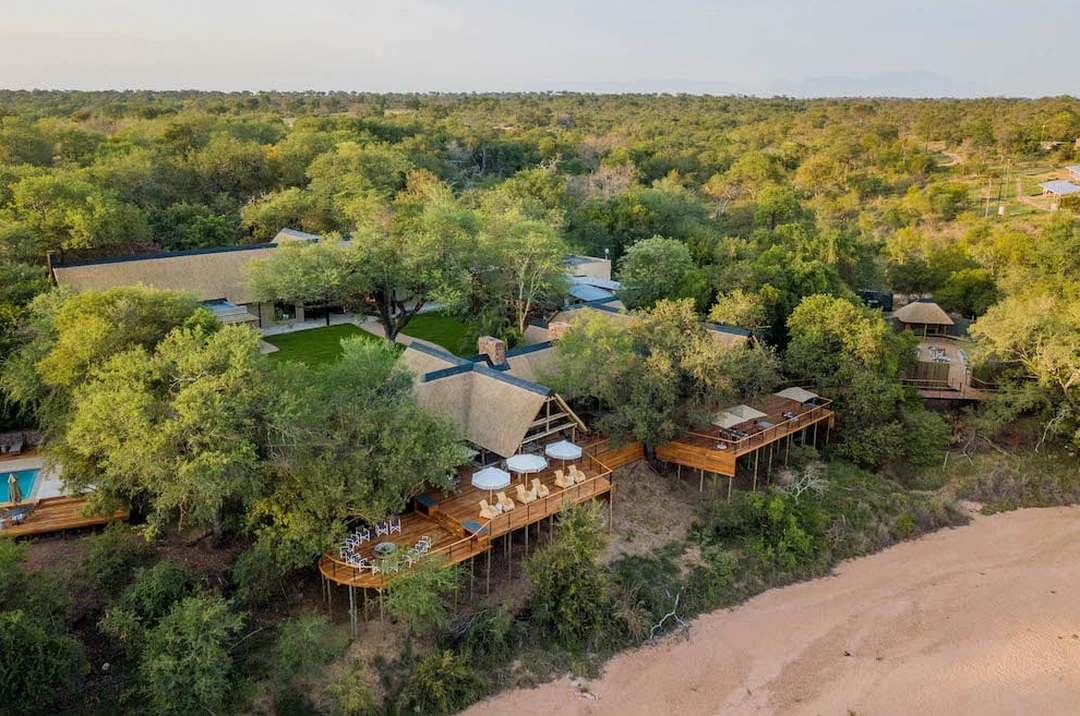
The spatial layout of South Africa’s safari network is a triumph of ecological planning, where the boundary between human civilization and primeval nature is nearly erased. Under the strict management of South African National Parks (SANParks), the vast Kruger wilderness is organized around a backbone of twelve main rest camps, scientifically distributed across distinct ecological zones from dense southern bushveld to arid northern savanna plains. Connecting these permanent settlement oases to millions of hectares of wilderness is a massive internal road network stretching over 2,500 km, weaving smoothly between paved river routes and winding gravel tracks engineered with deliberate roughness to limit vehicle speeds and protect predators’ natural movement.
At the heart of this network sits Skukuza headquarters, the central rest camp resting quietly beside the scenic Sabie River. It stands as an exemplary architectural model of indigenous organic building, blending comfortable eco-lodging with serious scientific research—anchored culturally by the Stevenson-Hamilton Memorial Library, which preserves thousands of invaluable records on African wildlife conservation history. Buildings at Skukuza, as well as outposts like Lower Sabie and Satara, strictly follow the rule of not breaking the savanna horizon. Indigenous round structures (rondavels) rise gracefully beneath ancient acacia and baobab shade, wearing a rustic look yet holding refined design thinking that melts into the surroundings as if born from the earth millions of years ago.
Craftsmanship and local material engineering at these wilderness lodges reach remarkable refinement, meeting demanding microclimate requirements. In harsh African savanna weather where summer temperatures can soar past 40°C, local engineers used stabilized earth blocks alongside locally quarried stone to build thick slate walls capable of storing and regulating heat across day and night cycles. Overhead, termite- and mold-treated timber frames support steep thatched roofs hand-woven in multiple layers from indigenous grass (Hyparrhenia hirta). This thick, porous thatch creates a natural thermal air buffer that keeps interiors cool and pleasant, while releasing a gentle herbal fragrance whenever summer showers fall.
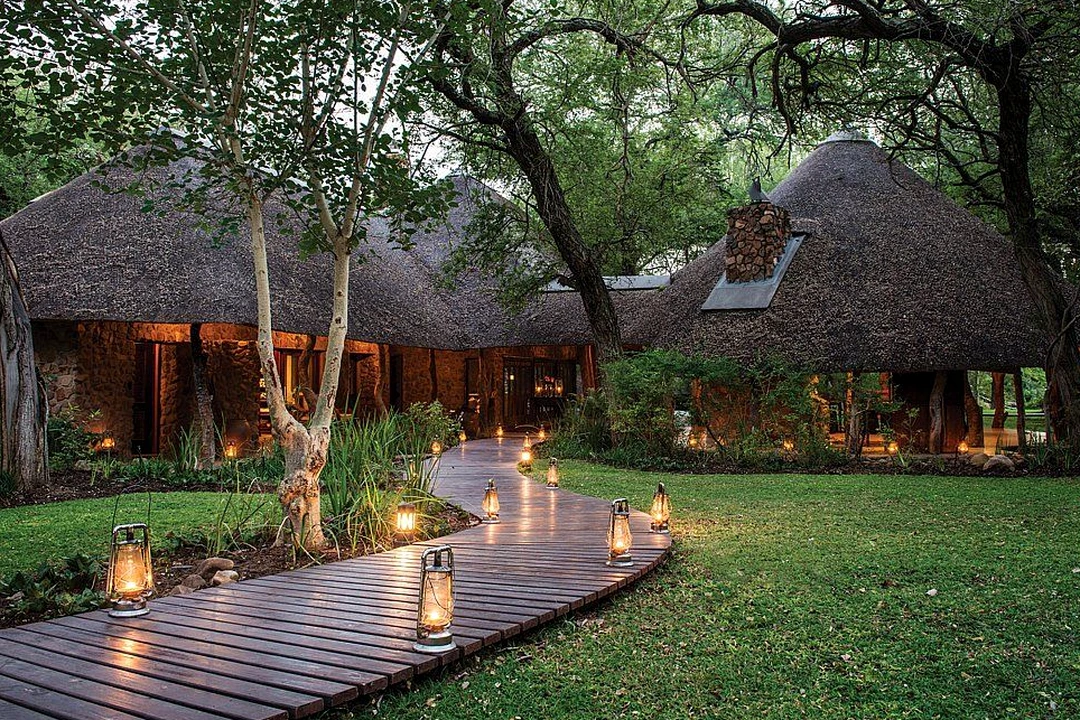
Actual investment in this conservation infrastructure demonstrates the Rainbow Nation’s sustainable vision and substantial financial capacity. With budgets reaching hundreds of millions of South African Rand (ZAR) disbursed regularly each year, the ecological complex is continuously modernized without harming its surroundings. Power for rest camps and borehole pumps feeding artificial wildlife waterholes comes from silent, standalone solar microgrids. Hidden beneath the rustic appeal of natural stone and thatch is a high-tech anti-poaching security grid equipped with ground sensors and invisible surveillance radar, firmly protecting Big Five habitats from external threats.
As the blazing red sun sinks behind thorny savanna acacias, nightfall brings the ancient survival rules of South Africa’s plains to life. Under strict management rules in national and private reserves, all visitors and safari vehicles must observe a field curfew, returning safely inside camp perimeters between 17:30 and 18:00 each evening. Yet the shift from twilight to deep darkness is hardly the end of the expedition; instead, it opens one of nature’s grandest live spectacles: the rhythm of nocturnal predators beneath Africa’s mysterious skies.
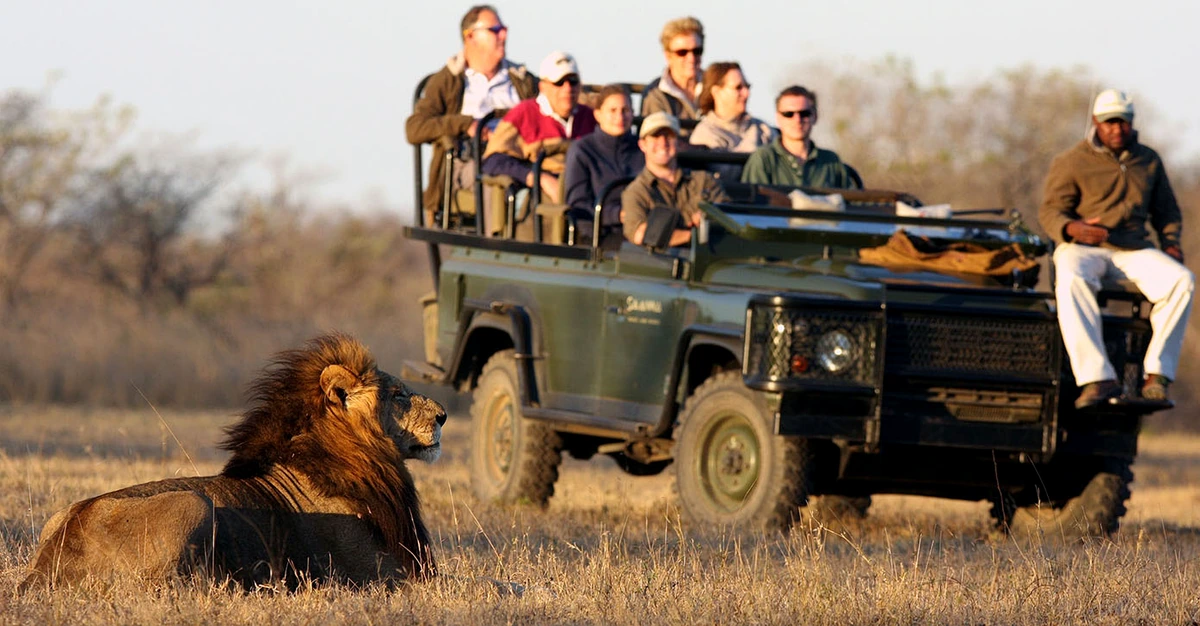
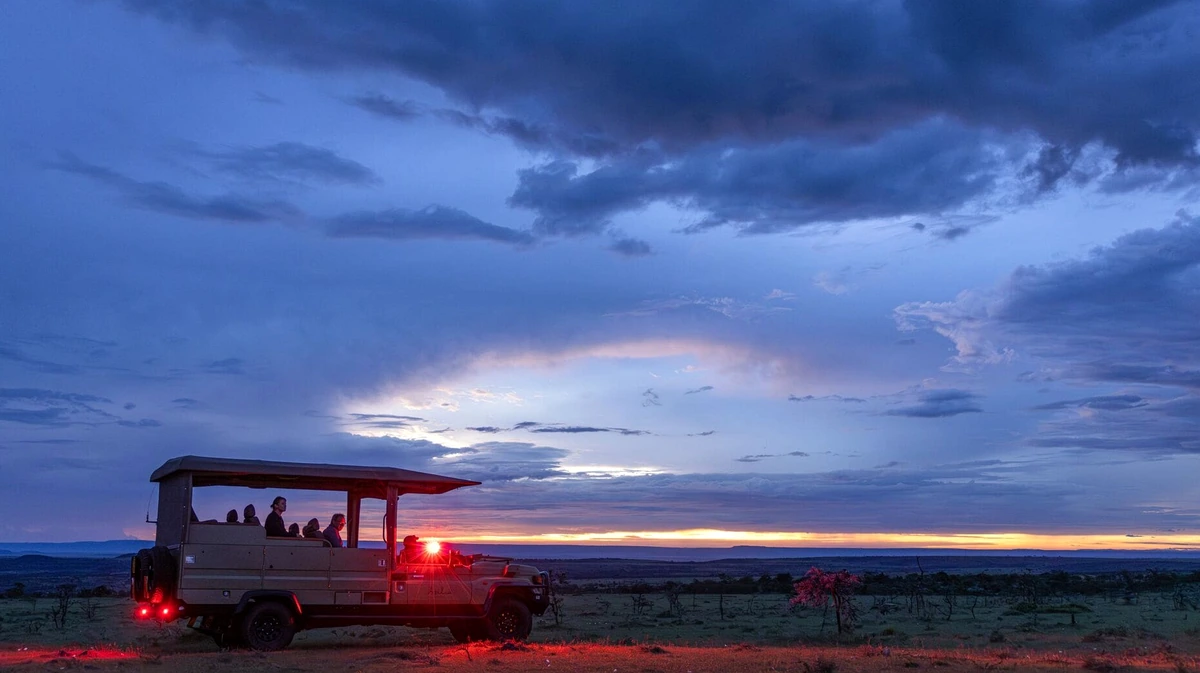
Dedicated night expeditions (Sunset and Night Game Drives) set out in sturdy open-top Land Rovers or Land Cruisers, led by field guides certified by the Field Guides Association of Southern Africa (FGASA). Amid the vast darkness, local guides elevate light handling into an exact ecological ethic. Instead of harsh white beams that disrupt wildlife, night-drive vehicles use spotlights fitted with deep red or amber optical filters. This specific color is scientifically calibrated to preserve rhodopsin—a light-sensitive pigment in rod cells of apex predators like leopards and spotted hyenas. Thanks to this gentle spectrum, visitors can catch twin phosphorescent eye-shine in the brush and observe silent stalking steps in detail without disturbing biological rhythms or harming animal vision.
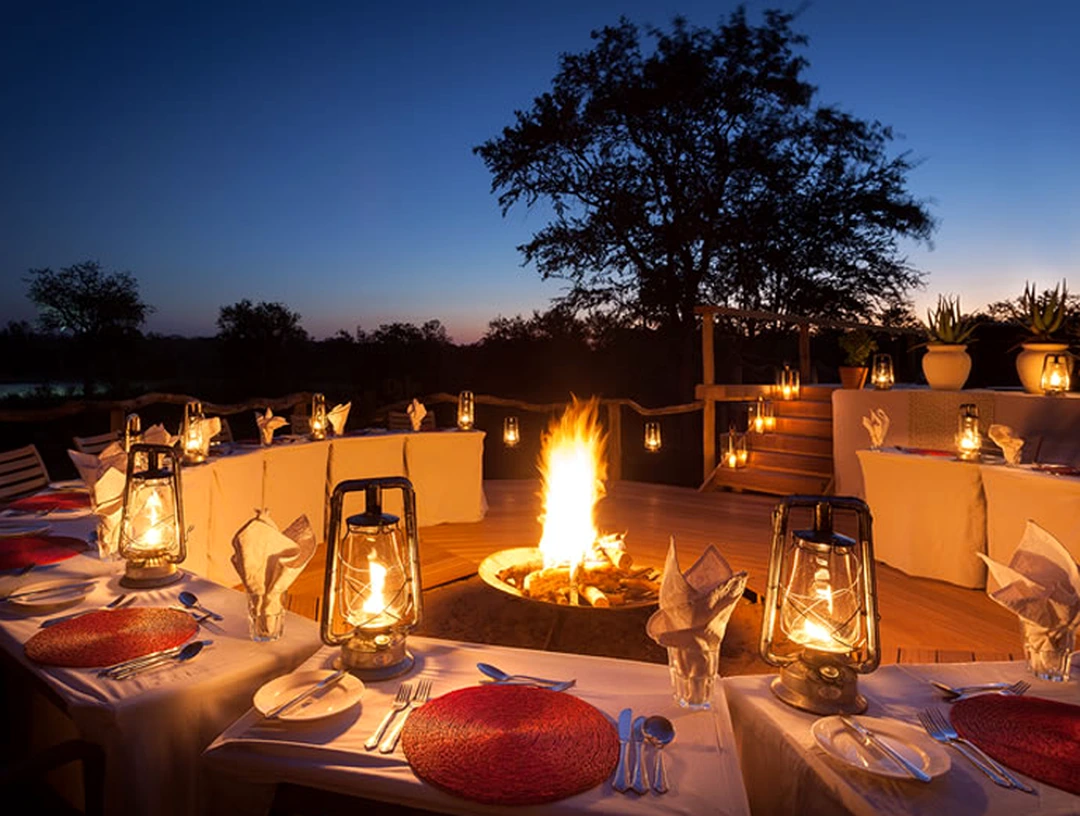
After tense hours tracking nocturnal hunts across the bush, evening hospitality brings travelers back to a traditional boma—a circular courtyard enclosed by stout thornbush branches, rooted in centuries-old customs of protecting communities and livestock. In the center of the boma, a campfire crackles through the night from dense mopane wood and seasoned lapa timber. When lit, this renowned bush firewood releases a mild, herbal smoke and warm glowing embers that push back midnight chill, turning the space into a legendary gathering spot.
Gathering beside glowing mopane embers with a mug of rooibos tea brewed over coals or sweet Amarula cream liqueur, human hearing welcomes the raw symphony of earth and sky. From up to 8 kilometers away, a lion’s deep, authoritative roar cuts through the cool night air, echoing across granite valleys and vibrating in the listener’s chest. Blending with that territorial call are the eerie whoops of spotted hyenas calling to share a kill and the lonely call of an owl crossing overhead. Looking up into the expanse, the Southern Hemisphere sky appears crystal clear, free of modern dust or light pollution. The Milky Way arcs across the fabled Southern Cross like an eternal river of diamonds, holding travelers in quiet awe before the wild, untamed beauty of an African night.
Cuisine on South African bush safaris is a living chronicle blending frontier Afrikaner flavors from the era of settlement with long-standing culinary heritage from the Shangaan, Venda, and Swazi peoples. As crimson dusk settles over the dark velvet of the continent, safari food culture awakens around crackling boma fires, where people and nature meet through the rich aroma of heritage dishes. The soul of savanna evenings begins with the Braai—not merely a cooking method, but a sacred ritual of community bonding. The fire must be built with dry sickle bush (sekelbos) or mopane wood, prized African hardwoods that hold glowing coals and release fragrant resinous smoke that infuses firm cuts of meat.
Before the main grill feast begins, travelers whet their appetite with biltong and droëwors—classic preserved provisions born from the survival needs of long treks. Crafted from lean game meats such as kudu or sweet impala, cuts of fresh meat are carefully seasoned with coarse salt, malt vinegar, black pepper, and crushed coriander seeds, then air-dried naturally in dry savanna breezes. Savory slices of biltong or chewy lengths of droëwors retain their natural sweetness, richness, and wild spice aroma, serving as an ideal snack to kick off tracking stories beside the fire.
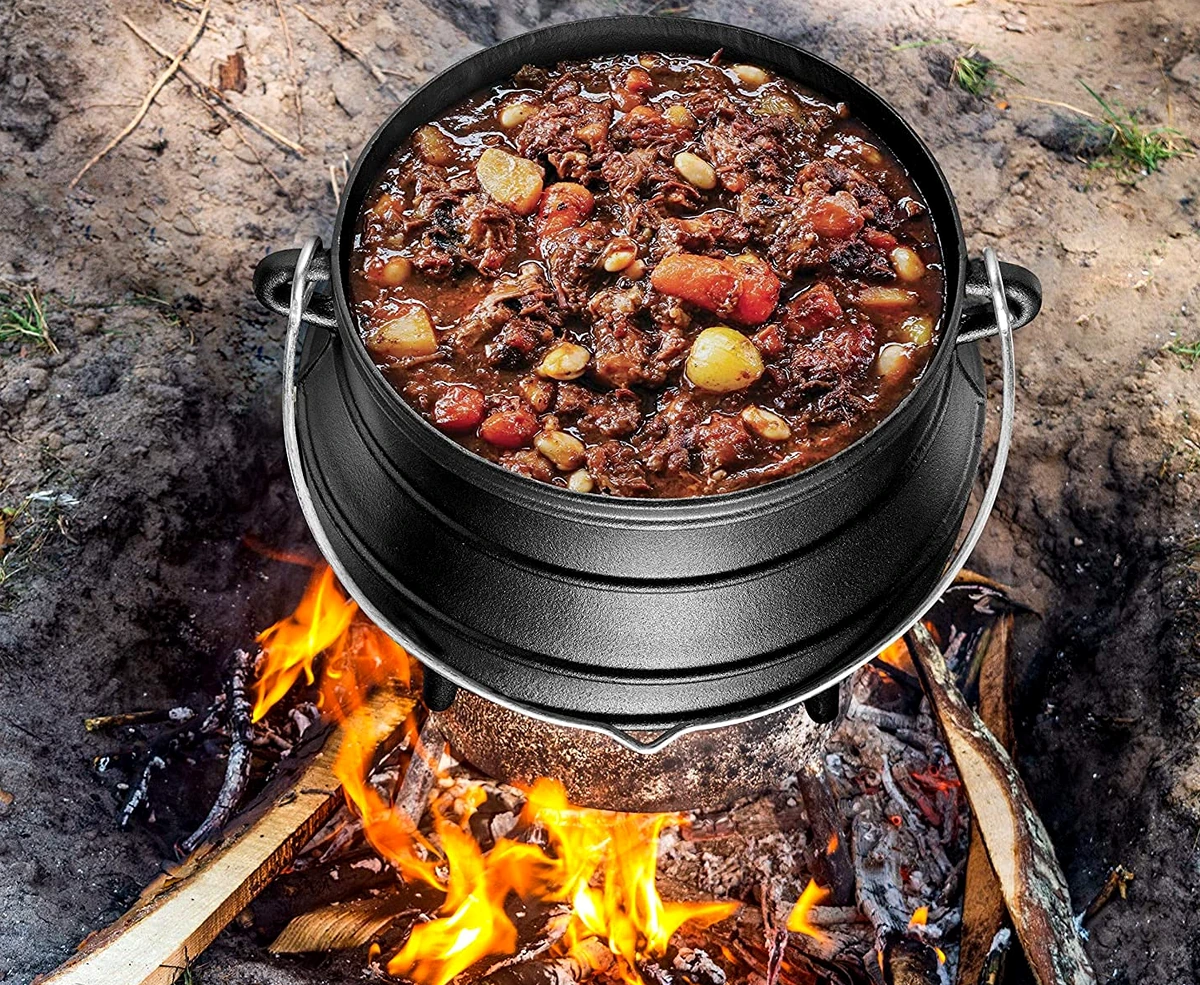
The peak of outdoor African cooking is captured in potjiekos, the celebrated stew passed down by Afrikaner trekker expeditions. This dish demands complete patience, cooked in a rounded, three-legged cast-iron pot set directly over smoldering sekelbos ash for four to five hours. Kudu or impala meat, seared with fat, is layered beneath fresh vegetables including corn, potatoes, carrots, and wild mushrooms. Throughout cooking, the cook never stirs with a spoon, letting heat circulate naturally beneath the heavy lid alongside fine red wine poured into the base. When the cast-iron lid is lifted, a glossy, rich sauce clings to tender, fall-apart meat layered with smoke and earthy herbs.
A fitting foil to rich game meats is the pairing of pap and chakalaka, foundational staples reflecting the cultural roots of the Shangaan and Venda peoples. Pap is white maize porridge stirred steadily over low heat until thick, smooth, and subtly fragrant with tropical corn. Its clean, mild character sets off chakalaka—a fiery, flavor-packed relish made from ripe tomatoes, onions, hot bird’s-eye chilies, grated carrots, and baked beans simmered with warming curry spice. Chakalaka’s lively heat paired with creamy white maize creates a rustic, inviting harmony that recharges energy after a long day out in the bush.
Rounding out the bush dining map is The Cattle Baron Grill, a well-known restaurant set strikingly inside the Skukuza rest camp. Perched along the scenic Sabie River, it offers top-tier dining where guests can enjoy a tender, juicy game steak cooked just right—its aroma rising in the air—while quietly watching hippos submerge in cool water or massive Nile crocodiles basking on sandy banks. The wild feast feels even more complete over a glass of South Africa’s signature Pinotage red with ripe plum and smoky notes, or a Stellenbosch Cabernet Sauvignon with deep tannin structure, weaving a refined culinary memory against grand natural scenery.
Stepping into the world of apex predators requires visitors to understand the savanna’s biological pulse along with strict operating rules in South Africa’s national parks. The prime window to open remarkable safari journals falls during the southern dry season, running from May to September. As winter arrives on the plains, dense vegetation dries and sheds leaves, maximizing visibility for telephoto lenses; at the same time, scarcer water draws wildlife—from towering elephants to shy antelopes—to gather in numbers around remaining waterholes and rivers. Moreover, cool, dry weather in this period markedly reduces disease-carrying mosquitoes, lowering malaria risk to a minimum for bush travelers.
Gate schedules at national parks are closely aligned with daylight cycles to protect both visitors and wildlife. In summer, from November to February, gates open at 05:30 to greet first light and close at 18:30 as night falls. Conversely, in winter from May to July, gate hours shift to 06:00 through 17:30. Every visitor entering a gate pays a daily conservation fee—a vital funding stream used directly by South African National Parks (SANParks) to cover patrol costs, support specialized anti-poaching units, and maintain pristine ecosystems. For explorers planning longer stays or visiting multiple reserves, a Wild Card membership offers an economical option with unlimited access for one year.
Road infrastructure for self-drive safaris in major parks like Kruger is built to high standards, comprising over 850 km of smooth tarred roads and more than 1,500 km of gravel tracks winding through remote habitats. While standard sedans can easily handle main routes, high-clearance four-wheel-drive SUVs are an even stronger companion, offering a higher vantage point above tall grass and handling tricky potholes during wet rainy months. Travelers from around the world can reach the wild core quickly via domestic flights connecting economic hub Johannesburg or mother city Cape Town to Skukuza Airport (SZK) inside the park, or Kruger Mpumalanga International Airport (MQP) on the border.
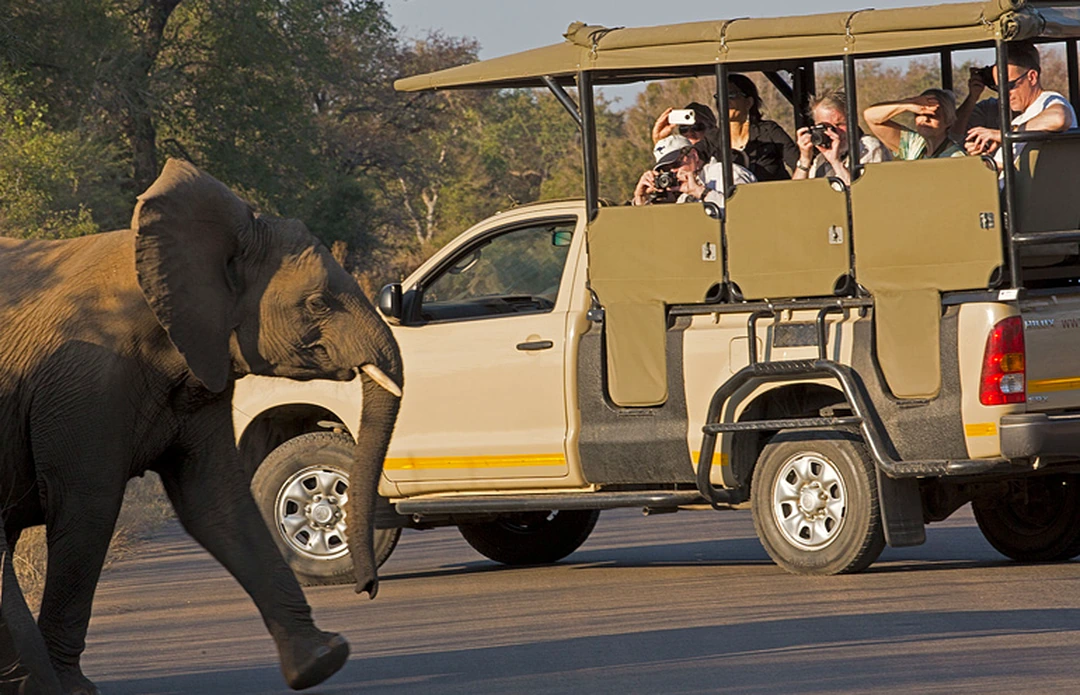
Once rolling through wildlife territory, life-critical safety rules must always be kept top of mind. Visitors must never step out of a vehicle except at designated picnic sites or fenced rest camps. Always maintain a safe minimum distance of 50 meters from elephants, rhinoceroses, or lions, and never cut across or block an animal’s path. Driving speeds are strictly capped at 50 km/h on tarred roads and 40 km/h on gravel roads to prevent tragic collisions with animals suddenly crossing tracks. Feeding wildlife is also strictly prohibited, as it alters natural foraging instincts and creates serious risks of human-wildlife conflict.
Practicing “Leave No Trace” wholeheartedly—keeping every branch and blade of grass intact as it was in the beginning—is the highest tribute to this land. To turn the dream of witnessing all of the Big Five into a safe, upscale, and culturally rich journey, travelers can join a structured all-inclusive South Africa tour meeting international standards, where every leg is guided by seasoned experts.