Deep beneath layers of alluvial sediment and ancient bedrock in the capital of Moscow, the underground transit system known as the Moscow Metro (Московский метрополитен) is far more than a triumph of urban transport infrastructure; it is an architectural chronicle capturing the full sweep of upheavals, aspirations, and indomitable resolve from a resonant historical era. The idea of a modern subterranean transit network had been germinating since the final golden twilight of the Russian Empire, yet it took the sweeping social transformations after the October Revolution for this monumental undertaking to step off the drafting table. In June 1931, amid severe gridlock on surface streets during a wave of rapid industrialization, a plenary meeting of the Central Committee of the Communist Party of the Soviet Union formally approved the decision to build an underground rail network of unprecedented scale, placed under the direct and resolute leadership of statesman Lazar Kaganovich. In the minds of Soviet planners at the time, underground transit could not be dark, cramped tunnels reeking of commercial profit like Western models; instead, it had to become “palaces underground for the people” (Дворцы для народа)—where socialist realism was elevated into the grandest public space imaginable.
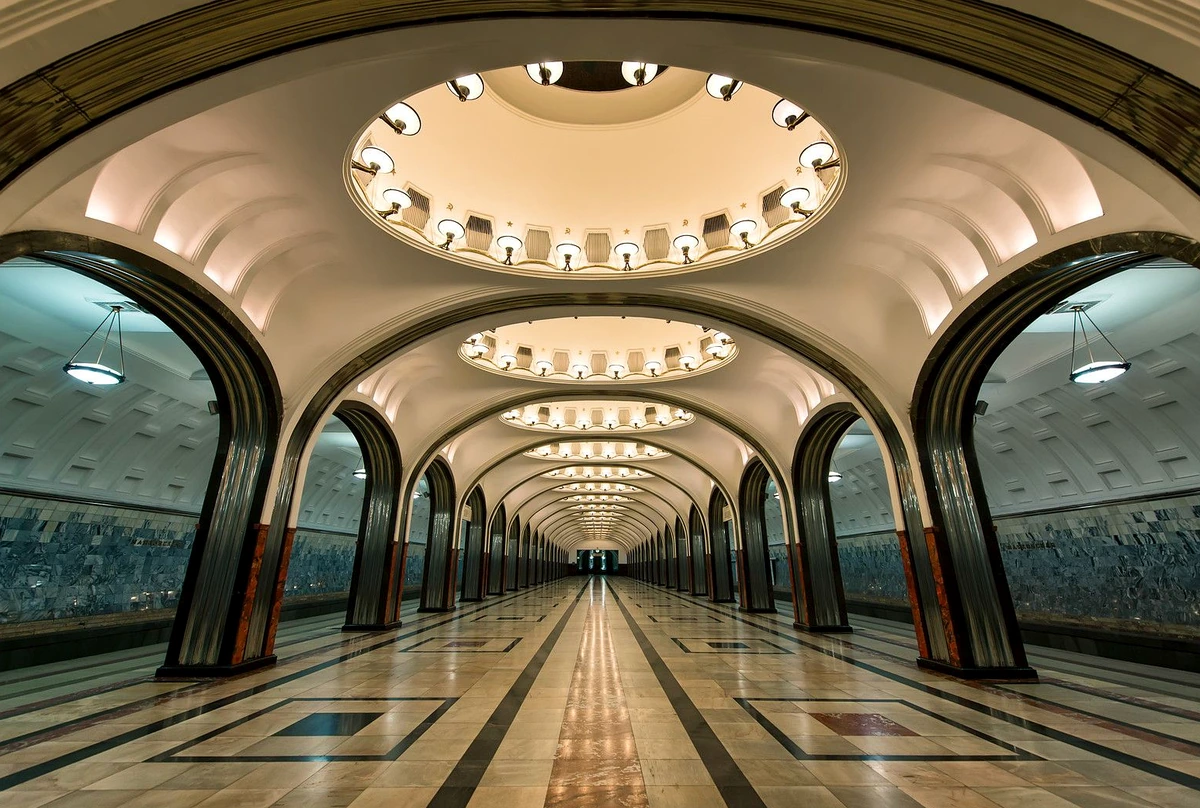
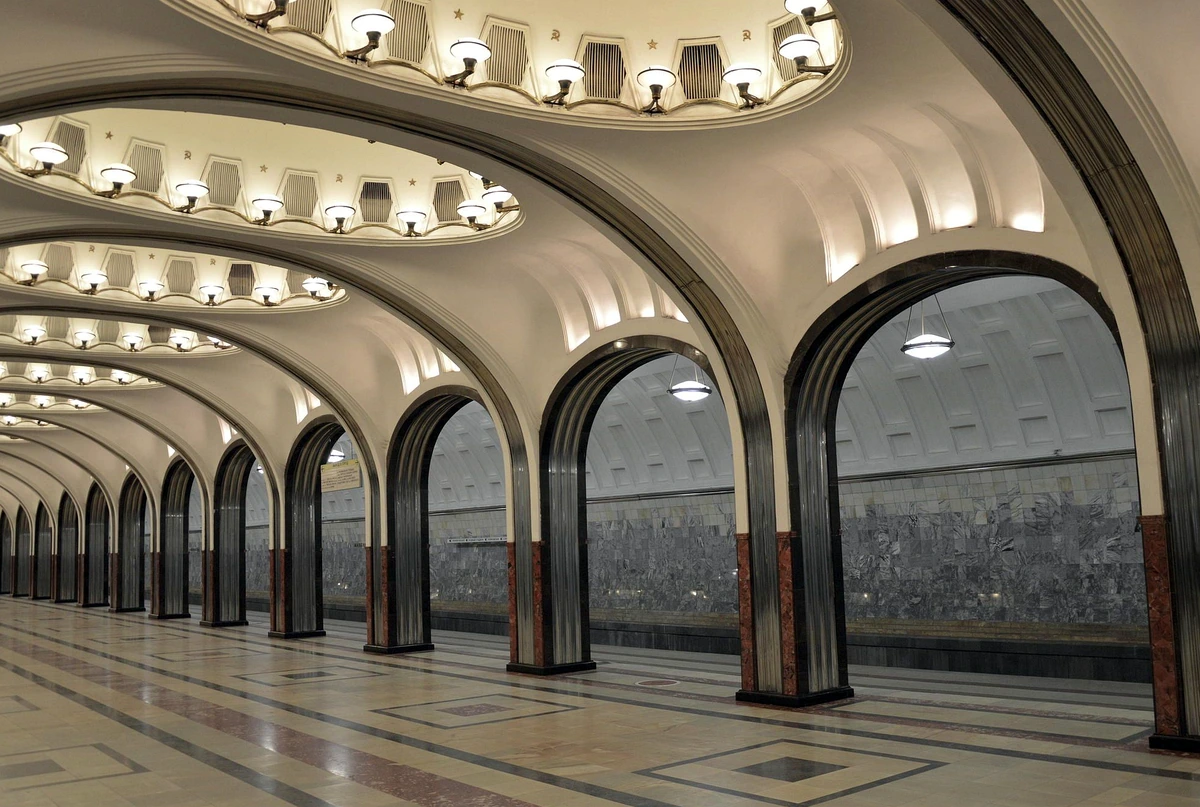
The remarkable shift from purely functional thinking to the pinnacle of Soviet aesthetics was vividly marked by the opening of Mayakovskaya station on September 11, 1938, as part of the second construction phase. Under the gifted hand of renowned architect Alexey Dushkin, Mayakovskaya rose as a masterpiece of the Avant-Garde blended with Art Deco, drawing intense inspiration from the poetic fire and revolutionary futurism of poet Vladimir Mayakovsky. Breaking away from heavy traditional masonry vaults, Dushkin achieved a structural feat with a slender steel-column frame clad in gleaming chrome-plated metal engineered by Pavel Chechulin, paired skillfully with rare rosy-red Ural rhodonite and white Ufaley marble. The spacious interior opened out like a resplendent industrial cathedral, where abundant light reflected across thirty-four ceiling bays adorned with intricate mosaics by artist Aleksandr Deyneka, weaving a panorama of the Soviet sky across twenty-four peaceful, luminous hours.
Yet the destiny of this grand architectural work did not stop at aesthetic expression or everyday commuting; it was swiftly swept into the fierce maelstrom of historic events. In the autumn of 1941, as the flames of the Great Patriotic War spread and fascist forces closed in on Moscow’s outskirts, the entire metro network immediately converted into a massive air-raid shelter, protecting hundreds of thousands of civilians from enemy aerial bombardments. Amid those life-or-death days, on the night of November 6 into the early morning of November 7, 1941, Mayakovskaya station witnessed a historic political gathering: more than thirty meters underground, with parked train cars serving as seating for delegates and a makeshift podium set up on the tracks, the Moscow City Council and General Secretary Joseph Stalin solemnly held the anniversary commemoration of the October Revolution. The rallying call echoing beneath Mayakovskaya’s steel arches that night ignited a fierce determination to defend the homeland, turning the platform into an unyielding symbol of Soviet spirit just before troops marched straight from Red Square to the front lines.
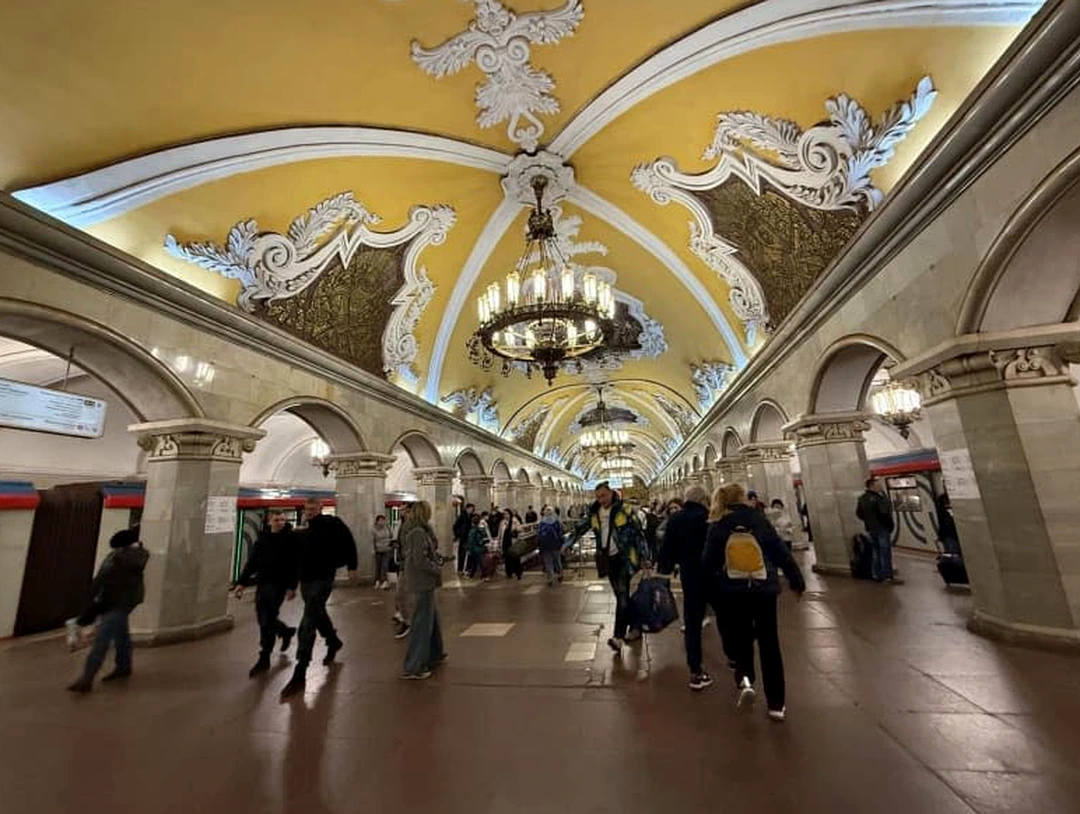
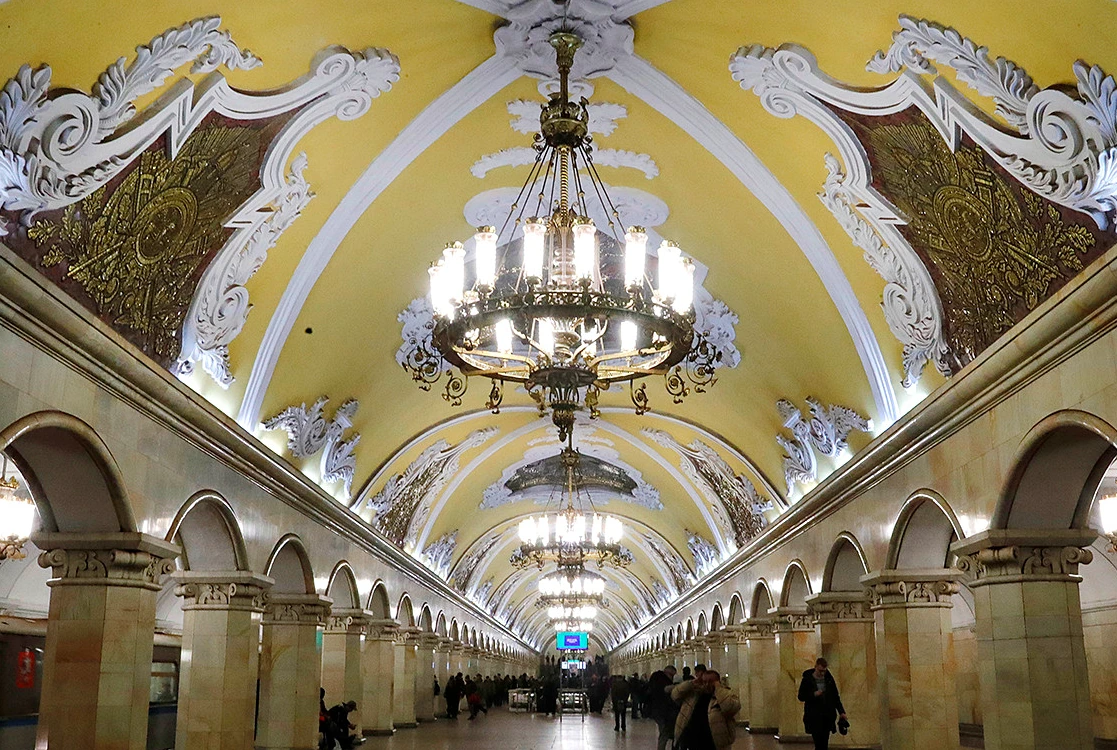
Once the smoke of war cleared, the country’s grand victory shaped a new architectural idiom full of authority and splendor: the Stalinist Empire style. The crowning achievement of this movement was etched into history with the arrival of Komsomolskaya station on the Circle Line (Koltsevaya Line), officially inaugurated on January 30, 1952. As the crowning final work of architectural titan Alexey Shchusev, Komsomolskaya recreated a majestic hall of honor echoing classical Russian Baroque combined with a spirit of national revival. Its nine-meter-high golden ceiling vault is supported by two rows of snow-white marble-clad columns, embellished with enormous gilded bronze chandeliers and finely sculpted relief moldings. Set along the vaulted ceiling are eight monumental mosaics crafted by artist Pavel Korin from jasper and colored glass, vividly portraying towering heroes from Russia’s history of defending the homeland—including Alexander Nevsky, Dmitry Donskoy, Kuzma Minin, Dmitry Pozharsky, Alexander Suvorov, and Mikhail Kutuzov—embodying the unbroken thread of nation-building and defense.
Through shifts in world affairs, changes of regime, and the ebb and flow of ideologies, the Moscow Metro has preserved its composed, majestic character deep beneath the capital. Every stretch of marble quarried from the Caucasus to distant Siberia, every hand-cast relief molding, and every granite-and-metal floor grille reflects not only the high-water mark of construction craft at the time, but also the memories, sweat, and deep conviction of generations. This space transcends the notion of a mere transit project to become a living anthropological museum, where history does not slumber silently on the printed page but continues to resonate with the rhythm of trains rolling beneath the city depths.
Behind the epic grandeur of the Moscow Metro lies a treacherous subterranean geological landscape, where the city’s strata test every limit of underground engineering. Designed around a radial-concentric layout mirroring the surface street network of the Russian capital, the tunnels had to bore through glacial deposits, ancient alluvial valleys, and crisscrossed water-bearing limestone seams. Each station is not merely a transfer point but a fortified structure anchored firmly amid complex hydrological shifts. Conquering the underground on a megaproject scale required a precise synthesis of grand urban spatial planning and revolutionary engineering solutions of the twentieth century.
Clear proof of the high-stakes clash between human ingenuity and natural geology is Mayakovskaya station, sitting 33 meters below the bustling intersection of historic Tverskaya Avenue and the famed Garden Ring (Sadovoe Koltso). This central cultural district holds a dense concentration of heritage landmarks, dramatic theaters, and vital buildings, imposing a strict requirement that no ground subsidence whatsoever affect the surface. Hidden deep beneath that bustling urban shell lay fractured limestone containing high-pressure underground water pockets. To create an exceptionally airy subterranean space without being crushed by the weight of the overlying strata, architect Alexey Dushkin and his structural engineers pioneered a three-span vault structure supported by high-strength aircraft-alloy steel columns instead of heavy traditional concrete walls, turning the immense downward load of earth and rock above into graceful curves and opening up sightlines along the platform.
Going deeper into the city’s complex geological map, Komsomolskaya station sits at a depth of up to 37 meters beneath Komsomolskaya Square—locally known as “Three Stations Square” because of massive passenger flows from three major rail hubs: Leningradsky, Yaroslavsky, and Kazansky. Below this busy square lurked a geological hazard from the underground Chechora River. That ancient watercourse had been diverted and channeled into artificial vaulted conduits centuries earlier, leaving the surrounding strata as a trap of waterlogged quicksand, soft mud, and weak alluvium, with a constant risk of blowout whenever deep excavation approached.
To counter the intense hydrostatic pressure from the Chechora and surrounding aquifers, engineers applied artificial ground freezing on a massive scale. Hundreds of deep pipes were driven around the perimeter of the station cavern, continuously circulating chilled calcium chloride brine at sub-zero temperatures to freeze surrounding mud, sand, and soil into an ice wall as hard as rock. This sturdy artificial ice shield completely stopped water seepage, protecting workers as they excavated and bolted heavy cast-iron vault rings before a permanent reinforced hydraulic concrete shell was cast to seal off the groundwater outside.
It was precisely the severity of the geology and extraordinary engineering treatment that forged such an unmistakable subterranean architectural landscape. Instead of the claustrophobia of dark tunnels, passengers descending into hubs like Mayakovskaya or Komsomolskaya are astonished by sweeping halls reminiscent of royal palaces. Warm golden light from rows of crystal chandeliers glints across Ural marble and Caucasian granite slabs, blending with finely carved reliefs. The contrast between the difficult mud-and-water ground outside and the openness and splendor within the tunnels turns Moscow’s underground network into an artificial landscape masterpiece celebrating humanity’s drive to conquer natural limits.
Whereas underground transit systems in Western cities largely solve mechanical movement through minimalism and pragmatism, in Moscow every square inch carved into the strata stands as a proud statement of aesthetic power and Soviet engineering achievement. The architectural space of the Moscow Metro does not operate in isolation; it forms a sequence of connected grand halls where high-load structural engineering merges with stonework and fine metalwork on a scale unmatched in human history.
The peak of lightness and breakthrough spatial design belongs to Mayakovskaya, which made history as the world’s first deep-level column-tripartite vault station. In stark contrast to heavy traditional stone piers, architect Alexey Dushkin achieved a tour de force by replacing bulky walls with slender columns clad in gleaming duralumin—a high-tech alloy originally developed for military aircraft fuselages. The bold pairing of modern metal with rare ruby-toned rhodonite, dark diorite, and silver-veined Ufaley marble erases any sense of confinement thirty-three meters underground. Looking up to the soaring vault, thirty-four deep oval recesses feature luminous smalt mosaics designed by celebrated painter Aleksandr Deyneka under the theme 24 Hours of the Soviet Sky. Light catching the mosaics evokes the day from dawn to late evening—with parachutists gliding, aircraft roaring, and apple branches heavy with fruit—turning the ceiling into a poetic open sky that lifts the weight of millions of tons of earth and stone above.
In complete contrast to Mayakovskaya’s sleek Art Deco grace, Komsomolskaya on the circular Koltsevaya Line represents the high-water mark of Stalinist Empire grandeur infused with classical Russian Baroque. Conceived as a monumental subterranean triumphal arch welcoming travelers at the capital’s gateway, Komsomolskaya’s central hall opens wide with remarkable vault height, supported by two rows of pure white Koelga marble columns from the majestic Ural Mountains. Solid slabs of red Kapustinsky granite pave the floor, creating vivid visual contrast beneath dozens of intricate gilded bronze chandeliers, each weighing tons and branching out like suspended royal crowns.
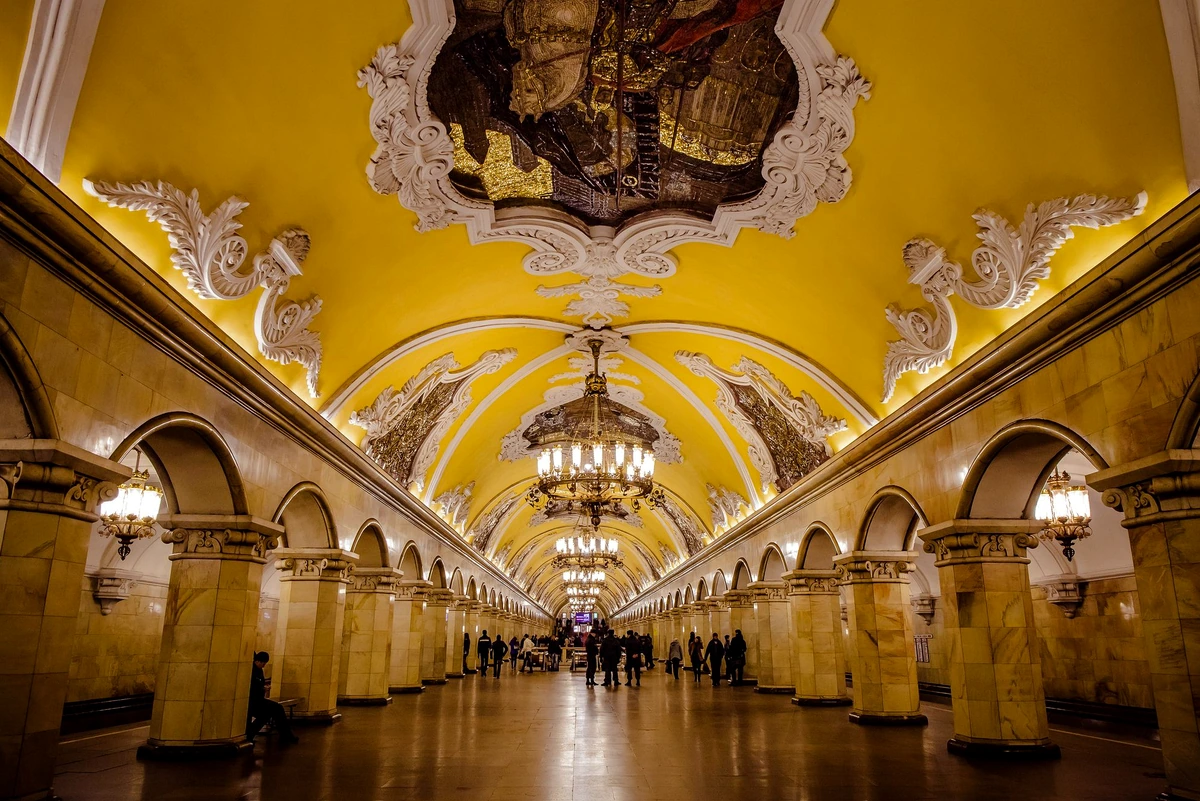
The soul of Komsomolskaya crystallizes in eight large mosaic murals crafted from tens of thousands of stone tesserae and colored smalt glass by master artist Pavel Korin against a royal yellow ceiling vault. This sweeping series traces an unbroken chronicle of Slavic history, immortalizing national heroes from Grand Prince Alexander Nevsky at the Battle on the Ice of Lake Peipus and a resolute Dmitry Donskoy along the Don River to legendary commanders like Mikhail Kutuzov and Alexander Suvorov, alongside courageous soldiers raising the victory banner in 1945 over the Reichstag. Every fold of armor, determined gaze, and spear tip is rendered with extraordinary precision, turning the underground hall into a living history museum where master craftsmanship serves enduring national pride.
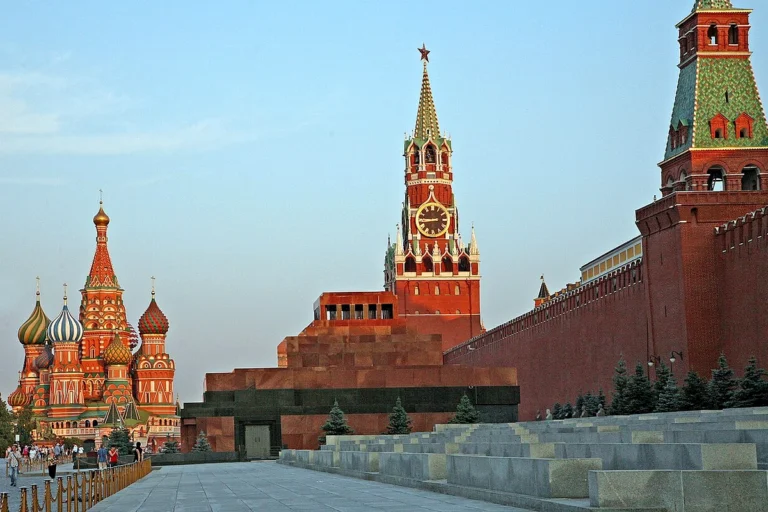
As dusk settles over the Spasskaya Tower of the Kremlin and street-level Moscow slips into a chilly slumber, the subterranean world of the Moscow Metro enters a captivating live performance of optics and architectural acoustics. Far from feeling confining or gloomy, it transforms into an eternal palace of light—where the line between day and night blurs through the masterful lighting schemes devised by Soviet architects in the mid-twentieth century. More than thirty meters below street level, the night rhythm of the city settles into a quiet visual symphony, guiding visitors through sculptures and paintings in stillness.
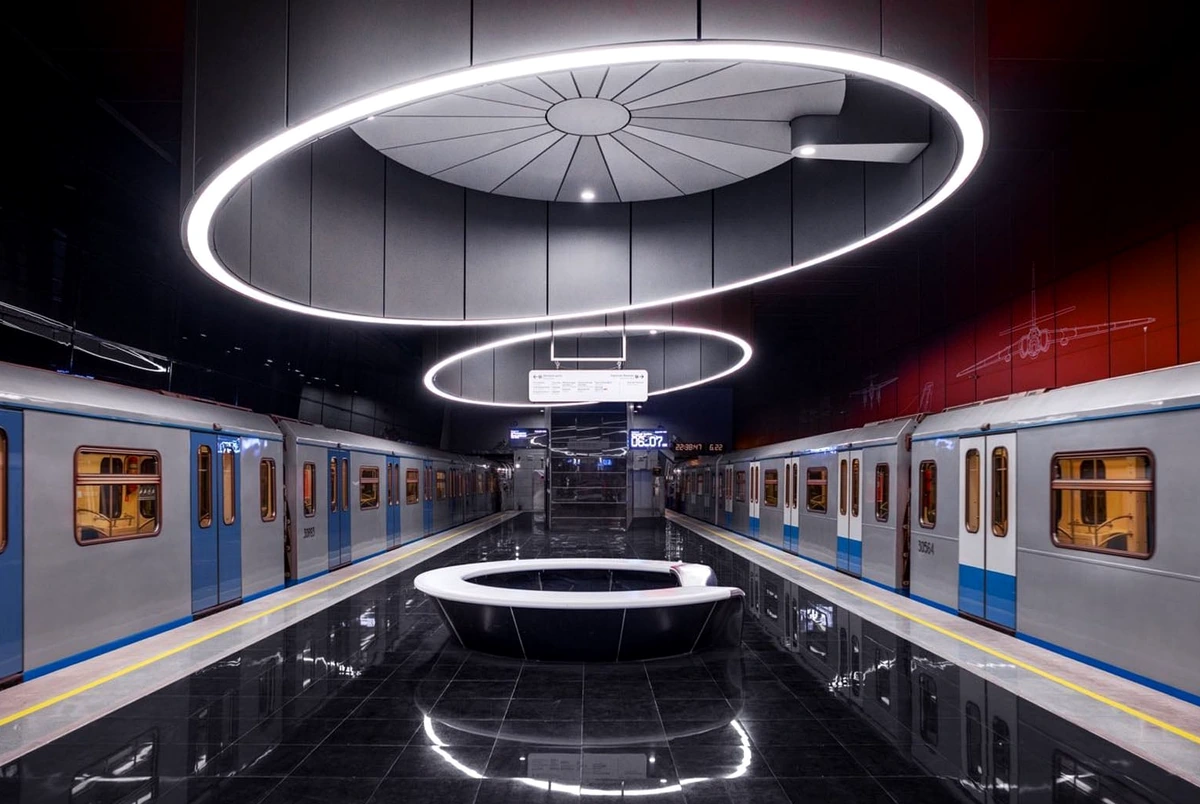
At Mayakovskaya—the height of Avant-Garde architecture fused with Art Deco by architect Alexey Dushkin—lighting reaches a poetic peak through a forward-looking indirect design. Dushkin tucked high-lumen fixtures inside thirty-four deep oval recesses along the vaulted ceiling. Soft light spills from the vault, bounces off gleaming stainless-steel ribs and duralumin aircraft aluminum, and washes down over fiery red rhodochrosite marble from the Urals. This creates a remarkable optical illusion that makes passengers feel as if they are standing beneath a natural sky flooded with midday summer sun, dispelling any fear of enclosed underground spaces. Looking upward, the reflected light illuminates every detail of Aleksandr Deyneka’s 24 Hours of the Soviet Sky mosaics, turning each ceiling bay into a celestial window opening onto a vast cosmos.
If Mayakovskaya carries the sleekness of the mechanical industrial age, the concourse of Komsomolskaya on the Koltsevaya ring displays the full pomp of Stalinist Empire style with Russian Baroque undertones. As night deepens and train intervals stretch slightly, Komsomolskaya takes on the look of an ancient grand cathedral. The 11.5-meter-wide vaulted space glows brightly under dozens of massive gilded cast-bronze chandeliers suspended gracefully from the royal-yellow ceiling. Warm light from these fixtures refracts through sparkling crystal, sweeps across snow-white marble columns, and shines directly onto master Pavel Korin’s famed smalt mosaic reliefs.
Smalt—opaque colored glass baked with enamel using a traditional Byzantine recipe—under the precise angle of thousands of warm bulbs produces rich spectral shifts that change with each step of a stroller. Illustrious historical figures such as Grand Prince Alexander Nevsky, Dmitry Donskoy, and Field Marshal Mikhail Kutuzov seem to step right out of the pages of chronicles, stately and lifelike. The golden glow enveloping the entire hall creates an enchanting visual illusion, carrying the viewer’s imagination toward the sacred grandeur of St. Peter’s Basilica in Rome or the imperial opulence of the Winter Palace in St. Petersburg.
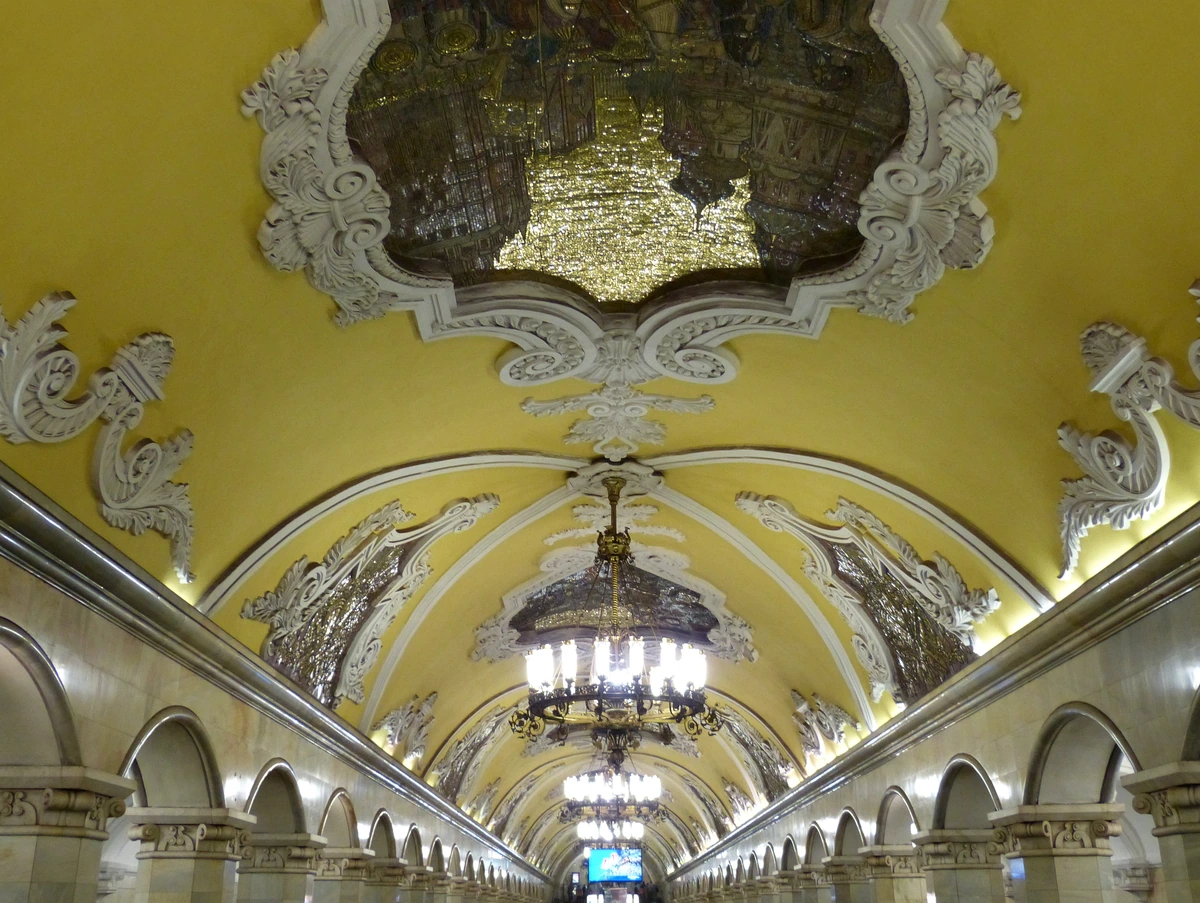
At night, when the hurried footsteps of commuters give way to unhurried evening strolls, this underground realm also turns into a remarkably fine acoustic hall. Parabolic vaults of granite and compressed marble hold sound cleanly, turning the echo of a lone street violinist or footsteps on granite paving into an enchanting auditory experience. That is when the Moscow Metro reveals its full identity as a “living museum,” where artificial light does more than guide transit—it acts as a soul awakening great artistic and historical values tucked deep within Mother Moscow.
Stepping up from the deep escalators of Mayakovskaya station, visitors do not merely enter a grand subterranean sculpture gallery; they also find themselves amidst an artistic culinary hub of Moscow. Situated right beside the famed Mayakovsky Theatre, the neighborhood has long drawn Soviet intellectuals, writers, and artists, with traces of the Thaw era still lingering along its cobbled corners. One of the most iconic stops is the nostalgic Mayak café, which preserves classic Russian flavors across decades. Here, a deep crimson bowl of traditional borscht—slow-simmered for hours from rich beef marrow bones with the gentle sweetness of local beetroot and a delicate aroma of bay leaf—comes topped with a snowy spoonful of rich smetana sour cream. Sampling a plate of handmade pelmeni—thin, tender dough tightly wrapped around finely minced beef seasoned with onion and generously drizzled with melted unsalted butter and finely chopped fresh dill—lets travelers feel the warmth and hospitality of Russian home kitchens during a freezing winter.
Food culture around Mayakovskaya also reflects the spirit of golden-era bufet counters, where golden-baked pirozhki filled with buttery cabbage, minced meat, or smoky wild mushrooms are served alongside strong black tea poured from a classic samovar. Riding across the circular line to Komsomolskaya shifts the culinary mood in a completely different direction, tied to the storied memories of Three Stations Square. As the meeting point of three major rail terminals—Leningradsky, Yaroslavsky, and Kazansky—this area was once the starting point of the great Trans-Siberian Railway. The bygone railway dining tradition—savory foil-wrapped roast chicken, crisp toasted rye bread with crunchy pickled cucumbers, and tea served in ornate metal podstakannik holders—is etched into the collective memory of millions of passengers across generations.
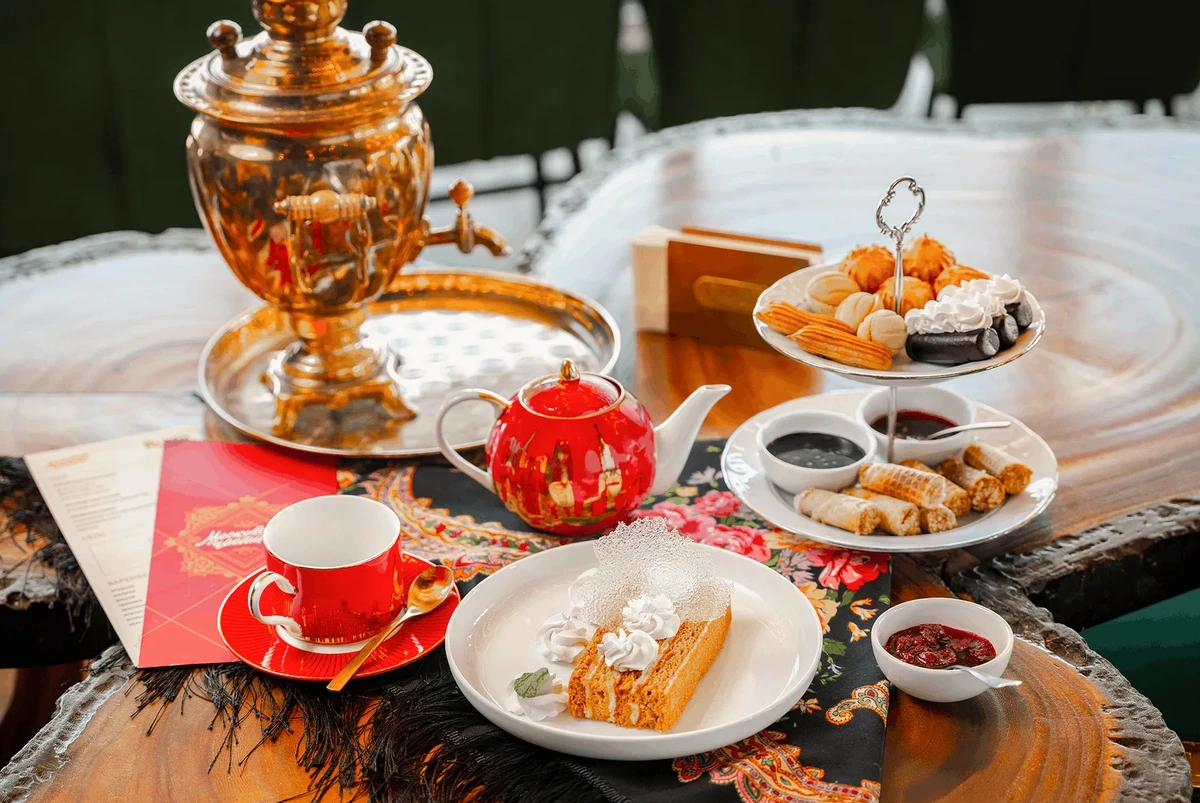
Those historic rail memories have been vividly revived inside the contemporary food hall Depo. Tri vokzala, housed in a converted 19th-century red-brick locomotive repair depot right next to Komsomolskaya station. Spanning thousands of square meters beneath original industrial steel trusses, Depo. Tri vokzala blends Russian culinary traditions with modern gastronomy. It brings together signature ingredients from across the vast expanses of the land of birch trees—from smoked northern tundra venison and Lake Baikal whitefish to soft brioche buns piled high with sweet Kamchatka snow crab from the distant Pacific coast.
To round out this flavorful culinary journey, little compares to sipping homemade herbal nastoyka infusions crafted from family recipes. Carafes glowing with ruby lingonberry, wild raspberry, tart sea buckthorn, or horseradish with linden honey deliver layered notes of warmth, gentle spice, and sweetness. Bringing together subterranean architectural heritage and regional food culture around Mayakovskaya and Komsomolskaya turns Moscow’s underground into a complete cultural story that awakens every sense.
The Moscow Metro runs like a tireless time machine, opening its doors to early riders at 05:30 AM and keeping up its brisk pace until 01:00 AM the next morning. Coordinated to fractions of a second, train intervals range from just 90 seconds during peak hours to roughly 3 or 4 minutes during quieter periods of the day. This steady rhythm makes waiting on the platform feel virtually nonexistent, giving travelers unhurried moments to admire gleaming Ural marble or crystal chandeliers glowing beneath high vaults.
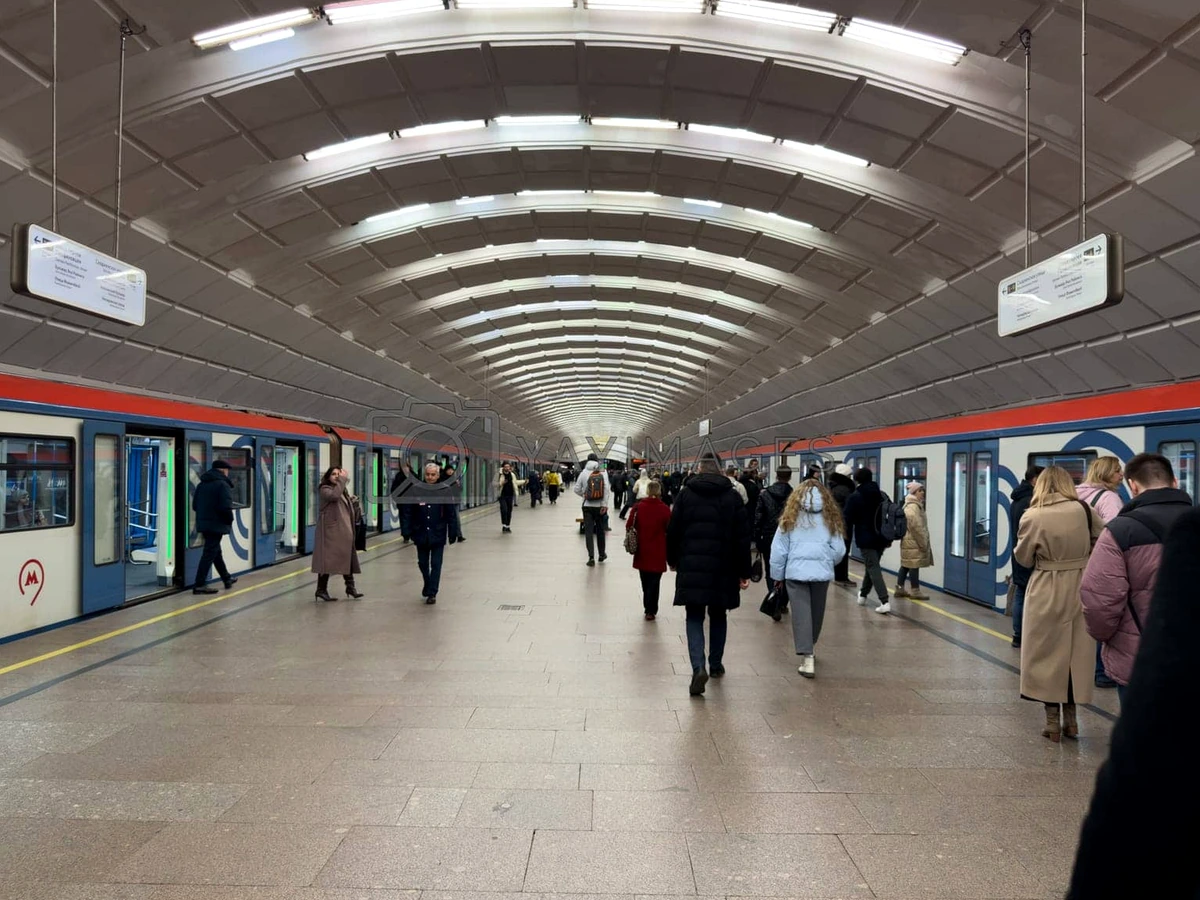
Entering this underground palace today comes with convenient, modern fare infrastructure, creating an intriguing contrast between Soviet Neoclassical lines and digital technology. Visitors can tap a domestic Mir card or international payment card at automated fare gates, enroll in Face Pay biometric recognition to pass through with a glance, or—most commonly—use a Troika transit card featuring the proud troika three-horse emblem of Russian culture. For a very modest fare per tap, you can travel across hundreds of stations and make unlimited transfers within a single paid entry, as long as you do not exit through the street-level turnstiles.
For photography enthusiasts drawn to subterranean design, timing your visit makes a big difference in getting clean shots. The Moscow Metro allows casual photography with a handheld camera or smartphone, while strictly prohibiting tripods and bulky lighting gear so as not to obstruct heavy passenger flow. Two ideal windows for calmly capturing intricate reliefs at Mayakovskaya or the golden ceiling vault of Komsomolskaya are from 11:30 AM to 3:00 PM, or after 9:30 PM, when commuter rushes ease and leave quieter, more open spaces to take in the art.
One handy tip for first-time visitors is the distinctive audio announcement convention maintained for decades. The iconic circular Koltsevaya Line (Line 5, brown) acts as a backbone linking many of the grandest stations: when trains run clockwise, a male voice makes announcements, while counterclockwise trains feature a female voice announcing stops. Similarly, on radial lines cutting across the capital, trains heading inward toward Red Square use a male voice—traditionally associated with the call to work—while outbound trains toward residential districts use a softer female voice welcoming riders home.
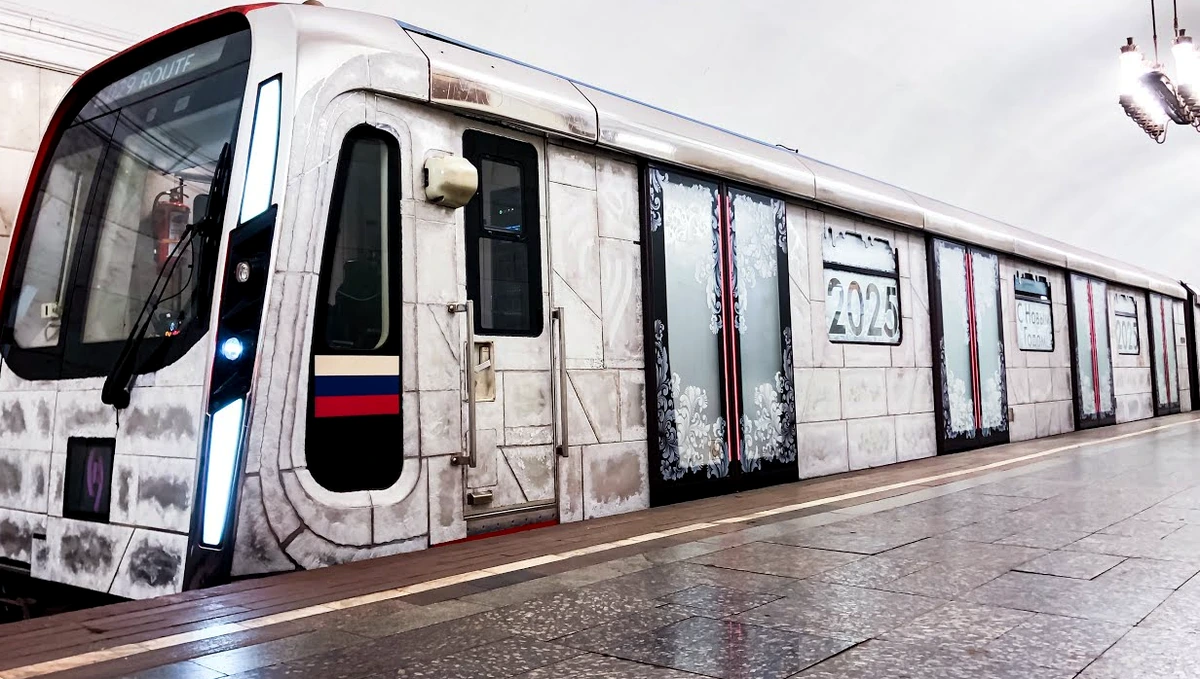
Exploring this network of underground marvels is more than just getting from one surface sight to another; it is a meaningful encounter with history, where every step echoes memories of a golden era in architectural art. To take in the grandeur of legendary stations at an unhurried pace and experience the cultural depth of Russia more fully, joining a thoughtfully curated Russia tour can give travelers a smooth, enriching journey with peace of mind.