The sedimentary roots of Russia’s heartland began taking shape on the ancient Borovitsky Hill promontory, where the Neglinnaya River flows into the surging waters of the Moskva River. Once a rugged natural stronghold of the Vyatichi tribe, this untamed stretch of land formally entered human chronicles in the twelfth century. In 1147, as famously recorded in the Laurentian Codex, Grand Prince Yuri Dolgoruky of Suzdal sent a bold summons to his ally, Prince Svyatoslav Olgovich of Novgorod-Seversky: “Come to me, brother, to Moscow.” That historic meeting set a decisive turning point in motion, and just nine years later, in 1156, Dolgoruky ordered the construction of a stout timber-and-rammed-earth fortress ringed by deep moats and high ramparts—marking the birth of one of the world’s great capitals.
Entering the fourteenth century, Moscow steadily established itself as the sole political and spiritual center of Rus under the rule of Ivan I Kalita (1325–1340). With strategic vision, Ivan Kalita persuaded Metropolitan Peter to move the metropolitan see from Vladimir to Moscow, turning the Kremlin grounds into a sacred spiritual sanctuary guarded by sturdy oak walls and the first white-stone churches. Carrying that legacy forward amid storms of foreign invasion, Grand Prince Dmitry Donskoy—reigning from 1359 to 1389—achieved a historic feat by building a white-stone fortress between roughly 1366 and 1368. Those formidable limestone walls stood as an unyielding shield that repelled fierce assaults by Grand Prince Olgerd of Lithuania and Khan Tokhtamysh of the Golden Horde, etching into the Russian consciousness the proud epithet “White-Stoned Moscow.”
The grand silhouette of the Kremlin and its neighboring square that later generations admire today bears the deep imprint of Ivan III the Great’s imperial ambition during his reign from 1462 to 1505. Determined to transform the grand city into a “Third Rome,” Ivan III summoned leading master architects from Renaissance Italy to Moscow, notably Aristotle Fioravanti, Marco Ruffo, Pietro Antonio Solari, and Aleviz Novy. Under the skilled hands of Western engineers blended with Eastern Orthodox aesthetics, the aging white-stone walls were replaced entirely with a sweeping circuit of dark-red brick fortifications punctuated by imposing defense towers, crowned by the Assumption Cathedral (Uspensky Sobor)—where Russia’s Tsars were solemnly crowned for centuries.
The origins of this historic complex’s names hold rich layers of cultural meaning across shifting eras. Etymologically, linguists trace “Kremlin” to the Old Russian word krom, meaning a fortified inner citadel or central urban defense, alongside a hypothesis linking it to the Greek kremnos, meaning a steep riverbank. Likewise, “Red Square” has no connection to political ideology or the color of the surrounding baked brick. In archaic Russian, the adjective krasny meant “splendid,” “beautiful,” and “most solemn.” At first, the open expanse was simply called the Market (Torg), then the Fireground (Pozhar) after fires swept through wooden stalls following upheavals, before officially receiving the name Red Square in the seventeenth century to celebrate its unmatched grandeur.
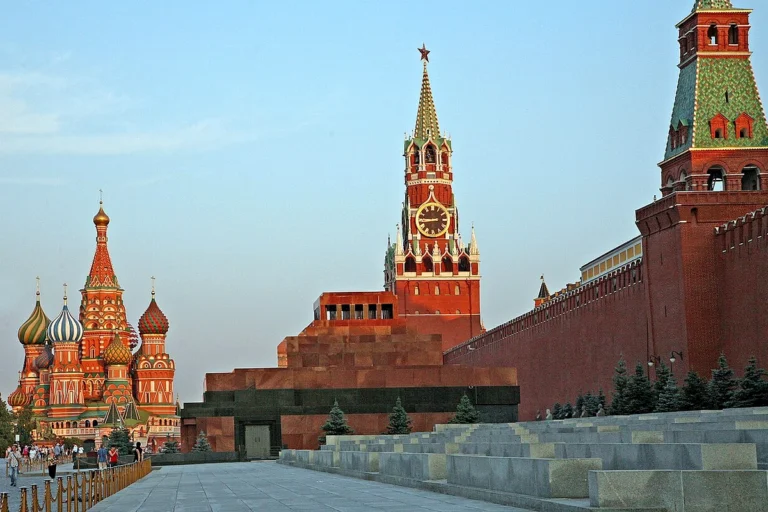
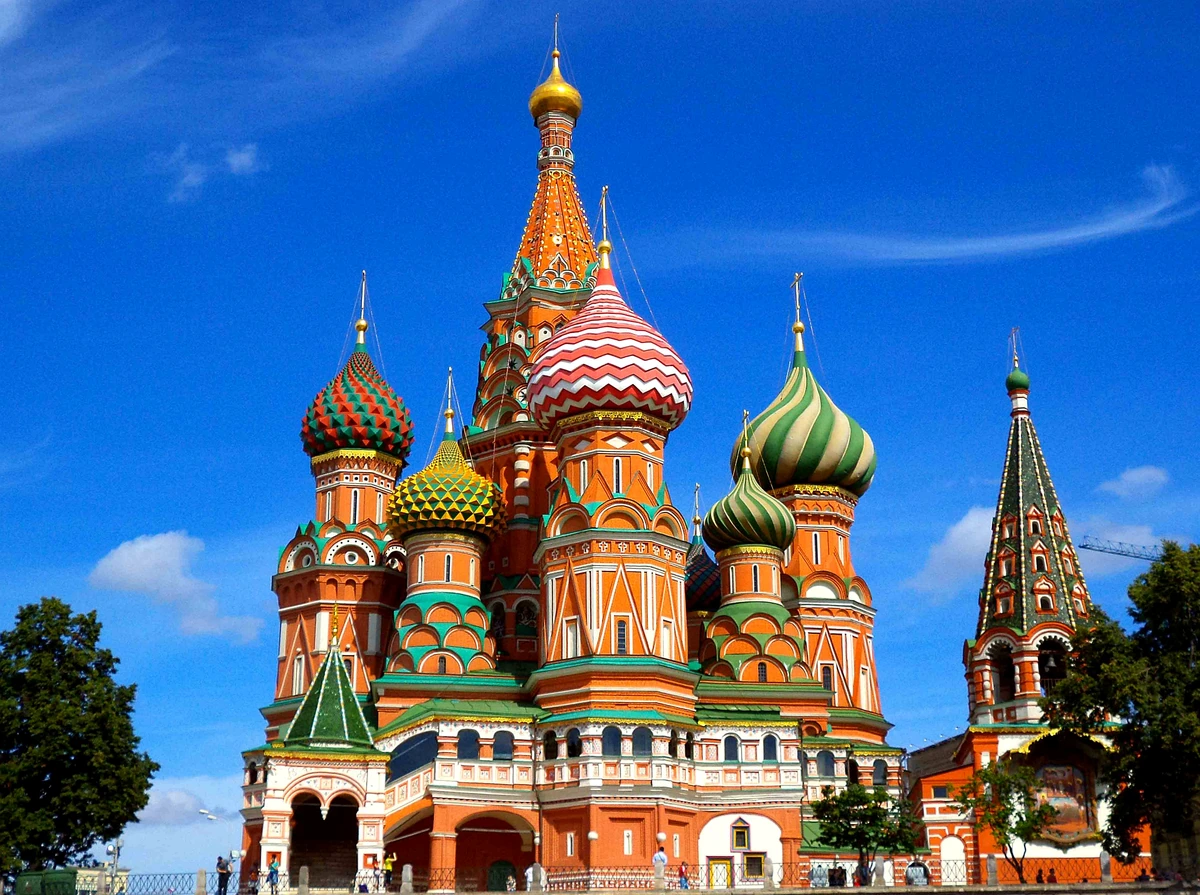
The crowning touch to this architectural and spiritual symphony came with Saint Basil’s Cathedral, the masterpiece anchored at the southern edge of Red Square. Formally titled the Cathedral of the Intercession of the Most Holy Theotokos on the Moat, this monumental church was built by decree of Tsar Ivan the Terrible to give thanks to the Mother of God after the famed capture of the Kazan Khanate. The everyday name Saint Basil became firmly woven into popular memory after Basil the Blessed—an ascetic fool-for-Christ revered across the city—died and was laid to rest there in 1552, forging an enduring legend at the heart of the Russian capital.
Perched on the curving left bank of the Moskva River atop gently rising Borovitsky Hill—reaching an absolute elevation of 140 to 145 meters above sea level—the Kremlin commands one of the finest military and geomorphic vantage points in central European Russia. Shaped over millions of years by the fertile Moskva–Oka plain, the local landscape forms a gentle ridge capable of dominating both overland views and vital river trade routes. Standing 25 to 30 meters above the river surface, the early Kremlin fortress resembled a sturdy ship’s prow jutting into a river confluence, naturally flanked by formidable defenses: the broad expanse of the Moskva River guarding the south, while its key left-bank tributary, the Neglinnaya River, flowed along the northwest.
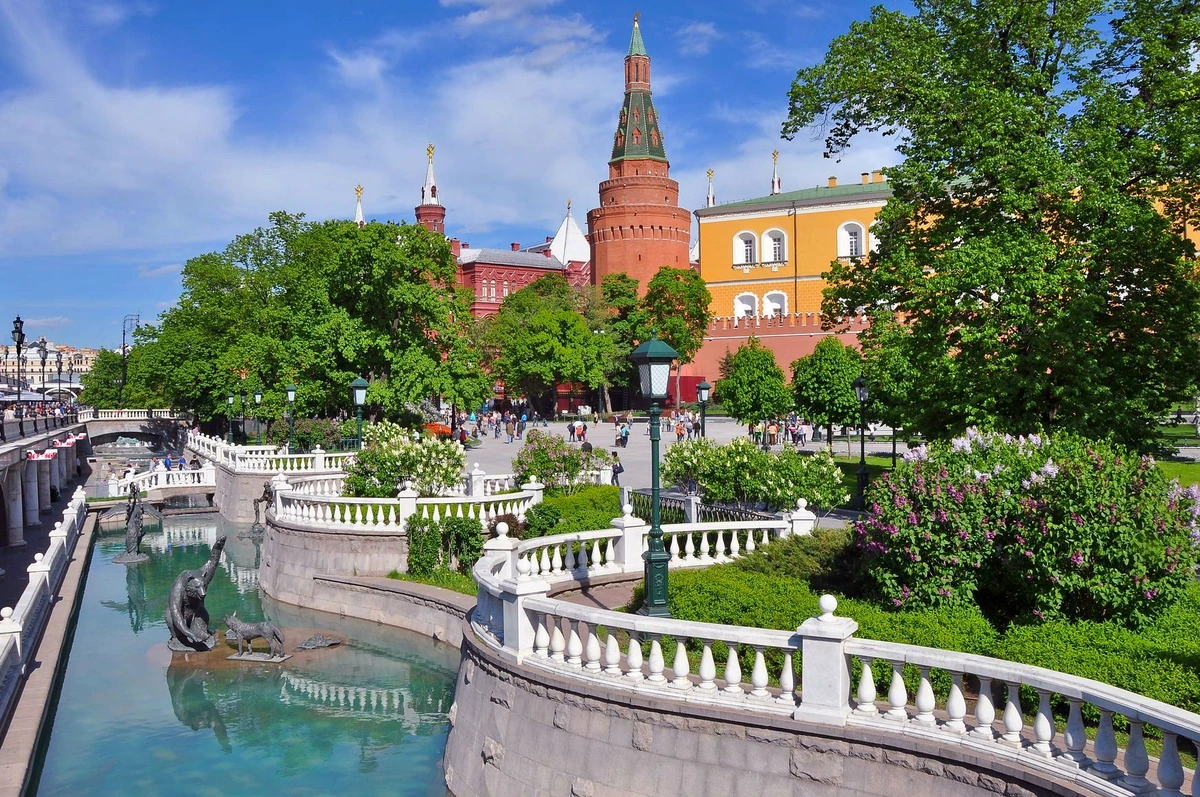
Russians’ remarkable remaking of the terrain is vividly seen in the fate of the Neglinnaya, the natural moat that once gave invading forces pause beneath the walls. In the early nineteenth century, engineers carried out a bold hydraulic undertaking, rerouting the river and enclosing its course within a vast underground network of brick vaulted conduits buried deep beneath the earth. Although rushing water gave way above ground to the tranquil greenery of Alexander Garden, traces of the old riverbed still serve as a reference line along the Kremlin’s western boundary, preserving its historic geographic frame through centuries of change.
Directly adjoining the eastern defensive wall of the fortress lies Red Square, a vast open arena stretching 330 meters long and up to 75 meters wide. It reads like an open-air urban theater where natural topography was subtly shaped to host grand religious ceremonies, military parades, and civic life. The square’s north–south axis slopes gently down Borovitsky Hill, drawing the eye and ceremonial procession toward the Moskva River basin while creating an expansive openness rare inside an old city.
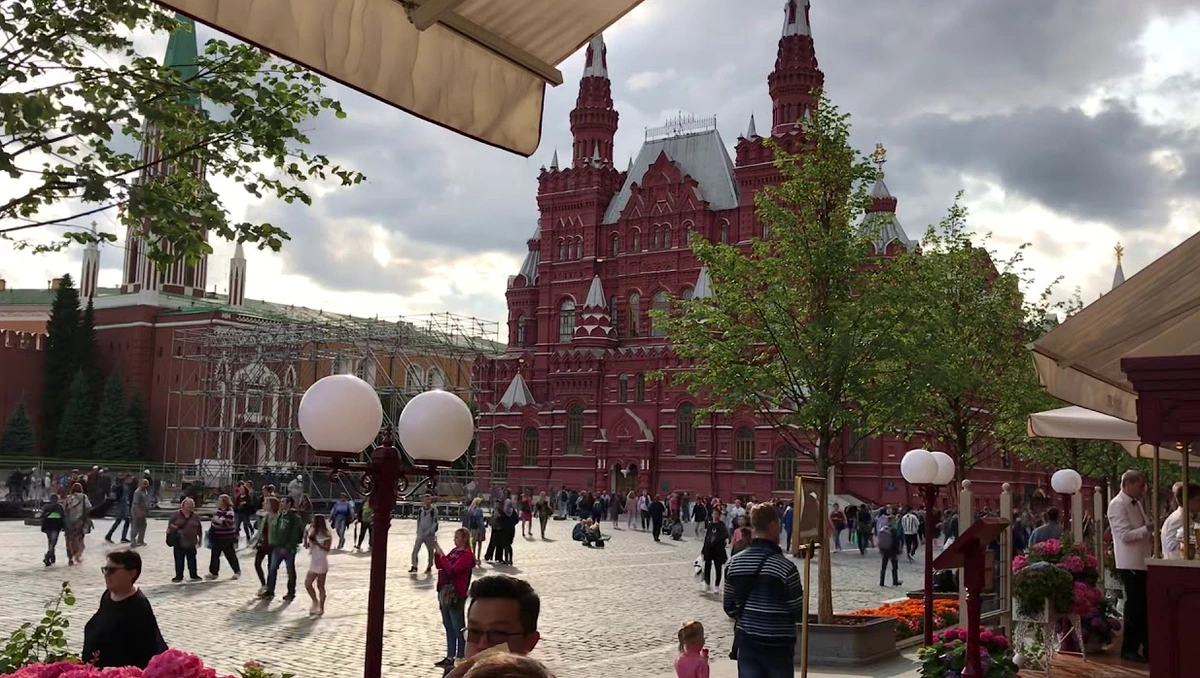
Framing the square is a striking ensemble of landmarks representing every direction and golden age of Russia. Its southern edge is anchored by the otherworldly silhouette of St. Basil’s Cathedral, its nine flame-like domes soaring skyward and marking a key passage down toward the Moskva River embankment. Across the northern end stands the State Historical Museum in sober brick-red Neo-Russian style designed by architect V.O. Sherwood, rising impressively beside the Old City Duma building to form a dignified threshold into the center of power.
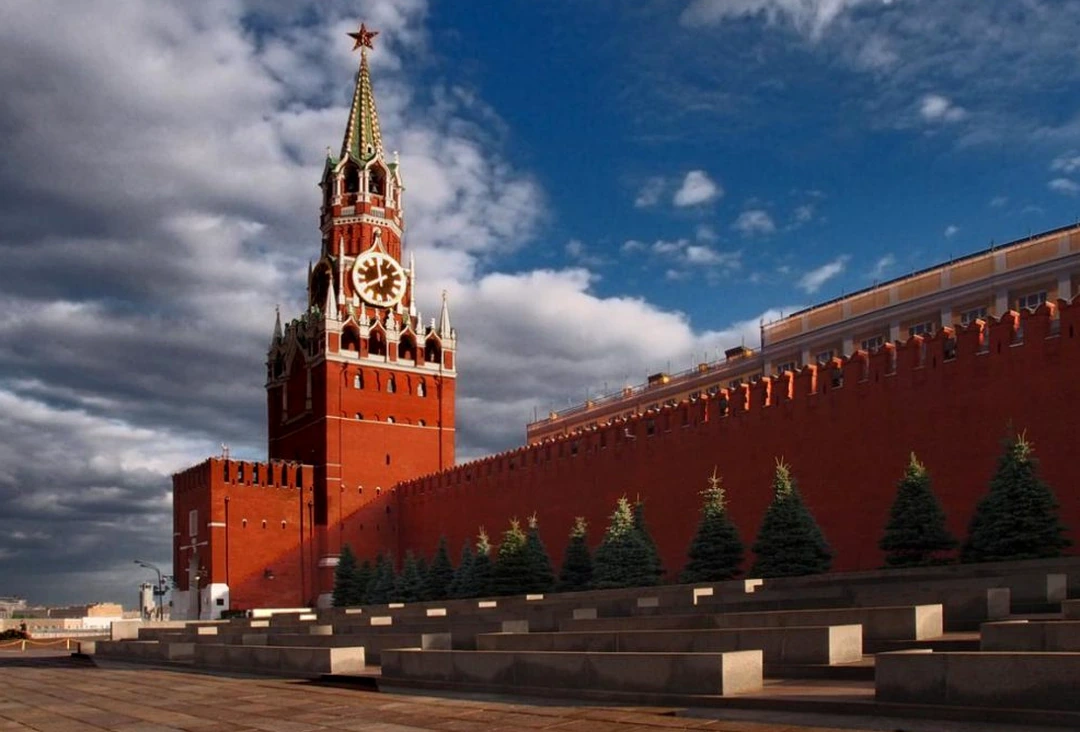
The western flank forms a formidable wall of deep-red brick with swallowtail merlons along the Kremlin, punctuated by the stately Senate Tower, the world-famous clock-bearing Spasskaya Tower, and the enduring red-and-black granite monument of V.I. Lenin’s Mausoleum. Running parallel along the east is the hundred-meter-long facade of GUM Department Store—originally the Upper Trading Rows designed by architect A.N. Pomerantsev—where modern steel-and-glass arches harmonize with Russian Revival ornament. Together, these four sides unite into an iconic spatial whole: enclosed like a sacred stronghold yet open to the vitality of people converging from every direction on the heart of the land of birches.
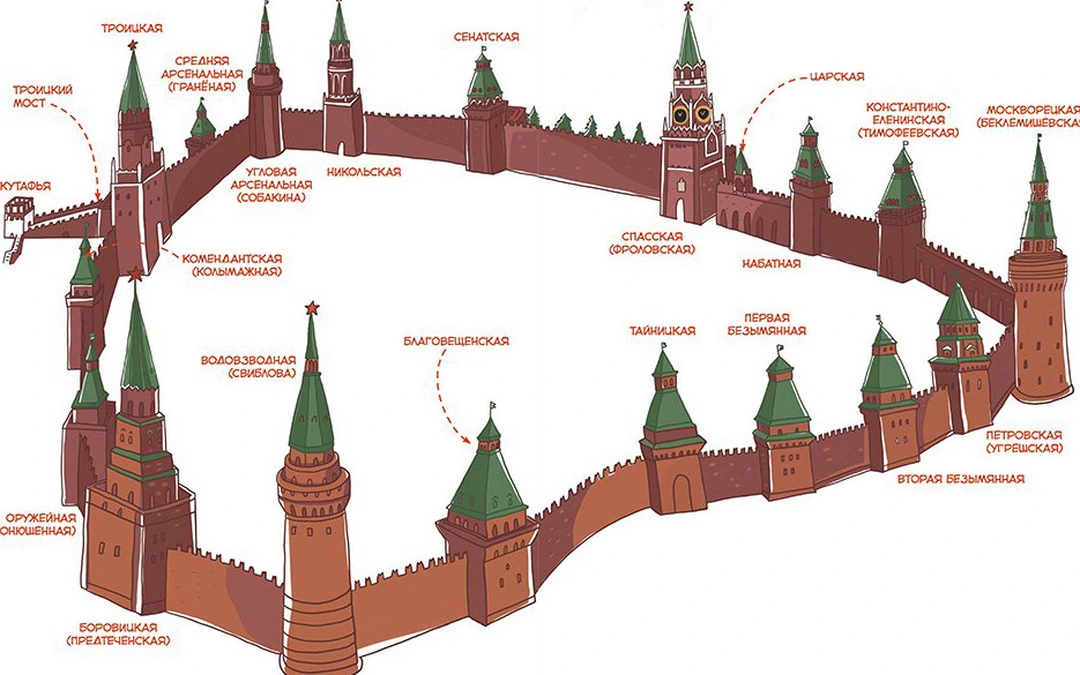
The Kremlin and Red Square ensemble is a splendid synthesis of architectural styles layered across centuries, where Italian Renaissance mastery was thoughtfully adapted to Russian visual traditions, followed by Neo-Gothic notes, imperial Empire grandeur, and crisp Soviet modernism. At the core of this fortified layout is the wall-and-tower circuit crafted by Italian masters such as Pietro Antonio Solari and Marco Ruffo—known collectively as fryaziny—between 1485 and 1516. Tracing the natural triangle between the Moskva and Neglinnaya rivers, the red-brick wall runs 2,235 meters in total length, rises 5 to 19 meters high, and measures an impressive 3.5 to 6.5 meters thick. Crowning the parapet are hundreds of swallowtail crenelations characteristic of Northern Italian fortresses, serving as sheltered firing positions for defenders. Building materials shifted markedly in this era as large fired red bricks, known as patok bricks, largely replaced medieval white limestone—though soft white stone was still carefully chosen for load-bearing foundations and carved trim around tower bases.
Commanding the main gateway opening straight onto Red Square is Spasskaya Tower, begun by Pietro Antonio Solari in 1491 and given its crowning tier in 1625 by architect Christopher Galov and Russian master builder Bazhen Ogai. Pairing a square Renaissance defensive base with a multi-tiered octagonal tent spire with Neo-Gothic accents, the tower rises to a total height of 71 meters to the tip of its glowing ruby star. Just beneath the spire sits the Kremlin clock mechanism with its renowned chimes, whose large metal-trimmed dials turn steadily through history’s shifts and set a measured rhythm across the square.
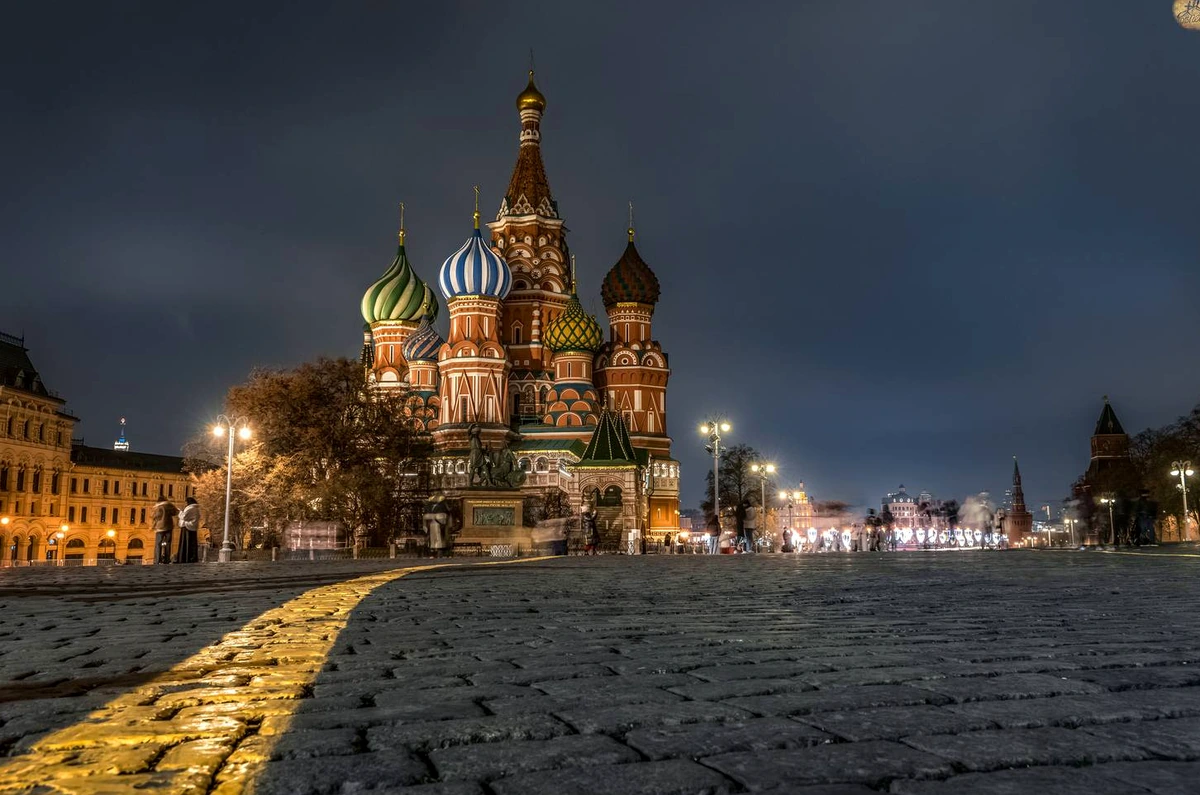
Facing the steadfast fortress wall is Saint Basil’s Cathedral—officially Pokrovsky Cathedral—a pinnacle of sixteenth-century tent-roof architecture built between 1555 and 1561 under master builders Barma and Postnik. The building is a feat of geometry and artistry, grouping nine symmetrical cylindrical chapels around a soaring central tent tower on a shared foundation, linked seamlessly by vaulted galleries. Its visual climax lies in the vibrant onion domes, each distinct in pattern: from blue spirals interwoven with gold and crimson diamond flutes to undulating ridges rising like flames against northern skies.
Stepping through solemn portals into the interiors of the Kremlin’s great cathedrals—such as the Assumption Cathedral, Annunciation Cathedral, and Archangel Cathedral—visitors are met with sacred decoration at its peak. Towering multi-tiered iconostases rise to the vaults, preserving priceless works associated with early Russian masters like Andrei Rublev and Theophanes the Greek. Surrounding the sanctuary, sixteenth- and seventeenth-century frescoes blanket walls and round piers, while polished floors of deep-red jasper, banded agate, and marble catch flickering candlelight and project the majesty of the Tsars.
As twilight settles over Moscow, the line between heroic history and dreamlike spectacle on Red Square seems to dissolve. The monumental complex undergoes a dramatic transformation shaped by lighting engineers. Daytime crowds and bustle give way to solemn quiet as modern illumination brings out every detail etched by time. Carefully angled indirect light accentuates centuries-old red brick, sharpens the geometry of the Kremlin’s swallowtail merlons, and highlights the layered curves of St. Basil’s nine vivid domes. Against the wide darkness of the Eastern European plain, the Kremlin appears not as a cold fortress, but as a vast sculpture gallery breathing the deep cadence of history.
Towering atop the highest Kremlin spires are the Kremlin ruby stars—a striking union of optical engineering and civic symbolism. Few realize that to hold an even, rich red glow day and night, each star is built from two precision glass layers: an outer deep-ruby glass tinted with gold and selenium, and an inner milk-white glass layer that diffuses light evenly to eliminate dark spots. Inside each heavy ruby assembly burn specialized incandescent lamps rated between 3.7 and 5 kilowatts. Despite their substantial weight, the stars sit on precision mechanical ball bearings that let them turn gently with cold breezes off the Moskva River, like enduring beacons guiding and anchoring the city in the night sky.
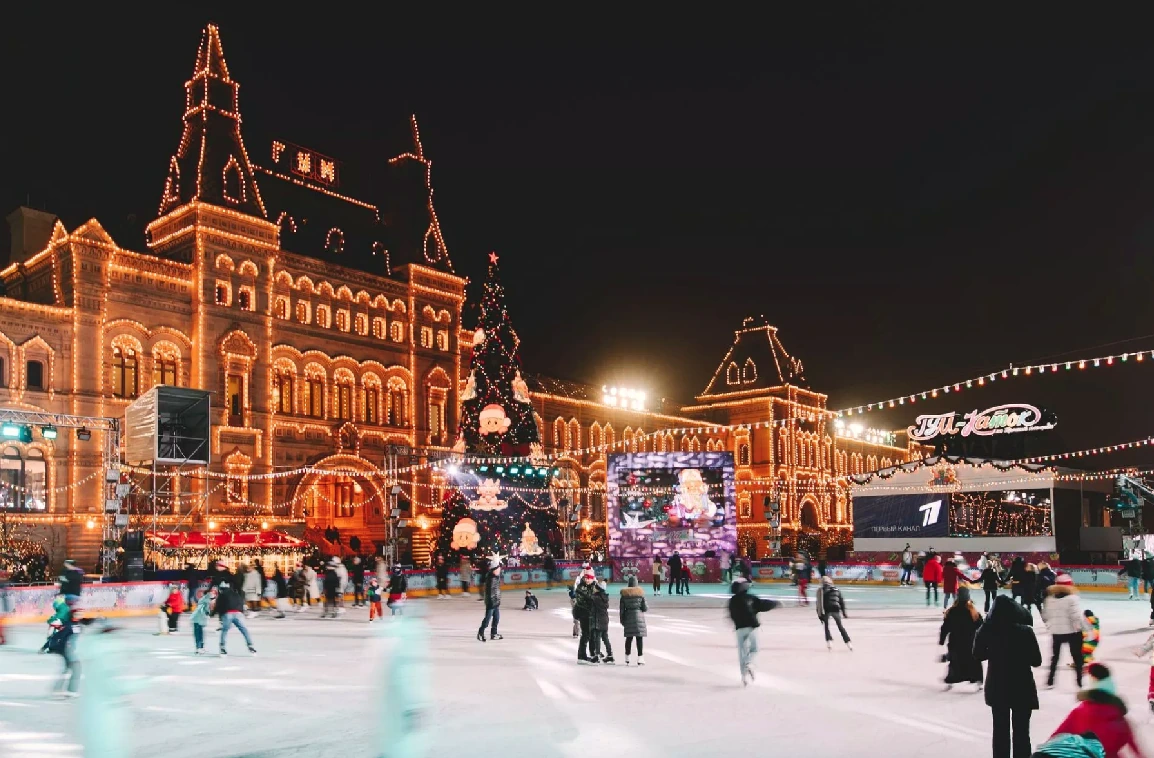
After seasonal rain or melting frost, Red Square’s paving turns into a vast mirror reflecting shifting tones. Dark polished gabbro-diabase blocks quarried in Karelia catch cool streetlamp glare in striking contrast to the warm golden glow radiating from GUM Department Store. Dressed in the Neo-Russian style, GUM sparkles with tens of thousands of small bulbs strung in the festive fairground tradition of nineteenth-century Russian arcades. Warm light tracing arches, Renaissance columns, and triangular gables creates a luminous border like an ice-and-crystal palace reflected in dark stone, turning an evening stroll into a walk through imperial memory.
During long winter months, when temperatures drop below freezing, the square comes alive with a lively seasonal tradition: the GUM-Katok ice rink. Set right in the historic square, the outdoor rink welcomes skaters gliding to classical orchestral pieces by Tchaikovsky or Rachmaninoff. The winter chill is quickly met by the inviting aroma rising from rustic wooden stalls serving sbiten—a traditional beverage dating back to Kievan Rus, simmered in large copper samovars with fragrant forest honey, ginger, cloves, and warming herbs. Sipping hot sbiten, tasting spiced pryaniki gingerbread, and watching fur-trimmed coats glide past falling snow under warm lights captures the Russian spirit in full: warmhearted, resilient, and proud against the northern cold.
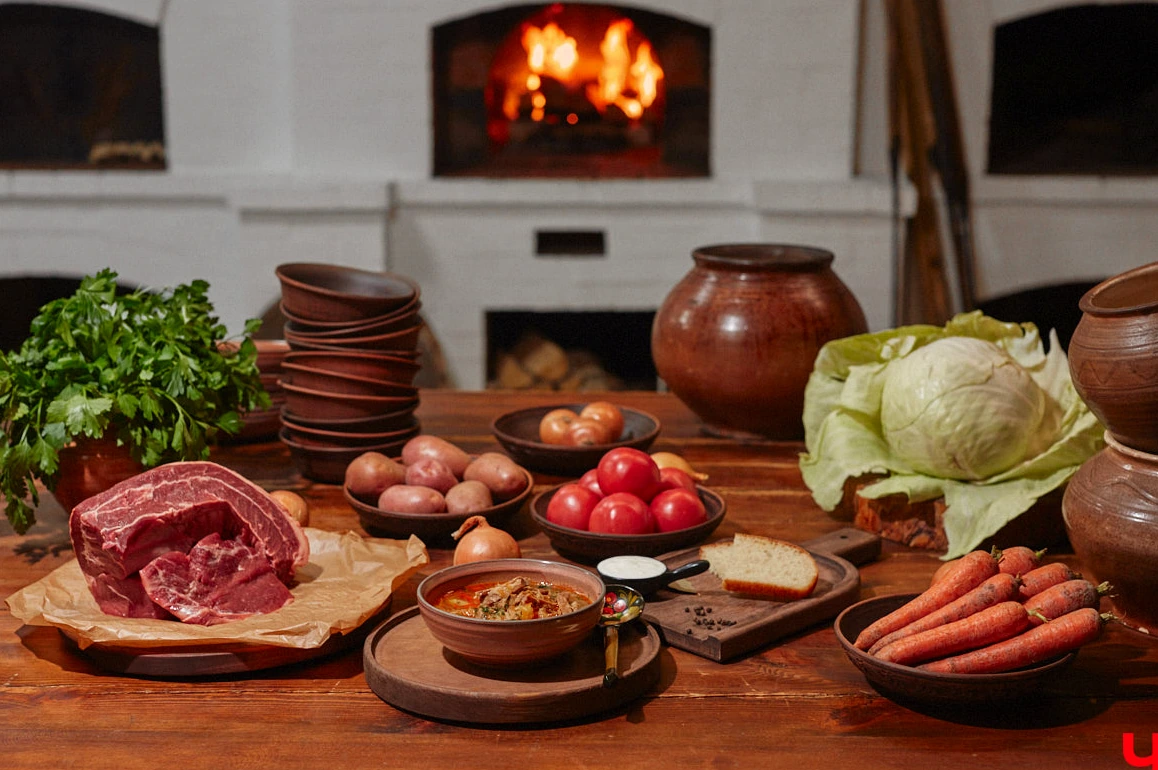
At the center of Russian statehood, the area around Red Square and the Kremlin is more than an open-air architectural museum—it is also a crossroads of Russian culinary traditions spanning centuries. From the generous banquets of the Grand Princes of Muscovy and courtly feasts under the Romanov Tsars to hearty Soviet-era classics, the local foodscape reflects Russian hospitality, resilience, and cultural depth. As crisp winds sweep past centuries-old red brick, steam rising from slow-simmered soups and family bakeries carries a special pull, leaving lasting impressions of northern flavors.
Topping the list of classics rooted in shared Russian memory is shchi, a sour cabbage soup with origins reaching back to the ninth century. Its broth is simmered for hours from rich beef marrow bones and balanced with the bright tang of naturally fermented cabbage, parsley root, and bay leaf, traditionally served alongside crusty dark rye bread. Beside the homestyle comfort of shchi, royal fish soup ukha brings an air of old court refinement. Crafted through a three-stage broth—starting with small fish for sweetness, building clarity with river perch and whitefish, and finishing with prized Volga sturgeon—top-tier ukha is best enjoyed with rasstegai, open-topped fish pies fragrant with dill and fresh butter.
Stepping into nineteenth-century aristocratic cuisine, visitors should not miss classic Beef Stroganoff, named after Count Alexander Grigorievich Stroganov. Tender beef strips are seared quickly over high heat to lock in juices, then gently simmered with fresh mushrooms and onions in a velvety sauce of sour cream (smetana) with a touch of tomato. Alongside it sits famed Pozharsky cutlet—tied to a story of Tsar Nicholas I stopping in Torzhok and taking a liking to finely minced chicken breast coated in crisp diced white bread crumbs and infused with butter. To shake off a Moscow winter chill, traditional Siberian-style pelmeni dumplings—filled with a blend of beef, pork, and lamb seasoned with black pepper—pair naturally with cool smetana and punchy horseradish.
To step directly into the everyday dining atmosphere of a bygone era, the eateries inside GUM Department Store across from the Kremlin act as a living time machine. Nostalgic spots such as Stolovaya No. 57 and the Festivalny food court recreate mid-twentieth-century Soviet public dining. Guests pick up an aluminum tray along glass counters and choose hearty favorites like minced-meat cutlets in gravy with smooth golden mashed potatoes, deep-red borscht served with garlic-drenched pampushki rolls, and a classic korzinochka pastry basket piped with rich buttercream.
In contrast to Soviet-era simplicity, Cafe Bosco along Red Square offers one of Moscow’s most poetic spots to pause and savor refreshments. Seated by wide windows or an outdoor terrace looking toward Spasskaya Tower and St. Basil’s vivid domes, guests can enjoy hot black tea poured from a traditional samovar. Sweet layers of medovik honey cake with cream, gently spiced Tula gingerbread filled with plum jam, and tart wild taiga berry mors come together in a memorable sensory taste of Russia.
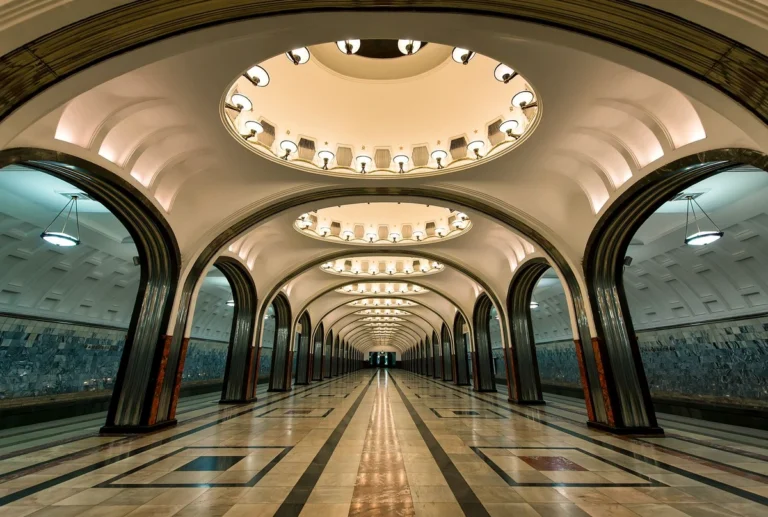
A visit to Russia’s historic core naturally begins with the Moscow Metro, famed for stations styled like grand underground palaces. The easiest and most direct way to reach the complex is via three closely linked stations: Okhotny Ryad on the red Sokolnicheskaya line, Ploshchad Revolyutsii on the dark-blue Arbatsko-Pokrovskaya line, and Teatralnaya on the green Zamoskvoretskaya line. Exiting toward the surface with bilingual signage leads straight to the green lawns of Alexander Garden and open Manezhnaya Square. Stepping past historic arches, Red Square and nearby streets—such as Nikolskaya Street aglow with string lights, quiet Varvarka Street holding medieval churches, and historic Ilyinka Street—offer car-free pedestrian strolling amid layered architecture.
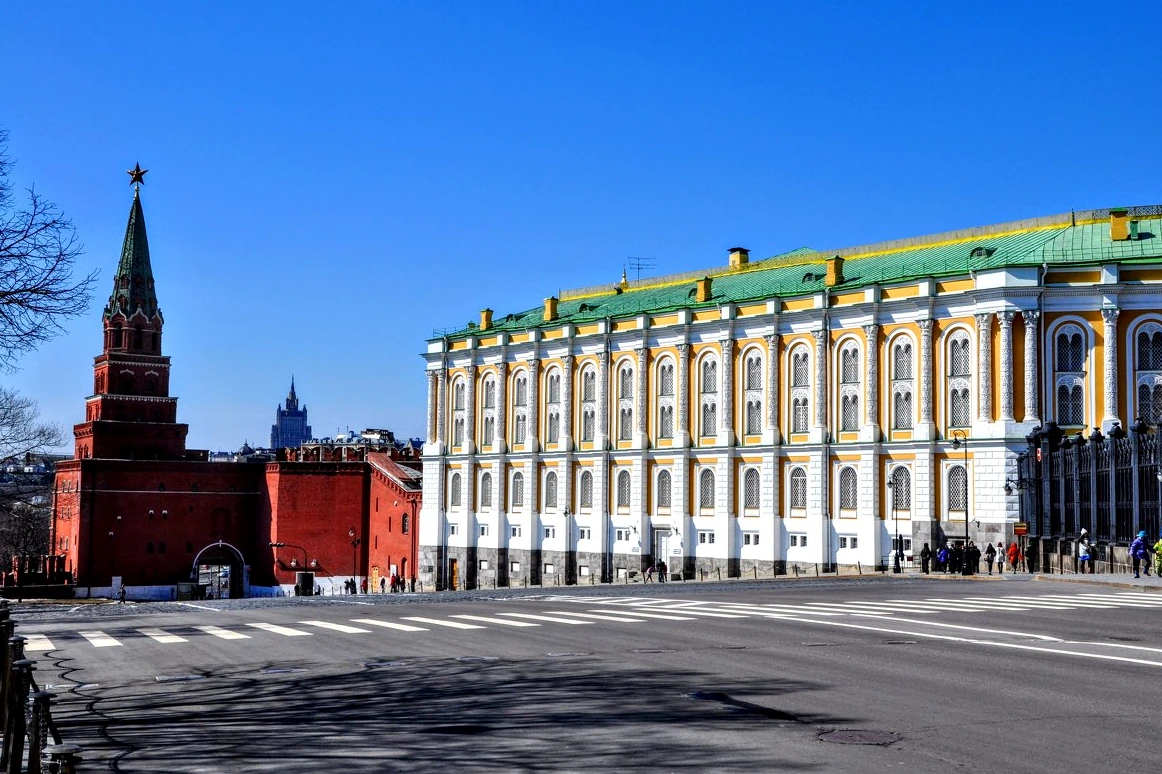
When planning an itinerary, travelers should note the specific operating schedules of federal heritage institutions. The Kremlin grounds and the Armory Chamber museum are generally open from 10:00 AM to 5:00 PM daily except Thursdays, when they close for diplomatic conservation and maintenance. Notably, admission to the Armory Chamber’s collection is timed across four fixed session slots each day: 10:00 AM, 12:00 PM, 2:30 PM, and 4:30 PM. Meanwhile, St. Basil’s Cathedral at the south end of the square follows seasonal hours: from May through October, it is open 10:00 AM to 6:00 PM (until 7:00 PM on Fridays and Saturdays); during colder months from November through April, hours run 11:00 AM to 5:00 PM. Lenin’s Mausoleum admits visitors on Tuesday, Wednesday, Thursday, and Saturday mornings from 10:00 AM to 1:00 PM, with free entry via the security checkpoint in Alexander Garden.
To make the most of your visit without missing out, buying tickets online ahead of time is essential. Travelers should check the official Moscow Kremlin Museums website to reserve tickets for the Armory Chamber and the Cathedral Square churches at least two weeks in advance, as entry quotas per time slot are strictly capped to protect the indoor microclimate of centuries-old buildings. For security, access points to the Kremlin and Red Square use airport-style screening. Sharp metal items, oversized bags, and liquids over 100 milliliters are not permitted past security; visitors must leave prohibited bags at the left-luggage facility by Kutafya Tower or along Alexander Garden before lining up for screening.
Timing also shapes the visual character of the trip. Early morning offers serene light as first sunbeams warm Red Square’s dark basalt paving in quiet calm before crowds arrive. Conversely, dusk right after sunset brings a different spectacle, as decorative lights switch on together and turn the Kremlin spires and bright domes into a vivid scene in the heart of the city. To prepare smoothly for exploring these landmarks without complex booking logistics, you can browse well-paced Russia tour options designed for rich cultural discovery.