Originating along the fertile southern coastline of Guangdong Province, the history of the Zhuhai Fisher Girl statue (珠海渔女) is intimately tied to one of the most monumental turning points in modern Chinese history. In the early 1980s, as the doors of the Reform and Opening-Up policy swung open, Zhuhai—then a quiet coastal expanse of modest fishing villages nestled humbly beside the Pearl River estuary—was selected to become one of the nation’s first four Special Economic Zones. Amid the rapid rush of transformation, as reinforced concrete towers and industrial infrastructure sprang up everywhere, local leaders nurtured a distinct cultural vision: seeking a spiritual emblem that would both honor a thousand-year-old maritime heritage and serve as the “urban soul,” defining the identity of an elegant “City of Romance” beside lapping ocean waves.
That historic responsibility was entrusted to acclaimed sculptor Pan He (潘鹤)—a veteran professor at the Guangzhou Academy of Fine Arts and one of the leading pioneers of contemporary southern Chinese fine arts. At a time when public sculpture nationwide was dominated by rigid geometric motifs or muscular industrial production imagery, Pan He courageously rejected formulaic conventions to return to the roots of folk culture. Over months spent in quiet contemplation along the shores of Xianglu Bay (香炉湾), listening to ocean winds sweep across granite boulders and immersing himself in the hardworking lives of local fisherfolk, he conceived the vision for a sculptural masterpiece imbued with mythological grace. On July 18, 1982, the Fisher Girl statue was officially unveiled to the admiration of scholars and the public alike, marking the moment a local folk legend stepped into reality to become an immortal witness to this coastal city’s new era.
Beneath every grain of its granite stone lies a rich stratum of folklore passed down through generations of fisherfolk around Xianglu Bay. According to ancient legend, she was the beloved daughter of the Dragon King of the South Sea; enchanted by the serene beauty of blue skies and emerald waters in the mortal realm, she slipped away from her opulent underwater palace and descended to Earth in the guise of a humble fisherwoman. Living harmoniously among coastal villagers, she fell deeply in love with an honest, earnest young fisherman named Hai Peng. Tragedy struck when a malicious schemer whispered slander into Hai Peng’s ear, leading him to doubt his beloved’s identity and demand that she remove the heirloom jade bangle from her wrist as a pledge of fidelity. Unbeknownst to him, that jade bangle was her mortal lifeline; the instant it left her skin, her spiritual essence would vanish. Devoted wholly to proving her unwavering love, she unhesitatingly slipped off the bangle and placed it in his hands—collapsing lifeless at the water’s edge to Hai Peng’s belated horror and heartbreak.
Moved by her selfless devotion and Hai Peng’s inconsolable remorse, the immortal sage Old Man Ren of Jiuzhou revealed a path to bring her back from death: he must journey to a deserted island in search of the sacred Changshan herb and water it day and night with fresh drops of blood from his own heart to gather enough vital energy to revive his beloved. Enduring countless trials and exhausting self-sacrifice by Hai Peng, the Fisher Girl was miraculously restored to life. Declining to return to immortal divinity inside the deep sea palace, she chose instead to remain in the mortal world, wed Hai Peng, and share joys and hardships alongside coastal villagers. On their joyous wedding day, she dove into the depths of Xianglu Bay, retrieved a colossal luminous pearl radiating pure light, and raised it high toward heaven and earth with both hands as an eternal blessing of abundance, good fortune, and prosperity for the land. That sacred moment became the enduring inspiration for Pan He to sculpt the towering statue by the bay, uniting romantic myth with the resilient spirit of a city surging toward the open sea.
Situated along the southern edge of the historic Lingnan region, the Zhuhai Fisher Girl landmark commands Xianglu Bay in Zhuhai’s Xiangzhou District, Guangdong Province. In classical East Asian geomantic geography, this setting achieves a rare perfection of “gathering vital energy and sheltering wind.” Erected directly atop a submerged granite outcrop jutting out along the threshold where surf meets sand, the statue faces the vast expanse of the South China Sea as its open ceremonial forecourt while resting its back against the undulating mountain spine of the Leizhou Peninsula stretching toward the coast. The natural crescent arc of Xianglu Bay curves like protective guardian arms cradling the sacred figure, creating gentle coastal currents that shield the monument from sudden tropical ocean storms.
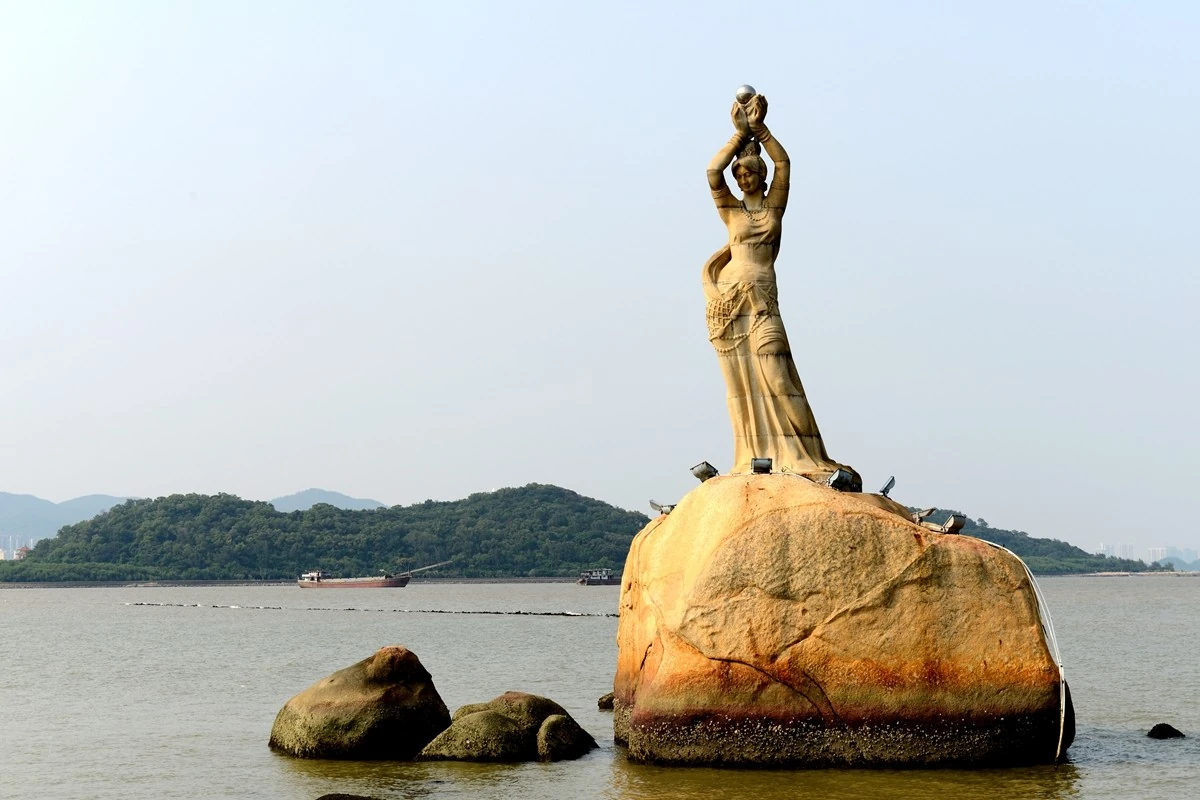
The most captivating feature of this coastal composition lies in the subtle geomantic relationship between the granite statue and Yeli Island rising directly opposite offshore. Standing sentinel in the open bay, Yeli Island acts both as a natural screen deflecting harsh incoming maritime winds and as an auspicious front-facing anchor completing the sacred coastal layout. Amid the tranquil expanse of sea and sky, the maiden raises her luminous pearl to greet the first rays of dawn rising over the South China Sea, absorbing the essence of sun and moon to channel vitality inland. The scene unfolds like a living ink-wash painting, where weathered, moss-kissed granite boulders merge seamlessly with turquoise waters, reflecting pure harmony between human artistry and untamed nature.
Framing this sacred setting is the famed Lovers’ Road (Qinglu Road), a landscape planning masterpiece stretching twenty-eight kilometers along the Xiangzhou shoreline. This coastal artery links urban life with the open ocean like a flowing silk ribbon sweeping past tropical coconut palms swaying in salty breezes and lush green waterfront lawns. Gazing inland from the base of the statue, travelers admire a graceful progression of terrain: from craggy intertidal reefs and gently sloping sandy coves to curved stone seawalls and tree-lined modern boulevards. This gradual elevation rising from water’s edge to coastal terrace moderates the seaside microclimate year-round while opening multi-layered vistas stretching all the way to the distant horizon.
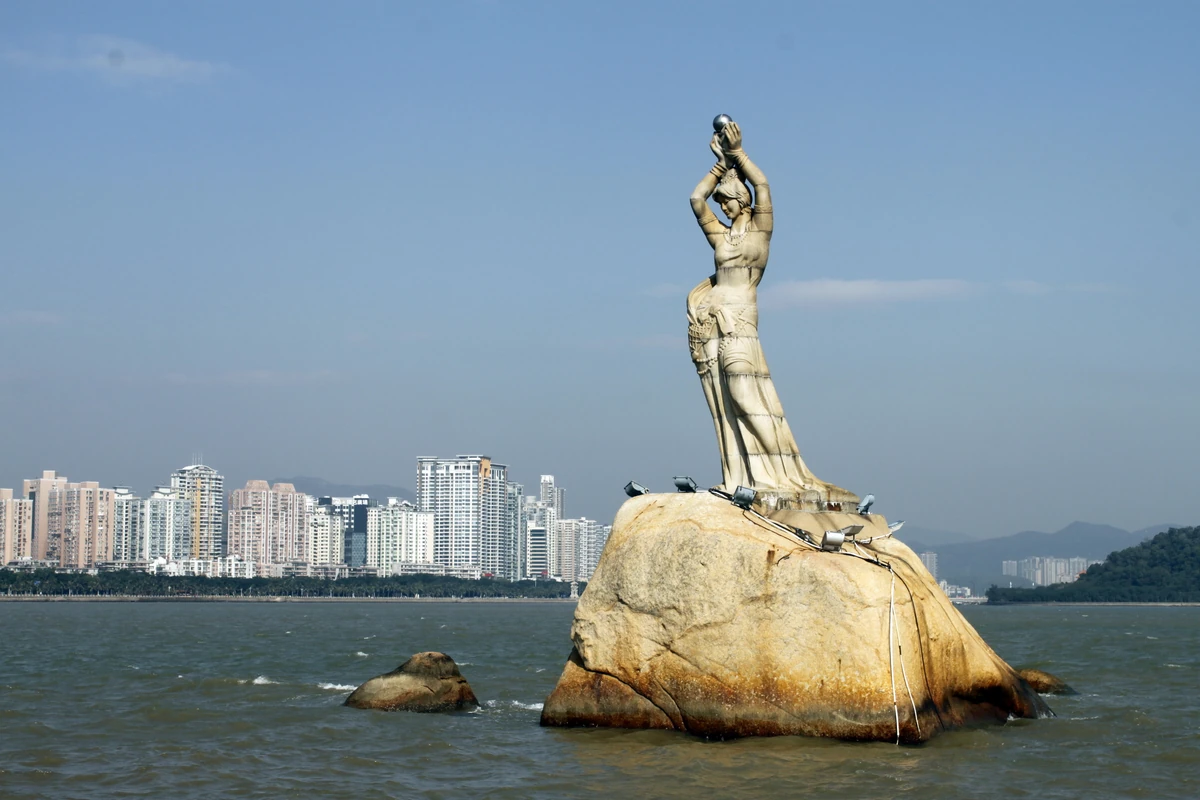
Viewed within the broader canvas of the modern era, the striking coastal presence of the Fisher Girl statue at Xianglu Bay also holds pivotal significance in ecological urban planning. Positioned at the heart of the Guangdong–Hong Kong–Macao Greater Bay Area—rapidly evolving into one of the world’s most dynamic and advanced economic hubs—the sanctuary around the statue retains an astonishing sense of serene, unspoiled coastal charm. It acts as a vital ecological counterweight, a “green breathing space” anchoring Zhuhai’s maritime soul amid rapid urbanization. The poetic contrast between time-honored folk heritage resting on ancient seaside boulders and modern sea-crossing bridges shimmering in the distance crafts an unmistakable identity steeped in maritime legend yet brimming with the vitality of a world-class port metropolis.
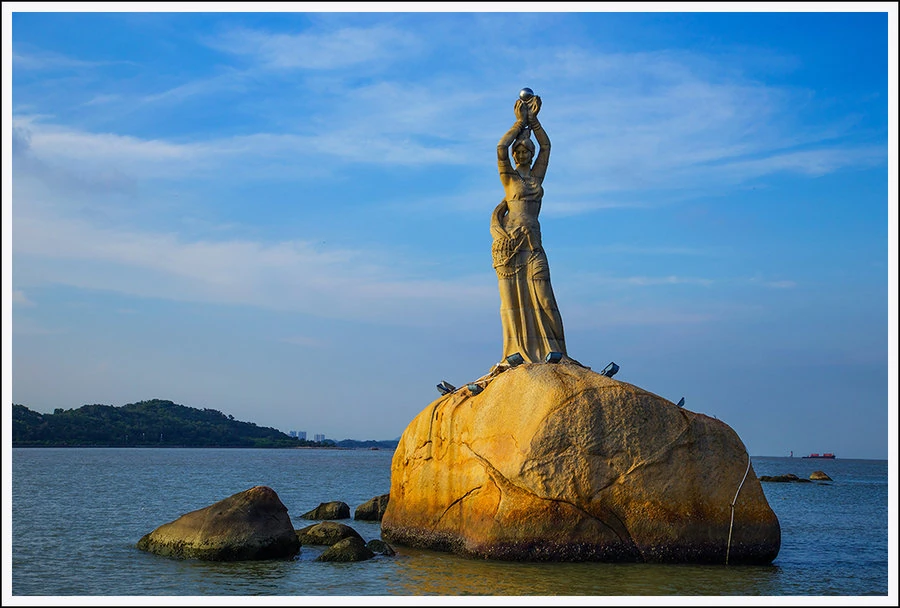
Viewed from the waters of Xianglu Bay, the Zhuhai Fisher Girl rises proudly as a masterwork uniting artisanal precision with the generosity of southern skies and seas. From an engineering standpoint, the monument stands as an extraordinary outdoor sculptural feat crafted entirely from natural granite with a total weight reaching ten tons. Standing 8.7 meters tall, its proportions were calculated down to the finest fraction so that the figure commands stately presence when viewed from the coastal boulevard while retaining graceful intimacy when approached up close. Even more remarkably, this monumental sculpture was not carved from a single monolithic block, but assembled ingeniously from seventy individual granite segments. Each stone block was hand-hewn, finely dressed, and joined using concealed mortise techniques paired with specialized salt-resistant marine adhesives—making seams virtually invisible in natural daylight so the statue appears carved from a single living boulder rising straight out of the surf.
The statue’s sculptural language represents a bold, harmonious synthesis of Chinese social realism and the golden canons of classical Greek sculpture. The artist skillfully applied Western anatomical principles to capture the supple, graceful curves of a maiden in the bloom of youth, while infusing her posture with the poised modesty and gentle dignity characteristic of East Asian aesthetics. Standing atop her submerged reef, her slender frame reaches skyward in a subtle, fluid sway against the sea breeze. A delicate sash and flowing skirt draped across her lower body are intricately chiseled with rhythmic folds that soften the rugged weight of raw granite. The supreme visual focal point lies in her slender arms raised high above her head, cradling a giant pearl toward the windswept sky—an emblem not only of compositional balance, but of abundant marine bounty, courage, and the outward-looking aspirations of Lingnan’s coastal people.
The surrounding landscape is organized along an expansive visual axis uniting land, sea, and contemporary architectural icons. Set atop a natural rock outcrop just offshore, the statue connects seamlessly to a broad granite-paved waterfront plaza via a curving stone causeway winding across natural reefs. This layout creates an ideal spatial buffer allowing visitors to witness the sculpture transform with the daily tides: at low tide, moss-draped foundation boulders emerge clearly above the sand; at high tide, the Fisher Girl appears to float gracefully upon the open sea. Looking across turquoise waters from the granite plaza, the monument engages in a striking visual dialogue with the Zhuhai Grand Theater on Yeli Island directly opposite—whose ivory twin-shell architecture (“Sun and Moon Shells”) mirrors itself in the bay in poised symmetry with the classic beauty of the Fisher Girl, weaving an epic narrative bridging mythic past and modern transformation.
As crimson sunset hues fade completely behind the western horizon of the Pearl River estuary, Xianglu Bay enters an enchanting metamorphosis of light and emotion. Nightfall over the water never plunges the Fisher Girl into somber darkness; instead, it provides a velvety black backdrop against which architectural lighting displays pure visual magic. Gentle waves lapping against submerged rocks seem to keep rhythm with modern optical choreography, turning the entire bay into a vast open-air live stage where boundaries between the legend of the pearl-offering maiden and contemporary urban life dissolve.
Designed by optical engineers and sculptors working in concert, the nighttime lighting system employs precision spot illumination to accentuate the expressive grace of the granite masterpiece. Warm-toned high-intensity beams angled with exacting care illuminate the Fisher Girl’s serene, refined features, highlighting the contours of her eyes, lips, and gentle, compassionate smile. Most strikingly, the giant pearl held aloft in her hands serves as the focal convergence point for crisp light beams, creating a dazzling refractive glow resembling a self-luminous crystal suspended in midair. Artificial light glancing off textured granite surfaces and reflecting across rippling water scatters countless golden sparkles—visually evoking the South Sea fairy tale of teardrops transformed into luminous pearls.
The evening window between 7:00 PM and 9:30 PM represents the golden hour when the bay reaches peak aesthetic splendor. Decorative lights along Lovers’ Road ignite in unison, blending with multicolored reflections cast from glittering skyscrapers and luxury beachfront hotels curving around Xianglu Bay. In the distance, the luminous ribbon of the sea-crossing bridge spans the horizon like a glowing thread, staging a breathtaking contrast between a timeless mythological icon on one side and the vibrant pulse of a thriving Special Economic Zone on the other. This interplay of architectural and landscape lighting crafts a deeply lyrical atmosphere that fully justifies Zhuhai’s enduring reputation as the “City of Lovers.”
Stepping into the evening energy around the statue reveals a relaxed yet richly authentic community culture. Beneath refreshing sea breezes carrying generous ocean moisture, crowds stroll unhurriedly along the stone waterfront promenade, admiring the Fisher Girl’s graceful silhouette against the night sky. Melodic instrumental music drifting from artistic teahouses, warm laughter from strolling couples, and the soft splash of surf against rocks blend into a soothing nocturnal symphony. Lighting here does far more than showcase modern technology—it breathes living soul into timeless granite, turning a heritage landmark into a vibrant repository of memory preserving the eternal romance of China’s southern coast.
Rooted in the celebrated Lingnan culinary philosophy that prizes natural flavors and peak freshness, the dining scene encircling Xianglu Bay flourishes at the meeting point of nutrient-rich Pearl River estuary waters and the briny depths of the South China Sea. Across generations of seafaring Tanka fisherfolk, coastal Zhuhai cooking has shunned heavy artificial seasonings in favor of pure culinary refinement that lets pristine ingredients shine. After admiring the graceful silhouette of the Fisher Girl poised atop her rocky outcrop, discerning travelers gravitate toward seaside food streets curving along the bay, where savory woodsmoke mingles irresistibly with salty ocean breezes.
Reigning supreme on this coastal culinary journey is Xianglu Bay charcoal-grilled oysters, hailed as the signature soul food of Zhuhai’s brackish estuary waters. Oysters cultivated where river meets sea develop plump, pearlescent meat bursting with natural oceanic sweetness. Placed over glowing charcoal embers, local chefs crown each open shell with aromatic golden minced garlic and house-fermented black bean sauce crafted according to time-honored fishing-village recipes. The creamy richness of fresh oysters melting into savory fermented black beans and pungent roasted garlic creates an unforgettable flavor explosion that chases away ocean chill and awakens every sense.
Equally celebrated is Hengqin seafood congee, a deceptively humble dish elevated to peak refinement through classic Lingnan temperature mastery. Fragrant rice is simmered slowly for hours in rich deep-sea fish bone broth until grains blossom into silky, cloud-like softness. Freshly harvested milk oysters gathered the very same day from Hengqin’s mangrove lagoons are slipped into the bubbling pot moments before ladling into earthenware bowls. Each velvety spoonful delivers pure oceanic sweetness accented by fine julienned ginger and crisp green scallions—a deeply restorative tonic after a long day of coastal exploration.
Stepping inland from the sea, the culinary trail leads to Haiquan salt-baked chicken, an emblem uniting rolling coastal hills with ancient sea-salt craft. Inheriting traditional salt-curing wisdom from Hakka communities long settled along the coast, free-range hill chickens are seasoned delicately with mildly spicy wild mountain pepper and fragrant shredded kaffir lime leaves. Wrapped tightly in multiple layers of herbal parchment paper, the whole bird is buried deep inside a cauldron of coarse sea salt heated glowing-hot over wood embers. Gentle radiant heat cooks every fiber evenly without losing a drop of natural juice, yielding crisp golden-amber skin and tender, savory meat imbued with subtle coastal minerality.
The culinary portrait of Xianglu Bay remains incomplete without morning yum cha tea service featuring classic Lingnan shrimp and crab-roe soup dumplings. Skilled dim sum artisans pleat gossamer-thin, translucent wrappers around plump, crunchy deep-sea shrimp landed at dawn, crowned with vibrant orange-red crab roe. One gentle bite releases piping-hot, richly savory broth bursting with oceanic umami—paired seamlessly with steaming cups of Tieguanyin oolong or aged Pu-erh tea to conclude a memorable journey into Zhuhai’s gastronomic heritage.
The waterfront park encircling the Zhuhai Fisher Girl statue operates as a completely open public space with free admission at any hour of the day or night. Nevertheless, to admire the granite monument at its most photogenic amid turquoise waves, seasoned travelers and photographers favor two serene golden windows. Dawn between 6:30 AM and 8:30 AM catches the sun rising directly over the South China Sea horizon, casting rosy golden light across the maiden’s graceful form and the luminous pearl held aloft—while letting you share the peaceful morning rhythm of coastal locals alongside breaking waves and seagulls wheeling past weeping willows. After dusk, the evening window from 7:00 PM to 9:30 PM offers an enchanting contrast as multicolored architectural spotlights ignite, turning the sculpture into a glowing beacon mirrored across the tranquil night bay.
Reaching Zhuhai’s signature landmark today is effortless thanks to the ultra-modern regional transit network of the Guangdong–Hong Kong–Macao Greater Bay Area. Travelers departing central Guangzhou can board intercity high-speed trains from Guangzhou South Railway Station, arriving smoothly at Zhuhai Station in roughly fifty minutes. For visitors crossing from Macao, walking through Gongbei Port takes only minutes; right outside immigration, coastal public buses or local taxis whisk travelers along scenic Lovers’ Road to the statue in about fifteen minutes. Additionally, the monumental 55-kilometer Hong Kong–Zhuhai–Macao Bridge (HZMB) spanning the Pearl River estuary provides a dramatic sea-crossing corridor linking Hong Kong International Airport directly to Zhuhai’s eastern shore.
While access is straightforward, observing thoughtful on-site etiquette ensures a smooth, respectful visit. During tranquil morning hours, stone walkways along the park serve as gathering grounds for local seniors practicing tai chi, qigong, and gentle morning exercises; visitors are encouraged to keep voices low and refrain from using loudspeakers or low-flying drones that disturb the peaceful ambiance. When low tide exposes the rugged, moss-covered boulders of Xianglu Reef, exercise caution on slick wet stone and strictly refrain from climbing onto the granite pedestal supporting the statue for photos—both to protect personal safety against sudden swells and to show proper respect for a cherished public artwork.
Regarding border formalities and local convenience, international travelers crossing land ports or HZMB checkpoints should carry valid visas and set up domestic mobile payment apps in advance for seamless transit and dining transactions. To enjoy the refined elegance of Lingnan’s coast free from distracting commercial detours, savvy travelers prioritize standardized “No Shopping” itineraries that dedicate every hour to folk legends, fresh bayfront seafood, and unforgettable photography. For a seamless, thoughtfully organized journey through Xianglu Bay’s coastal heritage, explore our all-inclusive China tour packages curated for an enriching southern coastal adventure.