Amid the serene expanse of Shanhu Lake—shining like a jade mirror in the heart of Guilin—twin ancient pagodas rise majestically into the southern sky, forming an unparalleled architectural masterpiece of dual symmetry. Against a backdrop of quiet, picturesque waters, the bronze Sun Pagoda radiates a magnificent golden glow, standing beside the pristine white-glazed Moon Pagoda like two celestial luminaries descending into an earthly fairyland. Tiered eaves and multi-layered roofs stretch gracefully above calm waters, linked to the shore by winding bridges and a subterranean lakeside corridor that freezes time amidst the bustle of modern urban life.
Tracing chronicles back to medieval times, the local waterways were closely bound to hydraulic engineering and formidable military defense. From the Tang Dynasty through the Song Dynasty, Guilin served as a strategic choke point in the Lingnan region, where imperial commanders and ancient engineers excavated sturdy defensive moats around the city. During the Song era, the urban water network was fully planned to connect the bountiful Li River with inner-city lake branches, transforming the area into a bustling commercial waterway and an unassailable defensive barrier. Shanhu Lake at that time formed a vital sector of the southern moat system, storing water, regulating currents, and safeguarding local residents through periods of wartime upheaval.
Through the Yuan, Ming, and Qing dynasties up to the early twentieth century, silt accumulation and the negative impacts of spontaneous urbanization caused the ancient waterway network to shrink gradually, fragmenting into isolated ponds and losing its ancient flow. Confronting the erosion of this thousand-year heritage, local authorities initiated an unprecedented urban renewal project known as the “Two Rivers and Four Lakes” system. The core of this historic initiative was dredging the entire network of Song-era waterways, reviving the elegant landscape of “cities within scenery, scenery within cities” praised by classical poets as a terrestrial fairyland.
The defining centerpiece of this grand revival project was the construction of the Sun and Moon Pagodas right in the heart of Shanhu Lake, officially completed and inaugurated in 2002. The structure transcends mere landscape architecture to serve as a living philosophical manifesto, synthesizing the deep essences of both Buddhism and Taoism. Combining the Chinese characters for Sun (日) and Moon (月) creates the character for Brightness (明), symbolizing the light of wisdom, the dispelling of darkness and ignorance, and the dawn of eternal auspiciousness.
According to East Asian geomancy and the Book of Changes, heaven, earth, and all things endure and thrive only when achieving absolute harmony between two opposing energies. The Sun Pagoda radiates a brilliant golden hue, symbolizing the firm principle of Yang, the sun, and enlightening illumination; conversely, the Moon Pagoda assumes a serene, ethereal luster representing the yielding principle of Yin, the gentle moon, and tranquil non-action. This harmonious symmetry blends seamlessly with guardian reliefs, Buddhist wheels of rebirth, and Taoist bagua diagrams, transforming the twin pagodas into a sanctuary for cleansing worldly dust and commemorating a thousand-year lineage of cultural heritage.
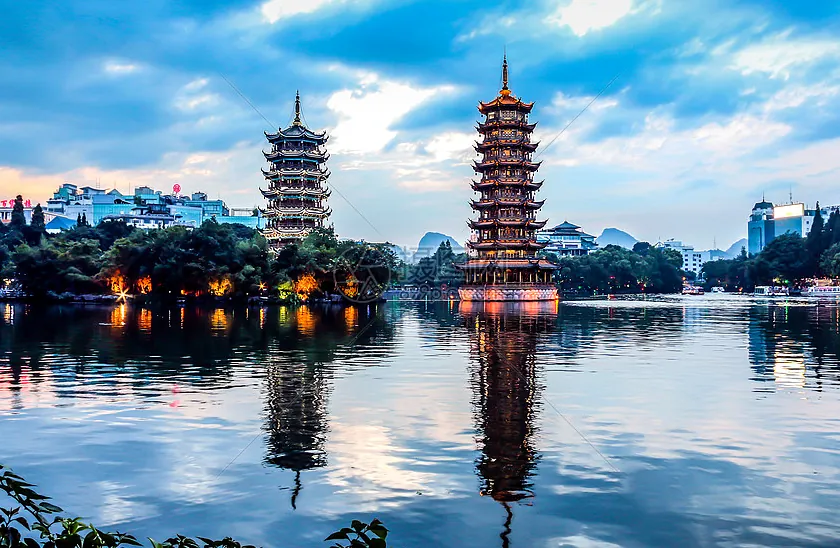
Amid the mirror-still waters of Shanhu Lake, the Sun and Moon Pagodas project an aura of serene majesty, acting as twin pillars anchoring the spiritual energy of ancient Guilin. The bronze Sun Pagoda proudly soars nine octagonal stories in radiant gold, while the white-glazed and stone-tiled Moon Pagoda rises seven graceful stories, exuding quiet beauty like a crescent moon leaning over the water. As dusk descends or artificial illumination brings night to life, both structures mirror themselves upon gentle ripples, creating an illusory realm where artificial architecture, picturesque waters, and mountain skies merge as one.
Viewed through traditional geomantic geography, the location of the Sun and Moon Pagodas forms the most auspicious nodal point within the renowned “Two Rivers and Four Lakes” scenic layout. This interconnected water system comprises two main arteries—the Li River and Peach Blossom River—alongside four inner lakes: Shan, Rong, Gui, and Mulong. Historically, Shanhu Lake originated as part of the defensive moat system established during the Song Dynasty, serving as a natural barrier against foreign invaders while regulating water supplies for a flourishing urban center. In traditional Lingnan geomancy, water governs wealth and smooth flow; gentle meandering currents embracing small islets embody the classic “mountains encircling, waters embracing” formation, where mountain dragons and water veins converge to concentrate prosperity for the entire region.
The architectural soul of this landscape stems from the Yin-Yang balancing philosophy expressed through the imagery of “Sun and Moon Shining Together.” The Sun Pagoda embodies the Yang attribute, cast from hundreds of tons of sparkling brass to signify abundant Yang energy, vitality, and upright illumination. Conversely, the Moon Pagoda embodies the Yin attribute, utilizing pristine porcelain glazes and translucent colored glaze motifs to represent coolness, tranquility, and inner depth. This metal-water, Yang-Yin interplay remains unified through a subterranean underwater tunnel stretching dozens of meters beneath the lakebed, symbolizing the eternal subterranean circulation between heaven and earth. Shanhu Lake serves as a bright ceremonial forecourt, gathering vital energy from all directions to nourish and reflect radiant light back into the surroundings.
Natural scenery surrounding the pagodas is enhanced by Guilin’s distinctive karst landforms. Limestone peaks rising straight toward cloud-filled skies—such as Solitary Beauty Peak and Elephant Trunk Hill—surround the Shanhu basin from afar like sturdy natural screens shielding against harsh winds while preserving the lake’s calm surface. Lakeside vegetation featuring soft weeping willows, lush pines, and seasonal floral patches gently softens the angular geometry of the artificial towers. The continuous circulation of water between lakes generates a clean microclimate, sending refreshing breezes through the pagodas’ open windows to immerse visitors in the serene tranquility of a traditional ink-wash landscape painting.
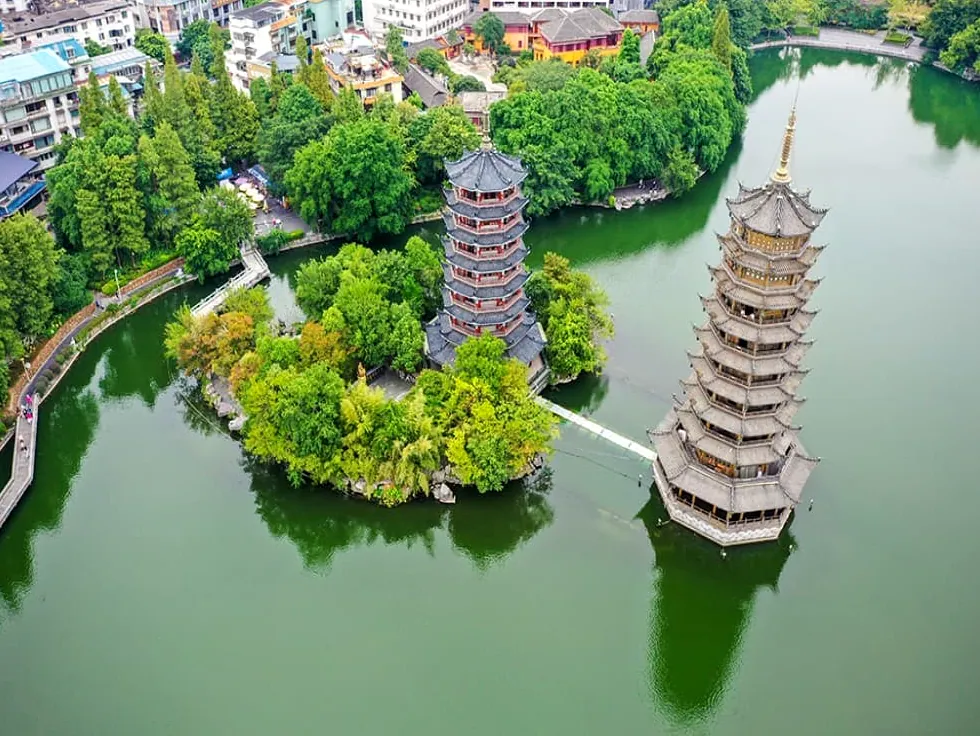
Observed in panoramic aerial views, the Sun and Moon Pagodas appear as a precious natural masterpiece amid the tranquil waters of Guilin’s Shanhu Lake. One towering pagoda stands proudly upon an islet shaded by ancient trees, while its twin rises directly from clear waters, creating majestic symmetry between land and water. A gracefully curving footbridge spans the gap, guiding travelers through drifting mist and highlighting the flawless geomantic layout crafted centuries ago within breathtaking natural surroundings.
The most breathtaking focal point of this scenic complex is the Sun Pagoda, reverently acclaimed by connoisseurs as the Golden Pagoda. Soaring an imposing 41 meters across nine octagonal levels, this masterwork holds an unmatched world record as the tallest bronze pagoda on Earth. Entirely cast from over 350 tons of refined pure bronze, it inherits imperial architectural styles from the Tang and Song dynasties, featuring dramatic upturned eaves. Every decorative relief on lintels, bronze doors, and suspended wind chimes exudes supreme solemnity. Moreover, internal load-bearing frameworks were calculated with millimeter precision, ensuring this colossal metal tower remains rock-solid against winds and the humid climate typical of Guilin’s waters.
Harmoniously and delicately contrasting with the Sun Pagoda’s brilliance is the Moon Pagoda, also known as the Silver Pagoda, rising 35 meters with a slender seven-story structure. Unlike its twin’s metallic material, the Moon Pagoda was meticulously built from tens of thousands of premium white ceramic tiles paired with refined glazed porcelain. The pristine ivory whiteness of ceramic bricks evokes moonlight shimmering on water, counterbalancing yet honoring the Sun Pagoda’s imperial gold while reflecting the enduring Yin-Yang philosophy of Eastern culture. Entering the Moon Pagoda feels like stepping into a miniature Buddhist art museum featuring delicate blue-and-white porcelain murals and arched patterned glass windows framing panoramic views of rolling mountains surrounding the city.
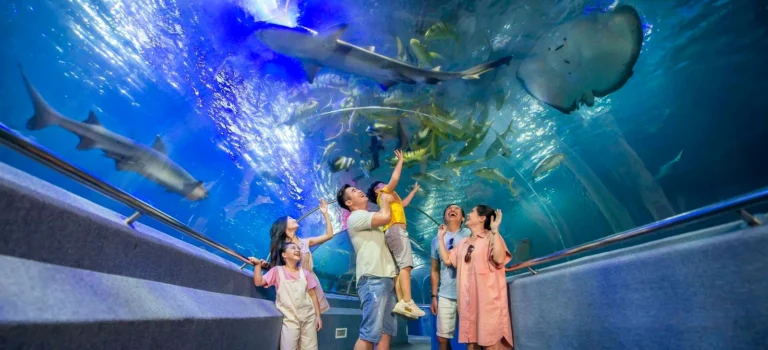
The most astonishing and sublime architectural touch in the overall design is the unique 10-meter underground subterranean link connecting the two towers. Rather than relying solely on surface walkways, master builders boldly engineered a magical underwater tunnel cutting through the lakebed’s mud and deep waters. Strolling down the pressure-resistant glass corridor beneath the lake allows visitors to admire fish swimming among green aquatic plants and fascinating geological sediment before refractive light transitions them from the vigorous warmth of the Sun Pagoda into the serene, mystical realm of the Moon Pagoda. This fusion of modern subterranean engineering and traditional cosmology transforms the twin pagodas into both a breathtaking architectural heritage and an invaluable material epic on earth.
As sunset fades behind the majestic limestone mountains surrounding Guilin, the daytime serenity of the Shanhu Lake core area yields to a spectacular visual metamorphosis. The mysterious velvet curtain of nightfall allows the entire aquatic landscape to strike up a symphony of light, drawing visitors into a nocturnal cultural exploration filled with poetry and millennia of legend.
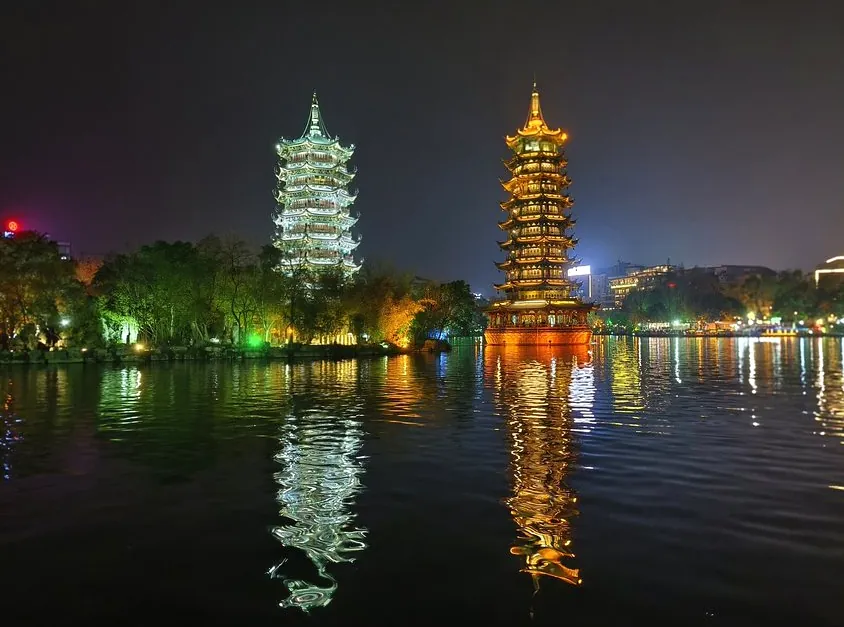
The moment darkness completely blankets Shanhu Lake, live photography captures breathtaking beauty as the Sun and Moon Pagodas enter peak illumination. Rising above deep-blue waters is a classic visual contrast: the Sun Pagoda glows like a majestic mass of solid gold with bronze roof ridges gleaming regally, while the Moon Pagoda beside it emits a pristine white glow resembling a full moon resting upon fine glazed ceramics. Every classical architectural detail—from upturned eaves soaring toward the sky to traditional patterned window frames—is reflected flawlessly across calm waters, weaving a gigantic mirror sparkling like a fairyland inside the ancient city.
The hours between 7:00 PM and 9:00 PM are hailed by lighting art connoisseurs as the golden window to admire the twin pagodas. Modern LED systems with precisely calculated light wavelengths deeply express Eastern Yin-Yang balancing philosophy and Five Elements principles. The Sun Pagoda’s radiant gold symbolizes the sun, the Metal element, and vigorous light, pairing perfectly with the Moon Pagoda’s soothing silver representing the moon, the Water element, and tranquil harmony. Indirect illumination avoids glare while gliding gracefully across relief carvings, reviving the soul of the world’s tallest bronze pagoda alongside its glazed companion, turning the vast lake into a living sculpture museum of light.
Nightlife around Shanhu Lake extends beyond silent contemplation into the renowned “Two Rivers and Four Lakes” water transit network. Gold-plated dragon boats slowly part waters from the Li River into Shanhu Lake, carrying literati and travelers to drift among reflective lights. Along the aquatic route, crisp pipa lutes and antiphonal folk ballads of the Zhuang and Miao peoples echo from lakeside pavilions, creating a natural live show without barriers. White foam churned beneath boat hulls catches gold and silver radiance refracted from pagoda bases, creating magical dragon-scale ripples reminiscent of sailing back into a lavish banquet night during the Tang and Song dynasties.
Stepping ashore, bustling evening energy spreads along willow-shaded lanes around Shanhu Lake, connecting directly to bustling Zhengyang Pedestrian Street. Locals and travelers stroll unhurriedly beneath weeping willows, breathing in osmanthus fragrances carried on cool night breezes. Beside traditional teahouses, the rich savor of a bowl of traditional Guilin rice noodles with crispy pork belly and pickled bamboo shoots, or the refined aroma of Cungcheng oil tea, anchors visitors inside the legendary nightscape of this peerless landscape city.
When sunset casts a dark indigo veil across Shanhu Lake, the radiant golden bronze Sun Pagoda and pristine silver glazed Moon Pagoda awaken from daytime quietude into the earthly warmth of human hearths. Guilin’s culinary heritage has for centuries represented a magical synthesis between refined Lingnan gastronomy and rich Central Plains flavors, deeply influenced by picturesque landscapes and monsoon climates. Strolling through ancient streets encircling the twin pagodas, discerning food lovers seek not ostentatious banquets, but root flavors that have crystallized into the cultural soul of this ancient land.
Reigning supreme in local culinary memory is Guilin rice noodles, a culinary heritage tied to historic heroics from Qin Shi Huang’s era. Legend holds that in the third century BCE, when Imperial Censor Shi Lu was ordered to excavate the Lingqu Canal linking the Xiang and Li river basins, hundreds of thousands of northern troops unaccustomed to southern local terrain fell ill from rejecting southern rice. Military cooks and local physicians thus invented the technique of soaking, grinding, and pressing rice into long noodles mimicking northern noodles, boiled and served with concentrated master stock brewed from over twenty southern herbs. That technique, passed down over two millennia, shaped famed “Lutai Rice Noodles.” Plump, snow-white, springy round noodles are blanched briefly, topped with thinly sliced crispy-skinned roast pork belly, tender braised beef slices, roasted peanuts, pickled cowpeas, and spicy pickled chili bamboo shoots. The supreme secret defining the noodle’s rank is its amber “lushui” master stock, simmered continuously over days and nights from beef marrow bones and pork knuckle marrow blended with star anise, cloves, amomum, cassia bark, and cardamom. Connoisseurs enjoy them through a strict ritual: mixing dry noodles with seasonings until every strand absorbs master stock aromas, savoring crispy roast pork, and finally pouring a spoonful of clean bone broth into the bowl to relish remaining rich flavors.
Leaving alleys fragrant with herbal noodle broth, the culinary journey continues with Yangshuo Beer Fish, an iconic cooking technique born from fishermen along the Li River. The standard fish choice is fresh carp or grass carp harvested directly from clear limestone river waters, boasting firm flesh free of mud. The unique twist lies in leaving fish scales entirely intact during preparation. Scored fish are dropped into a cast-iron wok of local tea-seed oil, deep-fried until surfaces turn golden and crispy as blooming flower petals. Next, fish are simmered in fresh ripe tomatoes, sliced red chilies, spicy fermented bean paste, and generous pours of local Guilin draft beer instead of plain water. Beer alcohol evaporating at high heat eliminates all fishy odors, leaving tender, sweet flesh wrapped beneath crispy scales drenched in rich, spicy, sweet-sour sauce.
The exploration of local flavors remains incomplete without osmanthus cake, an iconic pastry embodying Guilin’s namesake city of osmanthus forests. For millennia, locals have harvested blooming autumn osmanthus flowers early in the morning, washing and curing them in pure honey or rock sugar to lock in natural essential oils. Pastry bases crafted from finely milled round glutinous rice flour are mixed with powdered sugar and steamed inside traditional wooden steamers. The resulting osmanthus cake resembles a translucent piece of jade, soft and chewy without sticking to teeth, releasing clean, refreshing sweetness and elegant floral aromas across the palate. Savoring osmanthus cake alongside a cup of robust Liubao tea infused with aged tangerine peel in cool breezes off Shanhu Lake as the Sun and Moon Pagodas light up marks the moment a traveler touches the poetic peak of Guilin’s earthly flavors.
As dusk drapes blue velvet across Shanhu Lake, the Sun and Moon Pagodas awaken like luminous wonders lit up amid calm waters. Viewed from the lake shore, the pure bronze Sun Pagoda emits magnificent golden brilliance, rising majestically across nine stories with exquisite bracketed eaves; contrasting yet harmonizing is the white-glazed ceramic Moon Pagoda exuding clean platinum elegance. Tower reflections cast long, shimmering refractions across gentle ripples, framed by curving Sun and Moon stone bridges and lakeside weeping willows, creating a living ink-wash masterpiece bridging modern illumination with millennium-old town charm.
The lakeside park around Shanhu Lake opens freely day and night for leisurely strolls in clean air, though interior viewing areas inside the bronze pagoda and the underground aquarium tunnel connecting both towers generally welcome guests from 8:00 AM to 10:00 PM daily. The most magical hour to admire the scenic spot’s full beauty is when artistic lighting turns on from 6:30 PM to 10:30 PM. Visitors descending into the 10-meter-plus glass-floored subterranean tunnel cutting across the lakebed can admire swimming fish and fascinating karst rock formations while viewing elaborate relief carvings recounting Buddhist legends and Guilin’s Tang and Song legacy.
Reaching this jade gem amid Guilin’s karst waters is effortless thanks to a well-developed regional transit network. The most convenient and popular route for northern travelers is crossing via Huu Nghi Quan (Friendship Pass) in Lang Son to Pingxiang, continuing overland to Nanning. At Nanning East Station, modern high-speed bullet trains (CRH) reach Guilin or Guilin North Station in roughly two and a half hours. From urban downtown, a fifteen-minute taxi ride or leisurely stroll from bustling Zhengyang Pedestrian Street brings you right to breezy Shanhu Lake.
Regarding entry formalities, international travelers should secure individual tourist visas or group visas through reputable travel agencies, ensuring passports remain valid for at least six months from journey’s end. Border crossing and airport checkpoints feature streamlined biometric fingerprinting and arrival card processing when paperwork is prepared carefully. A valuable insider tip is prioritizing “No Shopping” itineraries (pure sightseeing tours free of mandatory shopping stops) to avoid wasting hours in commercial centers selling jade, silk, or herbal remedies—thus preserving precious time for Guilin’s cultural heritage.
For unforgettable photographs, aim for the “blue hour,” when twilight skies turn magical blue to contrast perfectly with glowing gold-and-silver radiance from the twin pagodas. The finest vantage point sits directly upon the Sun and Moon bridge spanning the water, or more romantically aboard sightseeing cruise boats drifting along the “Two Rivers and Four Lakes” route. To enjoy your journey unhurriedly without transport logistics worries, consider booking an all-inclusive China tour package to immerse yourself peacefully in Guilin’s millennium-old heritage.