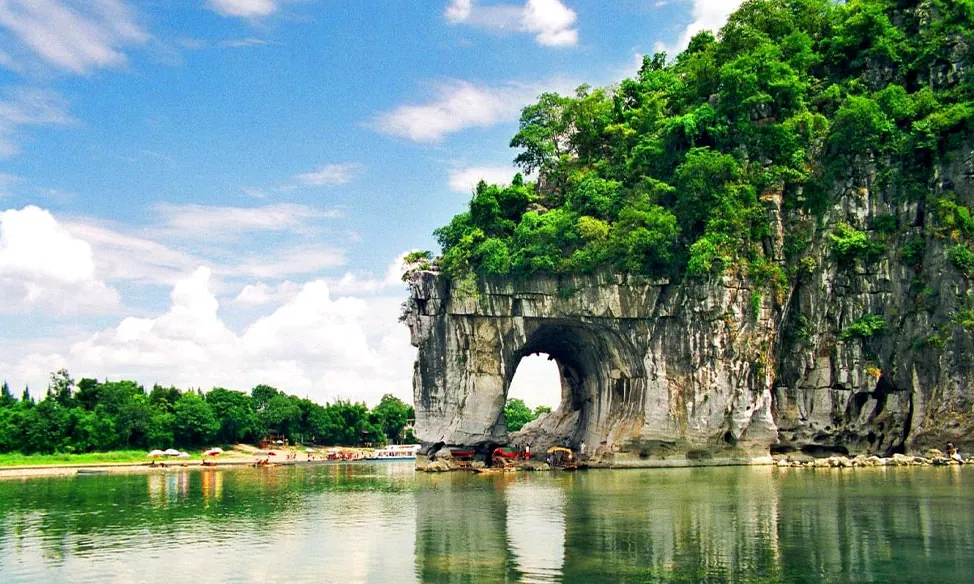
Standing majestically at the tranquil confluence where the emerald Li River meets the poetic Peach Blossom River, Elephant Trunk Hill has long served as the premier geographic emblem of Guilin, carrying layers of geological history and a thousand years of ancient Baiyue cultural heritage. Composed of sedimentary limestone formed beneath an ancient seabed over 360 million years ago during the Devonian period, this natural formation rises 55 meters above river level, resembling a colossal elephant lowering its long trunk to drink deeply from the crystal-clear waters of the Li River. Its earliest recorded names were Shishou Hill and Chenshui Hill, yet the image of a lush green elephant mirrored in turquoise waters has remained etched in local collective memory across the rise and fall of dynasties.
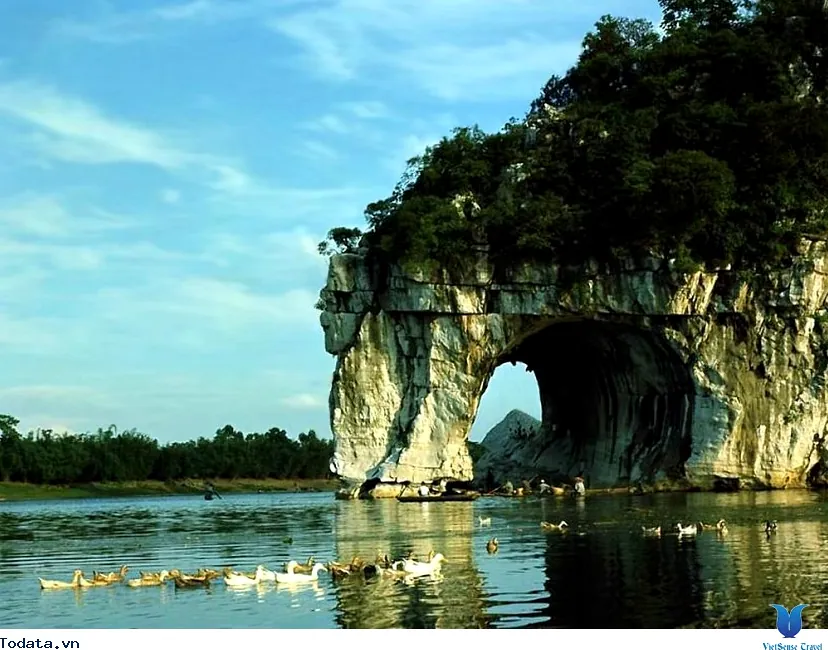
In person, the landmark reveals the graceful curves of Water Moon Cave—a circular natural archway piercing cleanly between the mountain’s body and its extended stone trunk—creating a ten-meter-high natural portal bathed in shimmering reflections off the river. Crowning the summit of the verdant karst massif is the antique silhouette of the two-story brick Puxian Pagoda rising against the sky, uniting nature’s sculptural artistry with centuries-old religious architecture.
Human cultural imprints at Elephant Trunk Hill blossomed brilliantly during the Tang dynasty, when literati landscape excursions and the flourishing of Buddhism inspired cliffside sanctuaries. During the Zhenguan and Kaiyuan reigns, the renowned Kaiyuan Temple was established along the mountainside, becoming a serene monastic center for hundreds of southern monks. Around the same era, celebrated scholar Li Bo—serving as Prefect of Guizhou—opened scenic trails with fellow poets and inscribed refined verses onto the stone vault of Water Moon Cave, initiating a celebrated tradition of cliffside stone inscriptions that preserves over fifty priceless calligraphic works on the cavern walls today.
Entering the Song dynasty, the ink-wash beauty of the hill captivated towering literary figures including Lu You and statesman Fan Chengda during his tenure as Military Commissioner of Guangxi. In his famous geographical treatise Guihai Yuheng Zhi, Fan Chengda praised the sight of the full moon framed inside the round river cave like a jade moon floating underwater—coining the classic poetic motif “Water Moon of Elephant Hill.” Later, during the Ming dynasty, the distinctive vase-shaped Puxian Pagoda was constructed atop the summit to enshrine Samantabhadra Bodhisattva riding a six-tusked white elephant, symbolizing boundless compassion and anchoring the sacred geomancy of the river basin.
Beyond its ethereal beauty, this dramatic limestone peak also witnessed poignant historical turning points in modern times. In the second year of the Xianfeng reign during the Qing dynasty, Taiping Heavenly Kingdom leader Hong Xiuquan and his rebel forces laid siege to Guilin after rising in Jintian, secretly positioning artillery batteries along the slopes of Elephant Trunk Hill to bombard Qing fortifications across the river. Rock crevices that had echoed for centuries with monastic chants briefly served as defensive earthworks during fierce clashes before the hill returned to eternal stillness mirrored in the gentle Li River.
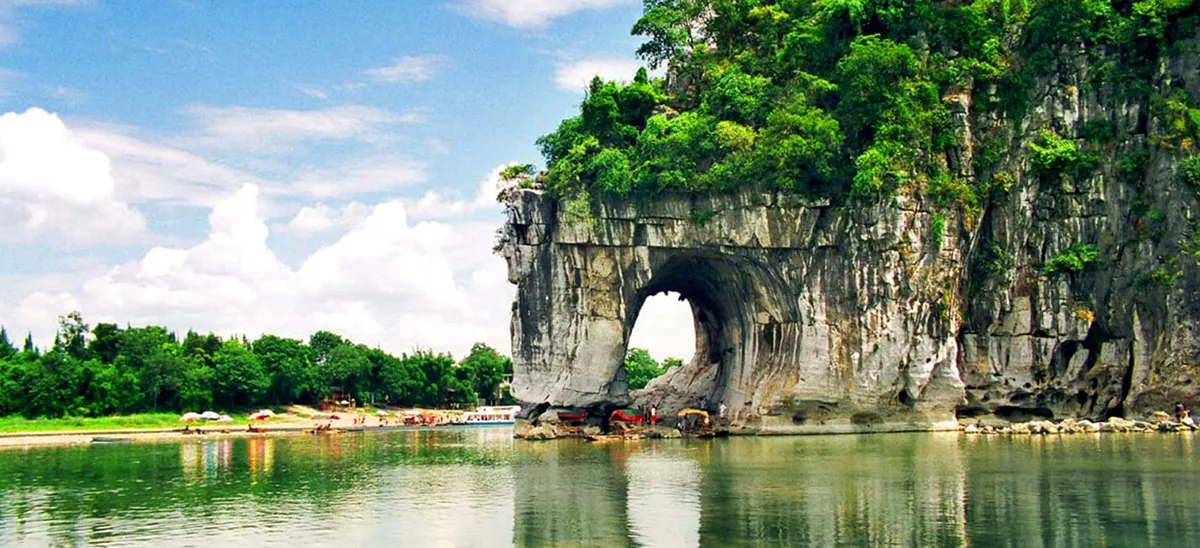
Viewed from a boat gliding down the Li River, Elephant Trunk Hill rises like a monumental natural sculpture where a sweeping limestone ridge extends outward like the trunk of a giant celestial elephant dipping down to sip the emerald current. Nestled between the extended trunk and sturdy flank is the perfectly rounded opening of Water Moon Cave, allowing sunlight and river water to pass smoothly through in a living natural tableau while ancient trees clinging to moss-covered crags cast shimmering reflections across the calm river below.
Geologically, this solitary peak is the crowning result of over 360 million years of karst weathering dating back to the Devonian period, when the entire Guilin plain lay submerged beneath a primordial sea. Pure limestone strata hundreds of meters thick were uplifted during the Himalayan orogeny and steadily sculpted by ancient river currents. Water Moon Cave—measuring roughly 17 meters long, 9.5 meters wide, and 12 meters high—is an ancient subterranean water tunnel carved along rock fractures by the Li and Peach Blossom rivers; as water levels receded over geological epochs, the vaulted arch emerged above the river to create a singular semicircular cavern where moonlight appears to glow on the water long after sunset.
In traditional East Asian geomancy, Elephant Trunk Hill ranks among the most auspicious landforms, embodying the classic configuration of “Sacred Elephant Drinking from the Spring”—symbolizing good fortune, protective strength, and enduring prosperity. Positioned squarely at the river junction where the vital currents of the Li River meet the gentle Peach Blossom River, the massif acts like a golden lock regulating water flow to shelter wind and gather auspicious energy across the ancient city. Ancient geomancers taught that while water brings wealth, overly swift currents carry prosperity away; the guardian elephant stationed at this strategic bend slows the flow into a tranquil eddy embracing the landscape in timeless harmony.
Spatial planning here also reflects the pinnacle of architectural harmony uniting heaven and humanity. Crowning the summit—precisely where the elephant’s back arches—stands the two-story brick Puxian Pagoda built during the Ming dynasty. Rising over 13 meters in the silhouette of a Tantric Buddhist treasure vase, the pagoda both honors Samantabhadra Bodhisattva and functions geomantically as a sacred sword hilt or purifying vessel anchoring the dragon vein on the beast’s back—balancing the sweeping horizontal curve of the river cave with a graceful vertical spire.
Seen from the tranquil Li River, the 300-million-year-old limestone formation resembles a giant celestial elephant bending low to drink clear water, with the round hollow of Water Moon Cave linking trunk and body above mirror-still reflections, crowned by the sword-hilt silhouette of Puxian Pagoda amid lush greenery and drifting bamboo rafts.
Geomorphologically, the limestone hill stands 200 meters above sea level while rising roughly 55 meters above river level, measuring 108 meters in length and about 100 meters in width across an area of 1.3 hectares. Nature organized the landmark into three signature geological highlights: Water Moon Cave at the waterline, Elephant Eye Cave midway up the cliff face, and Puxian Pagoda crowning the summit. Water Moon Cave’s 12-meter-high, 17-meter-long arch frames natural half-moon reflections on the river and inspired over fifty cliffside inscriptions carved by scholars across the Tang, Song, Yuan, Ming, and Qing dynasties.
Standing steadfast atop the summit is Puxian Pagoda, a Ming-dynasty brick structure steeped in geomancy and Esoteric Buddhist symbolism. Over 13 meters tall with a sturdy octagonal two-story profile, it resembles either a relic-bearing treasure vase or the hilt of a celestial sword driven into the elephant’s back. Local folklore recounts how a heavenly war elephant descended to help villagers plow their fields, angering the Jade Emperor, who hurled his sacred sword down into the elephant’s back—its hilt turning to stone over millennia to stabilize the land’s vital energy. On the western facade of the second story remains a finely sculpted relief of Samantabhadra Bodhisattva seated on a lotus throne atop a six-tusked white elephant, showcasing mature medieval ceramic relief artistry.
Midway up the southern cliff face lies Elephant Eye Cave, an ancient subterranean karst tunnel piercing straight through both sides of the mountain for roughly 50 meters at a height of nearly two meters. Gazing out through its two round openings resembling alert elephant eyes, visitors take in panoramic views of the confluence of the Peach Blossom and Li rivers framed by green bamboo groves and graceful bridges—a strategic vantage point once used as a military lookout during the Ming dynasty and the Taiping Rebellion.
Today, the entire scenic landmark is designed as an open ecological park balancing natural heritage preservation with cultural enjoyment. Natural stone river embankments, flagstone footpaths shaded by ancient trees, Lovers’ Island, classic wooden boat landings, and submerged 3D artistic lighting create a sustainable green corridor uniting primordial nature with modern urban elegance.
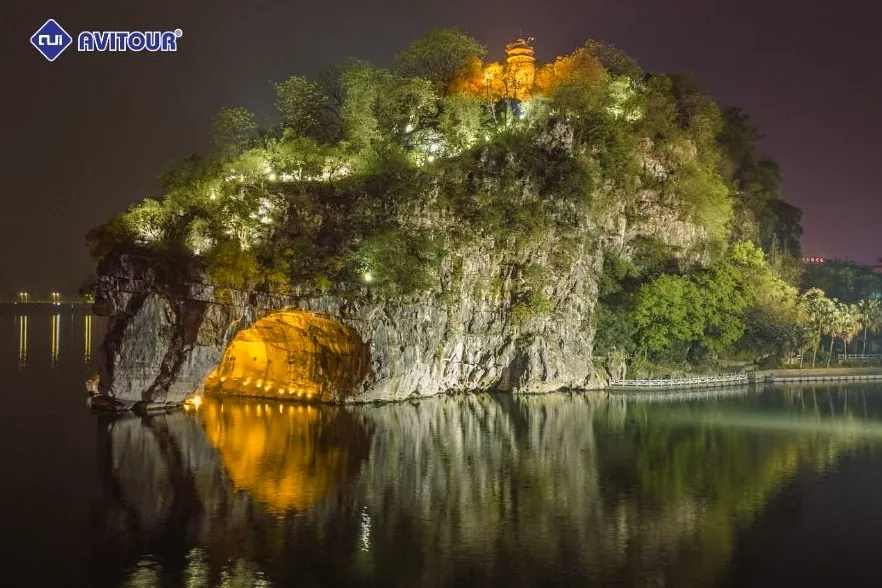
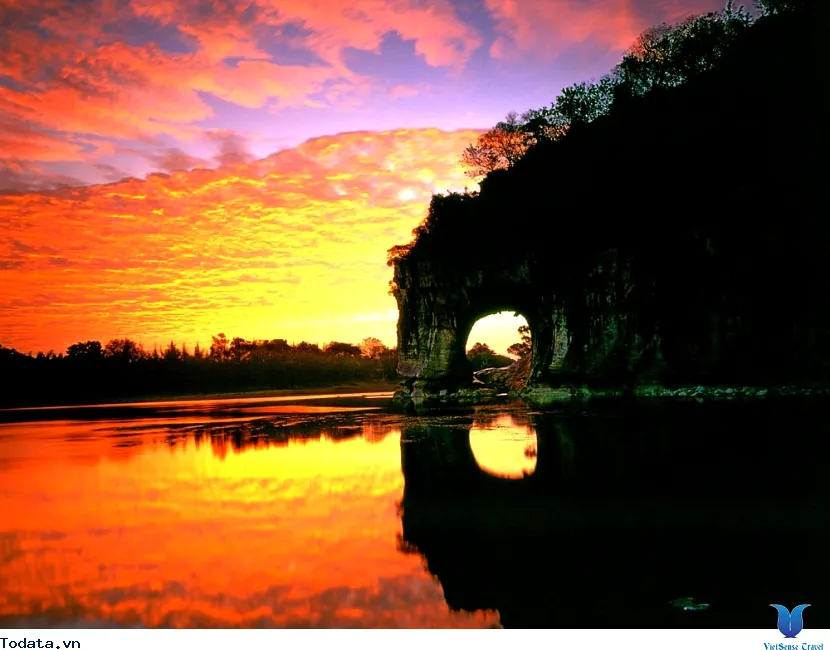
As crimson sunset fades across Guilin’s limestone valley, Elephant Trunk Hill sheds its quiet daytime dignity to enter a captivating nocturnal transformation of contemporary light art. Resting peacefully where the Peach Blossom River joins the emerald Li River, the millennial karst massif becomes a grand natural canvas—where architectural lighting weaves across moss-dappled crags and reflects brilliantly across mirror-still waters.
In the evening lightscape, Elephant Trunk Hill appears enchanting as shifting beams trace the graceful curve of the giant trunk dipping into the Li River, while soft illumination inside Water Moon Cave creates the illusion of a luminous jade moon floating atop gentle ripples, sculpting ancient limestone strata and summit foliage into a living light sculpture.
Lighting choreography at Elephant Trunk Hill goes beyond mere illumination to retell beloved local legend through modern digital artistry. The tale of the noble celestial elephant that descended to earth, fell in love with Guilin’s peaceful scenery and kindhearted people, and stayed behind to protect local villages unfolds dramatically across the vertical rock face—using multi-color lasers and water-screen projections to depict heroic battles before settling into golden serenity as Puxian Pagoda glows atop the peak, accompanied by lyrical folk music.
Evening magic around Elephant Trunk Hill reaches its peak aboard classic sightseeing boats cruising the celebrated Two Rivers and Four Lakes waterway. Gliding through cool karst canyon breezes toward Water Moon Cave, passengers witness the poetic phenomenon “A bright moon beneath the water, a bright moon floating above”—enhanced by submerged riverbed lights creating the optical illusion of two moons dancing together while live pipa melodies mingle with water lapping against limestone cliffs.
Beyond illuminated waters, evening life around Elephant Trunk Hill radiates cheerful charm along lantern-lit riverside promenades shaded by weeping willows, where visitors sip fragrant osmanthus tea in open pavilions or savor steaming bowls of herb-infused Guilin rice noodles as distant temple bells toll the late evening hours.
Beside the gentle Li River cradling the limestone peak, a spread of local delicacies unfolds like a still-life painting capturing the soul of Lingnan—headlined by classic Guilin Rice Noodles topped with glossy crisp-skinned roast pork, tangy pickled cowpeas, golden roasted peanuts, fiery chopped chilies, and fresh scallions, paired alongside steaming Li River beer fish, golden osmanthus cakes, and fragrant rice wine.
Every culinary tour around Elephant Trunk Hill begins with Guilin Rice Noodles, a dish boasting over two thousand years of history. According to ancient chronicles, in 214 BCE when Imperial Censor Jian Lu led hundreds of thousands of Qin Shi Huang’s troops to excavate the Lingqu Canal linking the Yangtze and Pearl River systems, northern soldiers accustomed to wheat noodles struggled to adapt to southern rice. Ingenious army cooks soaked rice, stone-ground it into liquid batter, strained it, and extruded long strands through perforated molds to mimic noodles—pairing them with a secret master braising sauce simmered from marrow bones and over twenty medicinal spices including star anise, amomum fruit, cloves, cassia bark, black cardamom, and aged tangerine peel, tossed dry with crisp roast pork before adding light bone broth at the end.
Another culinary treasure directly tied to Elephant Trunk Hill’s geology is Guilin Sanhua Liquor, revered as the king of traditional southern Chinese rice wines. Just as limestone stalactites filter groundwater over millennia, natural caverns deep inside Elephant Trunk Hill maintain a constant year-round temperature of 18°C to 20°C and humidity above 80%, serving as an ideal natural aging cellar since the Southern Song dynasty. Distilled from prime glutinous rice, herbal starter, and pure karst spring water drawn from beneath the elephant’s trunk, Sanhua (“Three Flowers”) earns its name from the classic pouring test in which fine effervescent bubbles rise into three shimmering, long-lasting layers of foam.
Equally iconic on local tables is traditional Li River Beer Fish. Local fishermen catch fresh river carp or catfish from swift currents and cook them with scales intact—pan-searing them golden in cast-iron woks before braising slowly with local malt beer, red horn chilies, ripe tomatoes, and fermented tofu. High heat evaporates alcohol while removing any muddy notes, leaving firm, succulent flesh infused with zesty river-town spice.
Completing the gastronomic map are delicate treats crafted from the fragrant blossom that gave Guilin (“Forest of Sweet Osmanthus”) its name: chewy steamed osmanthus cakes made from glutinous rice flour, rock sugar, and honey-cured autumn osmanthus petals, enjoyed alongside savory golden oil tea brewed from aged tea leaves, fresh ginger, and crushed garlic.
Admiring Elephant Trunk Hill from both banks of the Li River never fails to inspire awe at nature’s sculptural mastery across hundreds of millions of years—framing the glowing semicircle of Water Moon Cave beneath lush cliffside foliage.
To plan a seamless visit, keep park operating hours in mind: Elephant Trunk Hill Scenic Area typically opens from 7:00 AM to 6:30 PM in summer and 7:30 AM to 6:00 PM in winter before transitioning to evening illumination shows. Notably, general park admission is now free to the public, though visitors must complete real-name registration via the official online reservation portal or scan a QR code at the entrance service desk upon arrival; optional activities such as riverside boat cruises or bamboo raft rides beneath the stone arch carry separate posted fees.
Located right in downtown Guilin at the confluence of the Li and Peach Blossom rivers, the park is remarkably easy to reach. From Guilin Railway Station, public buses No. 2, No. 16, or No. 88 reach the Elephant Hill Park stop in roughly ten minutes, while local taxis offer inexpensive direct rides. Travelers arriving at Guilin Liangjiang International Airport can ride the airport express shuttle into downtown in about forty-five minutes before connecting to the park gate.
The finest hours for photography are early dawn or late afternoon, when low sunlight slants through Water Moon Cave to create luminous full-moon reflections on the river. Because the stone stairway ascending to Puxian Pagoda is moderately steep and limestone steps can become slick in Lingnan mist, wear sturdy non-slip walking shoes and breathable clothing. Be sure not to miss exploring the Sanhua Liquor Cellar cave deep inside the hill or stopping for a steaming bowl of spicy Guilin rice noodles at traditional eateries surrounding the park.
International visitors should ensure their passport holds at least six months of validity with an appropriate Chinese visa secured prior to departure, and set up mobile payment apps linked to international credit cards since cashless transactions dominate across Guilin. If you prefer a stress-free experience without language barriers or complex ticketing logistics, choosing a thoughtfully curated all-inclusive Guilin tour package is the ideal way to take in every angle of this millennial emblem of Guilin.