Nestled amid the rolling limestone mountains of the southwest, the history of Guiyang is an epic written through thousands of years of frontier weathering. In ancient Pre-Qin times, this land belonged to the mysterious Yelang kingdom territory of the Baipai tribes, renowned for their primitive nature worship. Entering the Western Han dynasty, Emperor Wu of Han expanded the southwestern territories, establishing Tributary Prefecture (Zangke) to assert Central Plain governance. By the Tang dynasty, the court applied the loose-rein (Kimi) policy to local chieftains, successively establishing dependent prefectures. Among them, this low-lying basin was called Hezhou, later transliterated to Juzhou, holding the vital position of a military transit post on the trade route southward.
The first defining naming turning point occurred in the first year of Xuanhe (1119) during the reign of Emperor Huizong of Song, when the court officially renamed Juzhou to Guizhou, marking the moment the two-character name Guizhou first entered official Chinese history. During the Yuan dynasty, in the 20th year of Zhiyuan (1283), Kublai Khan ordered the establishment of the Shunyuan Route General Administration, and by 1299, the first earthen fortress wall was built, laying the infrastructure foundation for a fortified capital. The fundamental historical turning point took place in the 11th year of Yongle (1413) under Ming Emperor Chengzu, Zhu Di. After quelling the bloody rivalry between the Sizhou and Sinan chieftains, the emperor permanently abolished the hereditary chieftain system, resolutely implementing the national policy of “replacing native chieftains with appointed officials” (Caituguiliu), officially establishing the Guizhou Department of Administration and designating this central land as the primary administrative seat.
Alongside the shifts of war, the 16th century marked an event that reshaped the landscape of East Asian thought when the great philosopher Wang Yangming (Wang Shouren) was exiled to the Longchang post station in the 3rd year of Zhengde (1508) during the reign of Emperor Wuzong of Ming. Amidst the harsh miasmic mountains, he attained sudden enlightenment of truth through the “Longchang Enlightenment” event, founding the famous Yangming School of Mind with the tenets of “the unity of knowledge and action” and “extending intuitive knowledge,” while simultaneously establishing the Longgang Academy to enlighten local scholars. By the 3rd year of Longqing (1569) under Emperor Muzong of Ming, the title Guiyang Prefecture was officially bestowed, originating from the ancient feng shui rule that “the south of a mountain is called Yang,” as the city was situated right on the southern slope of the majestic Gui Mountain. In 1598, the literary landmark Jiaxiu Tower was erected by the Nanming River; and by the 26th year of Kangxi (1687) under the Qing dynasty, the dismantling of military garrisons to establish Guizhu County under Guiyang Prefecture completed the transition from a defensive military outpost to a prosperous civilian administrative center.
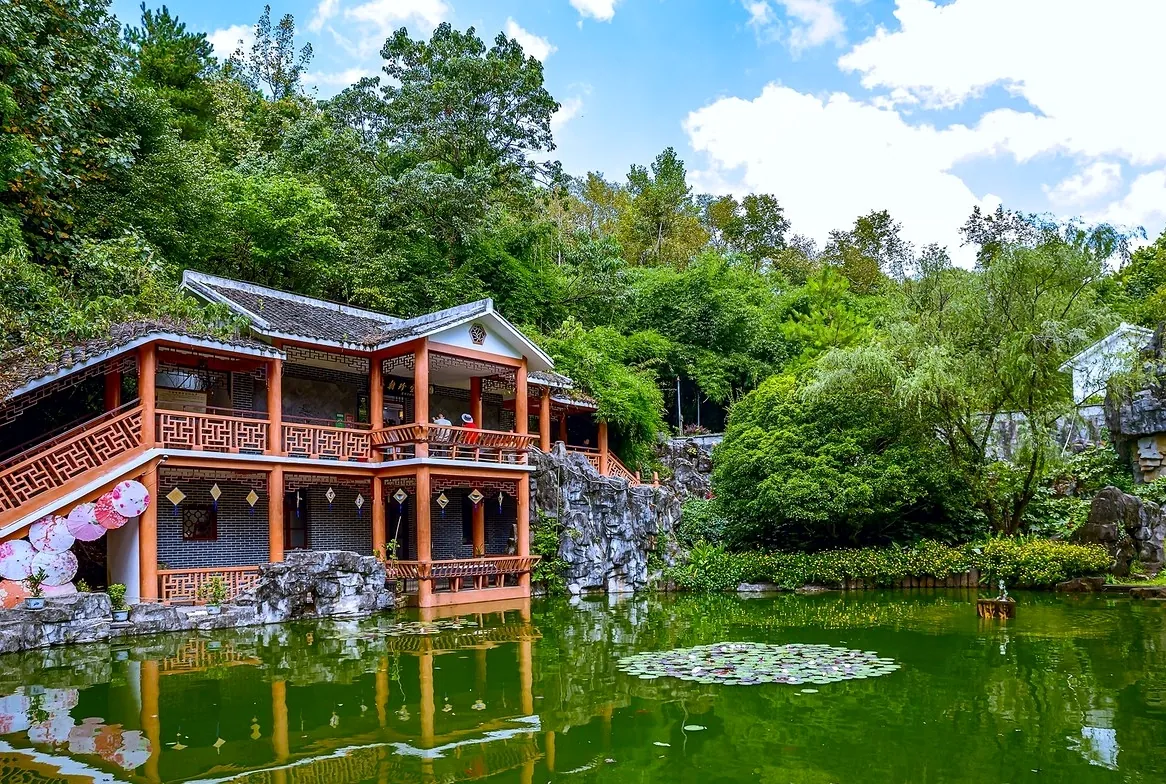
The imprints of time’s sediment and the soul of traditional local architecture still remain entirely visible through ancient houses mirroring themselves in flowing water. Standing out prominently in the space is a two-story architectural work exuding elegance with its quiet, upturned tiled eaves, accented by warm orange-painted wooden railings that contrast harmoniously against the azure sky. The building appears impressively and solidly on the edge of a crystal-clear, mirror-flat lake, where lush green water lily pads gently drift, perfectly reflecting every intricate pattern and ancient silhouette into the deep lake. Accented along the ground floor eaves are rows of brightly colored decorative window panes, harmonizing with the lush green of the dense ancient trees surrounding it, painting an ancient-style picture that is solemn, serene, and imbued with the poetic charm of a highland scenic spot.
Entering the modern era, Guiyang continues to undergo magnificent and unexpected transformations. In the 1960s, amidst the strategic context of the “Third Front Construction” aimed at building a national defense industry rear base, tens of thousands of experts and technical workers gathered here, establishing top-secret mechanical and electronic factory clusters hidden deep inside natural, solid Karst caves. It was this unique industrial foundation alongside year-round cool karst terrain that laid the premise for Guiyang in the 21st century to make a spectacular breakthrough, becoming the world’s “Big Data Valley.” From a misty frontier land of Yelang legends, Guiyang has skillfully connected a thousand-year historical thread from ancient mental philosophy to the modern cloud computing era, affirming its position as a unique economic, cultural, and technological center on the Guizhou plateau.
Amidst the rolling folds of the Yunnan-Guizhou Plateau, Guiyang emerges as a magnificent green oasis crafted by nature’s miraculous hands. The deeply dissected limestone Karst terrain once prompted ancients to utter astonished exclamations: “The roads to Shu are difficult, the roads to Qian are even harder”—the paths entering Shu were fraught with countless obstacles, and crossing the Qian passes was even more unimaginably perilous. Yet, this very topographical peril bestowed upon the city one of the most auspicious feng shui terrains in the southwest. The name Guiyang originates from its peaceful position nestled within the “sun of Gui Mountain,” meaning it nestles against the southern slope of Gui Mountain to fully embrace the warm vital energy of heaven and earth. The ancient city is skillfully surrounded by winding mountain ranges like a crouching dragon and a sitting tiger, while being nourished and gathering vital energy by the gentle Nanming River that embraces the very heart of the fortress.
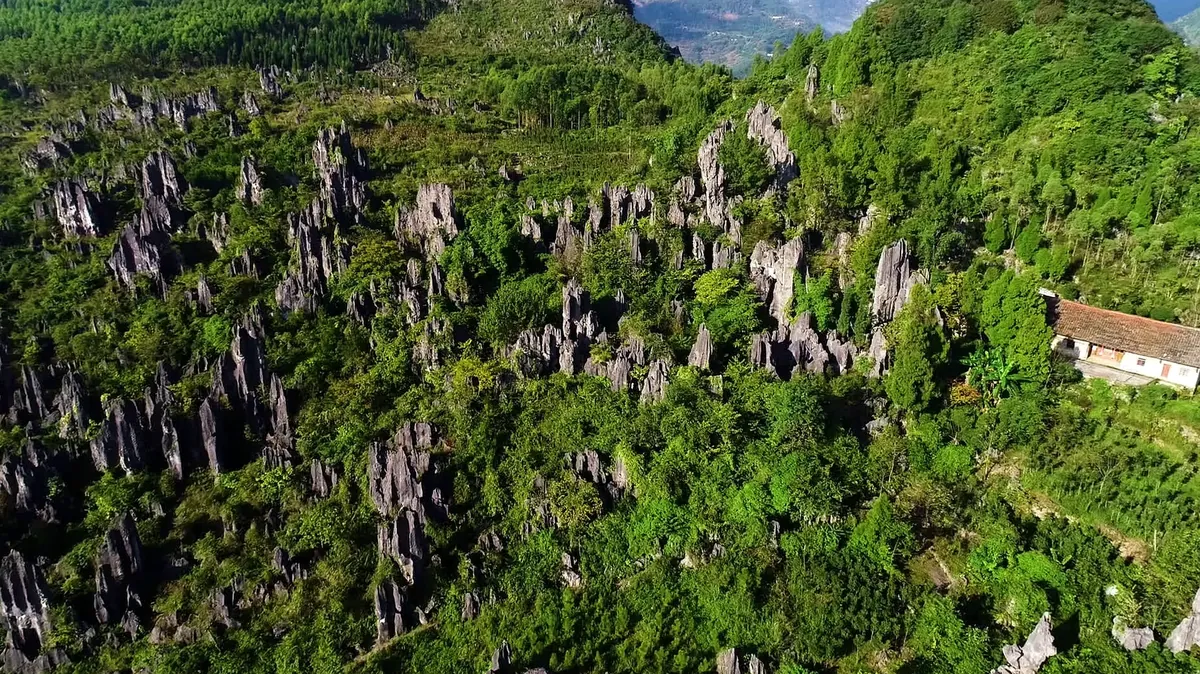
Not only endowed with breathtaking mountain and river landscapes, Guiyang is also praised by locals with the beautiful moniker “Forest City” – a city brimming with the shade of lush forests. Standing proudly at an average elevation of over one thousand meters above sea level with one of the highest forest coverage rates in Southwest China, this region boasts a uniquely gentle microclimate. While neighboring Sichuan basins or southern plains endure the blistering summer heat, Guiyang enjoys a cool, pristine atmosphere with an ideal average summer temperature of just 22.3°C. The perfect interaction between high altitude, river and lake moisture, and vast pristine greenery has allowed Guiyang to continuously hold its renowned title as the Chinese mainland’s “Summer Resort Capital”.
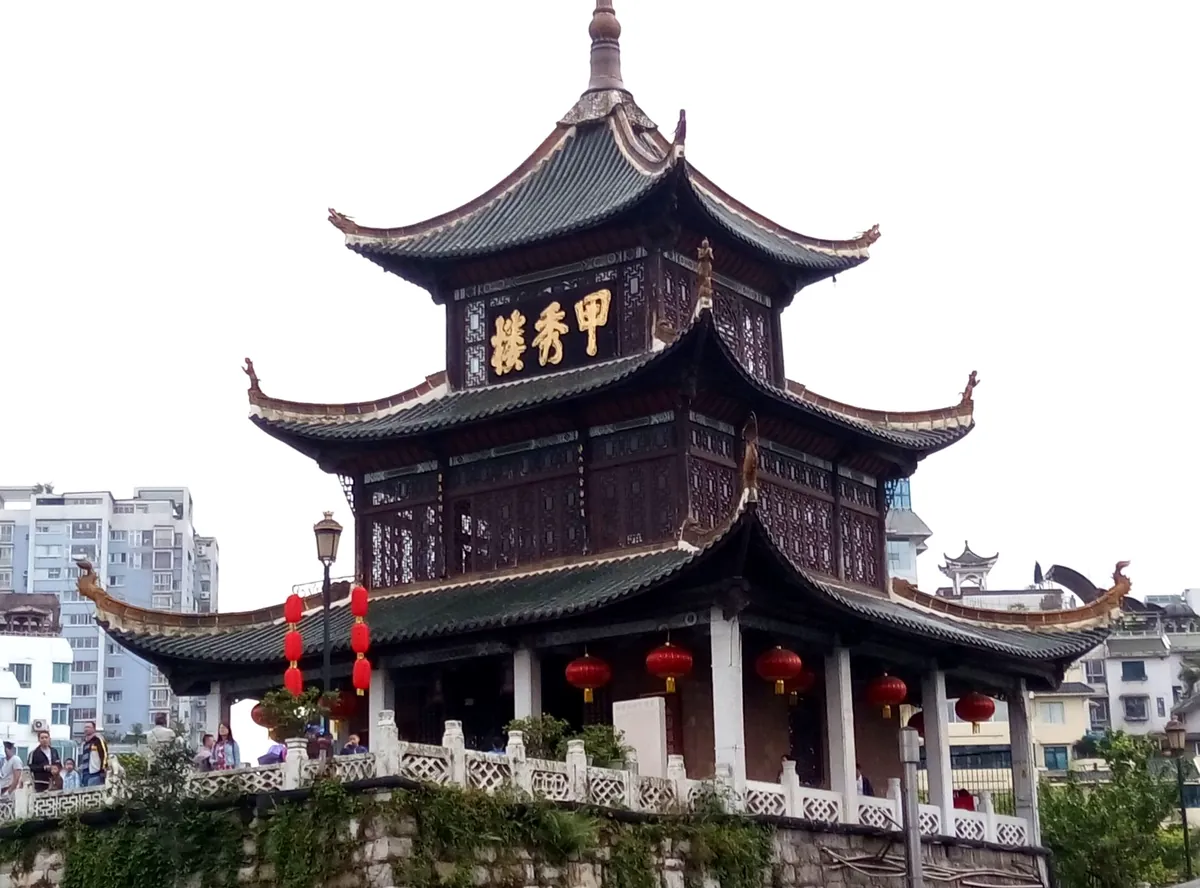
Guiyang’s picturesque natural beauty leaves a deep impression through ancient architectural structures gracefully nestled against expansive natural landscapes. Standing out in this space is a multi-tiered traditional pavilion that rises proudly, featuring curved tiled roofs intertwined with exquisitely carved wooden structures. On the solemn body of the pavilion hangs a plaque with Chinese characters inlaid in shimmering gold against a brilliant crimson background, harmonizing with the vibrant red lanterns hanging along the lower veranda. In front of the courtyard, pure white stone balustrades reflect upon rows of lush green trees where travelers leisurely stroll, poetically contrasting with the modern buildings looming on the horizon.
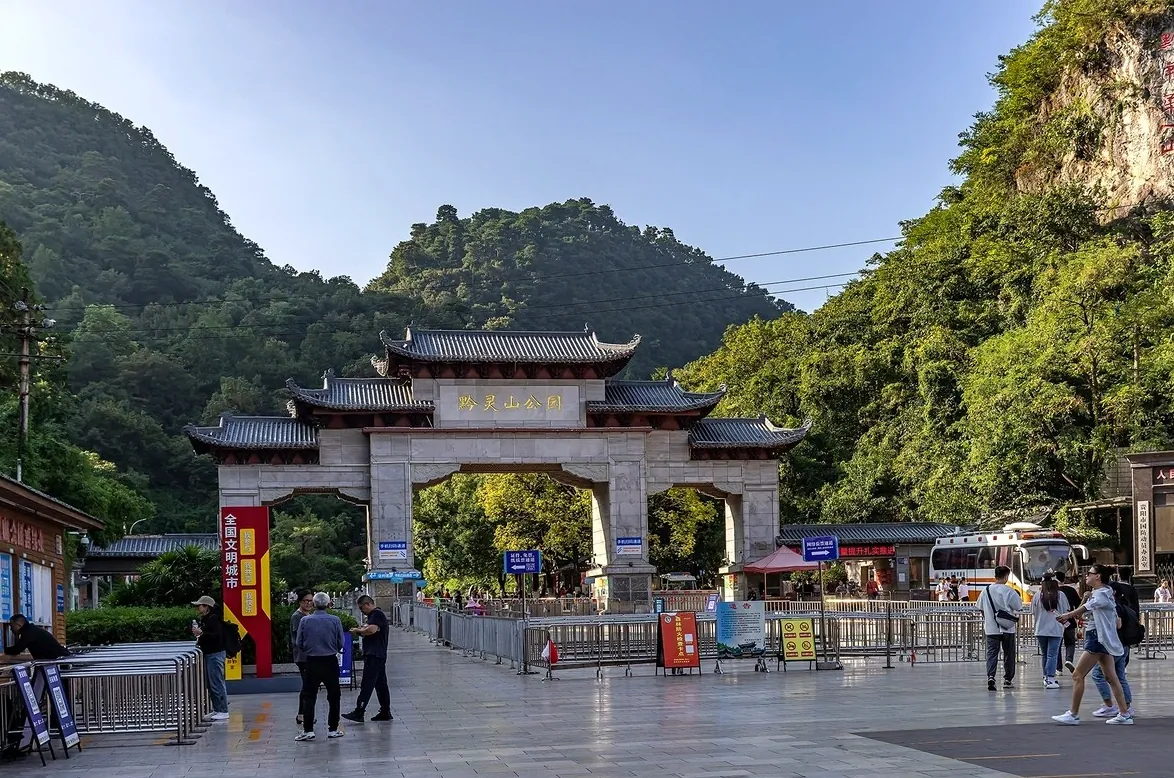
Following this scenic artery deep into the inner city, Guiyang’s natural landscape showcases its wild and mystical charm at Qianlingshan Park – a fairyland praised as the “First Scenic Mountain in Southern Qian”. This ecological core preserves pristine ancient forests, deep limestone valleys, and spectacular underground cave systems shaped over millions of years of weathering. Beneath the shaded canopies of pine and cypress, troops of wild macaques thrive naturally in their thousands, leisurely swinging through the branches along trails leading to solemn ancient temples, weaving a magical picture of symbiosis between wild nature and the dynamic urban rhythm.
In the panoramic geographical picture of Guizhou province, Guiyang’s terrain holds a strategic throat position, serving as a gathering center and a unique transit gateway bringing travelers to world-famous geological wonders. From the network of urban karst valleys, transportation arteries quickly pave the way westward to admire the majestic Huangguoshu Waterfall cascading with white foam amidst the great forests, or head south to access the jade-green Libo Xiaoqikong Karst cluster. The seamless blend of ecological urban planning and strict respect for the natural karst terrain has turned Guiyang into a model example of a modern city developing harmoniously in the heart of nature.
Guiyang’s urban spatial foundation was shaped from a critical military outpost within overlapping karst valleys. Originating in the Song Dynasty with crude earthen ramparts, its defense planning entered a golden age during the Ming Dynasty when it was expanded into a solid stone fortress with a circumference of nine li, equivalent to about 4.5 kilometers. This ancient citadel structure operated through five city gates imbued with the philosophy of governing and pacifying the country, typically the Chaotian Gate facing North to show allegiance to the Son of Heaven, or the Dehua Gate in the South symbolizing virtue and the education of all people. The vitality of ancient military architecture still remains intact at the over six-hundred-year-old Qingyan Ancient Town, where the city walls, watchtowers, and fortifications are entirely carved from local boulders, creating an impregnable fortress amid the rugged mountains.
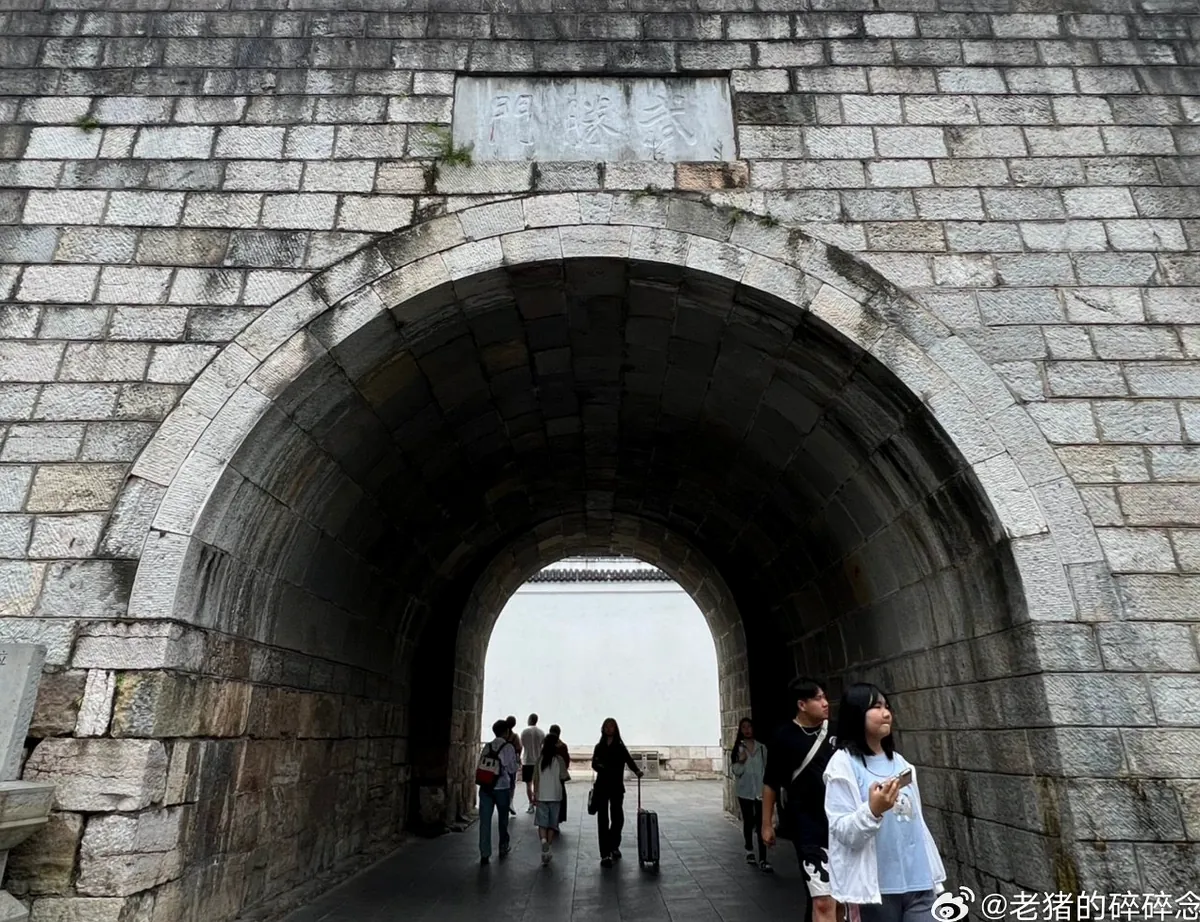
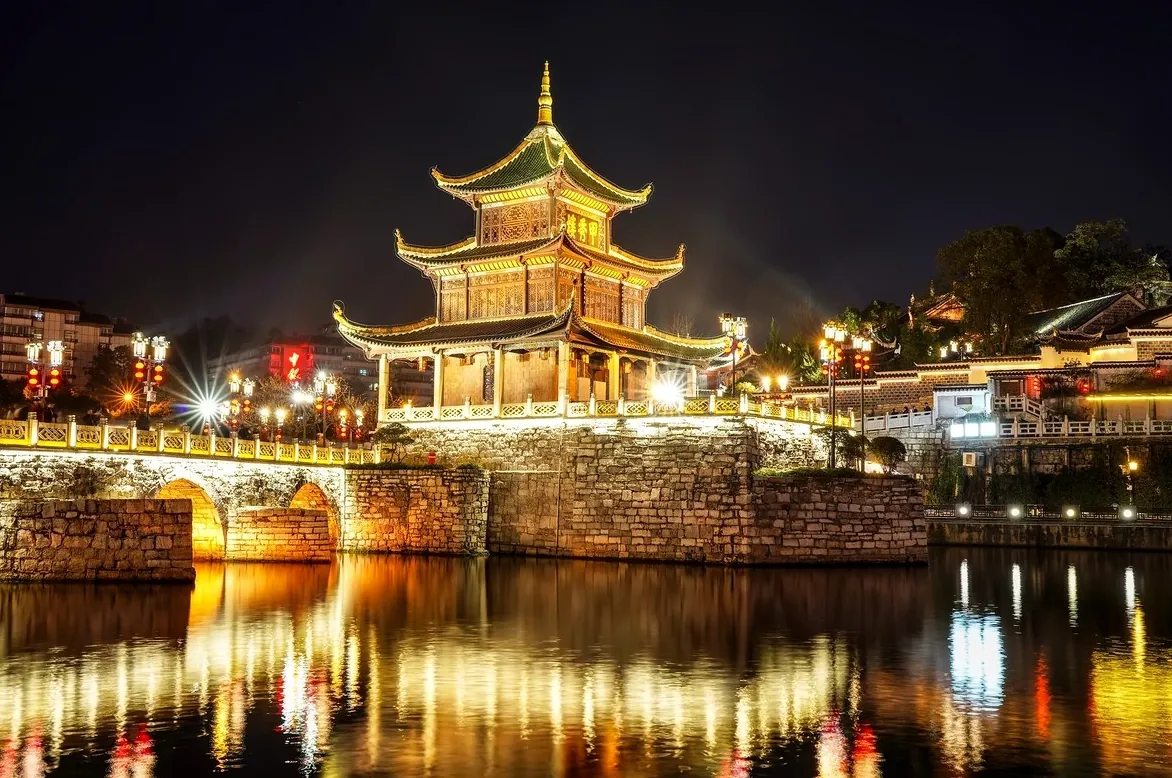
Running parallel to this resilient martial spirit, Guiyang’s cultural fabric brilliantly blossoms through its religious and traditional landscape architecture. The most prominent landmark along the tranquil Nanming River is Jiaxiu Tower, a famous pavilion initially built in 1598 during the Ming Dynasty. The structure features a unique “three-tier, three-eave” architectural design standing 22.9 meters tall, adorned with three curved roofs covered in vibrant green glazed tiles. Its graceful white stone columns are intricately carved with images of dragons and phoenixes paying homage to the clouds, reigning majestically atop the towering Aojiang Rock amidst the rushing current. Not far away, nestled among lush forests at the peak of Qianling Mountain, the Hongfu Temple complex represents the tranquil, solemn beauty of Qing Dynasty Chan Buddhism, where ancient wooden temple buildings blend harmoniously into the serene mountain scenery.
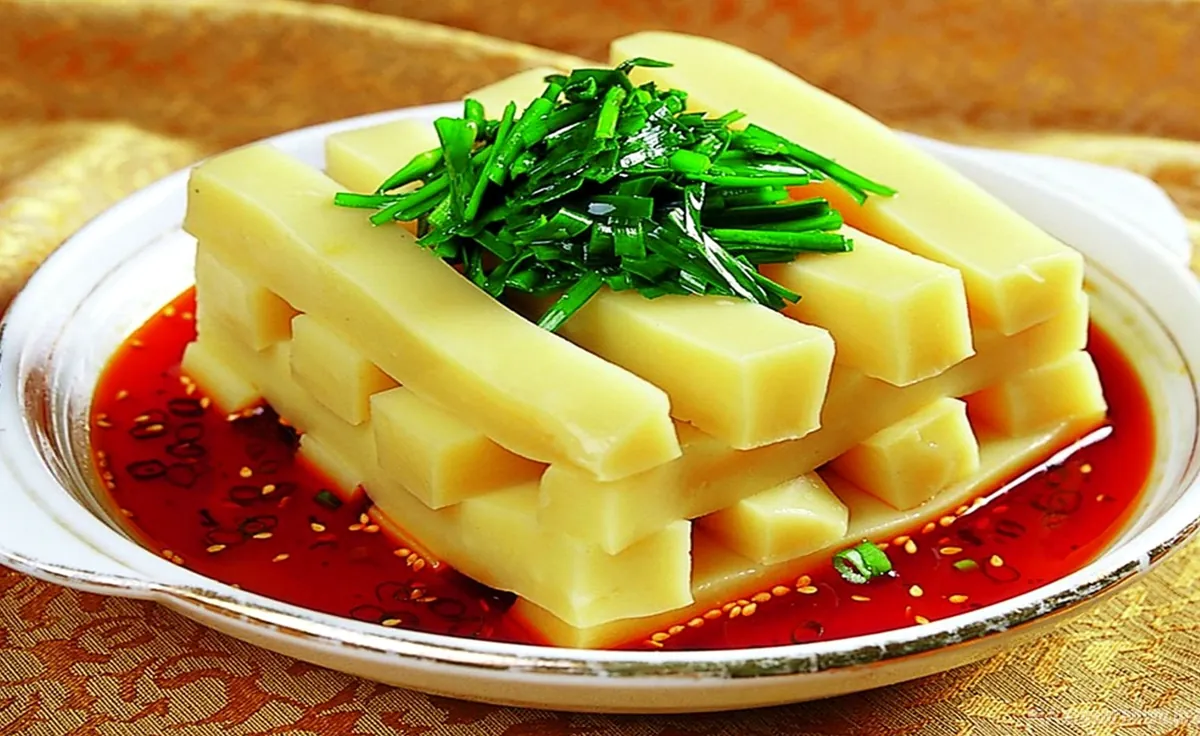
Venturing deep into the blue-slate-paved alleys of the ancient citadel, rustic local culinary flavors emerge as a vivid cultural piece that softens the ruggedness of the military fortress walls. Travelers often encounter local specialties elegantly presented, featuring meticulously cut rectangular yellowish pieces neatly stacked in a sleek white porcelain bowl. The dish is drenched in a signature vibrant red, spicy chili sauce characteristic of Guizhou, evenly sprinkled with aromatic toasted white sesame seeds and crispy dried chili flakes, and topped with a pinch of vibrant green chopped scallions—creating an enchanting masterpiece that captivates both the eyes and the sense of smell.
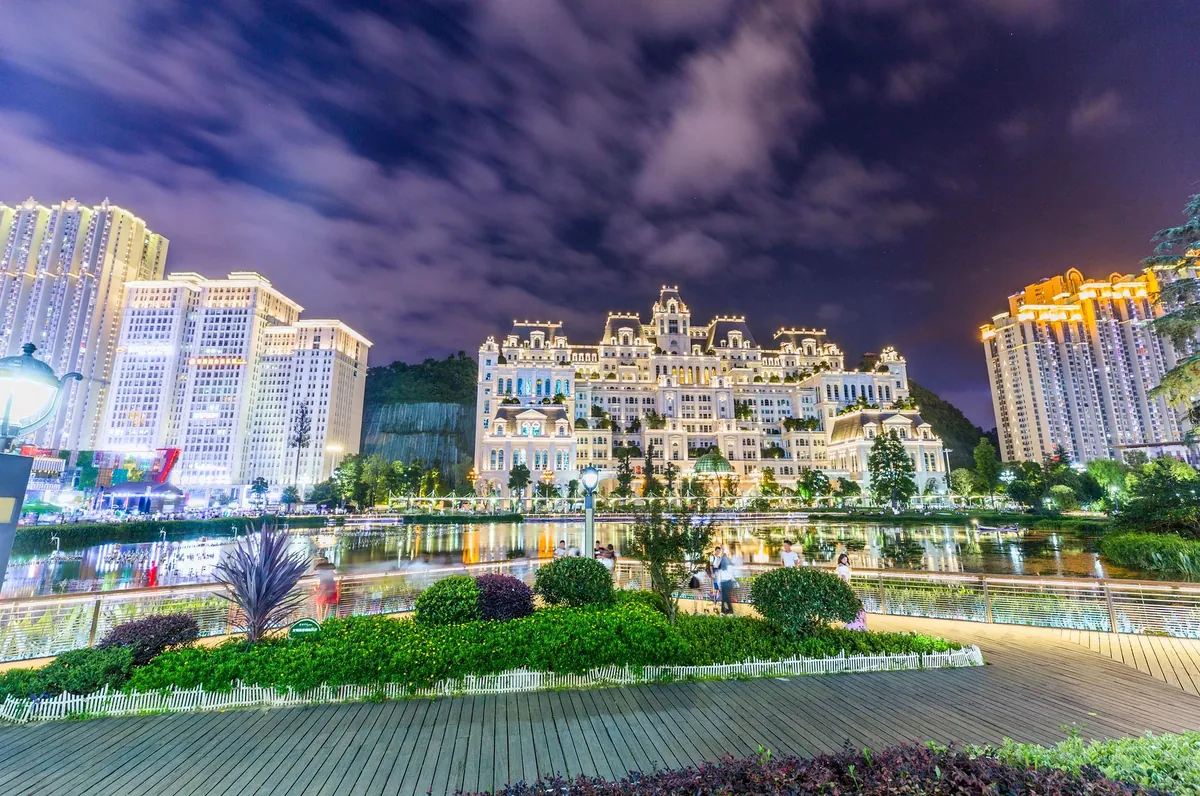
Emerging from the sediment of ancient ramparts, Guiyang’s spatial structure in the new era has achieved a striking breakthrough with a high-density compact urban development model. A prime example of this explosive transformation is the Huaguoyuan mega-urban area, with a total gross floor area of up to 18.3 million square meters, making it one of the largest residential complexes in Asia. Once a swampy, depressed valley, this land has transformed into a magnificent vertical complex, home to nearly half a million urban residents across hundreds of closely packed 40- to 50-story skyscrapers. Delicately crafted in grand fashion right at the foot of towering natural karst cliffs is the Guanyuan Art Center, often referred to as the “Guiyang White House,” a lavish neoclassical mansion that glows brilliantly as night falls.
Guiyang’s shift in status from a remote mountain outpost to a leading technology and big data center is fully crystallized in the 335-meter-tall Guiyang Twin Towers complex. Encased in a modern reflective glass skin that mirrors the surrounding sky and rolling terrain, the twin towers not only set a pinnacle for commercial and financial architecture but also symbolize the aspiration for global integration. The dramatic contrast between mossy tile roofs, centuries-old sandstone city walls, and towering megastructures reaching toward the sky defines the city’s unique identity, portraying a Guiyang that both quietly preserves its heritage and proudly breaks through beyond eras.
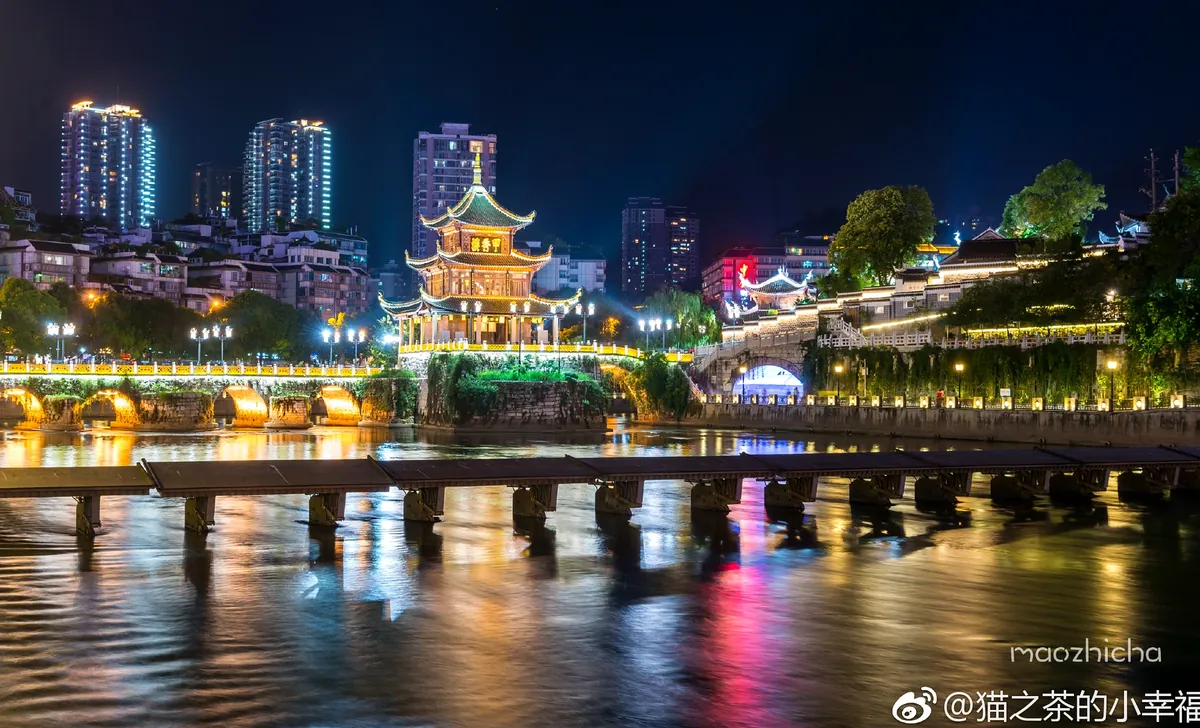
As the sunset gradually withdraws from the undulating folds of the karst valley, Guiyang enters a magical transformation of colors, where the boundary between millennia-old strata and the pulse of a modern compact metropolis dissolves beneath brilliant spectra. The starting point for this nocturnal visual journey is the serene bend of the Nanming River, where Jiaxiu Tower—a three-tiered, three-roofed pavilion masterpiece dating back to the Wanli era of the Ming Dynasty—lights up like an ancient pearl floating in the heart of the city. The entire graceful wooden architecture is draped in a regal golden glow, shimmering and reflecting upon the mirror-like water surface, seamlessly connecting to the subtle, curving nine-arch Fuyu Bridge. Under the tranquil night lights, every upturned eave and intricately carved railing of the ancient pavilion seems to fully preserve the soul of old Lincheng, contrasting sharply yet harmoniously blending with the sparkling distant highway lights twinkling on the horizon.
Leaving behind the quiet, dreamy realm of the ancient pavilion, the visual rhythm reaches a climax as visitors step into the Huaguoyuan metropolis – a symbol of the miraculous rise of Guizhou’s compact urban architecture. Rising amidst the limestone valley is the monumental structure commonly dubbed the “White House of Guiyang”, a magnificent European neoclassical mansion featuring majestic column orders, splendid Baroque domes, and silvery illuminated fountains by the lake. When tens of thousands of high-power lights are activated, the entire colossal castle seems to blaze with proud brilliance, casting a surreal beauty against the surrounding towering limestone peaks. Right next to it, the Guiyang Twin Towers soar proudly up to 335 meters, tearing through the night sky and turning tens of thousands of square meters of glass surface into a gigantic LED mapping screen. Digital streams, stylized Miao ethnic brocade patterns, and continuous 3D wavy effects constantly morph across the night sky, showcasing the technological prowess of a leading cloud data hub in the Southwest region.
Running parallel to this extravagant visual feast is a vibrant street life full of human warmth, pulsing with culinary smoke at Qingyun Market and the 24-Alley Ancient Pavilion. Originating from an old textile factory of past decades, Qingyun Market has today been reborn into a retro-styled complex of nightlife, arts, and culinary culture, where raw brick walls and glowing neon signs interweave harmoniously. Guiyang’s nightlife truly awakens after ten o’clock and keeps its bustling energy alive until two or three in the morning. The air is filled with the signature spicy-numbing aroma of Guizhou grilled chili, the rich, tangy scent of fermented tomatoes bubbling in Miao-style spicy fish soup, and the sizzling, crispy sounds of lover’s tofu roasting over fragrant charcoal.
Along rows of tables spilling onto the sidewalks, the clinking of midnight beer glasses blends with hearty laughter in local dialects, painting a vivid cultural portrait of the Yunnan-Guizhou plateau’s night-dining scene. From bowls of steaming fresh flower beef noodles sprinkled with chopped cilantro to skewers drenched in fiery Chili-flavor powder, everything nurtures the free-spirited, carefree epicurean soul of the locals. The nighttime pulse of Guiyang thus goes far beyond technological displays or golden heritage; it is a sublime gathering of human warmth, flavors, and urban memories burning brightly through the watch of the night.
The rugged plateau terrain and year-round misty humidity have forged the soul of Guizhou cuisine (Qian flavor) with a one-of-a-kind profile: refreshingly tart and passionately spicy. The people of Guiyang have long encapsulated this lifestyle in a famous local proverb: “San ri bu chi suan, qi bu da zuan” (三天不吃酸,走路打蹿蹿 – meaning if you don’t eat something sour for three days, your steps are bound to stagger). The sourness in the Qian region is not the harsh acidity of industrial vinegar, but the meticulous precipitation of natural fermentation. Standing out on Guiyang’s culinary map is Suantangyu (酸汤鱼 – Kaili Sour Soup Fish), a culinary heritage hailed as a local national treasure. The bubbling, vibrant red broth is a marvelous harmony between “Red Sourness” – wild highland tomato puree fermented tightly in earthenware jars for one to two months to develop a rich, fragrant yeast – and “White Sourness” gently distilled from fermented glutinous rice water. When boiled with slices of fresh, sweet river catfish or carp, the local chef adds a few drops of litsea cubeba essential oil (mountain pepper or may chang) fragrant with the wild mountain aroma, creating a tangy, spicy, and chilling lingering aftertaste that spreads across the palate.
If sour fish soup represents sophisticated culinary art, Changwang Noodles (肠旺面) embody the soul of vibrant, everyday mornings in Guiyang’s old town. The name “Changwang” stems from the combination of pig intestines (chang) and pig blood (wang), while sounding like “Changwang” (prosperity and longevity), wishing for a prosperous and smooth life. A bowl of Changwang Noodles captivates diners with its layered structure: alkaline egg noodles continuously kneaded by artisans on bamboo racks to create a signature chewy texture, topped with rich, braised pork intestines, tender pig blood as smooth as young tofu that melts on the tongue, and crispy fried pork cracklings. When drenched in rich bone broth topped with a fiery red chili oil film, the bowl becomes a perfect symphony of both sight and taste, awakening all the diner’s senses.
Strolling through the bustling food alleys at dusk, visitors cannot help but fall in love with the delicate, meticulous nature of Siwawa (丝娃娃 – Silk Doll Wraps). This evocative name comes from the image of thin, silk-like wrappers cradling vegetable fillings, looking just like a newborn baby snugly wrapped in swaddling clothes. On a traditional bamboo platter, diners manually arrange 12 to 16 finely shredded fillings including crispy white radishes, young bamboo shoots, bean curd skin, cucumbers, and notably, fresh houttuynia (fish mint) – the symbolic herb of the Qian region. The ultimate highlight of Siwawa lies in its exclusive dipping sauce made from soy sauce, minced ginger and garlic, and Guiyang’s legendary spicy chili, drizzled lightly into the wrapper to fully experience the refreshing, crunchy textures intertwined with a deep, tingling spice.
Right next to the Siwawa stalls is the alluring, fragrant smoke from charcoal grills making Lian’ai Doufu (恋爱豆腐果 – Love Tofu), a street snack tied to the dating memories of generations of city residents. Blocks of soft tofu are slowly grilled over wood charcoal until their outer skin puffs up golden and crispy, while the inside turns as soft and fluffy as a cloud; vendors use a small knife to slice a slight opening in the side and stuff it with a mixture of pickled minced chili, scallions, fish mint, and spicy garlic soy sauce. To cap off a culinary journey through the Qian region, nothing is better than sipping a glass of Moutai (China’s national liquor) renowned worldwide, originating from Guizhou’s Chishui River with its rich, pure soy aroma, or raising a glass of crisp, refreshing Guiyang-style draft beer at bustling night banquet tables, fully sensing the bold spirit and warm human hospitality of this highland landscape.
The transportation system connecting to the Qian region today is very smooth and convenient thanks to the strong development of the modern intermodal network. The Gui-Nan high-speed railway, operating at a design speed of up to 350 km/h, is a strategic backbone that shortens travel time from Nanning East Station to downtown Guiyang to just 2 hours and 15 minutes. Departing from Vietnam, the combined road and high-speed rail route goes from Hanoi through the Huu Nghi International Border Gate (Lang Son), completes immigration procedures to Pingxiang, and then follows the G7211 expressway to Nanning to transfer to the high-speed train to Guiyang North Station, with a total transit time of about 6.5 to 8 hours. In addition, direct or connecting flights landing at Longdongbao International Airport (KWE), located about 11 km from the city center, also provide a quick alternative connection by air. Administrative procedures are now optimized as the group visa policy has an actual processing time of 3 to 5 working days for groups of two or more, making entry smooth and precise.
Alongside scenic experiences, mastering travel security rules and identifying local commercial traps are prerequisites to keeping the joy of your journey intact. Although Guiyang’s pace of life is deeply peaceful, visitors still need to be wary of the "Miao Silver" matrix at suburban stops. Here, inferior handmade silver jewelry is often inflated in value to 25 to 45 RMB per gram through absurd rhetoric about "traditional snow silver curing all diseases." Another sophisticated trick is the forced herb grinding trap: roadside traditional medicine stalls often invite travelers to buy high-land Gastrodia elata or Notoginseng at prices vaguely listed per tael, then quickly crush them into fine powder in a grinder before demanding a payment dozens of times higher than the actual cost. In addition, ceramic jars labeled "Moutai Town Internal Liquor" sold loosely at cheap prices are mostly industrial alcohol disguised as famous liquor. To protect the rights of travelers from afar, Guizhou province has established a 12345 monitoring hotline with a commitment to unconditional refunds within 30 days for cases of forced shopping, while recommending that travelers prioritize standardized itineraries with zero shopping stops to completely eliminate hassles.
The 5-day 4-night itinerary is considered the golden ratio to capture the essence of both the landscapes and the culinary flavors of Guiyang. The first day kicks off with a high-speed train from Nanning arriving at Guiyang North Station at dusk, just enough time for travelers to check in, rest, and immerse themselves in the vibrant night food paradise at Qingyun Road. The second day focuses on downtown icons: admire the serene, ancient Jiaxiu Pavilion reflecting on the Nanming River in the early morning, stroll to watch wild macaques around the ancient Hongfu Temple amidst the lush greenery of Qianlingshan Park, and as dusk falls, behold the magnificent Huaguoyuan White House complex, resembling a European castle glowing brightly in the heart of the limestone valley. On the third day, the route leads to Anshun County to witness the majestic Huangguoshu Waterfall, listen to the roaring sound echoing through the water curtain cave, and savor the sour fish hotpot (Suantangyu) fragrant with local chili fermentation.
The final days of the trip expand the exploration boundaries to the emerald-water wonder of Libo Xiaoqikong or let your soul drift into the mythical space of Xijiang Qianhu Miao Village with thousands of overlapping wooden stilt houses lit up against the hillside. On the morning of the fifth day, visitors can leisurely stroll to shop for Qianhong tea specialties or famous chili sauces at the Hunter City shopping center before catching the southbound HSR train to conclude the vacation. To turn all the complex experiences of travel logistics, visas, and language barriers into a smooth, worry-free trip, choosing an all-inclusive tour package is the optimal solution to help travelers leisurely enjoy the majestic scenery and cultural depth of ancient Guizhou.