The origins of the Potala Palace are deeply intertwined with profound spiritual legends on the roof of the world, where its name is a smooth phonetic translation of the Sanskrit noun “Potalaka” (meaning Mount Potalaka in Chinese characters), signifying the pure sacred mountain—the serene abode of Avalokiteshvara, the Bodhisattva of Compassion. Tracing back through history to the 7th century, specifically in 637 AD during the eleventh year of the Zhenguan era under Emperor Taizong of the Tang Dynasty, the exceptional Tsenpo (Emperor) Songtsen Gampo completed the unification of various tribes across the vast Tibetan plateau. Deciding to relocate the center of power from the fertile Yarlung Valley to the Lhasa Valley, he ordered the construction of a large-scale royal fortress atop Red Hill (Marpori). The initial structure comprised nine sturdy tiers with 999 majestic rooms, at the highest peak of which was a secluded sanctuary dedicated to the Tsenpo’s meditation, while simultaneously preparing to welcome two historic consorts: Princess Bhrikuti of Nepal and Princess Wencheng from the Great Tang imperial court, who entered Tibet in 641.
However, the glorious era of the premier Tibetan fortress did not endure forever against the fierce vicissitudes of time. In the late 9th century, around 877 AD, following the devastating persecution of Buddhism under King Langdarma, the plateau plunged into a relentless vortex of internal conflict and fragmentation. Bloody clashes, fires, and lightning strikes reduced most of the original massive structure to ashes. After hundreds of years of decay, all that remained of the Tibetan dynasty’s heritage on Marpori Hill were two miraculously intact original relics: the quiet Chogyal Drupuk (Dharmaraja Cave) where Songtsen Gampo once meditated, and the solemn Phakpa Lhakhang (Holy Avalokiteshvara Chapel), which has enshrined the self-manifested sacred wooden statue of Arya Lokeshvara dating back to the 7th century for generations.
The majestic appearance that humanity gazes upon today was actually powerfully reborn in the 17th century under the Ganden Phodrang government. In 1642, with formidable military patronage from Gushri Khan of the Khoshut Mongol tribe, the 5th Dalai Lama, Ngawang Lobsang Gyatso, officially unified secular and religious power across all of Tibet. In 1645, during the second year of the Shunzhi era of the Qing Dynasty, he ordered large-scale reconstruction on the ancient foundations, and three years later, the graceful White Palace (Karpo Podrang) was officially completed to serve as his court and residence. A historic turning point occurred in 1682 when the 5th Dalai Lama passed away; to maintain political stability and complete the grand construction aspirations, Regent Desi Sangye Gyatso kept the news hidden for fifteen long years, announcing that His Holiness was in deep Samadhi meditation. Between 1690 and 1694, during the Kangxi era of the Qing Dynasty, over 7,000 master craftsmen from Tibet, inner China, Nepal, and Mongolia were mobilized to build the Red Palace (Marpo Podrang), consuming a colossal budget exceeding 2.13 million pure silver taels.
Towering majestically atop Marpori Hill with an elevation far surpassing the urban ground level, the entire complex emerges as a masterpiece that perfectly fuses a formidable military fortress with a solemn Buddhist sanctuary. The massive, pristine white walls of the White Palace embrace the deep red architecture of the Red Palace stretching straight up into the blue sky, creating a breathtaking visual contrast beneath the breezy plateau sky. Accenting the topmost level is the resplendent golden roof complex glittering brightly, contrasting harmoniously with the peaceful rhythm of life in the Lhasa districts sprawling below and the barren, rocky mountain ranges perpetually wreathed in distant white clouds at the horizon.
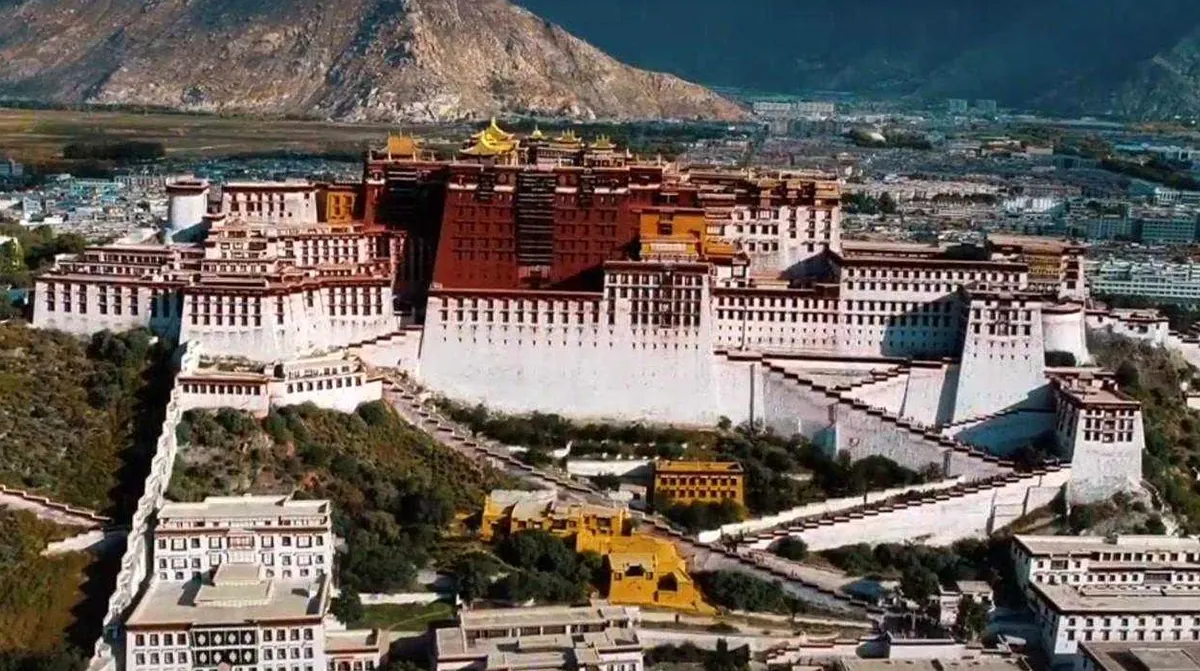
Entering the 20th century, this sacred space continued to witness pivotal reconstruction milestones. In 1922, the 13th Dalai Lama, Thubten Gyatso, presided over a comprehensive major restoration, expanding the East Sunshine Pavilion, redesigning the Xuecheng (Snow City) area at the foot of the hill, and embellishing the serene Dzongyab Lukhang (Dragon King Pool) park behind the cliff face. Despite enduring the historic political turmoil of March 1959 which led to the exile of the 14th Dalai Lama, as well as the tumultuous storms of the Cultural Revolution between 1966 and 1976, the Potala fortunately preserved its priceless values intact thanks to strict special military protection orders from Premier Zhou Enlai. In 1994, UNESCO proudly inscribed the Potala Palace as a World Heritage Site, before expanding the protected zone to include the Jokhang Temple in 2000 and the Norbulingka Palace in 2001, forever cementing it as the pinnacle symbol of Tibetan civilization on the map of human heritage.
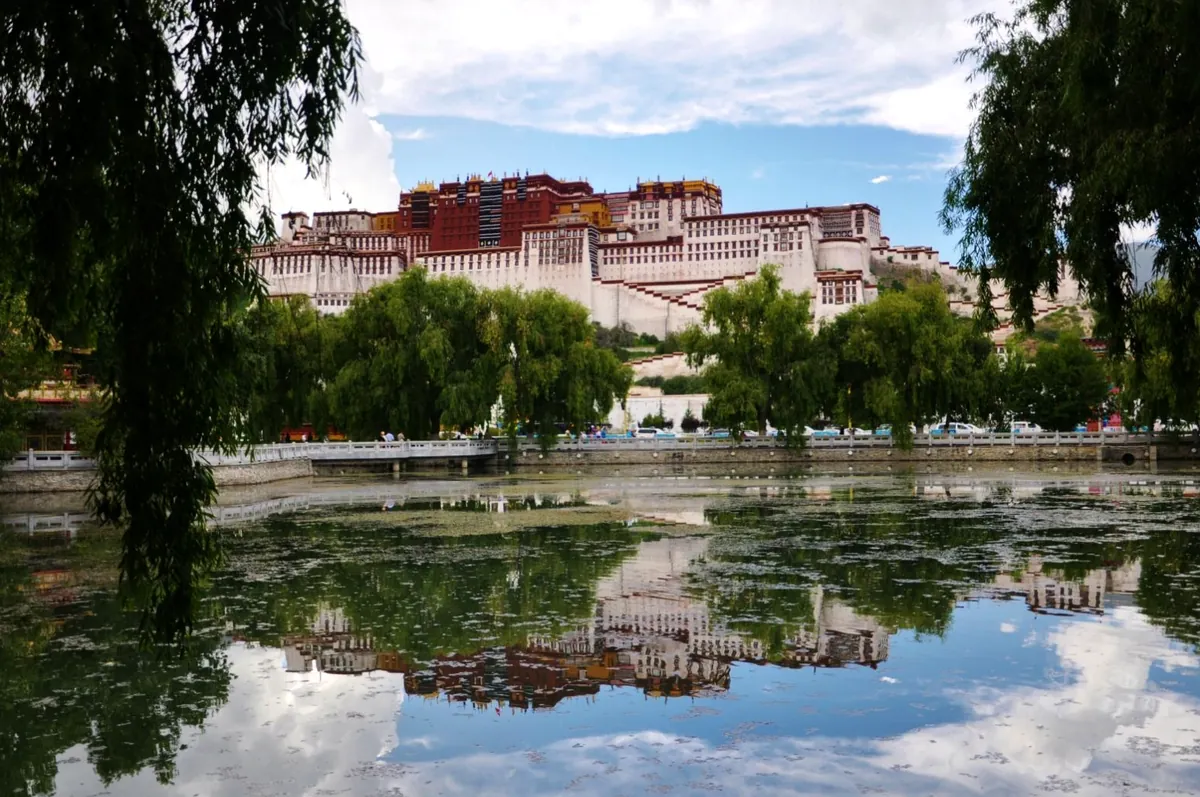
Situated at the focal point of the Lhasa River valley—a fertile tributary of the magnificent Yarlung Tsangpo river at geographic coordinates 29°39’28” N and 91°07’01” E, the Potala Palace stands imposingly as a wonder crystallized by human hands and the wondrous arrangement of nature. The entire massive architectural complex is built clinging tightly to the slopes of Marpori Hill (Red Hill), a dark red sandstone formation rising abruptly from the vast basin plain. Standing at an absolute elevation of 3,756 meters above sea level, the structure ascends to the highest peak of the Red Palace at 3,767 meters, creating a breathtaking vertical topographic slope of over 115 meters from the foot of the hill to the golden-tiled roofs. The absolute blending of natural cliffs and sturdy fortress walls seems to blur the boundary between the sacred mountain and the palace, transforming the Potala into an impregnable fortress rising from the womb of the Tibetan motherland.
}
From the perspective of Tibetan Tantric feng shui, the location of Potala is not merely a strategic military stronghold but also the ultimate spiritual epicenter of the entire Snow Land. Marpori Hill does not stand alone; together with two neighboring elevations—Chokpori (Medicine King Mountain) and Bamari (Toad Mountain or Mopan Mountain)—it forms the classic “Three Peaks” tripod formation. This trio of sacred guardian mountains represents three revered Bodhisattvas: Avalokiteshvara, Vajrapani, and Manjushri, whose combined spiritual energy has protected the holy city of Lhasa through thousands of years of storms. The palace is meticulously oriented facing south with its back to the north, utilizing the sheer rock face of Red Hill as an unshakeable stronghold to block harsh northern cold drafts while opening its entire facade to the direct south to capture maximum solar radiation and warmth in the arid, high-altitude climate of the roof of the world.
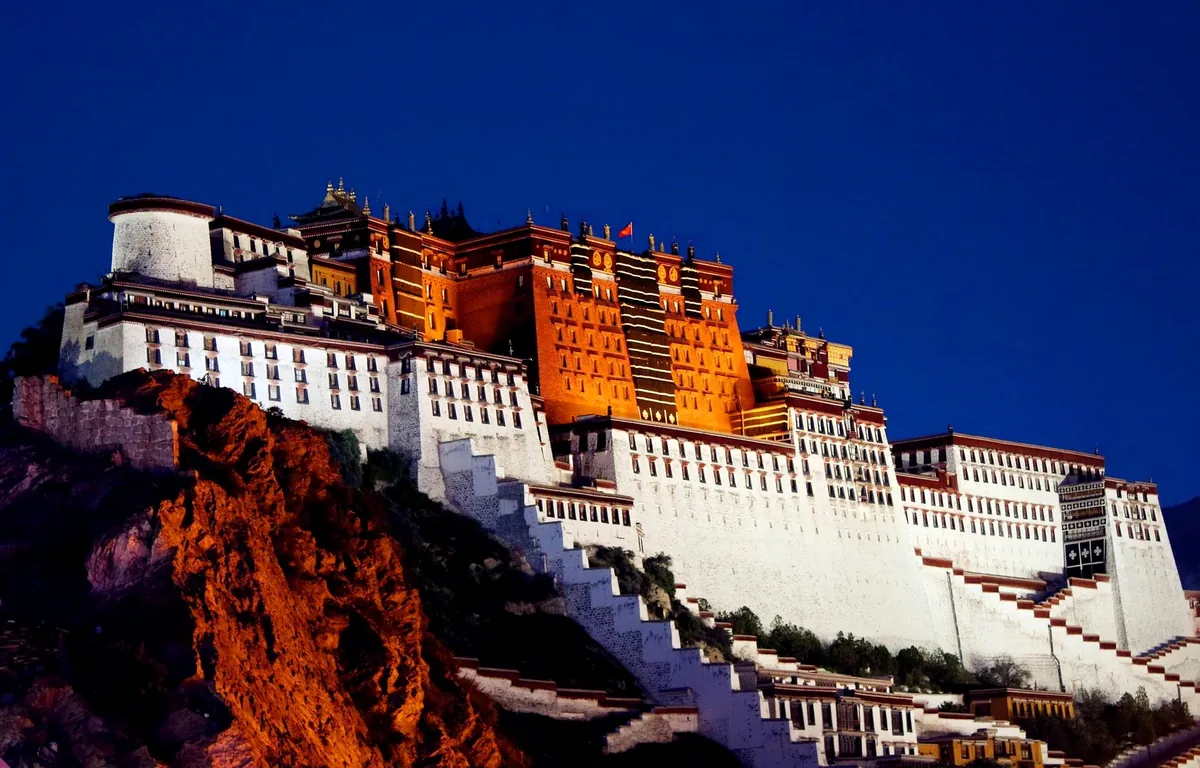
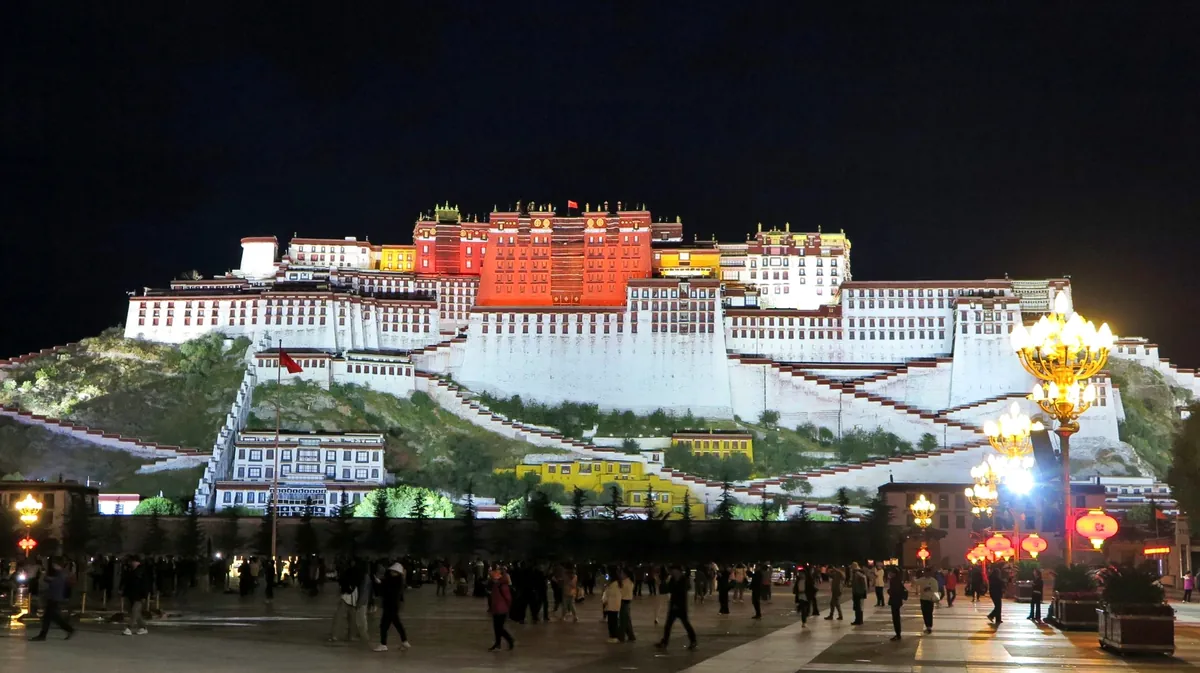
As dusk falls and night blankets the snow-covered plateau, the Potala Palace emerges like a sacred lotus glowing brilliantly in the quiet stillness. Artistic floodlights cast from the base of the sandstone cliff illuminate the raw, rugged rock textures, fully supporting the majestic architectural structure featuring two classic contrasting tones: the ethereal white White Palace enveloping the solemn deep-red Red Palace at its center. Beneath the endlessly deep blue Tibetan night sky, the castle radiates a brilliant, mystical aura, showcasing the ultimate grandeur of a human marvel standing proudly between heaven and earth.
Encompassing the regal terrain of Potala is an expansive and magnificent natural ecological belt. Gazing far beyond the Lhasa valley, travelers are greeted by the eternal ramparts of the Himalayas and the perpetually snow-capped Nyenchen Tanglha mountain range, which welcomes gathering clouds year-round and shields the basin from harsh geological upheavals. The harshness of the oxygen-deficient plateau climate is miraculously balanced by the tranquil waters of the Dragon King Pond (Zongjiao Lukang) park, nestled right behind the base of Red Hill. The jade-blue surface of the lake not only acts as an ecological lung regulating the microclimate of the entire area, but also serves as a giant mirror reflecting the quiet, majestic silhouette of the millennial palace through the changing seasons.
Acclaimed as one of the greatest architectural wonders of the ancient and medieval world, the Potala Palace complex rises proudly atop Marpori Hill at an impressive altitude of 115.7 meters, featuring 13 overlapping tiers and a total construction area exceeding 130,000 square meters. The entire structure inherits the classic Dzong fortress architectural style of the snow land, relying entirely on the treacherous cliffside terrain to create a defensive yet graceful stronghold. The harmonious blend of massive stone blocks, precious timber balconies, and gleaming gilded roofs against the highland sky transforms this site into an enduring symbol of the perfect fusion between secular royal authority and Tibetan Buddhist theocracy.
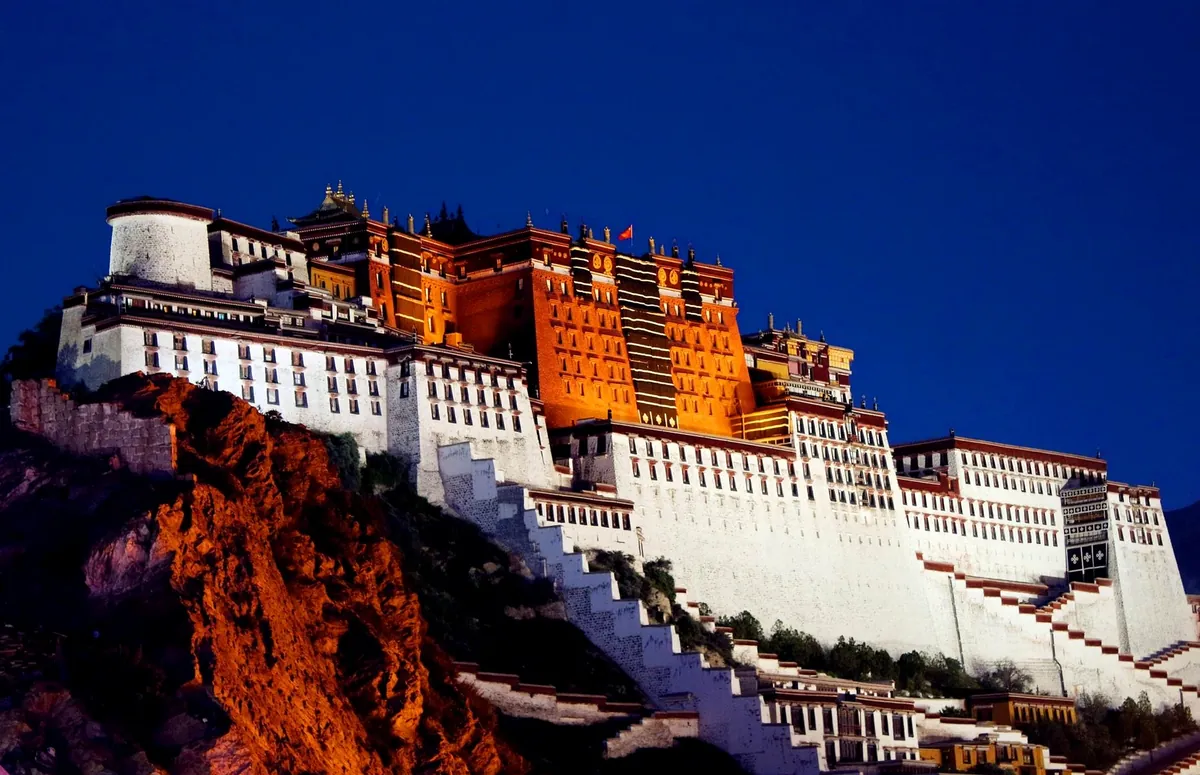
The spatial structure of Potala is clearly divided into two profoundly symbolic functional zones: the White Palace (Karpo Podrang) and the Red Palace (Marpo Podrang). The White Palace is adorned in pristine white lime, symbolizing compassion, pure wisdom, and peace. It once served as the administrative headquarters of the Ganden Phodrang government and functioned as the solemn winter palace for successive Dalai Lamas, featuring its unique highlight on the top floor—the East and West Sunlight Halls—flooded with natural light and used as a study and formal reception room. In contrast to the ethereal elegance of the White Palace, the Red Palace reigns supreme at the center with a deep red hue derived from mineral ochre, symbolizing the supreme religious authority and profound spiritual power of Vajrayana, where secret rituals take place and the immortal spiritual memories of the Buddhist realm are preserved.
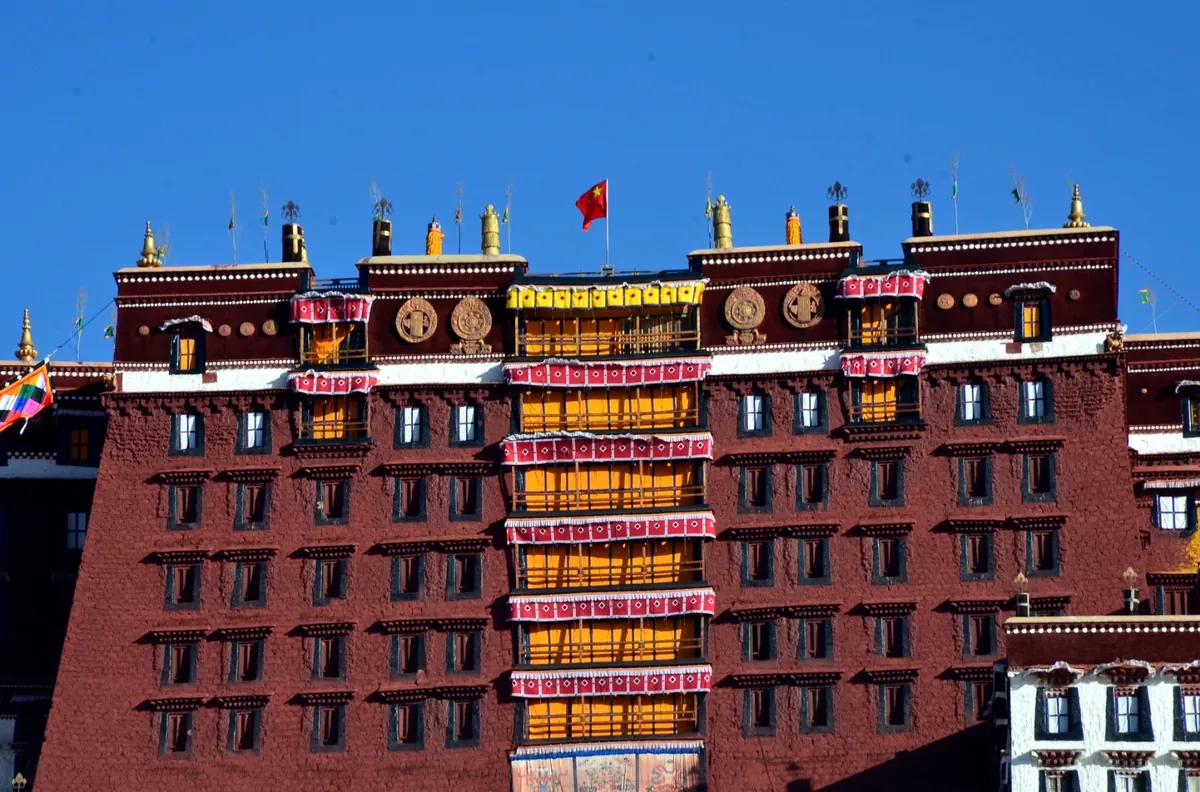
Deep within the Red Palace lies the most sacred devotional space, housing eight gold-plated funerary stupas of former Dalai Las. The crowning masterpiece among them is the stupa of the 5th Dalai Lama, named Namling Sershang, a magnificent structure towering 14.85 meters high, covered in 3,721 kilograms of pure 24K gold and intricately inlaid with over 18,680 precious gemstones, diamonds, red coral, agate, jade, and premium pearls. Beyond these religious stupas, Potala preserves an invaluable cultural treasure trove featuring over 2,500 square meters of murals depicting the history of the Tibetan Empire alongside mystical Mandalas, tens of thousands of gold-plated bronze statues, tens of thousands of ancient Thangkas, centuries-old handwritten Palm-leaf scriptures in original Sanskrit, as well as countless imperial jade seals and golden books bestowed by the Ming and Qing dynasties.
Potala’s resilience over centuries against severe geological upheavals is a testament to the pinnacle of ancient engineering. The palace’s base employs a battered load-bearing wall technique assembled from hand-chiseled granite blocks ranging from 2 to 5 meters thick, combined with intricate mortise-and-tenon joints completely free of iron nails, allowing the structure to perfectly withstand earthquakes exceeding magnitude 8 on the Richter scale. Even more remarkable is the sacred horse-wall layer enveloping the summit of the Red Palace, woven from countless dried red willow branches tightly pressed and soaked in a secret herbal mineral water; this unique solution minimizes foundation loads while effectively absorbing seismic tremors, providing insulation and pest resistance. The mortar binding the entire structure is also a masterclass in formulation, meticulously blending seashell lime, yak milk, molasses, and viscous tree resin, helping the structure adapt extraordinarily to extreme day-night temperature ranges and harsh highland wind and snow.
When night falls over the Lhasa valley, the magnificent Potala Palace lights up brilliantly like a mystical fortress amidst the mortal world, perfectly mirrored in the calm waters ahead to create a breathtakingly serene symmetrical scene. The solemn dark red hue of the Red Palace and the elegant pristine white walls of the White Palace stand out sharply against the majestic rocky hillside, illuminated by warm golden lights that dispel the highland chill. On the left side of the space, a towering flagpole holds the national flag fluttering in the wind, blending with the shimmering water to weave an impressive moment of harmony between millennium-old heritage and the pulse of the times.
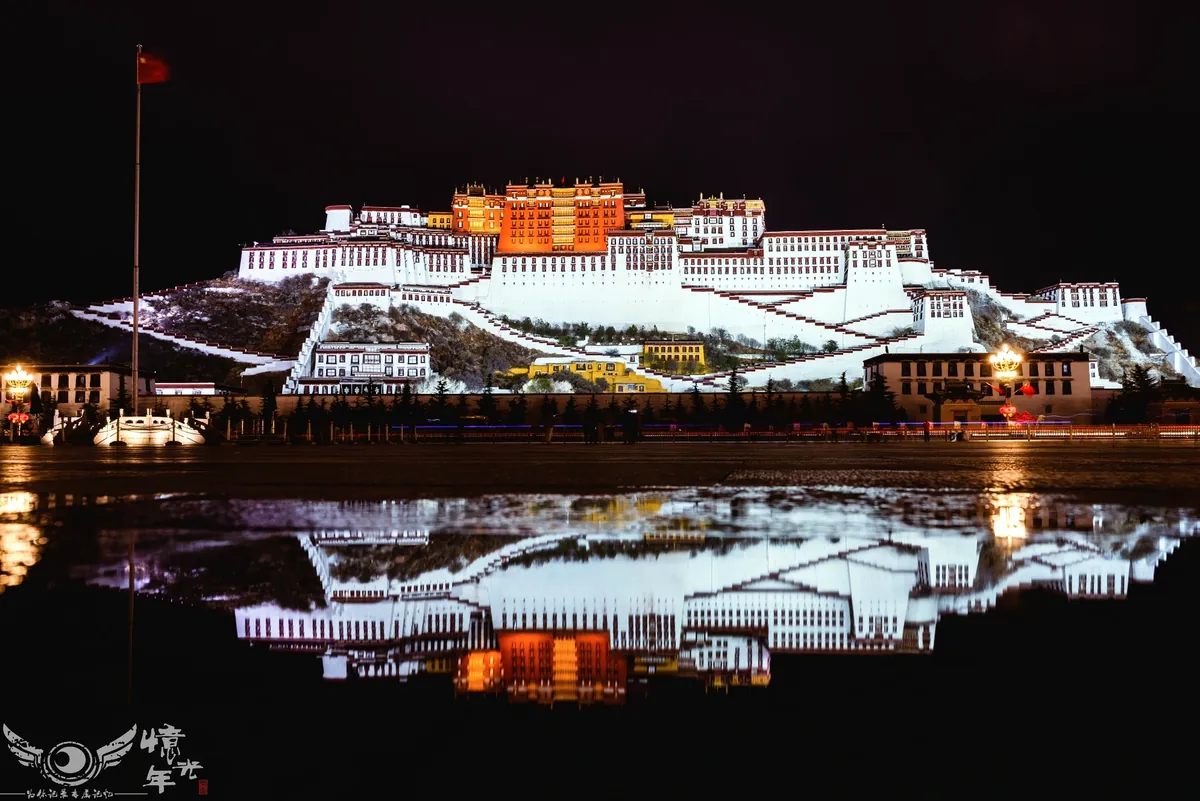
When the evening glow completely fades over the Lhasa plains at an altitude of over 3,700 meters, the surroundings of the Potala Palace enter a spectacular visual transition. The entire massive architectural complex reigning atop Marpori Hill is awakened by a high-capacity wall-washing lighting system, transforming the two magnificent structures—the White Palace and the Red Palace—into a blazing fortress of light floating against the deep blue night sky of the plateau. Warm golden light embraces every steep wall, clearly reflecting the whitewash mixed with milk and tightly bound straw of ancient Tibetan architecture. At the foot of the palace, night life in Potala Square is both solemn and vibrant; pilgrims persistently walk their familiar kora routes, the clicking sound of prayer wheels blending with the footsteps of strolling visitors in the chilly air, creating a mystical symphony between a thousand-year past and the contemporary rhythm.
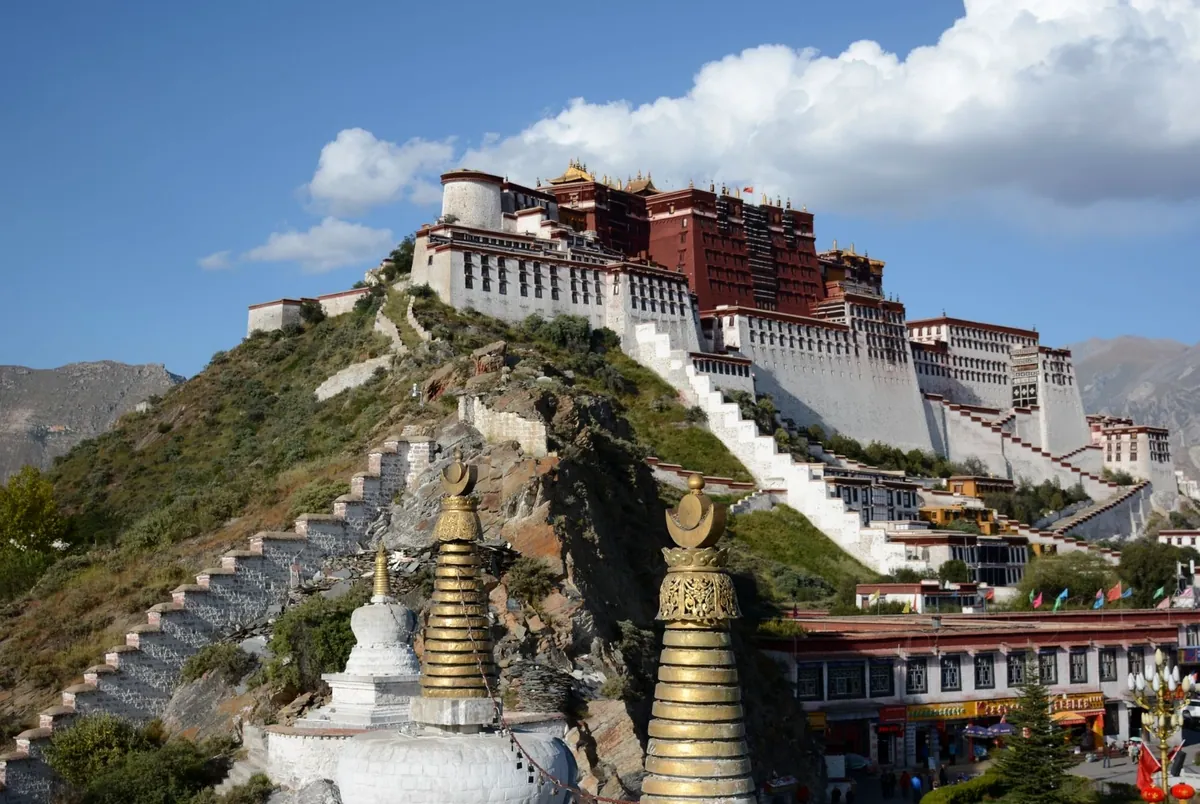
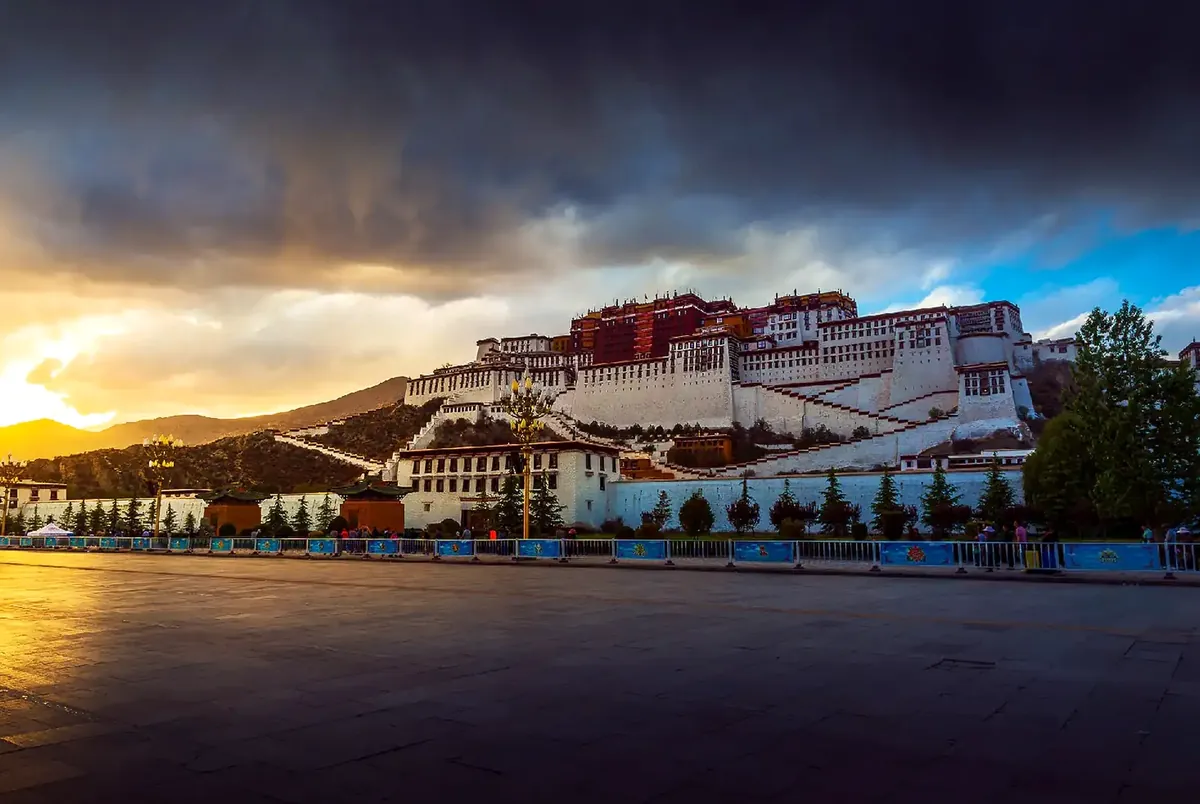
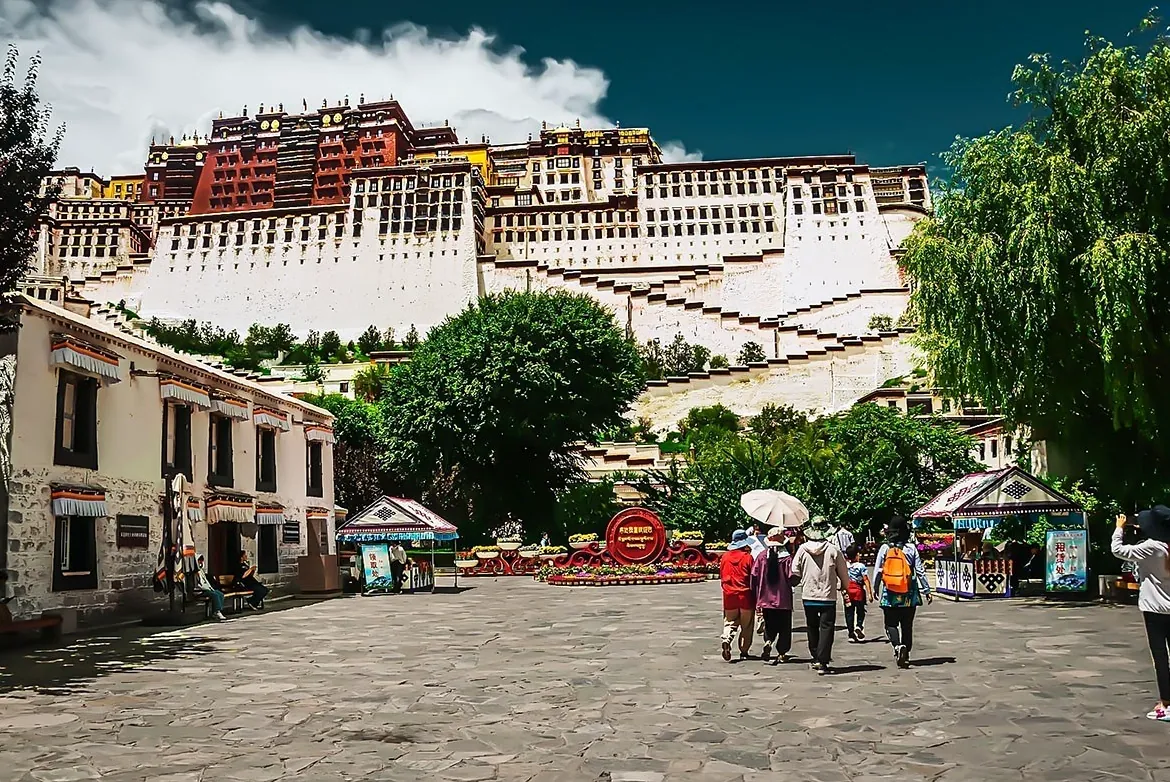
From a panoramic daytime perspective, the entire Potala Palace looms majestically against the backdrop of a dignified rocky hill, fully showcasing the sturdy geometric lines of its interlocking layers of red and white walls. Spreading right in front of the foothills is a vast stone-paved square, gathering local-style buildings with signature black window frames and lush green trees adding a touch of vitality. The square is brimming with life as groups of travelers stroll leisurely, small souvenir stalls nestle in orderly rows, and a striking red round sign stands impressively right in the center, forming a modern touch that harmoniously connects Lhasa’s millennium-old heritage with its daily routine.
However, the lighting art at Potala is not merely about showcasing exterior beauty, but a rigorous scientific conservation revolution quietly taking place within the ancient halls. To resolve the conflict between public pilgrimage needs and the degradation of heritage, the management has completely eliminated the high-heat incandescent lighting system, which posed potential fire hazards and altered the indoor microclimate. Instead, a sophisticated fiber-optic lighting network combined with cold-spectrum LED bulbs free of ultraviolet and infrared rays has been deployed. This precise cold lighting not only fully reveals the original mineral color palettes of thousands of square meters of 17th-century murals and precious thangkas, but also completely eliminates the risk of organic decomposition and material fading over time.
Alongside optical engineering, the digitization project named “Digital Potala” has ushered in a new era in preserving the soul of the palace using cloud computing technology. Through the application of millimeter-resolution 3D Lidar scanners and 8K geodetic stereophotogrammetry, the entire spatial structure along with tens of thousands of statues, scriptures, and ritual instruments have been replicated into an eternal digital twin. The VR virtual reality space not only brings a vivid pilgrimage experience to closed conservation sanctuaries, but also directly reduces the mechanical pressure weighing down on centuries-old cedar wooden floors. Notably, smart load sensor systems and AI-powered cameras have been densely installed along vital corridors. These devices continuously measure micro-vibrations and tremors of the wooden beam-column system, thereby automatically adjusting and regulating visitor traffic in real time to prevent any irreversible structural damage.
The cuisine of the snowy realm of Lhasa is not merely designed to please the palate; it is a precise biological mechanism perfected over millennia to help the human body adapt to harsh climates and thin oxygen levels at altitudes above 3,600 meters. When a sharp drop in atmospheric pressure causes the digestive system to slow down, Tibetan wellness philosophy strictly prioritizes energy-dense foods rich in healthy fats and complex slow-release carbohydrates. This sustained energy flows through everyday life, shielding travelers’ body temperatures from the freezing winds of the Himalayas and soothing altitude sickness symptoms.
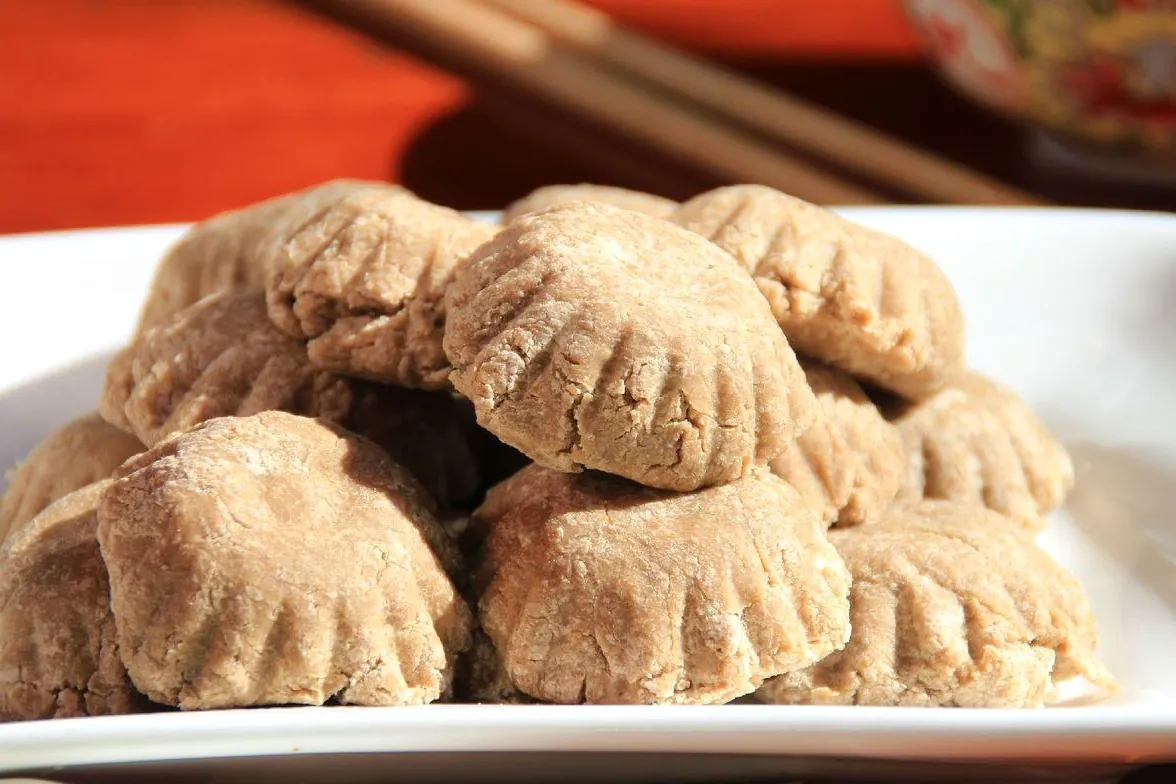
Reigning supreme in traditional Tibetan family meals is Tsampa, a staple food inextricably linked to the survival of the entire Qinghai-Tibet Plateau. High-altitude highland barley grains are roasted to a golden hue and then milled into a velvety powder, blended with fresh, rich yak butter, dried Chhurpi cheese crumbs, and a generous amount of hot butter tea. The deft hands of locals knead the flour inside a wooden bowl, pressing it into chewy, fragrant lumps that carry the rustic sweetness of the soil and the ability to sustain stable blood sugar levels throughout the day. Accompanying Tsampa is Po Cha (butter tea), a meticulously crafted ritual beverage made by churning aged Pu-erh black tea decoction with golden yak butter and natural mineral salt in a traditional Chandong wooden tube. Every rich, creamy sip of salty butter tea not only keeps the throat mucous membranes moisturized against the dry weather but also acts as a natural electrolyte solution that balances the body’s osmotic pressure.
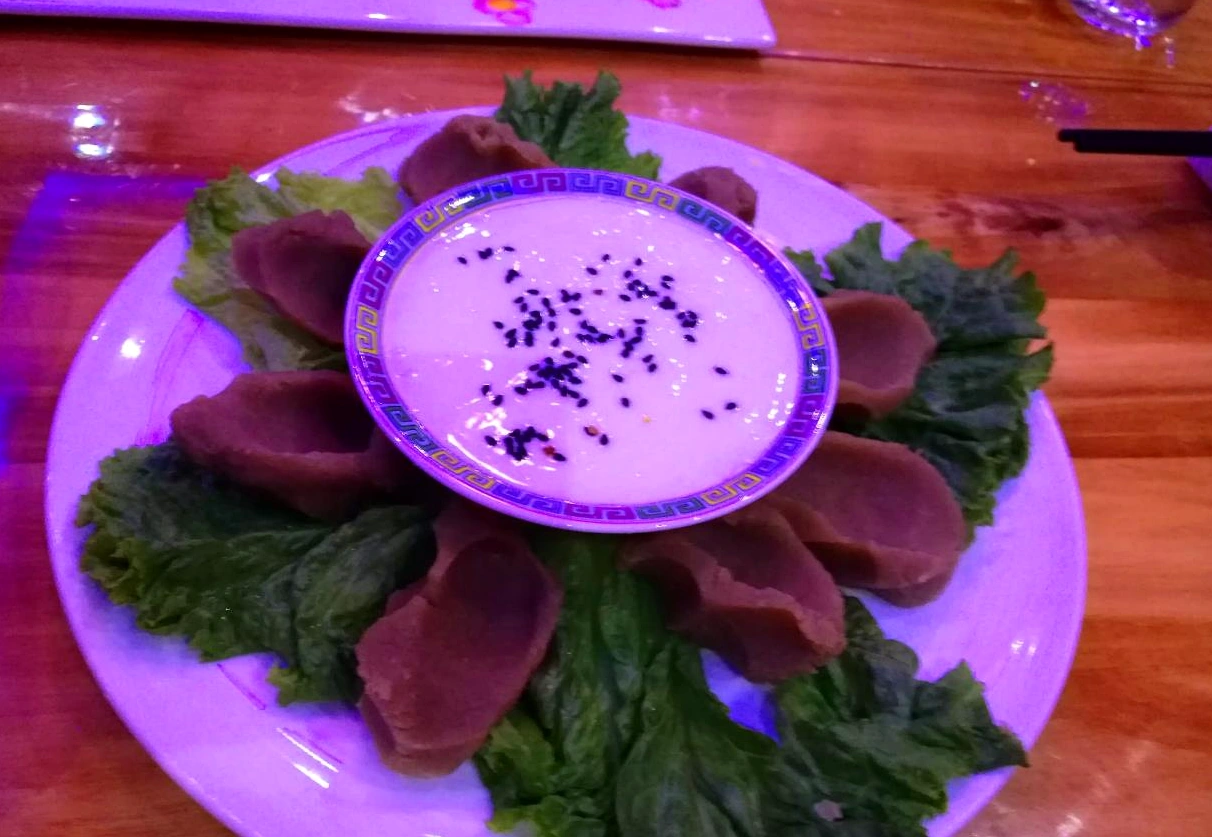
On the traditional snowy highland dining table, culinary presentation always exudes a rustic yet cozy charm, reflected in delicate pastry treats meticulously made from local grains. Each crispy, deep brown pastry piece is skillfully fried or baked, neatly arranged in an elegant circle over a bed of vibrant green lettuce, embracing a small porcelain bowl placed right in the center. Inside that bowl lies a smooth, ivory-white sauce speckled with toasted black sesame seeds, offering the mild richness of fermented fresh milk blended with an elegant nutty aroma, creating a perfect balance between the bold, crispy pastry shell and the delicate, appetizing sauce.
Leaving behind the condensed grain flavors, the area around the foot of the Potala fortress is also famous for centuries-old tea houses, notably the bustling Guangming Gangqiong sweet tea house. Here, steaming pots of amber-hued Lhasa sweet tea brewed from black tea leaves, whole milk, and premium rock sugar constantly emanate fragrant aromas. The abundant glucose content in each cup of sweet tea serves as the most effective local remedy to instantly stop dizziness caused by altitude sickness. As dusk falls over the Barkhor street corner, diners head to Lhasa Kitchen to gather around a steaming pot of yak hotpot. Freshly sliced, paper-thin yak meat—boasting iron and mineral content three times higher than lowland beef—is dipped into a rich broth simmered from bone marrow for twelve hours with wild snow fungus and sweet Tibetan radishes, awakening every single sense.
The breath of Lhasa’s street food is also crystallized through plates of steaming hot Momo dumplings at Dunya Restaurant, where each thin-skinned dumpling wraps a filling of minced beef infused with old ginger and highland coriander seed, dipped generously in the signature spicy Sepen chili oil stir-fry. Right beside the ancient Jokhang Temple, street vendors call out with Zho yogurt churned from pure yak milk, boasting a cheese-like thick texture with a sharp sourness balanced delicately by a drizzle of wild flower honey. The ultimate stopping point for this culinary journey is the golden-roofed Makye Ame attic, sitting humbly at the bend of Barkhor ancient street. Enjoying a plate of oven-baked lamb chops alongside a warm cup of Chang barley wine in the very place that once witnessed the immortal love story of the 6th Dalai Lama Tsangyang Gyatso, travelers can truly empathize with the depth of a cuisine rooted in reverence for heaven and earth and the resilient vitality of the roof of the world.
The journey to access the pinnacle of Tibetan Buddhist civilization in Lhasa today is an epic combination of modern infrastructure and some of the harshest geographical conditions on the planet. The primary aviation gateway leading to the holy land is Lhasa Gonggar International Airport (LXA), situated at an altitude of 3,700 meters above sea level, about 62 kilometers from the Potala Palace via the Airport Expressway running along the southern bank of the Yarlung Tsangpo River. Due to the characteristic thin air density of the high plateau, the runway here only accommodates specialized fleets equipped with high-performance propulsion engines such as the Airbus A319neo or Boeing 737-700. For those yearning to admire the desolate canvas of the snow-covered plateau, the Qinghai-Tibet Railway connecting Xining to Lhasa over 1,956 kilometers is a masterpiece of world railway engineering. The train designated as Z-train crosses the Tanggula Pass at an altitude of 5,072 meters, specially designed with airtight pressurized compartments and continuous forced oxygen pumps maintaining a concentration of 23.5% to 25% to minimize altitude sickness for passengers. This network is now also integrated with the Lhasa – Nyingchi high-speed railway utilizing the dual-power Fuxing train generation, shortening travel time to just 3 hours and 29 minutes, running alongside legendary national highways such as the 2,142-kilometer G318 Sichuan-Tibet South route from Chengdu or the G109 corridor connecting directly toward Qinghai.
To step foot on the threshold of the Potala Palace, international tourists holding Vietnamese passports are obliged to comply with a strict multi-tiered immigration legal framework issued by the local authorities. In addition to a valid Chinese L-type visa or group visa, visitors must possess a Tibet Travel Permit (TTP, namely 进藏批准函) processed through designated travel agencies at least 15 to 20 working days prior to departure, because the entire territory of the Tibet Autonomous Region does not accept independent backpacking travel for foreigners. If the itinerary extends to remote peripheral areas such as Tashilhunpo Monastery in Shigatse or Everest Base Camp (EBC), travelers will need an additional Alien’s Travel Permit. Specifically for sacred pilgrimage routes to the west such as Mount Kailash or the Ali district, a Military Permit is an absolute, non-negotiable prerequisite to ensure border security.
To protect the hundreds of years old wooden, rammed earth, and granite architecture from the erosive pressure of crowds, the Potala Palace Management Board imposes an extremely strict flow control mechanism. During the peak season from May to October, a maximum of 5,000 tickets are issued per day through a real-name passport identification system. Visitors passing through the Red Palace gate will be monitored by an infrared sensor system and RFID scanning technology with the “golden 1-hour rule”, meaning the tour duration inside this sacred complex is strictly controlled to no more than 60 minutes to relieve density pressure. Conversely, if visiting Lhasa during the “Winter Tourism in Tibet” campaign lasting from October 15 to March 15 of the following year, travelers not only enjoy a 100% free admission policy for the Potala (originally priced at 200 Chinese Yuan) but also benefit from 50% to 70% subsidies from local aviation and hotel networks.
Adapting to Acute Mountain Sickness (AMS) is a prerequisite survival lesson for any life form entering the roof of the world. High-altitude medical experts recommend taking Acetazolamide (Diamox) at a dose of 125 to 250 milligrams or using Rhodiola (Hong Jing Tian) herbal supplements 7 to 10 days before departure to stimulate red blood cell production and oxygen transport. Upon landing in Lhasa, the “golden 48-hour rule” must be strictly followed: visitors must absolutely avoid showering or washing their hair during the first two days to prevent peripheral vasodilation and sudden body temperature drops that trigger life-threatening High Altitude Pulmonary Edema (HAPE) or High Altitude Cerebral Edema (HACE). Every accommodation room and personal backpack should be equipped with specialized medical oxygen cylinders to support respiration during the restless sleep of the first night at an altitude of over 3,600 meters.
The explosion of commercialization has also dragged along a series of traps from cheap tour models or “Zero-Dollar” tours disguising cultural experiences. Travelers need to stay alert against marketing tricks involving Nagqu Cordyceps embedded with lead threads or heavy metals to increase weight or artificially labeled items masquerading as wild natural herbs. Beware of Tibetan traditional medicine clinics under the guise of free pulse diagnoses to scare patients about critical illnesses, forcing them to buy herbal pill formulas costing tens of thousands of yuan; or gemstone shops selling “Tibetan silver” which is actually a copper-nickel alloy and industrial laser-processed Dzi beads. A true cultural insight journey requires the companionship of transparent “No Shopping” commitments, where knowledge value and safety are absolutely honored. To gradually train your physical fitness and get accustomed to the high-altitude climate before conquering the Qinghai-Tibet plateau, you can start with an experiential journey through the mystical Tibetan cultural buffer zone via the Hanoi – Cat Bi – Lijiang – Shangri-La 5D4N tour before writing the next chapter of your dream to the sacred Potala.