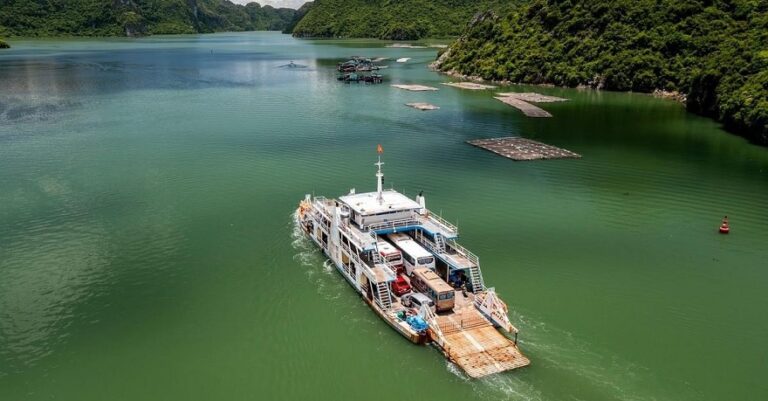
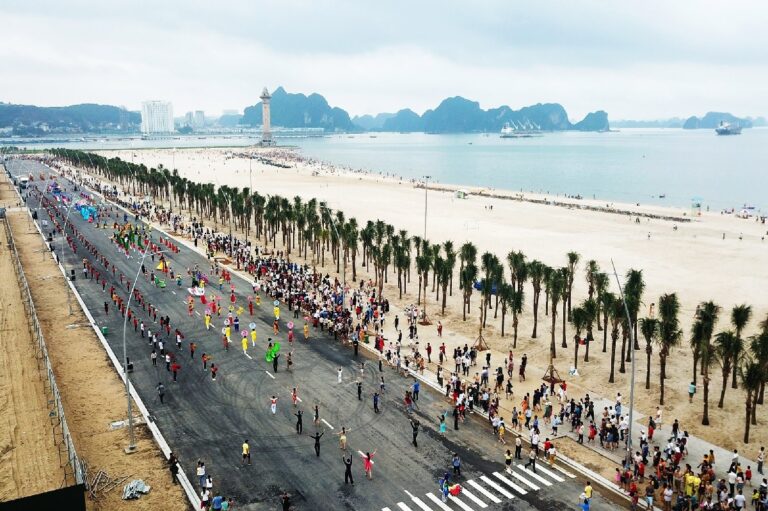
Connecting the two shores of Hon Gai and Bai Chay, Bai Chay Bridge rises proudly against the breathtaking backdrop of Ha Long Bay, creating a radiant symbol for the coastal city of Ha Long, Quang Ninh. This modern cable-stayed bridge is not only a distinctive architectural highlight enhancing the bay’s natural beauty, but also a testament to the remarkable economic and tourism growth of Vietnam’s mining heartland.
I. Introduction to Bai Chay Bridge
Bai Chay Bridge—a modern cable-stayed bridge spanning Cua Luc Bay—is a striking landmark linking the two sides of Hon Gai and Bai Chay in Ha Long City, Quang Ninh. Completed on December 2, 2006, the bridge serves both as an eye-catching architectural feature framing Ha Long Bay’s scenery and as a symbol of Quang Ninh’s economic and tourism progress.
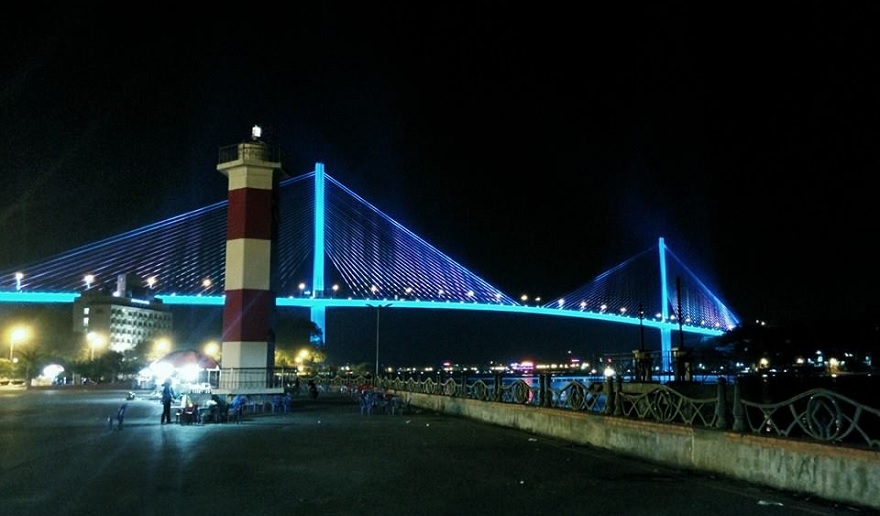
Bai Chay Bridge
Before Bai Chay Bridge was built, crossing between Hon Gai and Bai Chay relied entirely on the ferry terminal. That inconvenience inspired plans for a modern bridge to link both areas, meet rising traffic demand, and boost economic development across Quang Ninh Province—an idea conceived in the 1990s and formally approved by the Prime Minister in 1998.
The Bai Chay Bridge project, with a total investment exceeding 2,140 billion VND, received Official Development Assistance (ODA) from the Government of Japan. The Japan Bridge and Structure Institute (JBSI) handled bridge design with construction carried out by a joint venture of Shimizu and Sumitomo Mitsui. Built over more than three challenging years (2003–2006), engineers and workers overcame difficult geological and weather conditions using advanced techniques such as balanced cantilever casting—allowing girders to extend outward from main piers without disrupting boat traffic—and pneumatic caisson foundations ensuring stability in complex seabed geology.
Bai Chay Bridge stands out not only for its construction scale and engineering, but also for its impressive dimensions: a total length of 903 meters, width of 25.3 meters, and five spans including a 435-meter main span. With that main span, Bai Chay Bridge set a world record for the longest main span of a single-plane cable-stayed bridge, surpassing the previous 400-meter record held by America’s Sunshine Skyway Bridge.
Architecturally, Bai Chay Bridge presents a sleek, distinctive profile that harmonizes with Ha Long Bay’s dramatic landscape. Seen from above, it curves gracefully like a ribbon across Cua Luc Bay, with symmetrical cable stays lending visual balance and tall pylons rising like wind-filled sails reaching out toward open water.
At night, Bai Chay Bridge takes on an enchanting glow thanks to a modern lighting system. Thousands of multicolored LED lights installed along the structure create vivid artistic effects that earned the bridge its nickname, the “Ha Long Harp”—as taut stay cables and shifting LED colors weave a symphony of light over legendary Ha Long Bay.
II. Rumors and Reality
Alongside its striking beauty, the bridge has also been surrounded by eerie stories, tales of tragic suicides, and rumors of wandering spirits. Beneath its modern silhouette, is Bai Chay Bridge truly shadowed by curses, or are those stories merely local folklore?
1. Tragic Stories
Sadly, scenic Bai Chay Bridge has witnessed real human tragedies. According to figures recorded by the bridge security team, 14 people have died by jumping from the bridge, alongside dozens of attempted suicides prevented in time—averaging roughly one fatality every two months, a sobering contrast to the surrounding scenery.
Heartbreaking accounts recur in local memory: a young woman leaping into the water after heartbreak or betrayal, a woman overwhelmed by family strain or marital infidelity seeking an escape, or someone crushed by mounting debt seeing no way out—some departing quietly and others leaving final messages for loved ones.
For people in deep despair, the bridge has sometimes become a final turning point amid relationship struggles, family conflict, or life pressures—especially among younger individuals who may react impulsively to acute emotional shock without broader life experience.
Each loss leaves an irreplaceable void and lasting grief for family and friends, turning a bridge built to connect communities into a poignant reminder of permanent farewells.
1. Supernatural Rumors
Alongside suicide statistics, Bai Chay Bridge has also been wrapped in ghost rumors passed along by word of mouth, giving the landmark a haunting reputation in some people’s minds.
Ghost of a Japanese Engineer
One widespread tale centers on an ill-fated Japanese engineer who allegedly died in an accident during bridge construction and supposedly lingered around the site trying to pull people into the water to settle karmic debt.
Such rumors grew when people claimed his spirit remained unsettled during a memorial service for sea casualties, leading some to blame tragedies on the bridge on ghostly influence.
Restless Spirits Beneath Cua Luc
Cua Luc—the channel flowing beneath Bai Chay Bridge—has likewise inspired folk myths portraying it as a spiritual threshold between realms where water spirits supposedly demanded annual sacrifices for calm waters.
Past drownings in the Cua Luc channel before the bridge was built further fed beliefs that unseen forces lingered over the strait.
Abandoned Shrines
Another story points to two small shrines along opposite shores of Cua Luc—one demolished and the other left neglected—with rumors claiming human indifference provoked spiritual displeasure.
Though no factual evidence supports these rumors, they persist in popular imagination and surround Bai Chay Bridge with mystery—prompting questions of whether such tales are mere coincidence or unfounded superstition.
3. Explanations from Authorities
In response to spiritual speculation surrounding Bai Chay Bridge, authorities investigated and offered grounded, factual explanations refuting baseless claims.
Ha Long City police affirmed that most suicides at Bai Chay Bridge stem from personal conflicts and psychological distress rather than ghosts or curses—noting that young people with limited life experience can easily lose direction and act rashly during acute emotional, family, or financial crises.
Because the bridge rises high above swift currents where a fall leaves almost no chance of survival, it has unfortunately been chosen by individuals intending self-harm.
Authorities also dismissed rumors of vengeful spirits or sacrificial water deities as unscientific fabrications that spread unnecessary fear and can harm the mental well-being of people already going through difficult times.
4. “Silent Heroes” on Bai Chay Bridge
Beyond maintaining order and smooth traffic, the Bai Chay Bridge security team carries a vital mission: preventing suicides. Around forty personnel patrol day and night across the nearly 10-kilometer route (including approaches), watching closely to spot warning signs and step in before tragedy strikes.
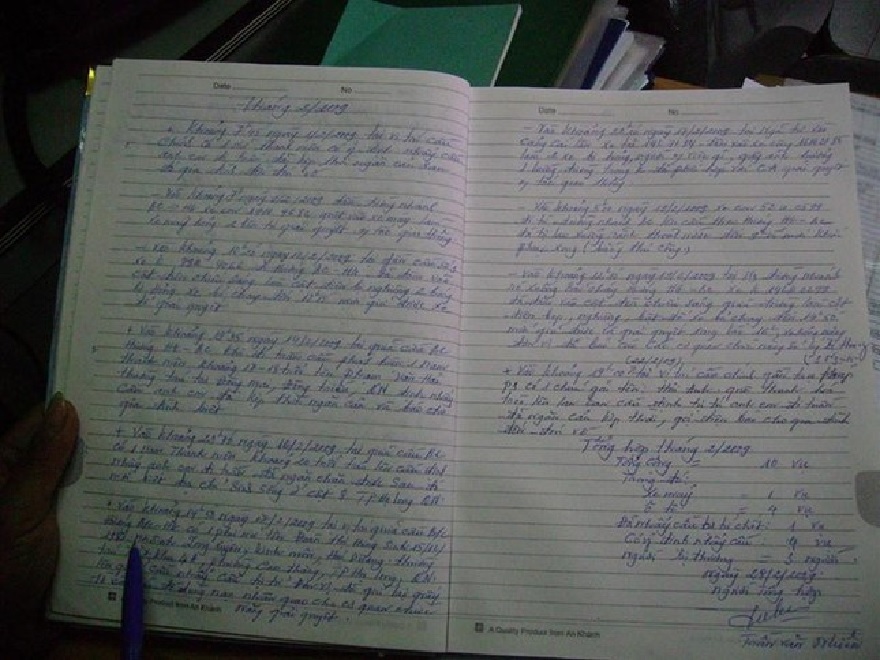
Detailed log of Bai Chay Bridge jump incidents recorded by the bridge security team
Through vigilance and empathy, team members have saved countless lives—approaching lone, weeping individuals beside the railing late at night to listen and encourage them, or acting swiftly in urgent moments to pull someone back from the edge.
Examples include guard Phan Van Hanh, who patiently talked down a young woman contemplating suicide after heartbreak so she could find hope again, and team leader Tran Van Kiem, who has intervened directly in multiple rescues and finds deep pride in helping preserve a life.
With compassionate dedication, these “silent heroes” work tirelessly so Bai Chay Bridge is remembered not for tragedy, but as a symbol of life, trust, and hope.
How to Get to Bai Chay Bridge
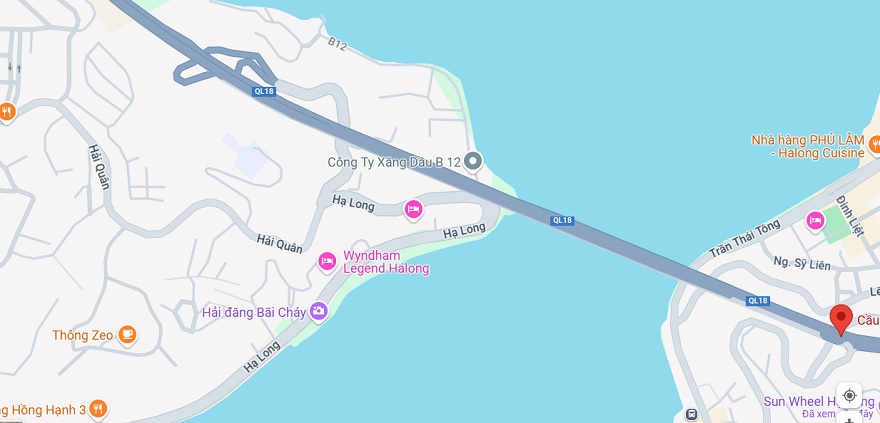
Location of Bai Chay Bridge on Google Maps
1. Via National Highway 18:
This is the main route to Bai Chay Bridge. Heading from central Ha Long along National Highway 18 toward Bai Chay brings you directly onto the bridge, easily recognized by its cable-stayed design and tall pylons.
2. Via Ha Long Street:
If you are already in the Bai Chay area, you can follow Ha Long Street along the coast and connect up onto Bai Chay Bridge.
Notes:
- Transportation: For convenient sightseeing and views from the bridge, traveling by motorbike or on foot is recommended; stopping or parking cars on the bridge is prohibited to keep traffic safe.
- In particular, if you are staying at a hotel in the Bai Chay area, you can head to the bridge approach near the B12 petrol station and take the elevator straight up onto the bridge (remember to pay a small ride fare).