History of Building Yen Tu Bronze Pagoda
Chua Dong (Bronze Pagoda) was originally named Thien Truc tu (天竺寺 – Buddha’s Realm Pagoda), built in the 17th century during the Later Le dynasty. The pagoda was initially just a small bronze shrine. By the Canh Than year 1740, under King Le Canh Hung, a storm blew off the pagoda roof, and thieves took the remaining parts, leaving behind post-hole traces on the rock peak. Surviving many centuries with historical upheavals, the pagoda was destroyed and restored multiple times. In 1930, Chua Dong was merely a small concrete-and-bronze reinforced temple, temporarily erected on the mountain peak through the pious devotion of Ms. Bui Thi My. It was not until 2006 that Chua Dong was reconstructed following the prototype of Dau Keo Pagoda (Bac Ninh), through the merits of visitors and Buddhist followers near and far both domestically and internationally, under the guidance of Doctor of Buddhism, Most Venerable Thich Thanh Quyet and the Chua Dong Project Management Board. Chua Dong held its casting ceremony and inauguration on January 30, 2007, exactly 360 days after construction commenced on the mountain.
See more: Top 9 Most Sacred Temples in Quang Ninh
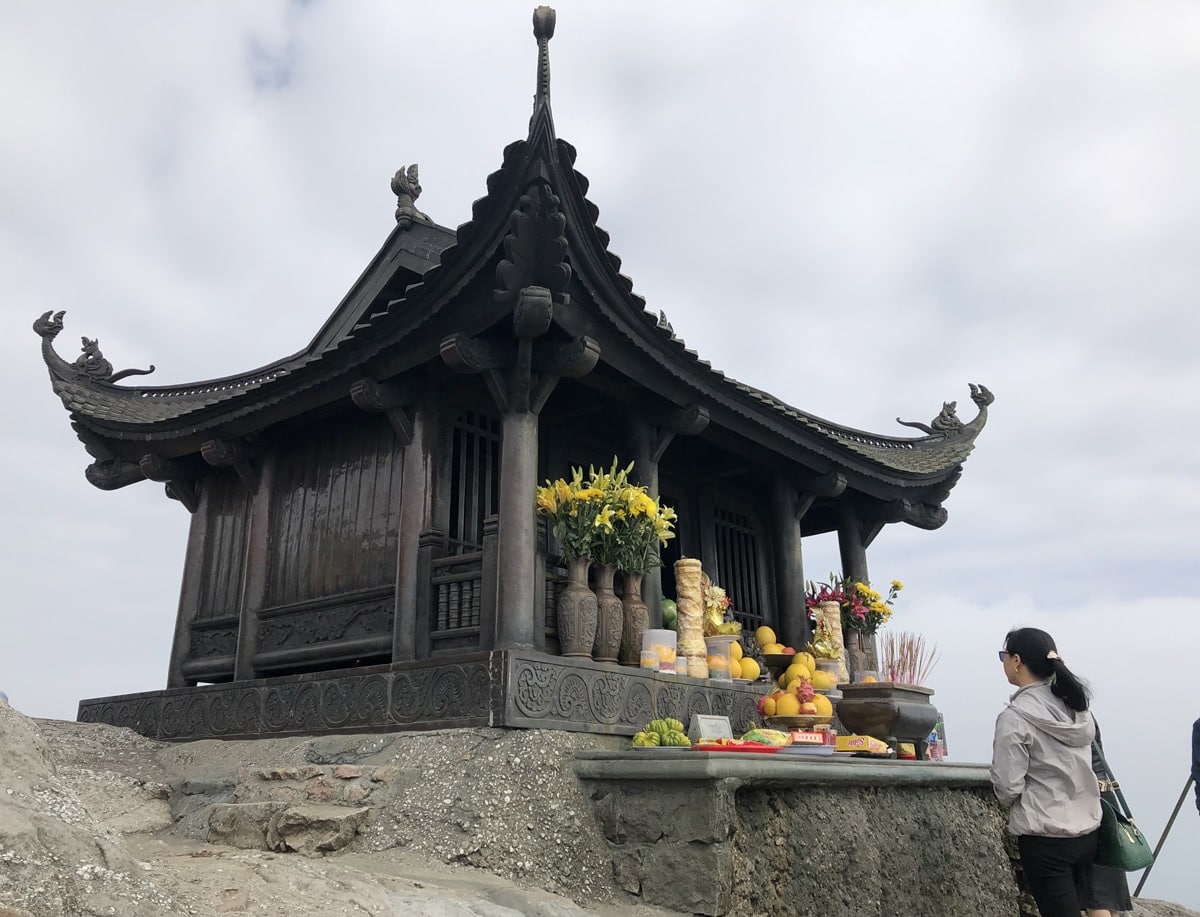
Yen Tu Bronze Pagoda
Situated at an altitude of 1,068m, the final stop of Yen Tu Pagoda, Chua Dong is considered the largest bronze mountain-peak temple in Asia. The pagoda is made of pure bronze, featuring a square block with four roofs, tiled with nose-shaped tiles, undecorated ridge lines, and dragon-head designs on both ends of the ridge and all four eaves in the Tran dynasty style. The pagoda covers an area of nearly 20 square meters, weighs 70 tons, measures 4.6m in length, 3.6m in width, and has a height of 3.35m from the foundation column to the roof. Inside the pagoda are statues of Shakyamuni Buddha and the Three Truc Lam Patriarchs, standing between 0.45m and 0.87m tall, seated on lotus thrones. The pagoda also houses a bronze bell and gong weighing over 250kg.
Exhibited Artifacts of Chua Dong
At the Quang Ninh Museum, within the second-floor historical exhibition space, lies a special sub-division dedicated to the theme of Tran dynasty Buddhist Yen Tu, where artifacts here demonstrate the brilliant cultural, architectural, and artistic development of the Tran dynasty, particularly the Truc Lam Yen Tu Zen sect.
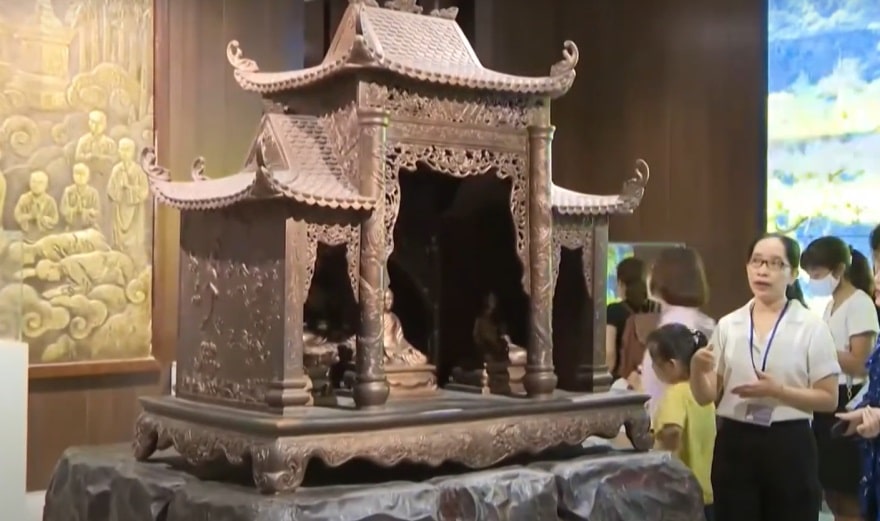
Simulated artifact of the bronze pagoda at Quang Ninh Museum
Standing out right in the center of the exhibition space is the simulated artifact of Chua Dong. Chua Dong is also called Thien Truc tu, built in the 17th century during the Later Le dynasty. Originally just a small bronze shrine, in 2006 the pagoda was newly cast in the shape of a blooming lotus flower based on the design model by architect Tran Quoc Tuan at the Institute for Conservation of Monuments. Since then, the pagoda remains a sacred sanctuary where countless pilgrims journey to worship. The model displayed at the Quang Ninh Museum is modeled after the old three-roof pagoda architecture, differing from the current Chua Dong architecture at Yen Tu (which is a single-roof pagoda). The pagoda worships Shakyamuni Buddha and the three Truc Lam Patriarchs: Dieu Ngu Giac Hoang Tran Nhan Tong, Phap Loa, and Huyen Quang.

Bronze painting of Buddhist Emperor Tran Nhan Tong
Expressing the theme of the exhibition space is a bronze painting depicting Buddhist Emperor Tran Nhan Tong in meditation, surrounded by civil and military mandarins and monks folding their hands in reverence. This painting is displayed solemnly in the exhibition area, providing the most favorable conditions for visitors to admire. Below the painting are the ancestral spirit tablets of the three Truc Lam Patriarchs—original artifacts demonstrating the sacredness and sanctity of the Zen sect.
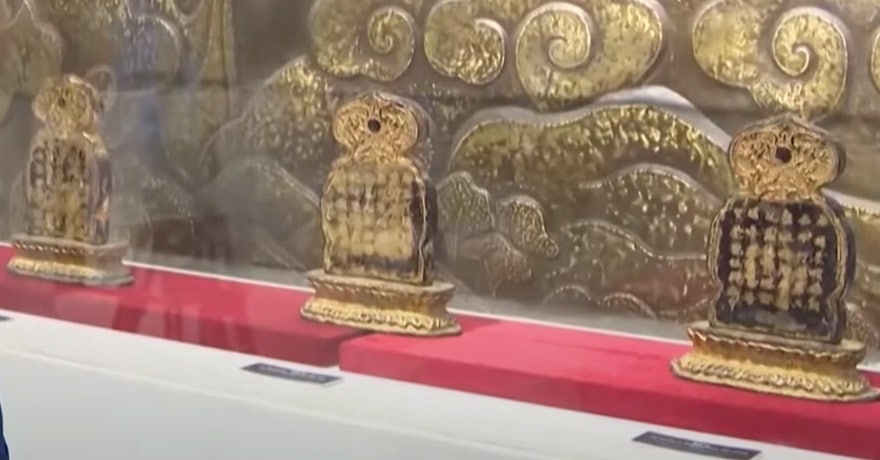
Spirit tablets of the three Truc Lam Patriarchs
Along with that, the Quang Ninh Museum also exhibits several ancient artifacts from the Yen Tu relic site, such as chrysanthemum-decorated bricks, double-lotus yin-yang tiles, and dragon heads with unique patterns. These artifacts all date back to the 13th-14th centuries, the most brilliant period of development of the Tran dynasty. Alongside these are photographs of several towers at Yen Tu and Ngoa Van Hermitage.
Xem thêm: 1-Day Yen Tu Tourism Tour