Bai Tu Long National Park is one of Quang Ninh’s most distinctive and captivating destinations. Set within the Bai Tu Long Bay archipelago, it features stunning coastal and island scenery, rich biodiversity, and rewarding activities. Let’s explore Bai Tu Long National Park together in this guide!
Location of Bai Tu Long National Park
Bai Tu Long National Park’s core zone lies within the administrative boundaries of three communes in Van Don island district—Minh Chau, Van Yen, and Ha Long—home to roughly 24,000 residents. Established on June 1, 2001 under Prime Ministerial Decision No. 85/2001 on the foundation of Ba Mun Nature Reserve, it spans a total natural area of 157.83 km² (260 km² including the buffer zone), comprising 61.25 km² of islands across more than 80 islands and islets and 96.58 km² of marine waters. Its geology mixes earthen islands with limestone formations—including Ba Mun, Tra Ngo Lon, Tra Ngo Nho, Sau Nam, Sau Dong, Dong Ma, Hon Chinh, Lo Ho, Mang Ha Nam, Mang Ha Bac, Di To, Chay Chay, and Da Ay—and notably preserves archaeological traces of Soi Nhu culture featuring ancient Viet remains dating back roughly 14,000 years, alongside karst peaks ringing broad valleys and enclosed lagoons (*tung* and *ang*) that shelter diverse plants and wildlife.
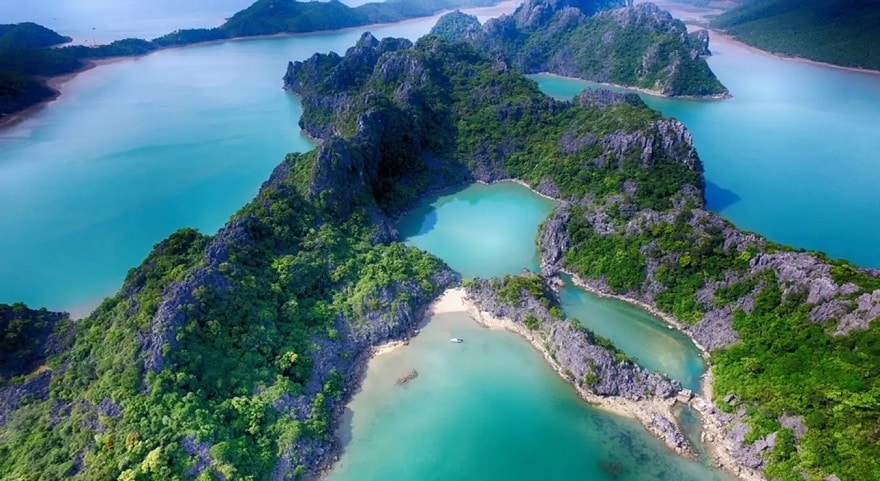
Bai Tu Long National Park
- Flora include Burmese rosewood (*lat hoa*), soapberry (*goi nep*), and *la khoi* medicinal leaves, among others.
- Terrestrial fauna include bears, rhesus macaques, long-tailed macaques, porcupines, three-striped box turtles, and leopards, among others.
- Marine fauna include dolphins, abalone, peanut worms (*sa sung*), and notably two sea turtle species: green turtles (*vich*) and hawksbill turtles (*doi moi*), among others.
- Birdlife includes Burmese goshawks, Japanese sparrowhawks, black kites, white-rumped shamas, greater coucals, and Hainan blue flycatchers, among others.
Wildlife and flora inside Bai Tu Long National Park are remarkably rich, rare, and valuable for genetic conservation—earning it recognition as the largest natural wildlife reserve in the northeast. In May 2017, Bai Tu Long National Park was honored as the 6th national park in Vietnam and the 38th in ASEAN to be designated an ASEAN Heritage Park. As ASEAN Centre for Biodiversity Director Roberto Oliva noted, the park met five criteria covering ecological integrity, representativeness, naturalness, uniqueness and rare/threatened habitats, and legal status.
Most notable are its ecosystems, which hold distinctive ecological, scientific, and educational value across Southeast Asia. Bai Tu Long National Park also stands out among national parks in Vietnam and worldwide by encompassing three classic, largely intact ecological realms—terrestrial forest, wetland, and marine—across an area spacious enough for forest and marine communities to thrive.
Ecosystems of Bai Tu Long National Park
Bai Tu Long National Park features rich biodiversity across six primary ecosystems: tropical evergreen broadleaf forest on earthen hills, ecological forest, evergreen broadleaf forest on limestone karst, mangrove forest, subtidal coral reefs, seagrass beds, and enclosed karst lagoon (*tung* and *ang*) ecosystems. This biodiversity stands out across three key dimensions.
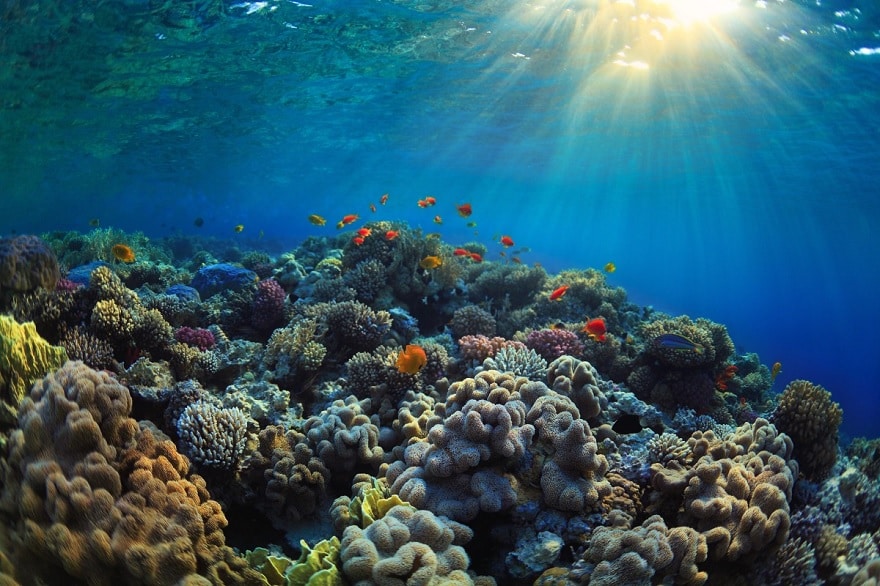
Coral reef ecosystem
The first dimension is representativeness and distinctiveness across the ecosystems above—with tropical evergreen broadleaf forest on earthen hills and freshwater streams on earthen islands offering notable contrasts with the Ha Long Bay World Natural Heritage Site, alongside distinctive *tung*, *ang*, and saltwater island lagoons unique to the Bai Tu Long – Ha Long region.
The second dimension is ecological integrity: these interconnected ecosystems form a largely intact habitat complex across the area—a rare achievement among national parks in Vietnam and globally at a time when ecosystems worldwide face severe fragmentation.
The third dimension is uniqueness: exemplified by Tra Ngo Lon Island, whose single island landmass combines two distinct geological foundations with very different origins. The northern portion features “earthen hills” over terrigenous rock covering nearly one-third of the island (over 400 hectares), while the southern portion is limestone karst marked by caves and enclosed lagoons (*tung* and *ang*, spanning over 1,100 hectares). At the transition between earthen hill and limestone karst lie *tung* and *ang* lagoons hosting mangrove forest (such as Ang Cai Lim)—evaluated by senior experts at the ASEAN Centre for Biodiversity (ACB) as among the most unique in Southeast Asia for ecology, science, and education.
Attractions in Bai Tu Long National Park
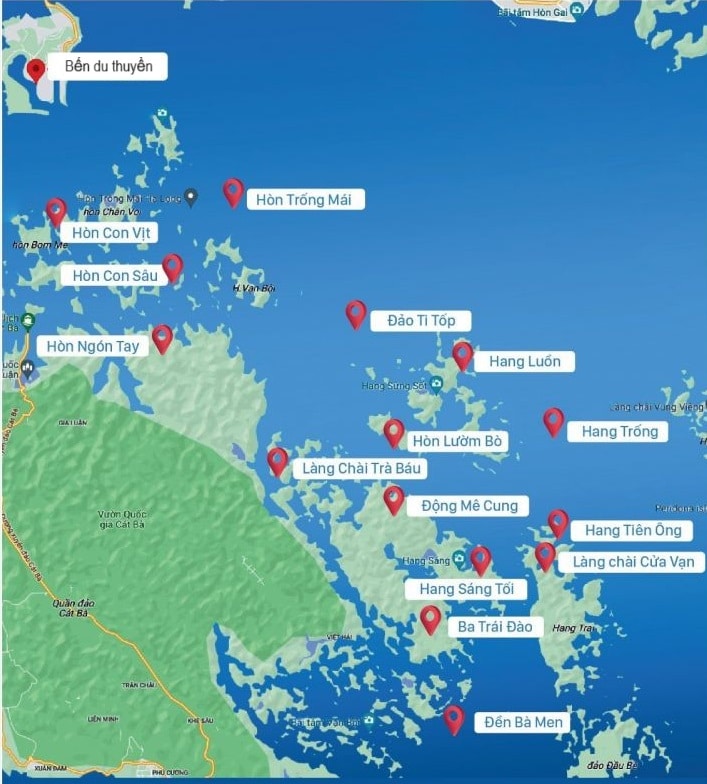
To refresh island and coastal tourism, Quang Ninh Province has expanded authorized sightseeing routes across Bai Tu Long Bay—including Route 3, which passes through highlights within Bai Tu Long National Park.
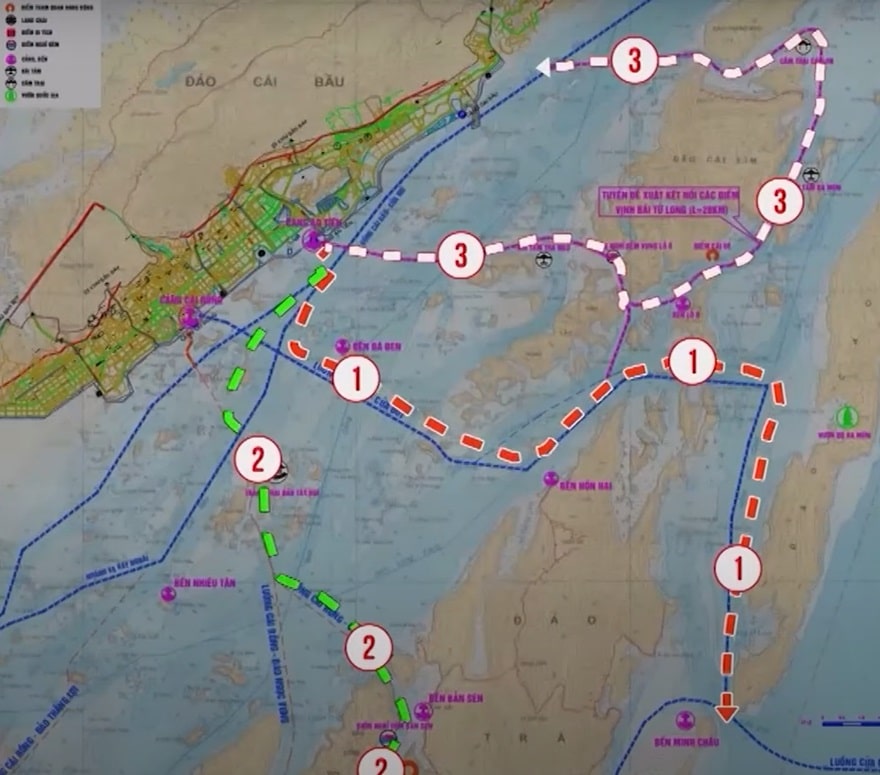
Bai Tu Long Bay sightseeing routes
1. Cai Lim Island
Situated within the Tra Ngo Lon island cluster, Cai Lim offers rich unspoiled scenery and biodiversity. Its first highlight is a natural ironwood (*lim xanh*) forest filled with hundreds of old-growth trees—many too wide for an adult’s arms to wrap around—planned for future park tours with zipline/canopy routes designed to let visitors explore without harming mature trees.
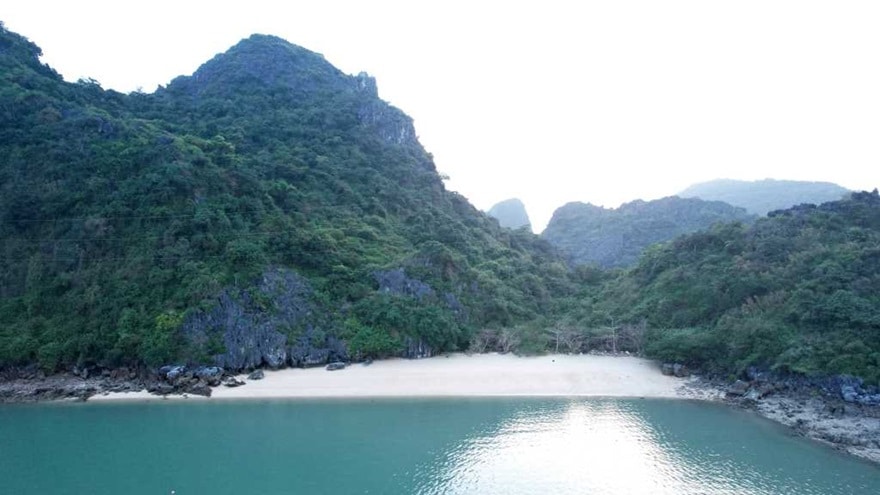
Cai Lim Island
Along the trail leading toward the mangrove forest at Ang Cai Lim, dense bamboo groves line both sides. Most striking in the mangrove forest are long-lived *gia* trees with tall branches and spreading roots reaching across surrounding flats, interspersed with large forest trees hosting epiphytic orchids in striking forms. Covering roughly 200 hectares, the mangrove area is best explored at low tide, as high water can rise waist-to-chest deep and restrict movement.
Crossing through the mangrove area leads to Bat Cave (*Hang Doi*), a spacious ancient cave with stalactites and narrow passages where visitors stoop to pass through, and piles of snail shells along the floor left behind where monkeys cracked open shells to eat the meat inside.
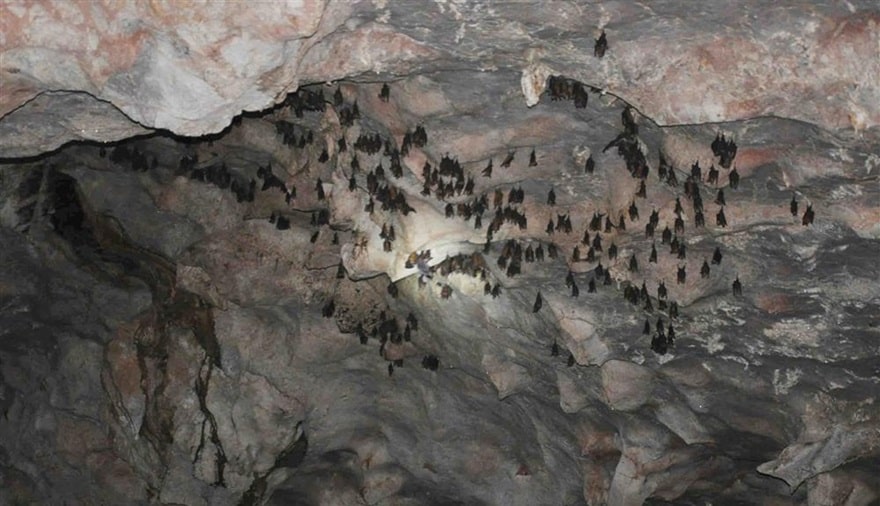
Bat Cave on Cai Lim Island
Along the route, visitors encounter distinctive plants such as wild orchid clusters growing on rocky cliff faces, camouflaged rock-gecko vines, and *xuoi* leaves used by Minh Chau residents to wrap traditional *banh gai* cakes for Tet ancestral offerings.
Beyond its rare ironwood forest, expansive old-growth mangroves, and Bat Cave, Cai Lim sits near other promising spots—including Mang Ha opposite the Cai Lim ranger station (proposed as an overnight mooring zone for bay cruise vessels) and scenic Cai Lim Beach at the foot of the hills—proposed by Bai Tu Long National Park’s management board to Quang Ninh Province for future 3-day/2-night bay overnight routes.
Across expansive Bai Tu Long Bay, Cai Lim Island and other corners of Bai Tu Long National Park hold rich potential for eco-tourism, long remaining quiet and uncrowded—visited primarily by scientific survey and research teams.
2. Swan Islet (Hon Thien Nga)
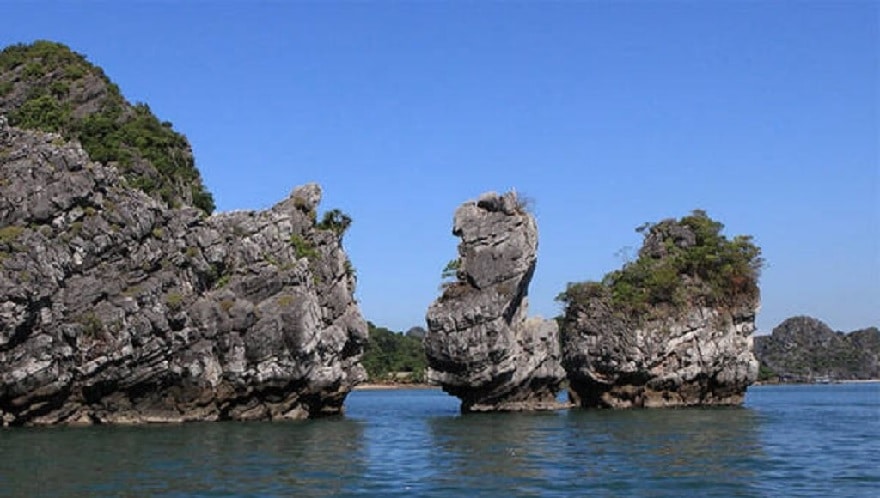
Cruising through the national park, visitors spot natural Swan Islet in Tra Than Bay (near Tra Ngo Lon Island). Formed from three large rock formations resembling a swan’s body, neck, and head rising about 15 meters above sea level, Swan Islet is one of Bai Tu Long Bay’s best-known rock landmarks and a favorite photo stop for passing boats.
3. Cai De Water Cave (Hang Luon Cai De)
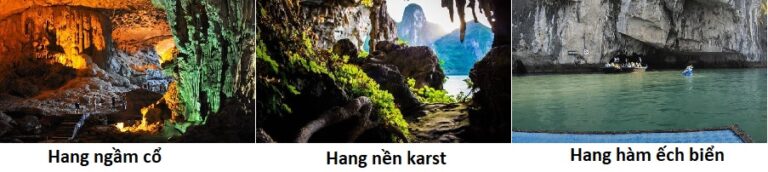
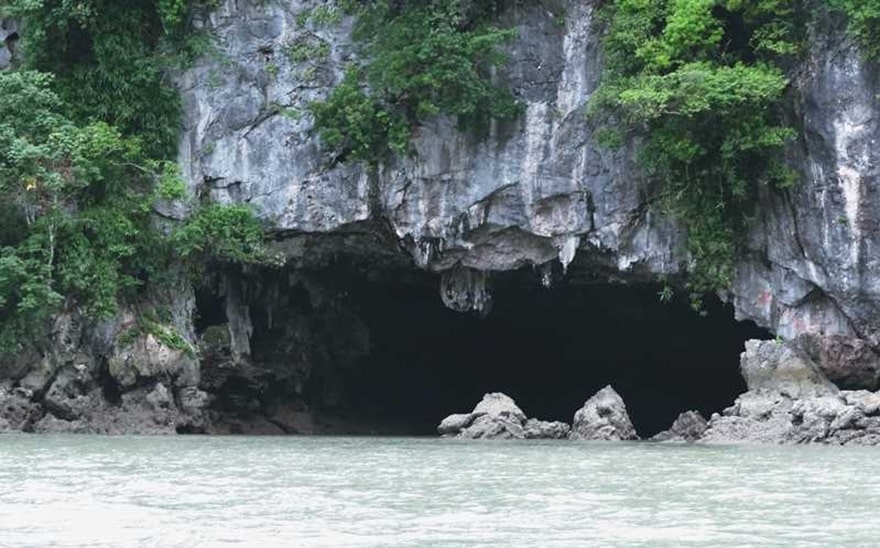
Cai De Cave is one of the largest caves discovered in Bai Tu Long Bay, stretching 300 to 400 meters through a limestone ridge and reaching up to 50 meters wide inside. Varied stalactites and stalagmites line its ceiling and walls in striking shapes, while two openings connect the outer *Ang Cai De* lagoon with inner *Thung Cai De* valley—home to a saltwater lake ringed by karst peaks. Spanning roughly 500 meters, *Ang Cai De* becomes a long, crystal-clear sea channel at high tide framed by lush primeval forest, ideal for kayaking, cave exploration, and swimming/snorkeling.
Cai De Water Cave