Vũng Đục is an attractive tourist destination in Cam Pha city, Quang Ninh. This place is not only famous for its natural scenery but is also closely associated with the historical upheavals of the Quang Ninh coal region. The article below will help you learn more about Vũng Đục.
Introduction to Vũng Đục
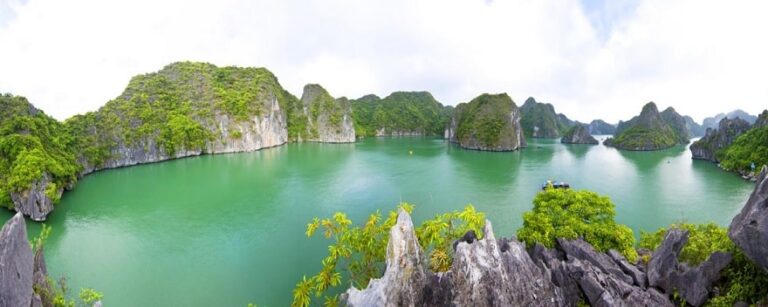
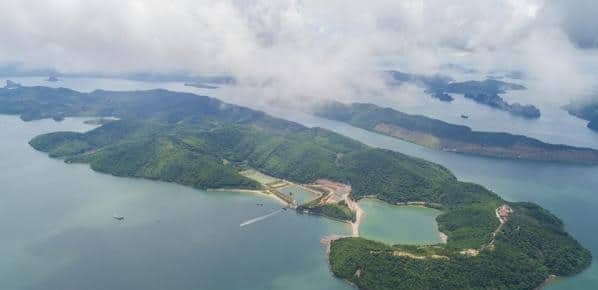
Located at the foot of Ban Co mountain right on the shore of Bai Tu Long Bay in Diem Thuy area, Cam Dong ward, Cam Pha city. Vũng Đục is known as a vast tourist area with an area of about 10,000m2, including temples, monuments, caves, and the sea. Under the management of Vũng Đục JSC, this tourist area has been renovated with an investment of about 15 billion VND for the elevator system, lighting, pathways in the caves… Vũng Đục has become one of the most beautiful and famous sightseeing spots in Cam Pha city, continuously captivating visitors who have the opportunity to stop by for over 20 years (since 1999)
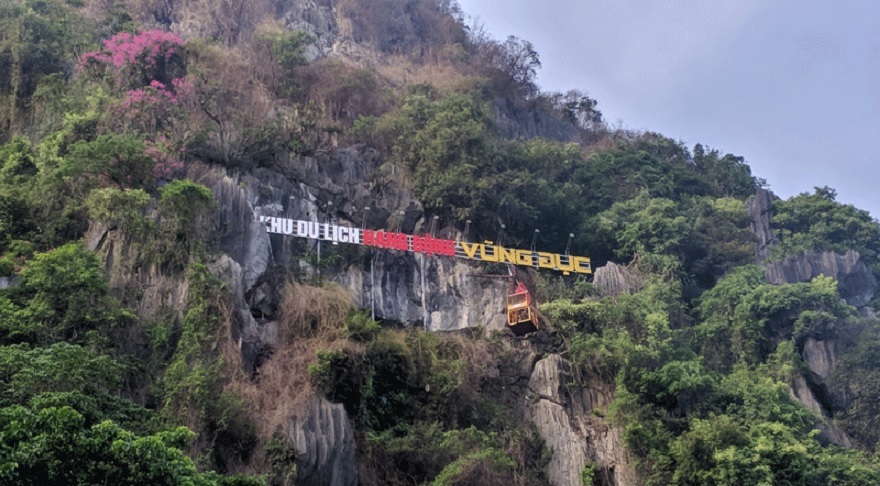
Vũng Đục tourist area
Over the past years, Quang Ninh has invested in building and upgrading many routes to serve tourism. Most notably is the Ha Long – Cam Pha coastal road, with a length of 18.7km, 6 lanes, inaugurated in January 2022. This is one of the modern and unique coastal tourist roads in Vietnam, delighting visitors with mountain scenery and blue sea along the journey. Just turn right at the intersection with the Pier road of Cam Pha city, and visitors will reach the Vũng Đục tourist area. Here, visitors will have the opportunity to learn about history – religion and visit 5 magnificent and majestic caves: Thien Dang cave – Long Van – Ngo Nga ng – Kim Quy cave – Bat cave.
Exploring the history of Vũng Đục
During the years 1946-1949, when the French colonialists occupied the Quang Ninh mining area, they massacred and suppressed patriotic people, workers, and national salvation youth in the mining region. According to the History of the Party Committee of Quang Ninh Province, Volume II (1945 – 1955), page 77, published in May 1993: “From October 18, 1948, to January 1949 (this is the largest base destruction among the 5 that occurred). The number of our people arrested included 9 cadres and party members, 1 Chairman of the Administrative Resistance Committee, 4 members of the Administrative Resistance Committee, 3 liaisons, 1 policeman, 2 honorary team members, 2 members of the sub-branch Executive Committee, 7 national salvation team members, 21 civilians, making a total of 61 of our people arrested. 52 were killed by them, of which the French invaders drowned 30 people in Vũng Đục, Cam Pha (including 8 women). The cause was overt activities, lack of vigilance, loose organization, recklessness, bringing even a scoundrel (Thao) who frequently socialized with secret agents into the union organization, and he informed the enemy about our base”…
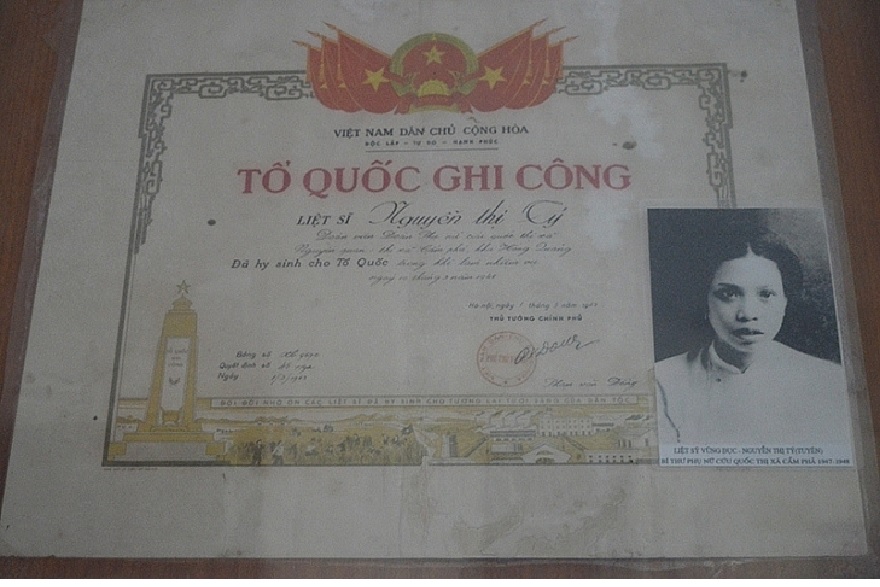
The Certificate of Recognition of Meritorious Service to the Fatherland awarded to martyr Nguyen Thi Ty, one of the eight female Communist soldiers stuffed into sacks, tied with stones, and drowned in Vũng Đục, proudly presented by the Fatherland.
Despite enduring torture and persecution by the French colonialists and their henchmen, the revolutionary movement of the mining region’s people did not weaken but continued to develop on a large scale from Cua Ong to Vang Danh, Mao Khe.
In the early 1990s, to commemorate this event and express the gratitude of the people of the mining region to the martyrs who sacrificed for the freedom of the Fatherland, Cam Pha town (now Cam Pha city) built a martyr monument on a rocky promontory facing Vũng Đục – where the martyrs were drowned by the French colonialists. The Vũng Đục monument was inaugurated on February 3, 1993. According to Mr. Kieu Si Khue – the designer of the monument: “The monument bears the idea of a seagull flying up to find the sky of freedom. The seabird’s aspiration for freedom is also the communists’ aspiration. Two large reliefs attached to the monument pillar symbolize the wings of a seagull, representing the main content of the monument: the struggle movement of the Cam Pha working class and the integrity of the communists.
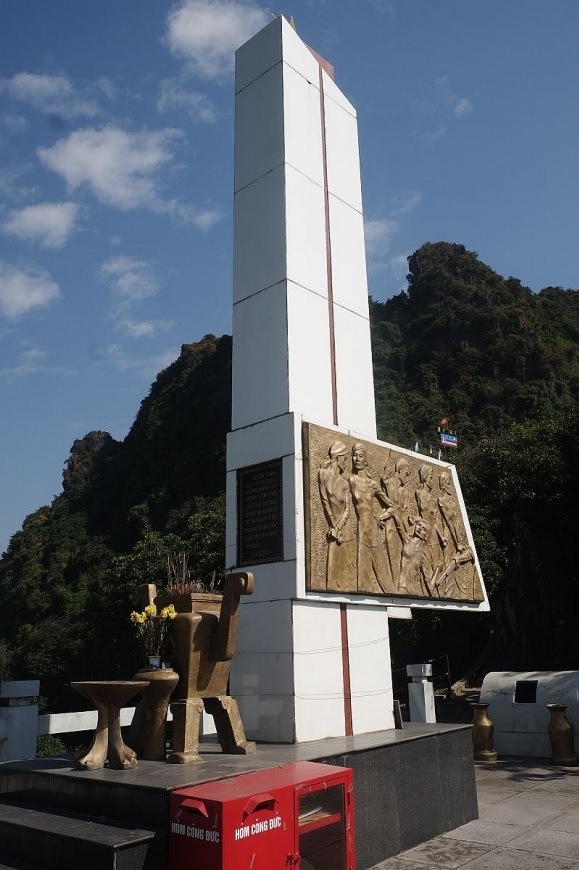
Vũng Đục Martyrs Memorial.
The Cave System at Vung Duc
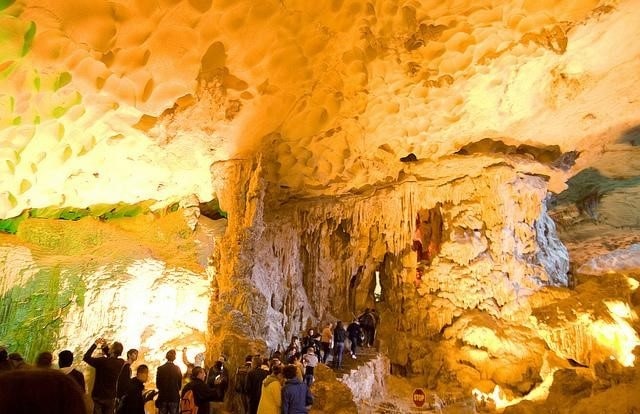
The cave system at Vung Duc is one of the most unique and fascinating tourist destinations in Quang Ninh, comprising 5 caves: Thien Dang, Long Van, Ngo Ngang, Kim Quy, and Doi (Bat). Each cave features its own distinct characteristics in terms of shape, size, and the formation of stalactites. The caves are distributed from low to high, with some requiring visitors to climb hundreds of stone steps to reach them. These caves formed alongside the creation of Ha Long Bay and Bai Tu Long Bay 150 million years ago. Among them, 2 caves are part of the Vung Duc relic site, recognized by the Provincial People’s Committee in 1999:
1. Thien Dang Cave
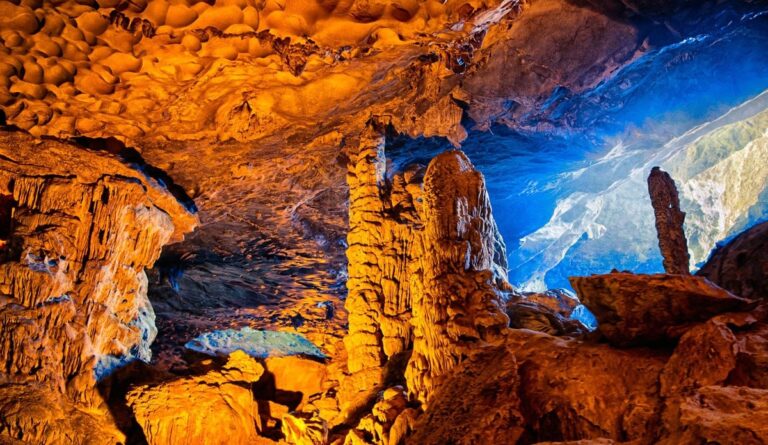
Thien Dang Cave is the first stop when visiting Vung Duc, located at an altitude of 46m above sea level, with an area of about 300m2 and a length of 24m. The cave features five interconnected chambers, including two entrance and exit gates. Inside the cave, stone curtains drape softly and gracefully, resembling a grand stage with intricate details. On the ceiling hang stalactites carefully shaped like chandeliers. Occasionally, natural light filters in from the outside, making the interior sparkle brilliantly. Hence, the cave was named Thien Dang (Heavenly Lantern) Cave.

Sitting and sipping coffee from Thien Dang Cave, visitors can admire a panoramic view of Bai Tu Long Bay from above
2. Long Van Cave
Long Van Cave sits higher than Thien Dang Cave, with its entrance facing the sea. The cave has a length of 157m, divided into 2 branches by a dragon-head-shaped stalactite formation. Branch 1 is 20m long and contains 1 sub-cave (Bach Tuyet Cave). Branch 2 is 137m long and consists of 9 chambers: But Phat, Hoa Da, Thap Chuong, Thien Dinh, Dai Bang, and more. The cave houses fascinating rock formations; through rich human imagination, these stone slabs transform into vivid animals like elephants, swans, bells, and lotus pedestals. Notably, inside Long Van Cave, there are large hollows containing raw stone materials of various sizes, commonly referred to by locals as the “gold treasury.”
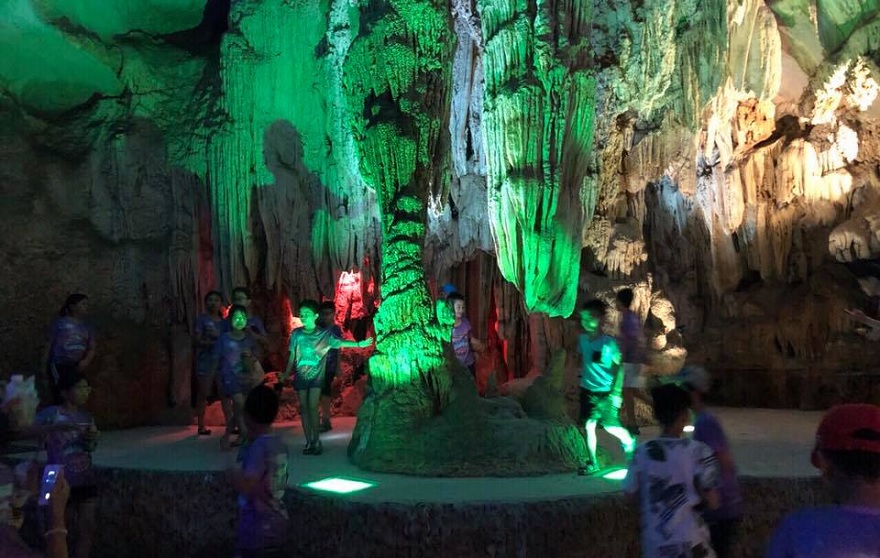
Long Van Cave is famous for its mystical and sparkling stalactites
3. Ngo Ngang Cave and Kim Quy Cave
Though more modest in size, Ngo Ngang and Kim Quy Caves never fail to amaze visitors with nature’s ingenious craftsmanship. The stalactites here look as though arranged by an invisible artisan, recreating the fairy tale of the “Hundred-Knot Bamboo Tree” or the image of three solemn sitting statues. The atmosphere here evokes the feeling of stepping into a miniature wonderland, a world of pure magic.
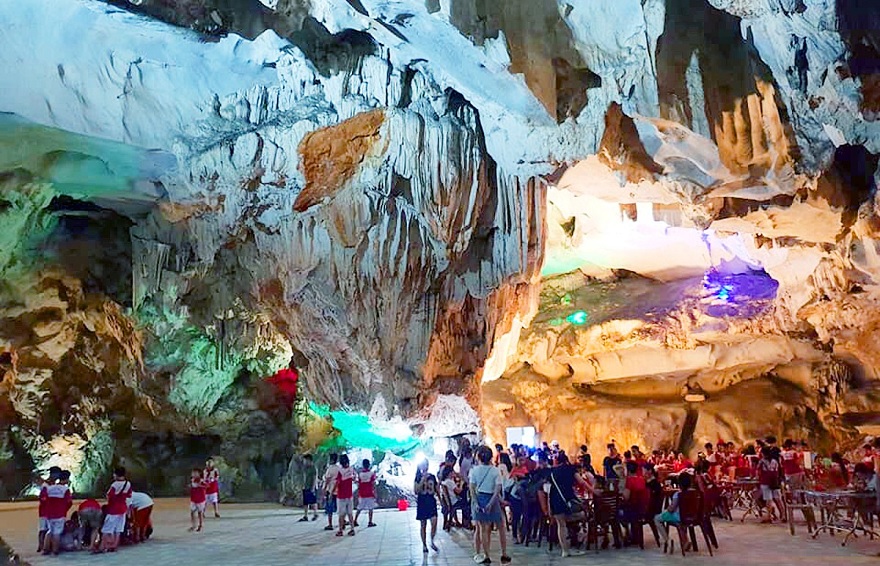
4. Doi Cave (Imperial Court Cave): Transforming into the High-End Dragon Pearl Cave
The final and most spectacular highlight of the Vung Duc expedition is the transformation of Doi Cave – the largest cave in the system. Stretching over 300m, it once served as a safe wartime shelter and a kingdom for thousands of bats. Few know that Doi Cave is also known as Imperial Court Cave (Dong Cung Dinh). Today, this heritage site has undergone a breathtaking reinvention, “reborn” under its new commercial name – Dragon Pearl Cave – a magnificent stage for top-tier entertainment and culinary experiences in Quang Ninh.
This groundbreaking transformation is spearheaded by Dragon Pearl Cave Co., Ltd., a member of APC Corporation. This is by no means an unfamiliar name in luxury tourism, as they are the group behind the resounding success of the 5-star Ambassador Cruise brand and the Seafood Station Restaurant. The endorsement from a hospitality giant with extensive experience in luxury services ensures that every experience at Dragon Pearl Cave, from the arts to gastronomy, is executed professionally and meets international standards.
For the first time in Quang Ninh, the mystical space of a natural cave has been transformed into a vibrant stage. Visitors will be captivated by two exceptional live shows. The “In Search of the Dragon Pearl” show, directed by General Director Le Thanh Phong, is an emotional journey about the Mother Dragon and iconic heritage, blending performing arts with modern 3D mapping technology. Meanwhile, the “Legend of Dragon Pearl Cave” show by General Director Dao Minh Vũ (Loki Vu) celebrates the beauty of art through contemporary dance and circus languages, turning million-year-old stalactites into enchanting co-performers.
The journey concludes perfectly with the “National Essence” culinary feast deep within the heritage site. Crafted by talented Chef Nguyen Gia Thien, the menu is a story told through flavors, featuring renowned dishes such as crispy-skin Tien Yen Chicken, high-end King-sauce Lobster, and finishing with a unique dessert of Gold-leaf Dragon Pearl. Savoring a candlelit dinner inside a million-year-old “palace” is undoubtedly an unforgettable experience.