In the heart of the prosperous Southeast region of Vietnam, the Ba Den Mountain Scenic Complex rises majestically as the “Foremost Heavenly Mountain” with an unrivaled vantage point, carrying within it a heroic chronicle alongside the most magnificent topography in the South. In terms of national territorial delineation, the mountain lies entirely within Tay Ninh Province; although in the nostalgic flow of certain administrative records it is occasionally confused with Can Tho, this landmark retains intact the spiritual and ecological value of a sacred borderland. Rising to an elevation of 986 meters, this highest peak in Southern Vietnam towers over vast plains, creating a distinctive microclimate shrouded in clouds year-round, often likened to a celestial realm on earth. Viewed through its geological and historical origins, the Ba Den Mountain landscape has served since primeval times as a witness to cultural accumulation. The foothills were once inhabited by prehistoric communities belonging to the brilliant Oc Eo culture from the 1st to the 7th century AD, evidenced by ceramic artifacts and ancient architectural traces scattered across the surrounding area. Moving into the 17th- and 18th-century frontier reclamation period, when Vietnamese settlers first arrived to cultivate the Tay Ninh region, the mountain was initially a wild, untamed forest where reclusive sages and Confucian scholars withdrew from the world to build hermitages and immerse themselves in pristine nature. Under the Nguyen Dynasty, across the reigns of Gia Long, Minh Mang, and Tu Duc, the mountain officially entered imperial chronicles. The Dai Nam Nhat Thong Chi (Comprehensive Gazetteer of Dai Nam) respectfully recorded the peak under the names Dien Ba or Van Son. Notably, in the 1840s, Linh Son Tien Thach Pagoda—the most sacred ancient temple in the complex—was established, marking a pivotal transformation from spontaneous thatched hermitages into an orthodox center of Buddhism and folk belief, crystallizing the harmony between the Dharma and the devotion of the people. The enduring vitality of Ba Den Mountain’s heritage is further enriched by layers of legend and historical figures deeply intertwined with the roots of Vietnamese spirituality. At the center of this devotional current stands Linh Son Thanh Mau—Ly Thi Thien Huong. According to oral hagiography, she was a virtuous maiden who sacrificed her life in the mountain forests to preserve her honor. Moved by her unwavering fidelity, the Nguyen imperial court posthumously bestowed upon her the title Linh Son Thanh Mau (Holy Mother of Linh Son), venerating her as the supreme tutelary deity of the entire Southern frontier. Alongside this tradition, the presence of eminent Zen masters of the Lam Te Chanh Tong lineage, notably Most Venerable Thich Trung Tinh—who pioneered and restored the network of pagodas and hermitages—helped shape a Buddhist cultural space imbued with profound identity. Today, in the eyes of heritage authorities and the press alike, Ba Den Mountain is not merely an extraordinary natural landmark of unique geological value, but also a living museum of spiritual and cultural history. The seamless harmony between its feng shui topography of “gathering waters and converging mountains,” centuries of sedimentary relics, and the aura of the Holy Mother legend has transformed this destination into a sacred wellspring, drawing millions of pilgrims to an authentic heritage site of Vietnam.

Standing towering amidst the vast Southern plains, the Ba Den Mountain Scenic Complex emerges as a singular natural wonder with a 986-meter summit, famously dubbed the “Roof of Southern Vietnam.” Exploring this expanse, visitors cannot help but marvel at the miraculous interplay between rugged tectonic terrain and the masterful craftsmanship of architectural artisans. The mountain’s landform bears strong hallmarks of traditional feng shui, nestled alongside an ancient granite massif millions of years old and facing lush green valleys and the mirror-calm Dau Tieng Lake. The scenery here transforms with every footstep and every passing hour—at times veiled in billowing seas of cloud like an otherworldly panorama, and at others ablaze beneath the brilliant golden sunlight of the South.
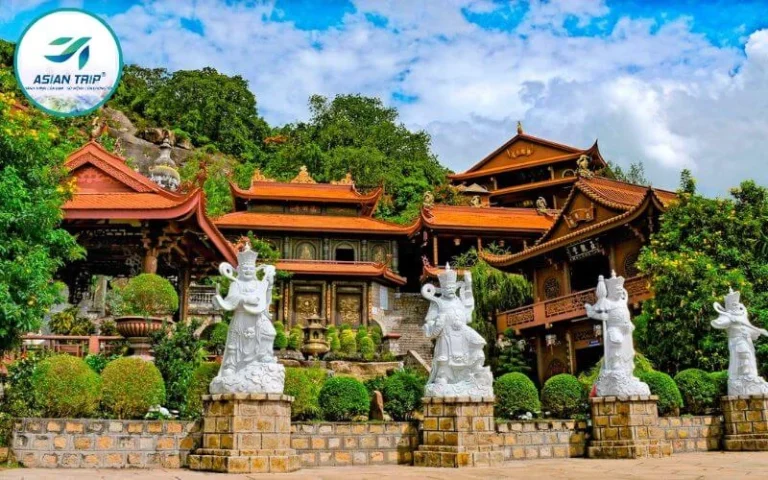
The highlight that captivates art enthusiasts is the refined fusion between centuries-old monastic complexes clinging to the cliffs and spiritual-cultural landmarks of record-breaking scale. The centuries-old Linh Son Tien Thach Pagoda peeks out from beneath ancient tree canopies, moss blanketing its laterite stone steps to evoke a contemplative, sacred charm. Contrasting yet harmonizing seamlessly with that antiquity is the modern Buddhist architectural complex at the summit. Here stands the towering Tay Bo Da Son Guanyin statue cast from solid red bronze—an Asian record holder—alongside a contemporary Buddhist art exhibition space utilizing advanced 3D projection technology. Every carved line on the stone bas-reliefs and every upturned roof eave inspired by Le–Nguyen architectural styles has been meticulously crafted, celebrating traditional artistry amidst swirling clouds and mountain winds.
To capture breathtaking, “million-view” photographs, professional photographers and the travel community frequently recommend two classic vantage points that cannot be missed. The first spot is located around the bronze Guanyin statue plaza on the summit, where your lens can frame the majestic statue merging with churning seas of clouds rolling beneath your feet. The ideal lighting here arrives at dawn (between 5:00 AM and 6:00 AM), when the first rays of morning sunlight pierce through thick mist, creating an ethereal optical halo that envelops the entire spiritual sanctuary. The second spot lies beside the glass facade of Van Son Cable Car Station or along the ancient stone steps of the Middle Pagoda complex, opening up sweeping panoramic views across the emerald Tay Ninh valley below.
Sunset at this second vantage point is widely hailed as one of the finest natural masterpieces in Southeast Vietnam. As the sun dips slowly behind the mountain range, the sky shifts from vibrant amber-gold to deep, mysterious violet, casting the day’s final beams across exposed boulders and moss-covered tiled roofs. Shooting during this golden hour rewards travelers with photographs of profound artistic depth, where dramatic nature and sacred architecture unite as one to tell an enduring story of a hallowed land along the frontier.

Stepping into the Ba Den Mountain Historical and Cultural Relic Complex, travelers are immediately drawn into a captivating real-world journey where untamed nature blends rhythmically with legendary spiritual life. Far more than a site for purely archaeological or historical study, Southern Vietnam’s highest peak opens up a vibrant realm of ecotourism and local culture that awakens every sense of those fortunate enough to visit.
For adventure seekers and trekking enthusiasts, ascending the ancient stone steps or hiking along shaded forest trails delivers an exhilarating rush. Amid the tranquil stillness of the deep woods, the gentle babble of streams, echoing birdsong, and crisp, cool mountain air wash away the fatigue of urban life. Whether gliding effortlessly above the clouds aboard a modern cable car or climbing stone step by step on foot, gazing out over the glassy expanse of Dau Tieng Lake, endless green rice paddies, and bustling Tay Ninh City from high above inspires awe and heartfelt pride in the homeland’s splendor.
Leaving behind the clamor of the city and stepping deeper into the sacred atmosphere of cliffside temples such as Linh Son Tien Thach Pagoda, visitors feel a palpable sense of serenity and inner stillness. The resonant chime of temple bells drifting through misty air and the subtle scent of incense bring profound peace. It is a moment for heartfelt worship—bowing before the image of Linh Son Thanh Mau and revered Buddhist patriarchs to reconnect with the ancestral folk spirituality cherished for generations by the people of Southern Vietnam.
Concluding the journey of discovery, the distinctive local culinary culture is sure to linger in every traveler’s memory. After hours of exhilarating mountain exploration, savoring famous Tay Ninh specialties—such as Trang Bang dew-wetted rice paper rolled with boiled pork and wild forest herbs, savory sun-kissed shrimp salt, or wholesome vegetarian dishes served at the mountain pagodas—offers an unforgettable gastronomic experience. The bold salinity of the shrimp salt, the refreshing crispness of wild herbs, and the warm hospitality of the locals strike the perfect final chord, bringing a rewarding trip to a close with lasting memories of a sacred, vibrant mountain.

Your exploration of the Ba Den Mountain Historical and Cultural Relic Complex will be far smoother and more fulfilling when you keep practical tips regarding timing, costs, transportation, and attire in mind. As for the best time to visit, Tay Ninh experiences two distinct seasons: the rainy season and the dry season. The period from November to April of the following year is considered the “golden window,” offering dry weather, minimal rainfall, and bright sunshine—ideal conditions for mountain trekking, cloud hunting, and visiting the spiritual landmarks at the summit.
The Ba Den Mountain Tourist Area welcomes visitors every day of the week, including Saturdays, Sundays, and public holidays. Operating hours typically begin early in the morning (around 6:00 AM) and run through early evening to accommodate sightseeing, worship, and sunset viewing. Regarding admission, entrance tickets to the relic site follow standard published rates for adults and children. For cable car services to the summit or Hang Pagoda, ticket pricing is clearly divided into round-trip and one-way options, with preferential discounts available for seniors, children based on height, and local residents. Travelers are advised to check the official fare schedule at the ticket counter or on the tourist area’s official website prior to their trip.
To travel from downtown Ho Chi Minh City or neighboring provinces to Ba Den Mountain (Tay Ninh), visitors can choose from various modes of transport, including motorbikes, private cars, or intercity buses. The most direct route follows National Highway 22A past the Trang Bang junction to Go Dau Town, where you turn onto the provincial road leading straight into Tay Ninh City and continue a few kilometers further to the foot of the mountain. For travelers who love nature immersion and physical challenges, trekking trails—such as the Pagoda Route, Electric Pole Route, and Water Pipe Route—offer rewarding adventures, though they require good physical fitness and proper protective gear.
Because this is a sacred space closely tied to long-standing monasteries, shrines, and Mother Goddess worship traditions, visitors to Ba Den Mountain should dress respectfully, modestly, and neatly when entering main prayer halls and temple grounds. Furthermore, as the terrain consists largely of rocky slopes and involves extensive outdoor walking, wearing athletic or hiking shoes with strong traction and packing an umbrella, sun hat, light jacket, and personal drinking water are essential precautions to stay comfortable and safe throughout your journey.
To enjoy a seamless getaway and take in the full splendor of Ba Den Mountain in Tay Ninh without worrying about arranging transportation, booking attraction tickets, or planning itineraries, travelers can choose VDS Travel’s premium all-inclusive Can Tho tour packages. Each itinerary is thoughtfully designed to optimize photo check-in times when the scenery is at its most radiant, accompanied by knowledgeable local guides and top-tier hotel and dining standards.