Perched precariously along the rugged slopes of Cheonmasan Mountain in Saha-gu District of the port city of Busan, Gamcheon is celebrated today as a triumph of contemporary community art, yet the roots of this hillside community bear the indelible scars of one of the most turbulent chapters in Korean Peninsula history. Originally, prior to the mid-twentieth century, this desolate ridge was a barren, sparsely populated tract of land where briny gusts from the Korea Strait swept across arid limestone valleys. The name Gamcheon—derived from auspicious Sino-Korean characters signifying a sweet, clear stream flowing through a mountain ravine—once stood as a geomantic aspiration in stark contrast to the harsh reality of a bleak urban periphery.
A fateful turning point descended upon this hillside when the Korean War erupted in full fury. During those years of conflict, Busan became the final stronghold and provisional capital of the Republic of Korea. Waves of refugees from battlegrounds across the North poured southward seeking sanctuary, crowding along the Nakdong River defensive perimeter. Among these displaced thousands were devout adherents of the indigenous Taegeukdo religion, led by spiritual leader Cheol-jeung Tae. Seeking a secluded refuge both to escape artillery fire and to preserve their sacred liturgical order, the leader guided more than four thousand followers up the slopes of Cheonmasan Mountain, clearing land to establish an isolated settlement known as Taegeukdo Village.
From the 1950s through the 1980s, the spatial layout of the settlement gradually took shape as a one-of-a-kind terraced hillside enclave. Using salvaged materials—scrap lumber, cardboard, and patched sheets of rusted corrugated tin—impoverished families carved into the mountainside to erect hundreds of tiny dwellings measuring just fifteen to twenty square meters each. Remarkably, despite extreme material hardship, the village’s spatial arrangement adhered strictly to Taegeukdo religious principles honoring light and cosmic harmony. Houses were staggered gently along the natural contour lines of the steep incline, upholding an inviolable rule that no house in front could ever block the view, ocean breeze, or morning sunlight of the house behind it. A labyrinthine network of steep, winding alleys—some barely wide enough for one person to slip through sideways—became silent witnesses to an era of hardship sustained by deep mutual solidarity.
As South Korea entered the rapid trajectory of the Miracle on the Han River, sweeping industrialization and urban modernization gradually left the hillside village in Saha-gu behind. By the 1990s and early 2000s, Gamcheon sank into steep decline. Younger generations steadily abandoned the remote stairways for livelihoods downtown, leaving behind an aging population dominated by senior citizens and rows of listing, abandoned wooden homes. The village faced complete erasure when urban redevelopment plans of the era proposed bulldozing the entire hillside to make way for uniform high-rise apartment blocks, threatening to bury the collective memory of the refugee generation forever.
On the brink of oblivion, a miraculous rebirth arrived at the turn of 2009 and 2010. Recognizing the irreplaceable human heritage and original terraced spatial structure of the settlement, the Ministry of Culture, Sports and Tourism of Korea joined forces with the Busan Metropolitan Government to launch the Village Art Project under the theme “Dreaming of Busan’s Machu Picchu.” An unprecedented collaboration unfolded uniting urban planners, architects, visual artists, and the village’s own elderly residents. Rather than demolishing the neighborhood, they chose restoration—transforming weathered brick walls into giant canvases, installing iconic sculptures, and cloaking the once-somber hillside in luminous pastel hues. From a destitute wartime refugee settlement, Gamcheon emerged as an internationally acclaimed model for urban memory preservation and community-based tourism.
Gamcheon (甘川, derived from the poetic imagery of a sweet, refreshing stream winding through a valley) sits along the steep foothills of Cheonmasan Mountain in Saha-gu District on the southwestern flank of Busan. Viewed through traditional East Asian geomancy, this terrain occupies an auspicious yet rugged posture of “backed by mountains, facing the sea,” where the ancient granite spine of the Korean Peninsula thrusts southward before stepping down abruptly toward the sweeping waters of Busan Bay and the Korea Strait. Unlike fertile lowland cities, Gamcheon began as an unforgiving, rocky slope where craggy outcrops and hardy coastal scrub confronted ocean gales head-on, forging a demanding environment that tested human endurance to its limits.
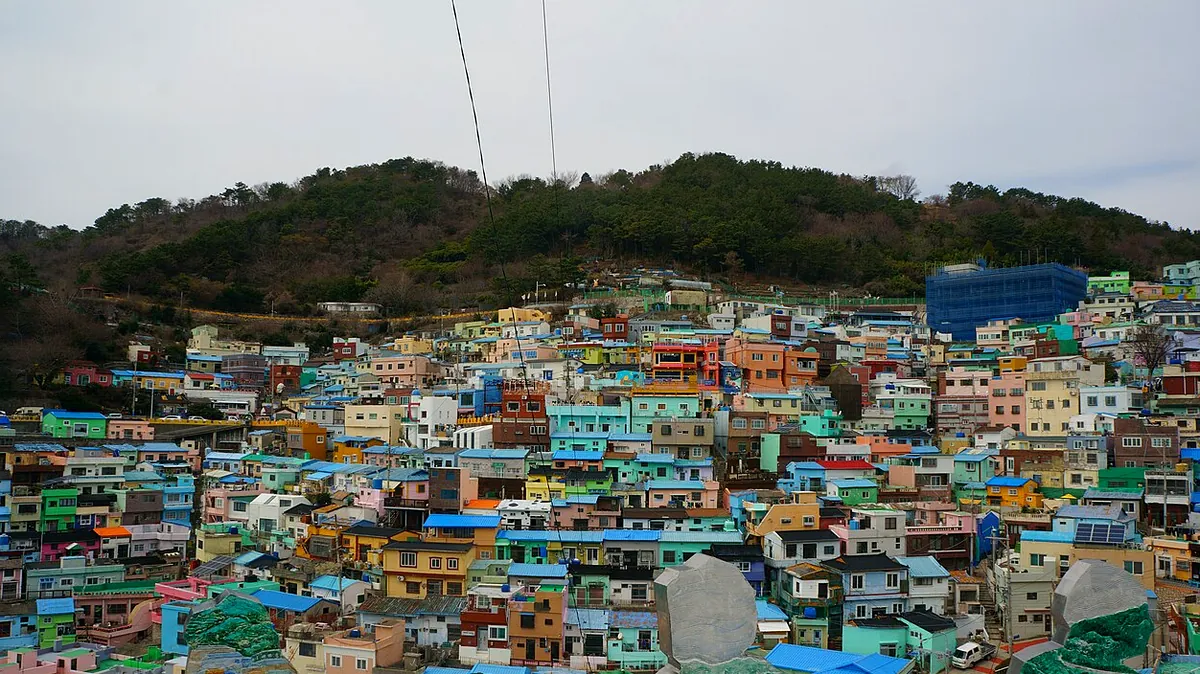
The defining essence of Gamcheon’s visual grandeur and architectural uniqueness lies in its steep topographic gradient—averaging 25 to 30 degrees—forming a natural amphitheater opening toward the sea. Confronted with nature’s strict physical constraints, local builders refrained from brute-force earthmoving and instead anchored every dwelling faithfully to the mountain’s natural contour lines. Thousands of homes are arranged in precision stepped tiers obeying an unwritten yet deeply humane code: no house on a lower tier may rise above the floor elevation of the house behind it. Thanks to this spatial discipline, the entire mountainside unfolds like a colossal open-air amphitheater, ensuring every household and every window receives generous warmth from the morning sun and refreshing vitality from southerly sea breezes.
This dramatic vertical stratification simultaneously gave rise to an internal pedestrian circulation network where boundaries between natural terrain and human craftsmanship blur seamlessly. The entire village is woven together by hundreds of narrow alleys curving along the slope, linked by precipitous stone staircases—most famously the celebrated “148 Stairs to See Stars.” Public walkways hug natural rock faces, widening intermittently into communal courtyards before narrowing to shoulder width beneath sturdy stone retaining walls. This organic layout creates dramatic visual reveals, where turning a tight corner along a steep path suddenly opens sweeping vistas across the colorful valley all the way to the ocean horizon.
This extraordinary synergy between dramatic mountain topography and expansive bay panoramas has earned Gamcheon evocative nicknames on the global cultural map, from “Busan’s Machu Picchu” to “Korea’s Santorini.” While Machu Picchu recalls the breathtaking stone-terraced engineering of an ancient civilization clinging to high peaks, Santorini resonates through the vibrant rhythm of stacked pastel-hued cube houses contrasting brilliantly against deep coastal skies. Morning sea mist drifting into the valley, paired with shifting sunlight raking across the 30-degree incline throughout the day, transforms Gamcheon’s natural terrain and terraced urbanism into one of Northeast Asia’s most compelling living topographic masterpieces.
Viewed from across the gentle valley opposite Cheonmasan Mountain, Gamcheon appears as a breathtaking tiered architectural marvel where spontaneous postwar construction and contemporary aesthetic planning merge harmoniously. Celebrated as South Korea’s most distinctive steep-slope terraced residential model, every dwelling in Gamcheon Culture Village honors an implicit, deeply considerate pact among neighbors: upper-tier homes step back and rise cleanly above lower-tier roofs, never obstructing a neighbor’s ocean view or right to natural sunlight. Thousands of compact, boxy homes—each spanning only a few dozen square meters—resemble meticulously fitted building blocks anchored firmly into steep contour lines, composing a rhythmic, multi-tiered architectural cross-section.
Beyond its symbiotic terraced structure, Gamcheon’s visual expressiveness bursts forth through an iconic color palette that transforms a historic working-class neighborhood into a colossal urban mosaic beneath open skies. In stark contrast to the uniform gray concrete apartment towers of central Busan, the exterior walls here wear spontaneous pastel shades: deep cerulean evoking the open sea, warm turmeric gold, soft cherry-blossom pink, and tender sprout green. Whether illuminated by morning sun rising over Busan’s harbor strait or bathed in twilight violet settling across Cheonmasan’s ridges, these layered colors interact dynamically with sunlight to create the dazzling impression of a multicolored Milky Way cascading down the mountainside—banishing the bleakness that lingered here during decades of postwar hardship.
Beneath this enchanting pastel exterior lies an intricate micro-spatial fabric formed by the famous Miro-ro pedestrian system—a dense, labyrinthine web of alleys. Untouched by motor highways or broad boulevards, Gamcheon functions as an intimate living organism sustained by hundreds of steep stone stairways and shoulder-width passages. Foremost among them is the steep 148-step staircase, once worn smooth by refugees hauling heavy buckets of water from the foot of the mountain to the summit—an exhausting climb so dizzying it felt as though stars danced before one’s eyes. This capillary alley network serves both as protective architecture and tight-knit social glue, where everyday routines—drying kimchi cabbages, sun-curing red chilies, hanging laundry, and sharing neighborly conversation—unfold along the fluid threshold between private homes and communal life.
The vision and investment behind Gamcheon’s revitalization extended far beyond freezing wartime dwellings in time; it represented a large-scale urban regeneration grounded in human-centered art. Municipal authorities partnered with architects and local artists to execute delicate visual interventions without disturbing original foundations. Winding corners, weathered retaining walls, and exposed utility pipes were thoughtfully integrated with metal sculptures, interactive murals, and intricate wooden installations celebrating everyday resilience and aspirations for peace. This remarkable transformation from makeshift refugee settlement into a world-renowned community art space stands as a triumph of humane urban planning, turning harsh steep-slope constraints into enduring architectural heritage.
Unlike artificial theme parks or mechanically staged outdoor attractions, Gamcheon Culture Village (甘川文化村) presents an endless living performance rooted in authentic daily life. Rather than a lifeless museum, it remains an active neighborhood where more than 30 percent of residents are local seniors—living witnesses who have spent entire lifetimes along these rocky slopes. The village therefore radiates a captivating duality: vibrant contemporary artistic expression side by side with the quiet, intimate rhythm of longtime elders. To preserve a delicate equilibrium between authentic residential life and surging visitor numbers, an unwritten yet respected etiquette limits primary visiting hours to between 9:00 AM and 6:00 PM daily—serving as an invisible boundary that curbs noise pollution and restores tranquil privacy to historic homes once evening falls.
For art observers and architectural photographers, light across Gamcheon dances in enchanting harmony with the sun’s trajectory. The golden window between 9:30 AM and 11:30 AM is widely regarded as ideal, when crisp morning rays from the Korea Strait slant across Oknyeo Ridge to fill the terraced basin. Under this angled morning glow, pastel facades across thousands of stepped homes radiate their purest, richest tones free of harsh midday shadows. Early sunlight penetrates deep into narrow lanes, turning time-worn walls into dramatic, high-contrast backdrops that accentuate every brushstroke, color block, and vibrant mural layered across varying elevations.
Amid this visual labyrinth, public sculptures serve as emotional anchors inviting travelers to pause. Most iconic is the sculptural installation of The Little Prince and the Desert Fox, perched atop a precipitous ledge along a dramatic bend on the main ridge path. Far more than a photo stop, the artwork creates a quiet philosophical moment: the seated figure gazing serenely toward the bustling port bay far below invites reflection on solitude, wonder, and infinity. Flanking these installations is a string of hillside rooftop cafes terraced skillfully along the incline, offering sweeping panoramas where the colorful valley cascades gently toward the sea like a giant ceramic mosaic spanning earth and sky.
Once official visiting hours conclude at 6:00 PM, Gamcheon enters its most magical nocturnal transition. Sightseeing crowds disperse, returning the hillside to the quiet serenity of an old coastal neighborhood. After dusk, illumination comes not from glaring laser arrays, but from the warm glow of neighborhood streetlamps and amber light spilling from tiny domestic windows. Viewed from afar after dark, the slopes of Gamcheon resemble a quiet river of warm embers flowing gently through the night, accompanied by soft ocean breezes and the subdued murmur of elderly residents sharing simple evening meals—composing a visual tableau steeped in nostalgic beauty.
Alongside cherished traditions, the village’s artistic landscape continues evolving through thoughtful integration of interactive technologies such as Virtual Reality (VR) and Augmented Reality (AR). Emerging digital experiences allow visitors to scan selected murals with a smartphone to peer beneath modern paint layers and witness historical reconstructions of early 1950s refugee shelters. This harmonious blend of peaceful evening ambiance, tactile sculpture, and invisible digital storytelling transforms Gamcheon into a multisensory open-air museum where poignant history and boundless human creativity shine side by side.
Gamcheon’s imprint (甘川) lives not only in its colorful murals and terraced dwellings, but also in street food traditions deeply rooted in Busan’s port-city identity. Born from communities of Korean War refugees in the mid-twentieth century, Gamcheon endured eras of severe scarcity where every snack and meal served to restore energy using coastal harvests and relief wheat flour. Across decades of change, griddles and steamers along the steep lanes still glow warmly each day, filling the mountain air with fragrant cinnamon and rich roasted aromas that define a humble yet vibrant local culinary map.
The undisputed street-food icon every visitor to Gamcheon’s slopes seeks out is Ssiat Hotteok (씨앗호떡)—sweet pancake stuffed with brown sugar and toasted seeds. Unlike classic flat hotteok filled solely with melted brown sugar in Seoul’s traditional markets, Ssiat Hotteok is a proud Busan original. Skilled Gamcheon vendors knead airy fermented dough around a core of dark brown sugar and fragrant cinnamon, frying each disc in a flat griddle shimmering with golden margarine. Once both sides puff up into a crisp, golden-brown crust, the vendor deftly snips open an edge with scissors and packs the molten pocket generously with crushed sunflower seeds, pumpkin seeds, cashews, and almonds. Biting into the piping-hot pastry reveals an irresistible symphony of crisp exterior, warm spiced syrup, and nutty crunch—instantly chasing away chilly ocean winds.
Alongside warming sweet pancakes, Busan Eomuk (부산어묵—fish cake skewers) embodies the maritime heritage and time-honored craft of coastal artisans. Thanks to immediate proximity to rich fishing grounds, Busan fish cakes boast an exceptionally high proportion of fresh minced fish with minimal filler starch, delivering a naturally bouncy, savory bite without artificial additives. Ribbons of fish cake threaded onto long bamboo skewers simmer continuously in steaming vats of clear broth brewed from sweet Korean radish, premium dasima kelp, and savory dried anchovies. Pausing at a small shaded stall to enjoy tender skewers dipped in chili-flecked soy sauce, followed by slow sips of piping-hot broth from a paper cup, connects travelers directly to the everyday rhythm of hillside life.
Ascending to rooftop cafes perched atop historic terraced homes rewards visitors with sweeping panoramas across the colorful valley toward the South Sea. In this breezy setting, refreshing modern treats such as velvety purple sweet potato ice cream and cool green tea bingsu shaved ice make unforgettable highlights. Mounds of snow-fine shaved ice dusted with subtly bitter matcha powder, chewy injeolmi rice cakes, and smooth sweet red beans strike a refined balance of sweetness and herbal aroma. Savoring cool bites melting on the tongue while watching sunset tint pastel rooftops pink as evening lights flicker on turns Gamcheon’s flavors into a poetic harmony of sight, taste, and tranquility.
Reaching Gamcheon Culture Village (甘川文化村) begins with Busan’s punctual, modern public transit system. From central hubs such as Seomyeon or Busan Station, board orange Busan Metro Line 1 heading toward Dadaepo Beach and alight at Toseong Station (土城驛). Exit via Gate 6, turn right, and walk a few dozen meters to the local mini-bus (Maeul Bus) stop—routes Saha 1-1, Saha 2, or Saha 2-1—parked directly in front of Pusan National University Hospital. These nimble neighborhood buses climb the dramatic switchbacks of Cheonnyangsan’s foothills in ten to fifteen minutes, dropping passengers right at the entrance of Gamcheon Elementary School, the official gateway to the village. For groups of three to four travelers or visitors carrying heavy bags, taking a taxi from Toseong Station costs roughly 5,000 to 7,000 KRW and conserves energy before exploring the steep hillside labyrinth.
Upon arriving at the tourist information center at the village entrance, the very first thing every thoughtful traveler should do is pay a nominal fee of 2,000 KRW for a “Village Stamp Map.” This modest contribution goes directly toward community conservation funds and welfare programs supporting elderly residents. Serving as an indispensable compass, the map charts winding routes across terraced levels, guiding visitors through more than ten signature art installations where you can collect unique woodblock stamps. Completing the stamp trail at designated checkpoints such as Haneul Maru or the Little Book Cafe rewards travelers with exclusive souvenir postcards depicting Gamcheon across the seasons—a meaningful keepsake unavailable in commercial gift shops.
To absorb the true soul of this terraced hillside community, plan to spend at least three to four hours exploring on foot. Above all, remember Gamcheon’s essential nature throughout your visit: it is neither a movie set nor a static museum, but a living neighborhood home to hundreds of households—many inhabited by seniors who have called these slopes home since the mid-century displacement. Maintaining public courtesy, speaking softly, and treading gently through narrow residential alleys represent fundamental standards of respect. Never push open residential doors, peer inside, or point camera lenses into ajar windows in search of candid shots. Small bird-shaped signs posted along stairway landings reminding visitors to keep quiet stand not merely as municipal notices, but as a humane boundary honoring the sacred privacy of local residents.
To maximize cultural immersion while conserving energy, seasoned travelers wear lightweight attire paired with supportive walking shoes offering strong grip for steep inclines and hundreds of winding stone steps. Equally important, avoid bargain-basement group tours weighed down by forced shopping traps that eat away precious sightseeing time, opting instead for curated itineraries celebrating authentic discovery. To uncover every layer of local heritage and experience the full rhythm of Busan without worrying about complex logistics, travelers can choose an all-inclusive South Korea tour package designed to elevate cultural exploration.