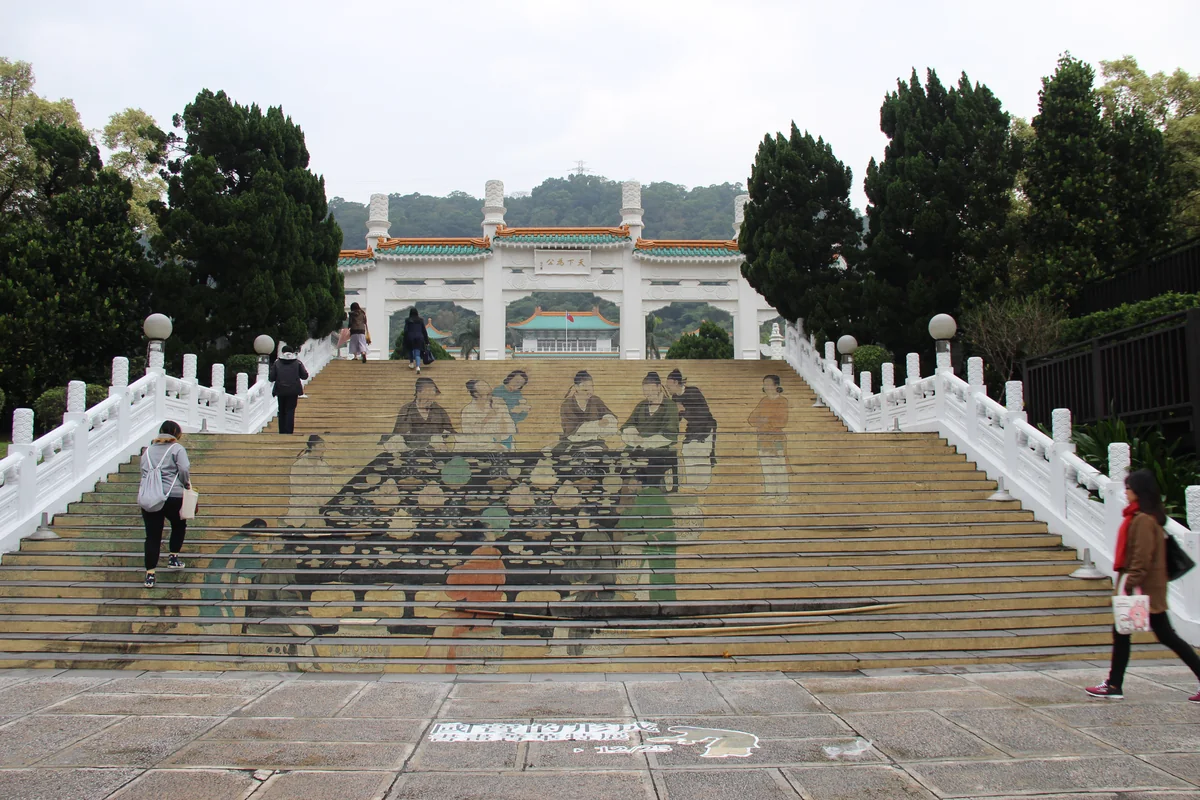
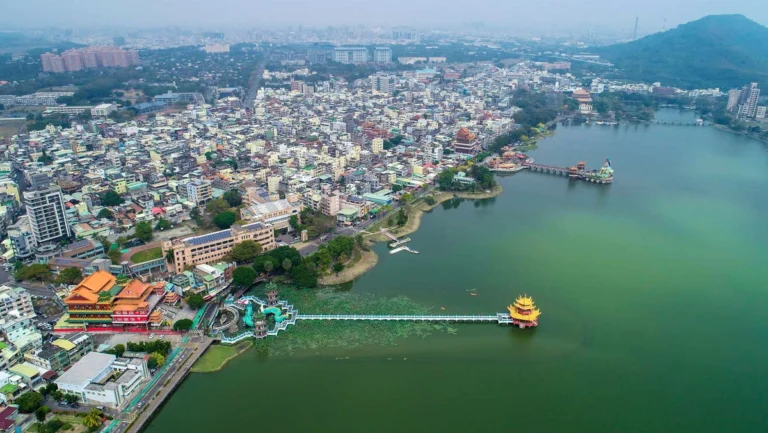
The historical roots of the Chiang Kai-shek Memorial Hall trace back to a political turning point that shook Taiwan in the latter half of the twentieth century. On April 5, 1975, President Chiang Chung-cheng (Chiang Kai-shek) passed away, bringing an end to a turbulent era in cross-strait relations. Immediately afterward, the Executive Yuan convened a state funeral committee chaired by Yen Chia-kan, who had just assumed the presidency, to plan a memorial complex on a scale rivaling the imperial mausoleums of East Asia. The chosen site lay on the eastern edge of Taipei’s old town—a parcel of land layered with historical memory, having once served as the barracks for the Imperial Japanese Army’s 1st Taiwan Infantry Regiment during the colonial era in a district formerly known as Asahi-cho. Transforming a colonial military compound of the Empire of the Rising Sun into a monumental national landmark set the stage for one of Taipei’s most commanding architectural focal points.
The monument is the intellectual culmination of two pivotal figures of the era: scholar Chin Hsiao-yi and renowned architect Yang Cho-cheng. Chin Hsiao-yi, a longtime confidential secretary and distinguished writer for the Republic of China government, was tasked with drafting the inscriptions that shaped the ideological soul of the entire complex. Meanwhile, architect Yang Cho-cheng—celebrated for masterpieces blending northern palatial styles—penned the master blueprint, distilling the architectural language of Tang, Ming, and Qing imperial tombs into modern reinforced concrete. After half a decade of construction, the complex officially opened to the public in 1980. Upon inauguration, its design immediately stood as an emblem of the prevailing political order, where every sightline, reflecting pond, white marble balustrade, and cobalt-blue glazed tile converged upon the colossal bronze statue enthroned in the main hall.
Far more than a static architectural marvel, the space is also imbued with classical literary artistry through horizontal plaques compiled from the fluid calligraphy of the Jin dynasty “Sage of Calligraphy,” Wang Xizhi. Across the interior walls, Chiang Kai-shek’s final testament alongside concise excerpts on the triad of values—”Ethics, Democracy, and Science,” the ideological pillars of Sun Yat-sen’s Three Principles of the People—are deeply engraved into solid granite. Every solemn Chinese character both sketches the portrait of a political leader and reflects an earnest effort to preserve traditional Chinese cultural orthodoxy amid the ideological divides of the previous century.
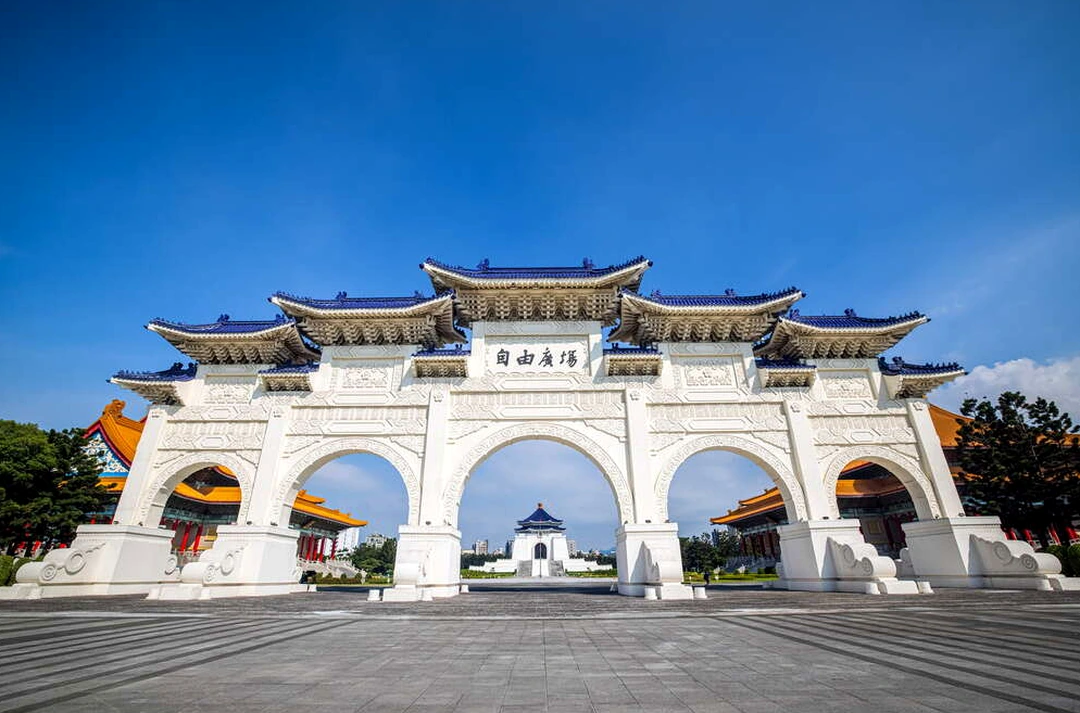
Yet the greatest value of this complex lies in the ceaseless tide of historical change it has witnessed. Entering the 1990s, what had once been a cloistered sanctuary of authority unexpectedly transformed into the epicenter of the Wild Lily Student Movement. Tens of thousands of youths, scholars, and intellectuals gathered across the vast plaza before the memorial hall to demand the dissolution of the “ten-thousand-year” parliament, an end to martial law, and a transition to direct multiparty elections. Through that historic watershed, a space once dedicated to personal authority was gradually demystified and reclaimed by the Taiwanese people. In 2007, amid a wave of transitional justice and localization under the Democratic Progressive Party administration, the complex was briefly renamed the National Taiwan Democracy Memorial Hall. The most visible mark of this shift was the removal of the four Chinese characters “Da Zhong Zhi Zheng” (meaning “Great Centrality and Perfect Uprightness,” a clever play on Chiang’s courtesy name, Chung-cheng) from the towering main archway along Zhongshan South Road, replaced by four characters reading “Liberty Square” in Wang Xizhi’s expressive cursive script. Over nearly half a century of political undercurrents, the memorial hall and plaza have become a chronicle in stone, capturing the dramatic democratic transformation of Taiwanese society.
Viewed through the lens of traditional East Asian feng shui, the memorial complex is strictly aligned along an east-to-west axis, situating the monumental structure within a natural energy-gathering pocket of the Taipei Basin. This basin marks the fertile confluence of three vital waterways—the Tamsui, Keelung, and Xindian rivers—forming a water-retaining bowl believed to generate rare auspicious energy. At the “Black Tortoise” position behind the hall to the east, the rugged Qixing Mountain range and the Datun Volcano Group stand as a sturdy backdrop, shielding the site from harsh winds. Conversely, the western facade opens out onto an expansive “Bright Hall” (Ming Tang)—the sweeping main plaza flanked by two massive structures on either side. This layout perfectly embodies the classic Four Symbols configuration: the National Theater rises on the left flank as the Azure Dragon, balanced by the National Concert Hall on the right bank as the White Tiger, creating a majestic palatial embrace that safeguards the solemn aura of the entire sanctuary.
From the heart of the main hall, a deliberate visual axis of power cuts straight through the urban fabric. The towering western main gate projects a commanding sightline across the granite expanse of Liberty Square, intersecting Zhongshan South Road to align seamlessly with Ketagalan Boulevard. This unbroken geometric ceremonial avenue points directly toward the facade of the historic Presidential Office Building, establishing a dramatic spatial dialogue between the seat of contemporary executive power and the supreme historical monument. The layout inherits the axial urban planning principles of ancient East Asian capitals while incorporating the linear geometry of grand Western plazas, anchoring the site as an immovable visual centerpiece in the heart of the city.
Surrounding the symbolic architectural core is a lush 25-hectare (250,000-square-meter) landscaped park designed around a philosophy harmonizing Western geometric axes with classical Jiangnan garden artistry. Interspersed among neatly manicured lawns are two artificial ponds named Yunhan Pond and Guanghua Pond. Their names evoke profound cultural allusions while faithfully recreating the winding waterside pavilions, natural rockery banks, and graceful short-span stone bridges typical of the famed gardens of Suzhou and Hangzhou. These bodies of water not only regulate the microclimate around the massive concrete and white stone structures, but also mirror drifting clouds and sky, imparting a tranquil, contemplative atmosphere wholly removed from the bustle of the surrounding metropolis.
A rich variety of native flora was carefully selected to enhance the enduring ecological value of this urban oasis. Rows of ancient camphor trees and shady banyans diffuse a crisp, clean fragrance, interwoven with sweetgum trees that turn vibrant crimson in autumn and groves of elegant white plum blossoms. Each spring, cherry blossom trails burst into bloom, weaving soft pink ribbons along the base of the white marble walls and blue-tiled roofs. This seamless fusion of auspicious geomancy, cohesive urban transit links, and refined garden scenery elevates the landmark far beyond an ordinary monument, turning it into an iconic urban landscape masterpiece of the island.
Set within solemn grounds spanning 24.78 hectares in the heart of Taipei, the Chiang Kai-shek Memorial Hall complex is a masterpiece blending traditional palatial architecture with modern engineering. At the very first point of arrival on the western side, visitors are immediately awestruck by the imposing ceremonial archway known as the Liberty Square Paifang. Standing an impressive 30 meters tall and stretching 80 meters wide, this classical-style gate follows the canonical Chinese architectural formula of five bays, six pillars, and eleven roofs. Six sturdy marble columns support eleven rhythmically tiered sapphire-blue glazed tile roofs, acting as a dignified ceremonial screen that opens onto the broad avenue leading straight to the central monument.
Stepping deeper into the central grounds, the main hall rises to a height of 70 meters, built with an advanced hybrid structure combining load-bearing reinforced concrete and a rigid steel truss frame. This engineering approach not only creates vast, unobstructed spans for the cavernous interior hall, but also ensures superior seismic resistance suited to the island’s geological conditions. Clad across its tiered foundation are tightly fitted slabs of white granite, forming a solid base supporting the main body faced in pure white marble. Its crisp symmetry and serene white palette give the edifice the appearance of a majestic stone lotus pedestal, reflecting natural light with quiet dignity from every angle.
The pinnacle of the building’s aesthetic and philosophical depth is concentrated in its double-eaved octagonal roof, inspired directly by the Hall of Prayer for Good Harvests at Beijing’s renowned Temple of Heaven. This eight-sided polygon draws deeply from the Bagua (Eight Trigrams) cosmology of the I Ching, symbolizing the harmonious interplay of heaven and earth and the cyclical motion of all things in the universe. The sweeping double-tiered roof is covered in tens of thousands of sapphire-blue glazed tiles that contrast brilliantly against the pure white marble walls, faithfully echoing the two primary colors of the national emblem. Crowning the apex of the roof is a gleaming gilded glazed finial, adding a regal finishing touch while conveying wishes for eternal peace and prosperity.
Footsteps toward the main hall are guided up two grand flights of granite stairs totaling 89 steps—symbolizing the 89 years of Chiang Kai-shek’s life. Each broad stone tread carries visitors from the stillness of the plaza into the awe-inspiring memorial chamber. The symmetry of the overall layout is further anchored by two neighboring landmarks completed in 1987: the National Theater and the National Concert Hall, collectively honored as the National Performing Arts Center’s “Two Halls.” Positioned symmetrically on either side of the main ceremonial axis, the National Theater features the prestigious four-sloped hip roof (Wudian) of the Ming and Qing dynasties, while the National Concert Hall displays the graceful hip-and-gable roof (Xieshan). Their vibrant golden tiles and upturned eaves not only celebrate classical palace craftsmanship, but also create a polyphonic architectural harmony that makes the entire complex a benchmark of contemporary East Asian landscape planning.
If the complex exudes quiet majesty by day, the Changing of the Guard by the Tri-Service Honor Guard is its most dynamic live spectacle, drawing millions of eyes to every movement executed with clockwork precision. Following a historic spatial transition, the silent indoor sentry duty inside the solemn main hall gave way to a fully outdoor drill performance, bringing military discipline closer to the public. Every hour on the hour from 9:00 AM to 5:00 PM daily, the crisp cadence of marching boots echoes from the two side gates, Gate of Great Filial Piety and Gate of Great Loyalty. Contingents of honor guards emerge from both side entrances and march in straight formation toward the wide expanse of Democracy Boulevard, where they perform a captivating 15-minute precision rifle drill rotated among representatives of the Army, Navy, and Air Force.
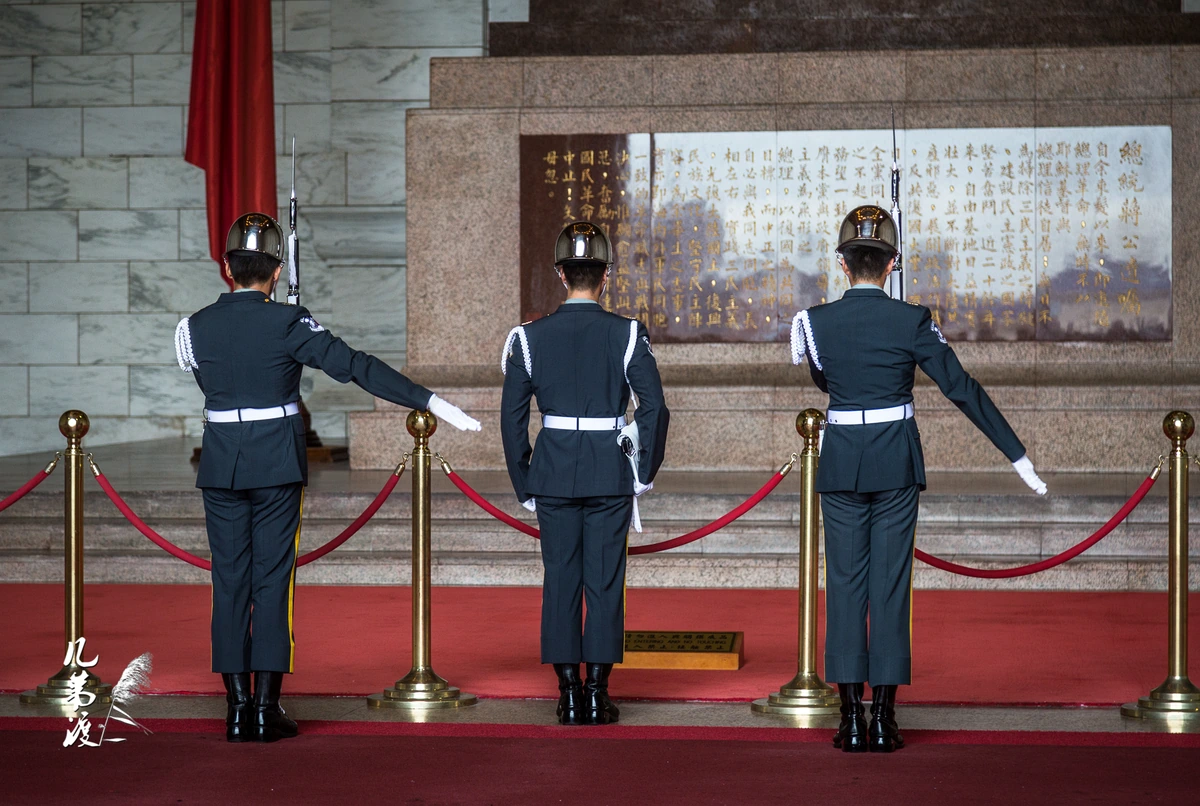
Rigorously selected for a minimum height of 180 centimeters and exemplary physique, each honor guard carries the iconic M1 Garand rifle weighing nearly five kilograms, fitted with a gleaming bayonet. Under the sunlight catching every crisp crease of their uniforms, the rifle drill reaches astonishing precision as the heavy steel weapons are spun whistling through the air, tossed aloft, and caught cleanly in the palm without missing a single beat. Each synchronized stomp of hobnailed boots onto the granite pavement rings out sharp and decisive like a crack of thunder across the plaza, showcasing indomitable spirit, physical strength, and ironclad military discipline—turning a 15-minute drill into an unforgettable work of visual and auditory performance art.
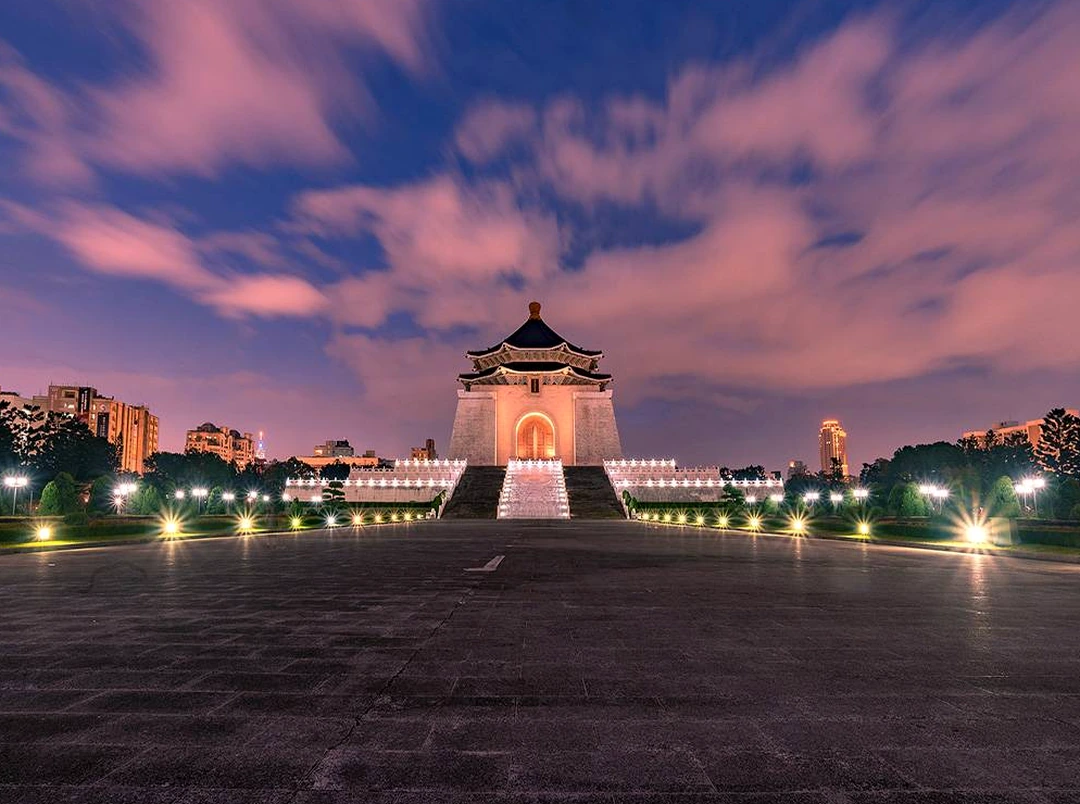
When twilight fades and night blankets Taipei, the memorial complex undergoes an enchanting transformation through masterful architectural lighting. High-powered uplights concealed along the base of the foundation illuminate simultaneously, casting beams upward onto the eight corners of the deep-blue glazed octagonal roof. The visual effect makes the entire marble monument appear like a celestial jade palace floating against the endless night sky. Contrasting harmoniously with this cool sapphire glow is the warm, radiant illumination of the Two Halls flanking the ceremonial axis. Bathed in soft honey-gold light, the steep yellow glazed roofs and vermilion pillars of the National Theater and National Concert Hall exude regal antiquity, turning the central grounds into a breathtaking, gilded nocturnal tableau.
Nightfall also marks the hour when formal solemnity yields to a vibrant, laid-back rhythm of contemporary urban life. The expansive paved grounds of Liberty Square become an organic cultural gathering spot for Taipei residents of every walk of life, where tradition and modernity mingle effortlessly. In one corner, groups of seniors unwind body and mind through flowing Tai Chi forms or step rhythmically to lively folk dance melodies; in another, young people gather beneath the curved eaves of the Two Halls to practice intricate skateboarding tricks or spin glowing LED diabolos high into the air. Meanwhile, around the granite steps and rain-slicked reflecting pools, photographers patiently frame flawless symmetrical shots of the illuminated classical silhouette. Together, they weave a rich human tapestry in which historical memory dissolves gently into the living pulse of an East Asian city that never sleeps.
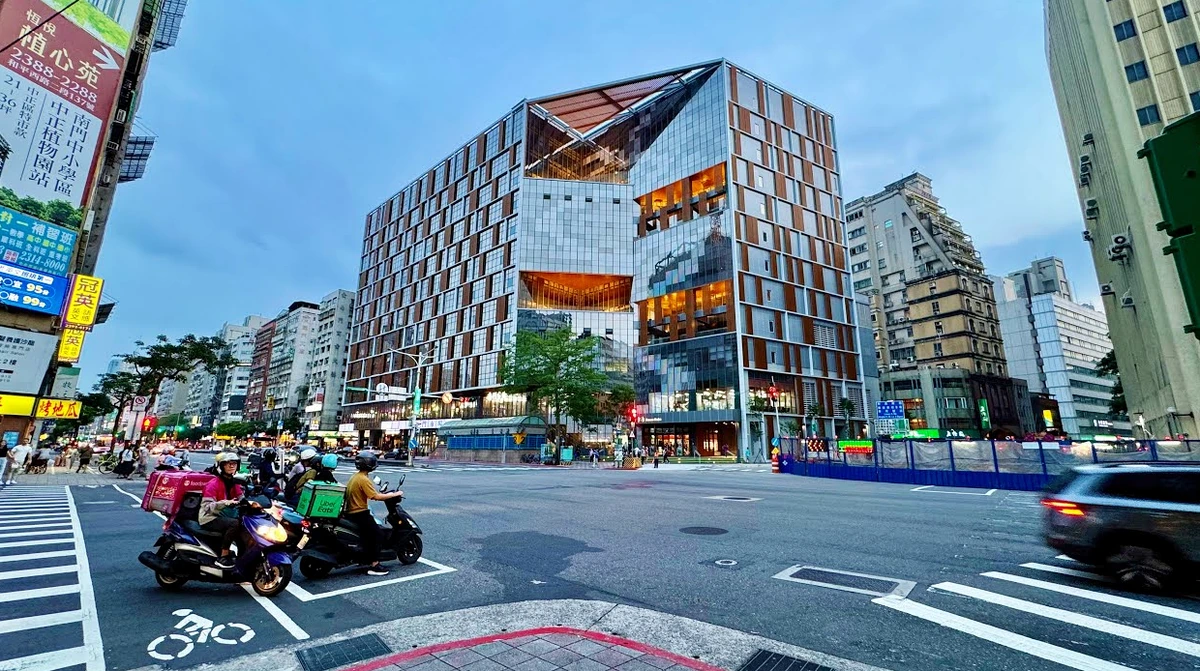
The neighborhood ring encircling the Chiang Kai-shek Memorial Hall—stretching from Hangzhou South Road and Jinhua Street to Roosevelt Road—not only preserves deep political history, but also serves as one of Taipei’s richest hubs of migrant culinary heritage. Waves of mainlanders who relocated to the island with the government in the mid-twentieth century brought with them the nostalgic flavors of coastal Jiangnan, blending seamlessly with the culinary traditions of military dependents’ villages (juancun) and native Taiwanese food culture. This historic fusion turns the dining district around Liberty Square into a living flavor map, where visitors can trace the memories of an era through wisps of steam rising from bamboo baskets and generations-old broth pots.
Just steps from the memorial grounds stands Nanmen Market, an iconic trading hub established in 1907 during the Japanese colonial period under its original name, Chitose Market. It has long been celebrated as a sanctuary of traditional Jiangsu and Zhejiang cuisine in the heart of the city. The moment you step inside, your senses are drawn to the famed Yichang Yufang stall, a venerable artisanal purveyor of nostalgic delicacies. Foremost among them are Huzhou zongzi, meticulously wrapped in long bamboo leaves into an elongated, pointed shape, enclosing sticky rice infused with savory pork fat and filled with either richly seasoned pork or smooth, delicate red bean paste. Alongside them, rock-sugar braised lotus root stuffed with glutinous rice and glazed in amber syrup, as well as tender Lion’s Head pork meatballs simmered with Napa cabbage in a sweet, clear broth, faithfully recreate refined imperial-style cooking. Right next door, Hexing Gaotuan preserves traditional Jiangnan rice-cake craftsmanship with Shanghai songgao—steamed in rustic wooden molds from finely milled rice flour to reveal fragrant black sesame or red bean fillings—paired with thin-skinned, generously stuffed Suzhou-style glutinous rice dumplings.
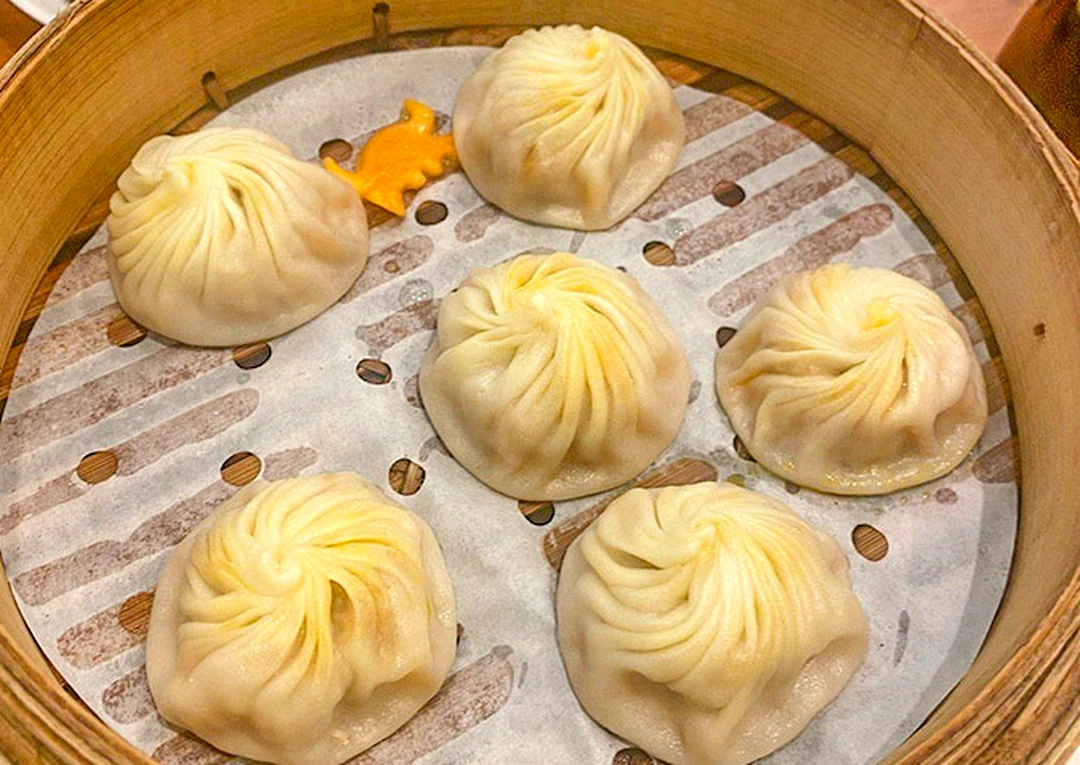
Leaving the lively century-old market behind and strolling along Hangzhou South Road opposite the eastern garden wall of the memorial, visitors will encounter the celebrated Hangzhou Xiaolongtangbao. While preserving the spirit of humble everyday dining, this eatery adheres to exacting artisanal standards. Each petite soup dumpling is rolled, pleated, and steamed fresh to order, boasting a paper-thin wrapper expertly gathered into more than eighteen uniform folds. The soul of the dumpling lies in its filling of fresh, same-day pork combined with a rich aspic slow-simmered from marrow bones and mature hens. In the high heat of the bamboo steamer, the broth jelly melts instantly, enveloping the savory meatball. Diners simply lift a dumpling onto a porcelain spoon, gently pierce the delicate skin to release the piping-hot, deeply flavorful broth, and savor it with slivers of fresh ginger steeped in aged black vinegar for an unforgettable burst of flavor.
The final piece of this nostalgic culinary journey is Jin Feng Braised Pork Rice, located on Section 1 of Roosevelt Road. For decades, this unassuming eatery has drawn patient lines of locals eager for a bowl of its legendary heirloom braised pork rice (lu rou fan). Rather than using ordinary minced meat, the kitchen selects pork belly with a balanced ratio of lean meat to fat, hand-diced into neat cubes. The pork is sautéed with crispy fried shallots and simmered gently over low heat with premium soy sauce and a secret blend of Chinese medicinal herbs until its natural collagen reduces into a glossy, velvety glaze. Ladled generously over plump, fragrant Taikeng No. 9 rice and paired with a bowl of clear, sweet shiitake chicken soup, the dish elevates humble comfort food to perfection—bringing an unforgettable close to a journey through history, architecture, and capital cuisine.
Exploring the Chiang Kai-shek Memorial Hall complex rewards thoughtful timing so you can take in both the solemn precision of the military ceremonies and Taipei’s distinctive local cultural rhythm. The surrounding park grounds are open to the public daily from 5:00 AM to 10:00 PM, allowing visitors to blend into the capital’s daily life as locals practice Tai Chi beneath ancient trees or stroll at sunset. Meanwhile, the white octagonal main hall and its historical exhibition galleries welcome visitors daily from 9:00 AM to 6:00 PM year-round with free admission and no advance reservation required, offering seamless access to this heritage landmark for travelers from around the world.
Taipei’s modern public transit system makes reaching the memorial effortless and stress-free. Simply take the Taipei MRT Tamsui-Xinyi Line (Red Line) or Songshan-Xindian Line (Green Line) and alight at Chiang Kai-shek Memorial Hall Station. From Exit 5 of the underground station, a stone-paved walkway leads directly out onto the wide expanse of Democracy Boulevard and Liberty Square rising against the downtown skyline, sparing you any worry over city traffic or congestion.
To make the most of your visit and catch the grandest moments, a half-day itinerary is ideal. Start around 9:30 AM by walking beneath the monumental archway of Liberty Square, admiring the classical symmetry of the National Theater and National Concert Hall modeled after Ming and Qing palace architecture. By 10:30 AM, ascend the 89 granite steps to the bronze statue hall to secure an unobstructed vantage point, ready to witness the stately 11:00 AM Changing of the Guard as the Tri-Service Honor Guard marches in crisp formation out onto Democracy Boulevard.
After taking in the stirring midday ceremony, walk just a few hundred meters over to traditional Nanmen Market or stroll down Hangzhou South Road to sample renowned Jiangsu and Zhejiang culinary heritage. The area is packed with family-run eateries serving famous xiaolongbao soup dumplings with paper-thin skins brimming with savory broth, crispy-bottomed pan-fried buns, and rich southern-style Dongpo braised pork. In the early afternoon, once you have recharged over lunch, return to the ground floor of the memorial hall to view original historical artifacts, vintage bulletproof presidential limousines, and chronological exhibits vividly chronicling the island’s transformations across the decades.
To preserve the sanctity of the memorial space, visitors should dress neatly and respectfully, avoiding tank tops or overly short attire when entering the bronze statue hall. Throughout your time inside the main hall and exhibition galleries, flash photography is strictly prohibited to protect historic artifacts, and eating, smoking, running, or loud conversation are not permitted. Please also note that the airspace above the plaza and memorial hall lies entirely within a strict municipal no-fly zone enforced by aviation authorities, so carrying or operating unmanned aerial vehicles (drones/flycams) is strictly forbidden. For a seamless journey with complete peace of mind regarding itinerary coordination and local regulations, travelers can explore all-inclusive Taiwan tour packages thoughtfully curated by experienced cultural travel specialists.