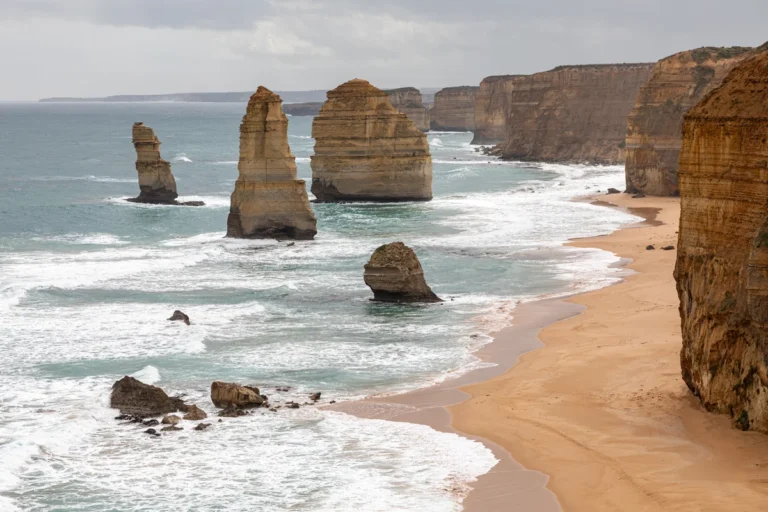
The geological history of this legendary coastline began deep beneath the ocean roughly 20 million years ago during the Miocene Epoch. At that time, the entire region lay submerged beneath a rich, nutrient-filled shallow sea in the Southern Hemisphere. Over countless millennia, billions of bone fragments and fossilized shells from ancient marine life—including foraminifera, bryozoans, mollusks, and echinoderms—accumulated and compressed under immense weight to form thick strata of Port Campbell limestone in its signature cream-yellow hue. As the continental shelf rose above sea level and met the relentless battering of Southern Ocean swells and winds, a grand process of natural sculpting began. Long before Western expedition sails appeared on the horizon, the coastal stretch from Cape Otway to Warrnambool was the sacred Country of the Gunditjmara, Girai wurrung, and Eastern Maar First Nations. Across tens of thousands of years of habitation, these communities preserved a deep Indigenous ecological knowledge system spiritually tied to every rocky outcrop and cliff face, weaving oral histories of coastal change into the very fabric of their culture.
Entering the modern maritime era, this coastline became one of the most treacherous sea passages on Earth, earning its haunting place on world nautical charts as the Shipwreck Coast. Lying directly in the path of the howling Roaring Forties sweeping up from polar latitudes, the area was frequently shrouded in dense fog, swirling rip currents, and razor-sharp sheer limestone cliffs. Tragedy struck its peak in the predawn hours of June 1, 1878, when the three-masted clipper Loch Ard, sailing from Britain to Melbourne, slammed into reefs near Muttonbird Island. The fury of the ocean claimed the lives of 54 passengers and crew, leaving just two miraculous survivors: eighteen-year-old apprentice seaman Tom Pearce and young passenger Eva Carmichael. The disaster sent shockwaves through the press of the day and etched Loch Ard Gorge into history as a grim testament to nature’s overwhelming power.
The shifting tides of history after World War I opened an entirely new chapter in the creation of the region’s monumental coastal route. Seeking to ease unemployment and provide a livelihood for thousands of returning Australian Imperial Force (AIF) veterans after the devastation of war, a bold proposal was championed under the direction of architect and engineer Campbell Howard Armstrong alongside the persistent advocacy of Member of Parliament Wilfred Kent Hughes. On September 19, 1919, the first soil was turned to forge the Great Ocean Road. Through sheer human grit—using picks, shovels, wheelbarrows, and blasting powder—returned servicemen suspended themselves from precarious limestone cliffs to carve out the road meter by meter through crags and dense bushland. After more than a decade of grueling rock-cutting and roadbuilding, the project officially opened on November 26, 1932, becoming the world’s largest war memorial—an enduring tribute honoring fallen comrades who never returned from overseas battlefields.
The transformation from a perilous stretch of coast into an international travel icon is also closely tied to a fascinating shift in cultural perception. Originally, the towering limestone stacks rising from the surf were known to locals by the plain, somewhat blunt name “Sow and Pigs,” with Muttonbird Island cast as the “sow” and the surrounding stacks as “pigs.” Recognizing the extraordinary scenic value of the formation, the Victorian tourism authority decided in the 1950s to rename the dramatic cluster “The Apostles,” lending it a sense of solemn grandeur with biblical and classical resonance. To establish a strict conservation corridor against human impact and safeguard the integrity of the rock strata, Port Campbell National Park was officially gazetted in 1964. Through subsequent planning stages, the reserve expanded to more than 1,750 hectares, creating a carefully managed geological heritage landscape that preserves millions of years of geomorphic evolution alongside chapters of human history.
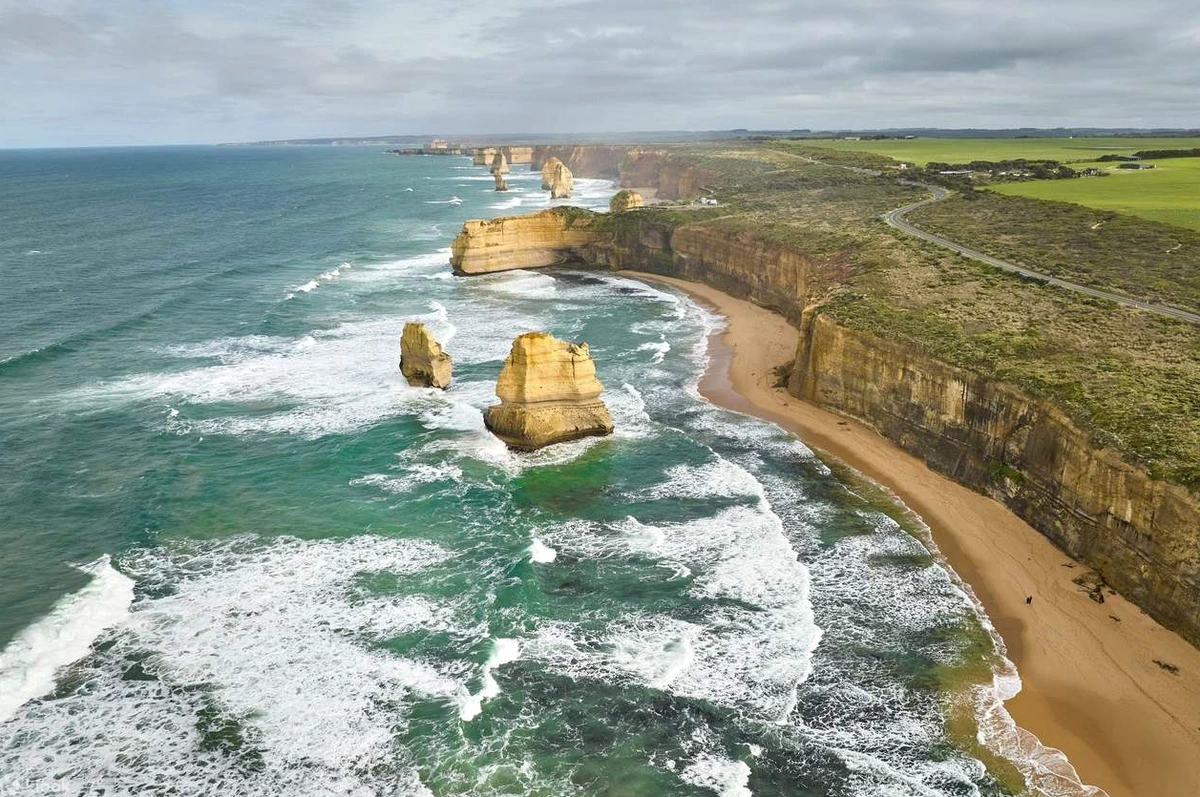
Situated along the southwestern edge of Victoria, the 12 Apostles limestone stacks lie within the protected boundaries of Port Campbell National Park, roughly 275 km from central Melbourne via the Great Ocean Road (designated B100) or the inland Princes Highway (A1). Viewed through the lens of geomorphology and natural landscape character, this coastline showcases a fierce clash of land and sea paired with rare majesty. The terrain stretches out as gently undulating coastal plains and tranquil grassy expanses before dropping away abruptly at the cliff edge. Sheer sedimentary limestone walls rise like natural ramparts—reaching dizzying heights of 45 to 70 meters above sea level—facing head-on into biting westerly winds and surging swells rolling in from the Southern Ocean.
Landform sculpting along this coast takes place through pure natural mechanical force across millions of years of continuous geological change. The immense kinetic energy of Southern Ocean swells—both destructive and creative at once—tirelessly undercuts the bases of soft cliffs formed from Tertiary marine shells. At first, wave surge compresses air into microscopic fissures, splitting the limestone into narrow clefts and sea caves carved deep into the headland. As cave roofs are hollowed from below and weathered by rainwater from above, high-pressure blowholes open up, blasting white sea spray skyward with each rising tide. Over time, interconnecting caves form sweeping natural arches spanning turquoise waters, until gravity overcomes the fragile span of limestone and the arch collapses into the sea, leaving solitary stacks standing proud amid whitecaps.
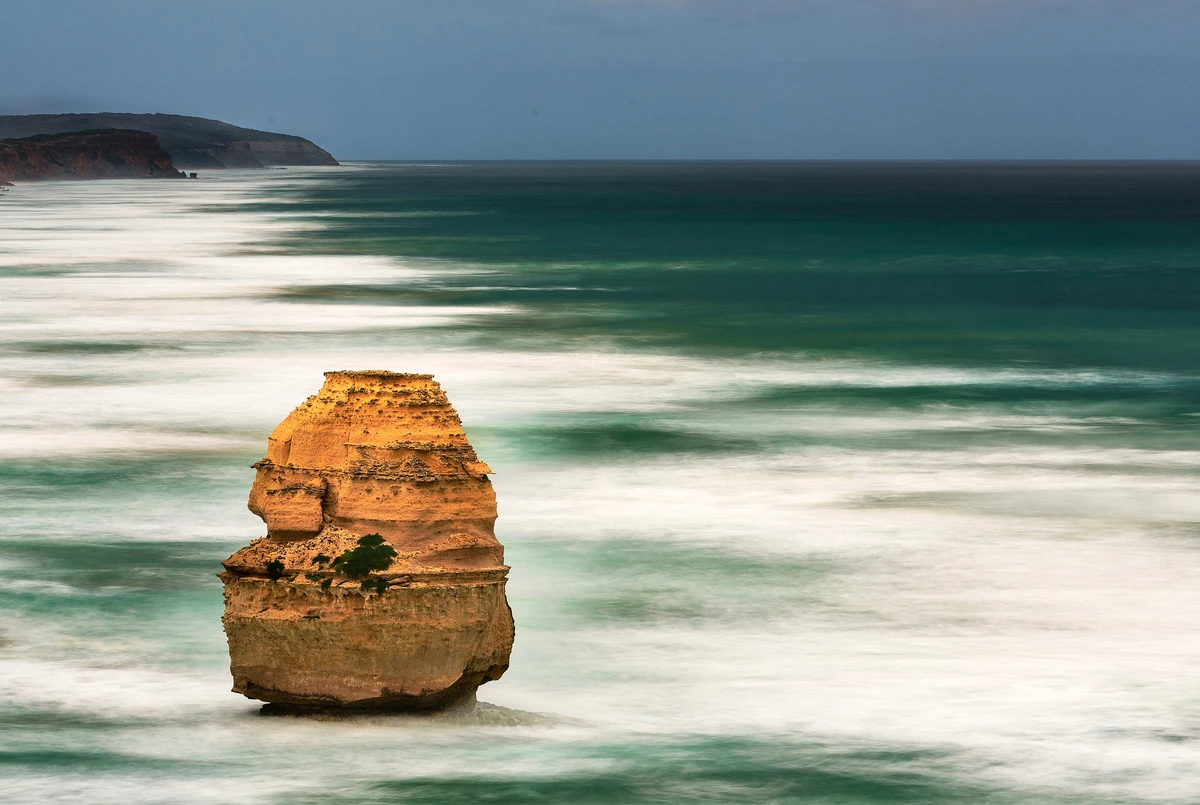
In sharp contrast to the raw drama of bare stacks surrounded by saltwater, the plant community crowning the clifftop plateau displays remarkable resilience against harsh conditions. Every green patch here must endure year-round heavy salt spray and scorching gales blowing off the open sea. Anchoring the thin topsoil are stands of Coast Beard-heath (Leucopogon parviflorus), interspersed with clumps of Coast Daisy-bush (Olearia axillaris) whose fine hairs help trap moisture. Scattered across the slopes are wind-sculpted Moonah trees (Melaleuca lanceolata) alongside hardy tussock grass (Poa labillardierei), forming a silvery-gray-green fringe along the cliff rim that checks erosion of scarce soil.
This natural setting also brings together a distinctive array of wildlife within the adjoining Twelve Apostles Marine National Park. Across wind-swept skies and isolated rock pinnacles, Peregrine Falcons (Falco peregrinus) reign supreme with breathtaking hunting dives, while sandy pockets at the cliff base offer nesting ground for the critically imperiled Hooded Plover away from heavy surf. During summer months, dusk along the bay is darkened by hundreds of thousands of Short-tailed Shearwaters (also known as muttonbirds) streaming back to their burrows after migrating thousands of nautical miles from the Northern Hemisphere. Below intertidal ledges, Australian Fur Seals (Arctocephalus pusillus doriferus) haul out to bask in the sun, sharing nutrient-rich waters with Humpback Whales and Southern Right Whales (Eubalaena australis) cruising past during their annual breeding migration.
Facing the relentless power and shifting moods of the Southern Ocean, visitor infrastructure at the Twelve Apostles is designed as a restrained, low-profile presence in the landscape. Coordinated closely by Parks Victoria, the entire precinct is built to maintain a delicate balance between surging visitor numbers and the preservation of fragile coastal habitats. Located about 6 km southeast of the coastal town of Port Campbell, the Twelve Apostles Visitor Centre follows a philosophy of blending seamlessly into the windswept terrain. The building makes thorough use of passive solar design to optimize natural light and local microclimate, pairing sustainably sourced structural timber with warm, earthy rammed-earth walls. This design language honors the untamed character of the Port Campbell coast while setting a high standard for contemporary ecological architecture.
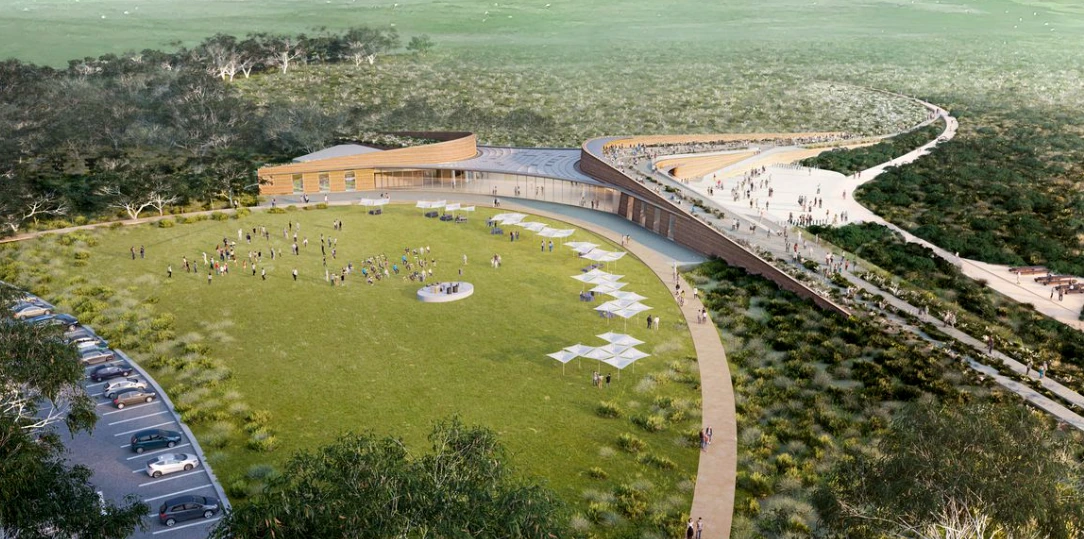
From the main hub, the movement of tens of thousands of daily visitors is managed thoughtfully through an ingenious underground passage. A deeply excavated, heavily reinforced subterranean pedestrian underpass creates a completely safe route beneath the busy asphalt of the Great Ocean Road (B100). This solution eliminates conflict between fast-moving vehicles and people on foot, guiding travelers away from engine noise and directly toward the open views of the clifftop viewing decks.
Emerging from the underpass, visitors continue along a network of elevated boardwalks and walkways stretching more than a kilometer and winding smoothly over the rolling coastal heathland. To protect the tangled yet delicate root systems of native scrub on sandy soils, engineers avoided traditional surface concrete pours. Instead, the walkways are raised clear of the ground using fiber-reinforced polymer (FRP) combined with marine-grade hot-dip galvanized steel grating. Supported by steel screw piles driven tens of meters through surface sediments into sound limestone bedrock, the structure handles heavy foot traffic while letting wind, rain, and sunlight nourish the vegetation below.
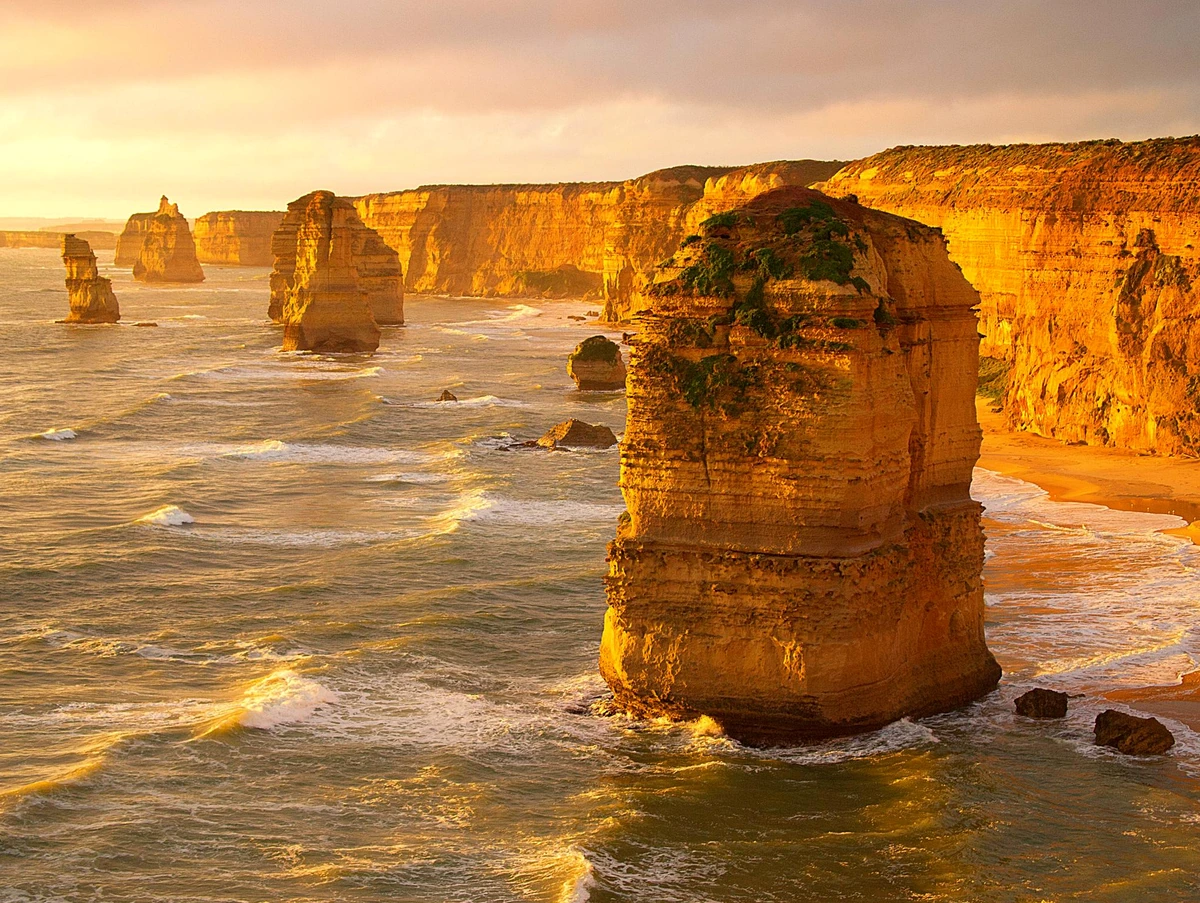
The centerpiece of the entire viewing precinct is the grand sculpture carved by Nature over millions of years: towering limestone stacks rising up to 45 meters above churning seas. They are the product of complex geological change, where Miocene limestone cliffs face constant hydraulic pounding from Southern Ocean swells. Each year, these stacks erode and wear down by roughly two centimeters on average. This unforgiving law of natural erosion creates awe-inspiring scale alongside real structural hazard, requiring human design to always step back in deference to geomorphic safety.
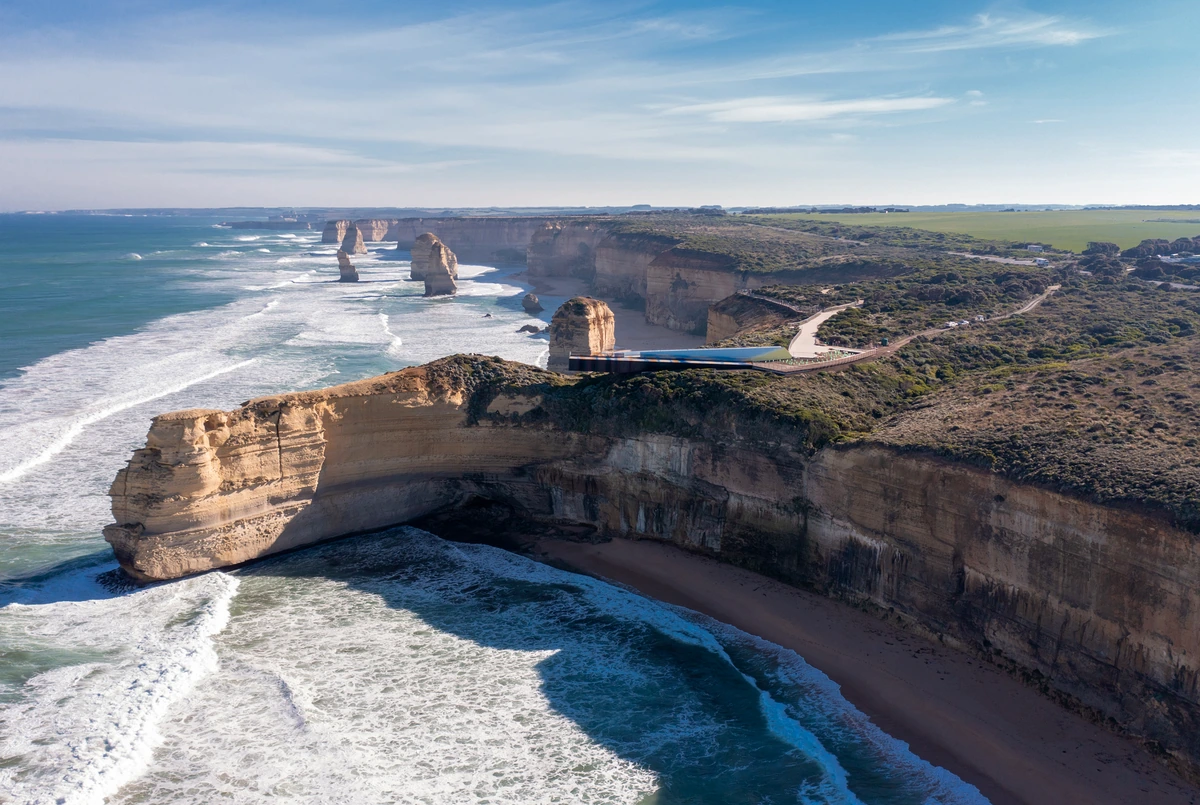
The ongoing geological motion of this limestone coast has been punctuated by dramatic events, notably the near-instantaneous collapse of a 50-meter iconic stack on July 3, 2005, and a cliff fall in June 2009. In response to the inherent fragility of the rock formations, every viewing platform is set back at a strict safety margin from cliff edges prone to fracturing. Combined state and federal investment in the precinct over the past three decades has exceeded 50 million Australian dollars, funding integrated parking facilities, advanced wastewater treatment systems that protect local groundwater aquifers, and clear geological interpretive signage—making the site a benchmark for architectural adaptation to Earth’s ever-changing forces.
As sunset draws a final deep-crimson curtain across the Southern Ocean horizon, the Twelve Apostles does not light up with flashy laser shows or artificial sound-and-light spectacles common at mass-market attractions. Instead, it enters a raw natural stage crafted by Earth itself, where deep darkness becomes the grandest backdrop and stillness is celebrated as the highest aesthetic ritual. The reserve enforces stringent dark-sky standards, deliberately avoiding high-output floodlighting to protect the integrity of coastal wildlife along Australia’s southern shore.
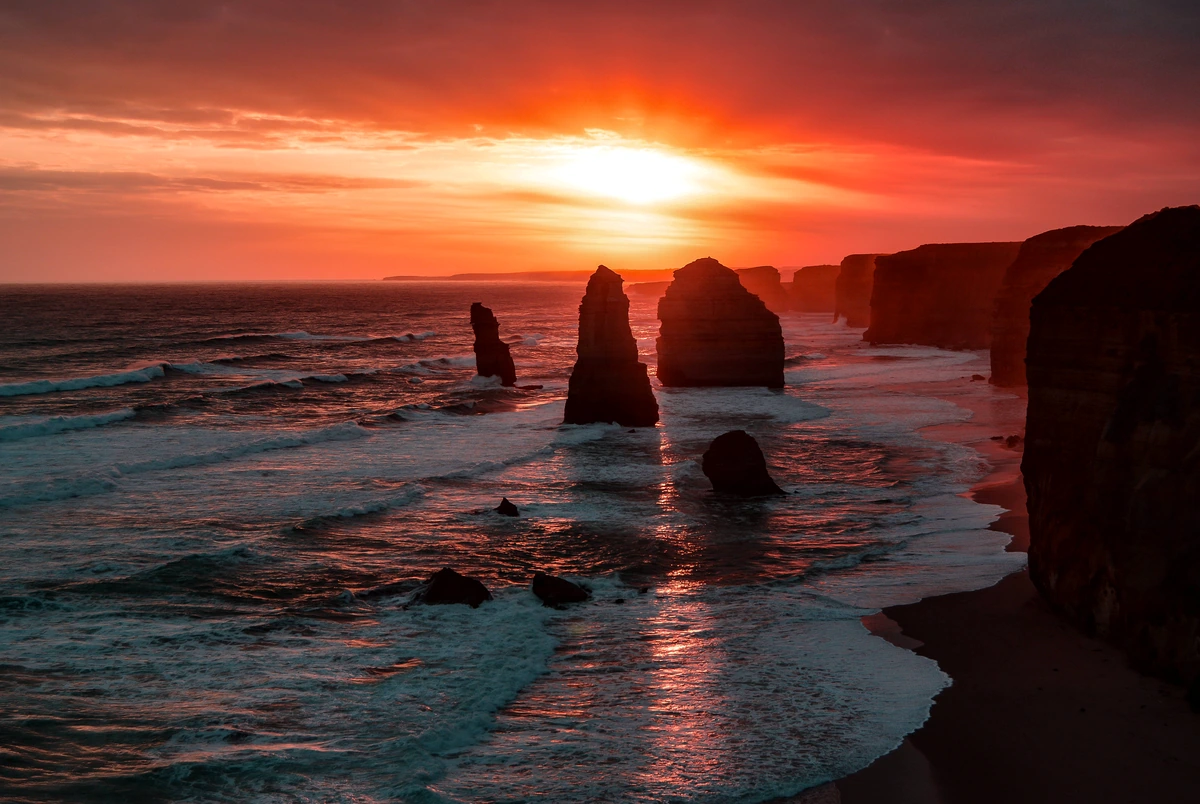
Lighting across the heritage precinct is pared back to a refined minimum. Along the path leading from the visitor center toward the viewing overlooks, management uses low-lux warm-spectrum bollard lighting that gently marks the walking route without disturbing nocturnal creatures. Once visitors reach the timber viewing platforms jutting over the drop-off, artificial light disappears altogether, handing full visual immersion over to the night sky. The view opens to infinity as the southern heavens reveal the glowing core of the Milky Way like a ribbon of diamond dust arching overhead, accompanied by the Southern Cross and the soft, wondrous glow of the Magellanic Clouds. Illuminated by starlight millions of light-years old, the towering limestone stacks stand like silent monuments in quiet dialogue with ancient darkness.
Nightlife along the limestone coast does not fall silent; instead, it transforms into a captivating soundscape. Once daytime tour crowds thin out, natural acoustics take center stage: the deep, rolling boom of Southern Hemisphere swells crashing against submerged rock bases, sending low vibrations through the coastal shelf. Woven through that thunder are chilly katabatic breezes carrying salt air across grassy headlands, along with the sharp, chattering calls of Little Penguins (Eudyptula minor). After a long day foraging far out at sea, these tiny seabirds come ashore on secluded beaches, calling back and forth as they make their way to burrows tucked beneath rugged limestone cliffs.
To respect nature’s rhythm and protect nocturnal seabird habitat, stairways leading down to low-lying beaches are locked at dusk. Rather than diminishing the experience, this boundary turns a nighttime visit into a deeper journey of cultural reflection and ecological mindfulness. Standing between a sheer drop and ink-black ocean water, listening to the timeless breath of wind and stone, travelers become quiet witnesses to Victoria’s enduring symphony of land and sea.
Exploring the geological heritage of the Great Ocean Road would feel incomplete without experiencing the rich culinary tapestry of the Shipwreck Coast across the Corangamite and Warrnambool regions. Here, the brisk temperate maritime climate of Bass Strait meets some of western Victoria’s most fertile volcanic plains. Mineral-rich basalt soils formed from ancient volcanic ash sustain lush pastures year-round, making the region a celebrated heartland of Australian dairy. Purebred Friesian and Jersey dairy herds grazing windswept hillsides draw nourishment from the land to produce rich milk high in butterfat—the golden foundation for artisan cheesemakers crafting aged rustic cheeses, golden farm butter, and creamy ice creams with clean, distinctive flavor.
Alongside this dairy heritage, the culinary map along the limestone coast is enriched by Koorie bush tucker traditions practiced in harmony with the land for thousands of years. Today, skilled local chefs revive and weave native wild plants into modern plates. Standouts include Warrigal Greens (Tetragonia tetragonioides) with a mild bite and clean sweet finish, Saltbush (genus Atriplex) holding a crisp, savory hint of sea breeze, aromatic lemon myrtle leaf, and the warm, lingering spice of Mountain Pepperberry. Blending Western culinary technique with native bush botanicals creates a dining experience that feels both intriguing and authentic to the coastal bushland.
From the cold, deep waters of Bass Strait, clean ocean currents yield prized seafood known for firm texture and rich sweetness. The undisputed star of the sea here is Southern Rock Lobster (Jasus edwardsii), prized for its glossy deep-red shell, snow-white meat, and natural sweet snap when steamed over coals or roasted with herb butter. Near submerged reefs thrives Blacklip Abalone (Haliotis rubra), a coastal delicacy harvested by skilled divers and celebrated for its savory richness and tender crunch. On food lovers’ tables, pan-fried King George Whiting (Sillaginodes punctatus) holds a place of honor for its delicate silver scales, clean white flesh, and ocean-fresh flavor straight from white-capped swells.
Local food culture also comes alive at historic stops steeped in character. In the peaceful harbor town of Port Campbell, the long-standing Port Campbell Hotel overlooks the bay, welcoming locals and travelers alike for flame-seared Gippsland beef paired with fresh day-boat seafood. Inland in the lush Timboon valley, Apostles Gourmet Sheep Cheese opens a window into artisan cheesemaking, where firm herb-marinated pecorino and creamy feta are matured from pure local sheep’s milk. Not far away, The Timboon Railway Shed Distillery sits quietly inside a historic 1892 railway station, offering single-malt whisky distilled in traditional copper pot stills—best enjoyed alongside a scoop of handmade ice cream amid the nostalgic charm of a bygone rail era.
The Twelve Apostles and the wider Port Campbell National Park welcome visitors 24 hours a day, 365 days a year, with no admission or entry fee. All raised timber boardwalks, clifftop viewing decks, and main car parks are free to access, making it easy to take in the grandeur of the Southern Ocean. Right at the entrance precinct, the Twelve Apostles Visitor Centre generally operates daily from 9:00 AM to 5:00 PM, closing only on Christmas Day. Inside, travelers can pick up detailed geological interpretation, orientation maps, and visitor facilities before setting out along the boardwalks toward the coast.
Journeys to this coastal wonder typically start from Melbourne, where the B100 hugs the surf for one of the world’s most dramatic self-drive routes. While a direct non-stop drive takes around four to four and a half hours behind the wheel, experts strongly recommend setting aside at least two days to unhurriedly soak in every coastal lookout. For travelers who prefer not to drive, organized coach tours depart the city daily. For a breathtaking bird’s-eye view of the sculpted coastline, visitors can also book scenic helicopter flights departing from the helipad right beside the Visitor Centre.
Because Victoria’s coastline is geologically fragile, protecting personal safety and respecting local heritage call for clear, disciplined etiquette. Limestone cliffs here are porous and eroded by sea wind and undercurrents, meaning rockfalls or slumps can occur suddenly without warning—so visitors must never step past fenced trail boundaries. This Country also holds deep ancestral significance for the Eastern Maar people, where ancient shell middens and every native plant are tied to living cultural memory and must remain undisturbed. To safeguard wildlife—and especially beach-nesting shorebirds like the Hooded Plover—dogs and pets are strictly prohibited throughout the park.
The finest moments to experience the full pulse of bush and ocean are at first light or during late-afternoon sunset, when limestone faces glow with warm golden light and the area is free from the busiest coach arrivals between 11:00 AM and 3:00 PM. Southern coastal weather is famously changeable—capable of cycling through all four seasons in a single day—so bring a windproof jacket, waterproof layers, and sturdy walking shoes with solid grip. Your trip becomes even richer when you extend your route to nearby highlights such as the Gibson Steps—86 steps cut into the cliff face leading down to sweeping sand—along with Loch Ard Gorge, The Grotto sinkhole, and the dramatic natural arches of London Arch and The Island Archway.
To pair this dramatic ocean scenery with lively city culture across Australia’s major hubs, travelers can explore the curated itinerary in our 7-day 6-night Melbourne – Canberra – Sydney tour to make the most of their time and create lasting memories along the southern coast.