Amid the serene valley of the ancient capital of Nara, Todai-ji Temple (Great Eastern Temple – 奈良東大寺) stands tall as a monumental wooden epic, preserving the dazzling radiance of the Nara Period (Nara Jidai). The genesis of this sacred sanctuary is intimately tied to the Tenpyō era (天平) and the grand vow of Emperor Shōmu (聖武天皇). During his reign, the Land of the Rising Sun endured devastating natural disasters, epidemics, and fierce political upheaval. Confronted with these crises, Emperor Shōmu held an unwavering conviction that the majesty of the Buddha Dharma could safeguard the nation, alleviate the suffering of his subjects, and usher in an era of peace and prosperity. He issued an imperial edict establishing a nationwide network of provincial temples (Kokubunji), crowning Todai-ji at its supreme apex: the head temple presiding over Japan’s entire Buddhist establishment and serving as the spiritual pillar shielding the destiny of the realm.
The seeds of this monumental complex were actually sown in 728, originating as a modest hermitage named Kinshō-ji founded by Emperor Shōmu in memory of a young deceased prince. To bring his grand vision of a supreme Buddhist center to fruition, Nara’s history recorded the indelible contributions of extraordinary high priests. Monk Rōben (良弁), the temple’s founding abbot, laid the institutional governance and initial spiritual layout. Alongside him, Great Master Gyōki (行基), whose spiritual charisma inspired hearts far and wide, traveled tirelessly across the provinces to rally resources, uniting tens of thousands of citizens—from humble commoners to high nobles—to contribute labor and wealth toward casting the Great Buddha and erecting the monastery. A decisive milestone cementing its ecclesiastical authority arrived in 754, when Master Jianzhen (Ganjin – 鑑真), the renowned Tang Chinese monk who braved perilous storms across the sea to reach Japan, formally established an ordination platform at Todai-ji. This event marked the first time members of the imperial family and hundreds of monks received orthodox monastic precepts, establishing the Great Eastern Temple as the supreme fountainhead of Buddhist monastic discipline in Japan.
Yet Todai-ji’s historical journey was not merely bathed in glory; it also bears the deep scars of warfare and turbulent eras. The first tragedy struck in 1180 during the Genpei War, when forces of the Taira clan set fire to vast portions of the monastic compound, reducing the Great Buddha Hall and countless priceless treasures to ashes. Amid the smoldering ruins, the resilient spirit of Kamakura Buddhism rekindled the temple’s flame. Under the resolute leadership of Master Chōgen (重源), a nationwide reconstruction campaign was launched. Incorporating the robust Daibutsu-yō (“Great Buddha Style”) architectural technique supported by sweeping patronage, the magnificent Great Buddha Hall rose triumphantly once more, completing restoration in 1195 and reclaiming its sacred grandeur.
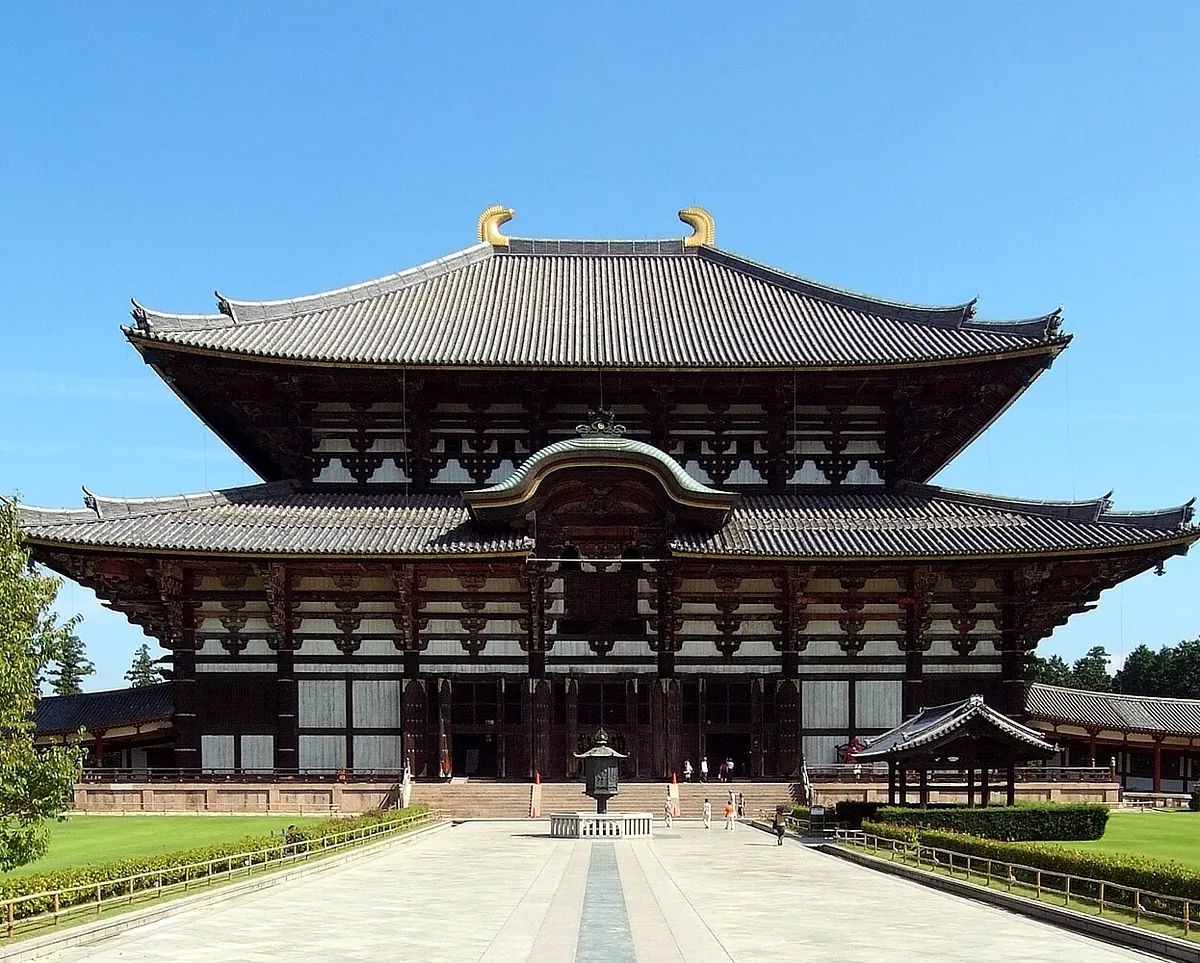
Still, tempestuous fate had not yet spared the ancient monastery. During the chaotic Sengoku (Warring States) period in 1567, flames of battle between rival warlords once again engulfed the Great Buddha Hall, leaving the colossal bronze statue exposed to wind, rain, and sun for over a century without a roof overhead. It was not until the peaceful Edo period that a comprehensive reconstruction took place between 1701 and 1709. Although the scarcity of giant old-growth timber and economic constraints of the age compelled master carpenters to reduce the building’s width by roughly thirty percent compared to its original Tenpyō footprint, the Edo-period Great Buddha Hall proudly retained its stature as one of the largest wooden structures on Earth. These cycles of destruction and rebirth stand as enduring proof of Todai-ji’s indomitable vitality, where every grain of timber and architectural line carries the cultural depth of an entire nation.
Nestled at the foot of the Kasuga mountain range and verdant Mount Wakakusa along the eastern edge of ancient Heijō-kyō, Todai-ji commands one of the most auspicious geomantic positions in the history of Nara-period urban planning. Within classical East Asian spatial philosophy deeply influenced by Tang-dynasty Chang’an capital layouts, the east symbolizes the Wood element, sunrise, and the perpetual renewal of life. When issuing his decree to build the monastery, Emperor Shōmu deliberately selected this luminous eastern orientation to establish the “Great Eastern Temple,” envisioning a grand monastic sanctuary protecting national peace while absorbing abundant vital energy cascading down from the eastern peaks into the fertile Nara basin. The site embodies the classic geomantic ideal of “backed by mountains, facing open waters”—shielded at the rear by the primeval Kasugayama forest, untouched by logging for over a millennium, while opening onto broad plains in front to unite sovereign majesty with Buddhist transcendence.
Todai-ji’s sacred precinct does not stand in isolation; it merges organically into the sweeping expanse of Nara Park, forming an immense ecological and spiritual sanctuary spanning hundreds of hectares. Giving living soul to this landscape is the free-roaming presence of hundreds of Sika deer, revered as Shinroku—sacred messengers of the gods in Shinto tradition. Rooted in the legend of the thunder deity Takemikazuchi-no-Mikoto, who arrived at sacred Kasuga riding a white deer from Kashima Shrine, these gentle creatures have enjoyed absolute protection for over a millennium as living embodiments of the divine. Watching sacred deer step gracefully across moss-draped stones, granite column bases, and the shade of centuries-old cedars dissolves every boundary between the earthly world and a serene pure land. Surrounding flora unfolds in enchanting seasonal layers—from fiery Momiji maples to ancient ginkgo trees blazing gold each autumn and reflecting off the mirror-still surface of Kagami-ike Pond, celebrating beauty forged between human craftsmanship and untamed nature.

This prime geographical location also makes the Great Eastern Temple an indispensable link along Japan’s classic Kansai Golden Route, offering effortless transit connections while preserving an aura of tranquil seclusion. From neighboring metropolises, travelers need only 35 to 40 minutes aboard the Kintetsu Nara Line departing Osaka’s Kintetsu-Namba Station, or roughly 45 relaxing minutes via the Kintetsu Kyoto Line from Kyoto Station. Even on longer journeys from Tokyo, pairing the ultra-fast Tokaido Shinkansen to Kyoto with a southward transfer operates with clockwork precision. The walk from Nara Station along tree-lined historic streets and up Sanjō-dōri Avenue toward Todai-ji’s sacred grounds serves as a visual and emotional pilgrimage—shifting gradually from modern townscape to sweeping lawns, rolling hills, and silent pine groves that prepare every visitor’s mind with quiet reverence before beholding the world’s grandest wooden monument.
The monumental architectural progression begins at Nandaimon (Great South Gate), an imposing two-story wooden portal guarding the southern approach. Rebuilt in 1199 during the Kamakura period, this structure exemplifies the Tenjikuyō style introduced from China by Master Chōgen, distinguished by penetrating tie beams locking directly through colossal round pillars to maximize structural strength. Flanking the grand passageway stand the awe-inspiring twin Kongō Rikishi guardian statues towering over eight meters high and facing one another. Under the direction of legendary Kei-school master sculptors Unkei and Kaikei, a team of court artisans completed these multi-block wooden masterpieces in just 69 days. Rippling with coiled muscle, fierce gazes, and swirling drapery, the pair forms a cosmic polarity: one with mouth open pronouncing “A” (the beginning of all creation), the other with mouth closed pronouncing “Un” (the completion of all things), establishing an impenetrable spiritual shield over the sanctuary.
Advancing along the broad stone approach, the Daibutsuden (Great Buddha Hall) rises like a man-made mountain at the heart of the Nara valley. Although its current Edo-period reconstruction measures roughly one-third narrower than the original golden-age hall, it proudly endures as one of the world’s largest wooden buildings, spanning 57 meters wide and soaring nearly 50 meters high. What astounds architectural scholars worldwide is the total absence of iron nails or chemical adhesives. Instead, the entire framework relies on traditional Kigumi joinery executed with extraordinary precision, interlocking aged Hinoki cypress and thousand-year-old cedar timbers. Intricate bracket complexes provide resilient flexibility capable of withstanding severe earthquakes across the volcanic archipelago while safely supporting a multi-tiered handcrafted tile roof weighing thousands of tons that sweeps upward like a phoenix spreading its wings.
Enthroned in majesty at the center of the Daibutsuden is the Great Buddha Vairocana (Rushana Butsu), embodiment of cosmic wisdom illuminating countless worlds. Seated calmly in lotus posture at roughly 14.9 meters tall, the sacred image rests upon a bronze lotus pedestal whose petals are finely engraved with Buddhist realms. To cast this nearly 500-ton colossus in the mid-eighth century, the Nara court mobilized the national treasury and resources in an unprecedented bronze-casting campaign. Hundreds of tons of copper and tin ingots alongside vast quantities of mercury and pure gold were gathered from distant mines for complex multi-tiered clay-mold casting. Though its original dazzling gold leaf has yielded over a millennium to a dignified, weathered bronze patina, every compassionate contour of its face and its mudras of Fearlessness and Wish-Granting radiate serene grace—instilling deep inner stillness in all who stand beneath its gaze.
The interior hall draws visitors into a profound spiritual dimension through towering ancient wooden columns rising straight into lofty rafters, evoking a walk through a petrified sacred forest. In the northeast corner behind the Great Buddha stands a special wooden pillar that perpetually draws patient lines of visitors: pierced near its base with a narrow rectangular opening matching the exact dimensions of the Great Buddha’s nostril. Local lore holds that anyone who manages to squeeze through this aperture sheds karmic obstacles and receives clarity of wisdom and longevity. The quiet fragrance of aged cypress mingled with curling incense smoke, diffused daylight filtering through lattice windows, and the resonant tolling of a giant bronze bell in the temple grounds transform Todai-ji into an immortal ode uniting pinnacle architectural mastery with timeless spiritual aspiration.
As cinnamon-hued twilight settles across Mount Wakakusa and evening shadows drape the sweeping tiled eaves of the Daibutsuden, an entirely different rhythm awakens in the thousand-year-old capital of Nara. Far removed from the lively daytime bustle of visitors strolling alongside Sika deer, the grounds around Todai-ji settle after dusk into a hushed pure land where earthly reality and the spiritual realm feel separated by only a whisper of mist. Ancient Heijō-kyō eschews neon-lit nightlife in favor of contemplative light artistry akin to a quiet cosmic ceremony.

The most enchanting highlight of nocturnal life in this sacred precinct arrives during the Nara Tōkae Lantern Festival, when tens of thousands of candles are hand-lit inside glass cups stretching from the lawns of Nara Park all the way to the base of Nandaimon Gate. Each candle flame (“tōka”)—a symbol of good fortune in local Buddhist culture—casts a warm golden glow across dark timbers that have weathered centuries of storms. Particularly during the grand Mandōe Ten-Thousand-Lantern Ceremony at Obon and on New Year’s Eve, the small upper observation window (Koto-mado) high on the facade of the Great Buddha Hall is ceremonially swung open. Looking upward from the solemn stone courtyard below, visitors stand hushed as the gentle, serene face of the Great Buddha Vairocana appears illuminated by thousands of flickering candles before the lotus throne—an ethereal vision as though the Tathagata himself were radiating light into the dark night.
No account of live nocturnal ritual at Todai-ji is complete without Shuni-e—widely known as Omizutori—an unbroken Buddhist ceremony observed every year for over twelve centuries at Nigatsu-dō Hall on the eastern hillside. In the crisp silence of March nights, ascetic Rengyōshū monks hoist colossal blazing Kago-taimatsu pine torches weighing dozens of kilograms and run along the precipitous wooden veranda of the sacred hall. Showers of crimson embers cascade like falling stars into the darkness while resonant chanting echoes across the valley, forming a dramatic purification ritual cleansing worldly defilements and stirring primal awe in every onlooker.
Alongside ancient traditions, evenings around Todai-ji today are enriched by immersive cultural experiences using modern technology to awaken historical memory. Virtual Reality (VR) and Augmented Reality (AR) installations vividly reconstruct the temple complex as it stood in the eighth century under Emperor Shōmu. Gazing through digital lenses into the quiet night, visitors can behold the twin seven-story East and West Pagodas—once soaring nearly one hundred meters into Nara’s skies before being lost to historic fires and warfare.
After soaking in centuries of splendor, travelers can wander quietly toward neighboring sub-temples for an evening session of Zazen seated meditation or Shakyō sutra transcription beneath serene lamplight. Concluding the night at a traditional inn over a steaming bowl of heirloom Miwa sōmen noodles in delicate dashi broth—or sipping celebrated Nara sake, whose brewing lineage originated at nearby Shōryaku-ji Temple—reveals that Todai-ji’s true magnificence lies not in outward spectacle, but in boundless, timeless stillness.
Beneath the sweeping eaves of Todai-ji and the unhurried footsteps of sacred deer, Nara’s culinary heritage opens a quiet, deeply nuanced world distilling the flavors of eighth-century Heijō-kyō. Encircled by the mountain ranges of the landlocked Yamato Basin, ancient Nara lacked direct access to fresh ocean seafood—a geographic reality that inspired sophisticated preservation arts steeped in Buddhist mindfulness and harmony with nature. Cuisine around the great monastery avoids ostentatious display, carrying instead the quiet depth of centuries in every heirloom specialty.
Standing out across the ancient capital’s culinary map is Kakinoha-zushi (柿の葉寿司), famed persimmon-leaf-wrapped sushi born from merchants traversing rugged Mount Yoshino. Long before refrigeration existed, rich mackerel caught in Wakayama Bay was heavily salted to stay fresh during overland transport to the capital; upon arrival, slices of cured fish were pressed onto vinegared rice and wrapped tightly in wild mountain persimmon leaves. Natural tannins in the persimmon foliage acted both as an effective antibacterial preservative and imparted a subtle, earthy herbal aroma to the cured mackerel or salmon. Unwrapping each emerald leaf reveals a neat rectangular morsel glistening with savory richness and a lingering, delicate tang.

Moving beyond rich cured seafood, travelers discover pure refinement in a bowl of Miwa Sōmen (三輪素麺)—an artisanal noodle heritage spanning over 1,200 years originating near sacred Mount Miwa during the Nara period. Gossamer-thin white wheat noodles measuring under one millimeter in diameter undergo painstaking hand-stretching, vegetable-oil brushing, and cold winter air-drying. Come summer, boiled sōmen chilled in ice-cold spring water is dipped delicately into light dashi broth brewed from kombu kelp and katsuobushi bonito flakes accented with freshly grated ginger. Its crisp, silky bite paired with refreshing broth washes away fatigue after exploring the Great Buddha Hall.
Strolling down Sanjō-dōri Avenue just beyond the temple precinct leads visitors to the lively artisanal charm of Yomogi Mochi (よもぎ餅) at famed confectioner Nakatanidou. This thousand-year-old mugwort rice cake preserves high-speed traditional mochitsuki pounding, where artisans coordinate heavy wooden mallets and lightning-quick hand turning in seamless rhythm. Its vibrant jade-green exterior derives from wild mountain mugwort harvested in early spring, lending warm herbal fragrance and healthful vitality. Beneath the chewy rice cake dusted lightly with nutty roasted kinako soybean flour lies a smooth core of slow-simmered Tokachi azuki red bean paste—delicately sweet and melting effortlessly on the palate.
Completing the culinary portrait of this sacred sanctuary are heirloom Kaiseki banquets and Kansai delicacies served in historic ryokan inns tucked behind bamboo fences. Master chefs weave temple-inspired Shōjin Ryōri vegetarian aesthetics together with aristocratic gastronomy, presenting charcoal-seared Omi and Kobe beef marbled to melt on the tongue alongside lacquered boxes of grilled unagi eel glazed in decades-old tare sauce. Seated beside shōji paper screens as late afternoon sun slants across moss-covered garden stones, dining near Todai-ji transcends mere appetite to become a quiet ritual nourishing the spirit.
Reaching the great monastery of Todai-ji begins with a relaxed train ride from nearby cities such as Kyoto or Osaka. Most travelers favor the Kintetsu Railway straight to Kintetsu-Nara Station, the most convenient arrival point located just a pleasant twenty-minute stroll across the green lawns of Nara Park. Visitors arriving via Japan Railways at JR Nara Station can hop aboard Nara Kotsu City Loop Bus Line 2 straight to the Daibutsuden Kasugataisha-mae stop, saving energy before exploring the sprawling temple grounds. Along the stone-paved approach leading toward Nandaimon Gate, urban bustle fades away, yielding to the solemn aura of a Buddhist sanctuary that once stood supreme over Nara-period Japan.
Todai-ji’s daily rhythm follows the natural turning of the seasons across two distinct operating schedules. From April through October, as sunlight lingers across the Yamato Plain, the Daibutsuden Great Buddha Hall opens from 7:30 AM to 5:30 PM. From November through March, cooler weather shifts visiting hours to 8:00 AM through 5:00 PM. To experience the solemn grandeur of the Great Buddha Vairocana undisturbed by large tour groups, arrive early in the morning while wisps of mist still drift across Kagami-ike Pond. Admission to the Great Buddha Hall is set at 600 JPY for adults and 300 JPY for elementary school children; carry Japanese yen cash on hand, as most traditional ticket counters at ancient temples across the Land of the Rising Sun continue to operate primarily with cash payments.
A defining hallmark of Todai-ji’s landscape is the presence of hundreds of Sika deer roaming freely throughout the grounds. In native Shinto belief, these deer are honored as sacred messengers of Kasuga Taisha Shrine. When interacting with these revered animals, observe strict safety etiquette: feed them only official Shika-senbei deer crackers sold for a fixed 200 JPY per stack of ten at wooden stalls around the park. Made solely from sugar-free rice bran and wheat flour, these plain crackers are the only food suited to their digestive systems; offering outside snacks, seasoned sweets, or letting plastic bags and paper maps fall within reach can cause fatal internal blockages. Notably, during peak autumn rutting season, male deer can become sensitive and territorial—bow politely in response to their characteristic head-nodding request, and hold both open palms outward once crackers are finished to signal clearly and avoid gentle nips or nudges.
To ensure your pilgrimage to Todai-ji unfolds as a deeply rewarding cultural exploration rather than a hurried checklist stop, thoughtful itinerary planning is essential. Securing a Japanese tourist visa requires transparent travel schedules and clear financial documentation. Above all, beware of suspiciously cheap package tours built around mandatory shopping traps, which herd travelers through commission-driven retail centers and slash precious time at Todai-ji to a rushed twenty-minute dash—robbing you of the chance to climb the ancient wooden veranda of Nigatsu-dō Hall to hear evening temple bells ring out over a sunset panorama of the ancient capital.
Pausing quietly before the contemplative silhouette of the Great Buddha Hall at dusk reveals the true reward of venturing into Japan’s timeless heartland. Choosing a thoughtfully curated all-inclusive Japan tour package that guarantees unhurried heritage exploration with zero forced shopping stops unlocks the finest, most enriching way to experience Todai-ji in all its scholarly and spiritual splendor.