Along the silt-red waters of the Chao Phraya River, a historic transfer of power in the late eighteenth century ushered in a glorious era for Siam with the birth of the illustrious Chakri Dynasty, also known as the Rattanakosin Kingdom. Following fierce political upheaval in Thonburi, the brilliant military commander Phra Phutthayotfa Chulalok ascended the throne, taking the royal title King Rama I. Recognizing that the western bank of the Chao Phraya offered rugged terrain yet cramped quarters vulnerable to military threats, he made a visionary decision to relocate the capital to the fertile eastern bank. On May 6, 1782, the solemn foundation-stone laying ceremony took place, officially establishing the Grand Palace complex and the royal national temple of Wat Phra Kaew, known formally as Wat Phra Si Rattanasatsadaram. Unlike conventional Buddhist monasteries across the Land of Smiles, the Temple of the Emerald Buddha was constructed strictly as a royal chapel, entirely devoid of monastic quarters or resident monks. It was designed as a supreme sacred sanctuary, completely secluded from the secular world and reserved exclusively for monarchs and the royal family to conduct state ceremonies, oaths of allegiance, and prayers for the eternal prosperity of the realm.
At the spiritual heart of this complex—and serving as the palladium of the Rattanakosin Dynasty—is the priceless Phra Kaeo Morakot, or the sacred Emerald Buddha. Exquisitely carved from a single block of deep green jadeite, the revered statue stands approximately 66 centimeters tall and measures 48 centimeters from knee to knee in its meditative posture. Tracing its history back through the centuries reveals a thrilling odyssey intertwined with the rise and fall of ancient Southeast Asian kingdoms. According to legend, the jade icon was first discovered in 1434 in Chiang Rai, northern Thailand, when a bolt of lightning struck an ancient crumbling stupa, cracking its outer stucco casing to reveal the mystical green radiance hidden within. Throughout the fifteenth and sixteenth centuries, the statue became the ultimate symbol of sovereign legitimacy coveted by every dynasty, journeying through Chiang Mai before crossing into the Kingdom of Lan Xang in Laos. It resided in the ancient capital of Luang Prabang before being enshrined in Vientiane for over two centuries. Finally, in 1779, Rama I—then serving as General Chakri on a military campaign in Laos—reverently escorted the sacred treasure back to Thonburi. When the new dynasty established its capital on the eastern bank in 1782, the Emerald Buddha was formally enshrined inside the royal ordination hall, concluding its three-century peregrination and transforming Wat Phra Kaew into an inviolable center of faith.
Rather than remaining frozen in time, the complex evolved continuously under successive monarchs, resulting in an unparalleled architectural synthesis. While King Rama I laid the foundational layout with the solemn Ubosot hall and fortified walls modeled after the golden splendor of ancient Ayutthaya, his successor King Rama III left his mark through an unprecedented grand restoration. He expanded the grounds, adorned structures with dazzling porcelain mosaics inspired by Oriental artistry, and commissioned the restoration of the two-kilometer-long gallery murals featuring 178 continuous panels depicting the epic Ramakien, transforming the temple cloisters into a magnificent open-air art museum. Entering the reign of King Rama IV, or King Mongkut, religious reform introduced classic Sri Lankan Theravada architecture to the heart of the complex through the construction of Phra Si Rattana Chedi, a gleaming bell-shaped golden stupa soaring into the azure sky to enshrine relics of the Buddha.
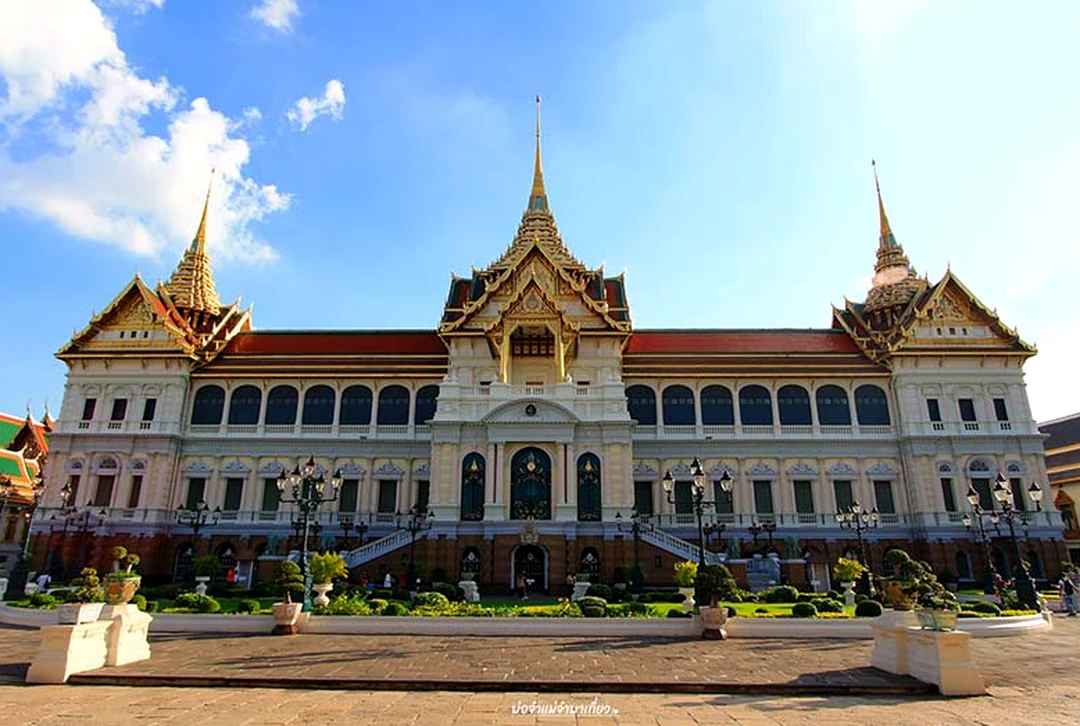
This spirit of adaptation was further cemented under King Rama V, Chulalongkorn the Great. Confronted with the sweeping tide of Western colonialism, the monarch enacted comprehensive reforms and expressed his deft diplomatic vision through the Chakri Maha Prasat Throne Hall. This iconic edifice masterfully fuses a monumental European Neo-Renaissance facade with multi-tiered, spire-crowned roofs tiled in traditional Siamese green and gold—making a bold statement of an independent indigenous civilization ready to embrace global progress without ever losing its national soul. Every slab of granite and layer of gilded lacquer across the Grand Palace and Wat Phra Kaew thus embodies not merely opulent visual beauty, but an enduring testament to the resilience of the Thai people through centuries of change.
Standing majestically along the eastern bank of the Chao Phraya River in the Phra Nakhon district, the Grand Palace and Temple of the Emerald Buddha occupy the very heart of the artificial Rattanakosin Island—the supreme seat of power and cultural soul of the Chakri Dynasty for over two centuries. Selecting this site was far more than a wartime strategic maneuver when King Rama I moved the capital from Thonburi to the left bank in 1782; it represented the pinnacle of Eastern royal geomancy harmonized with the Theravada Buddhist worldview. The sweeping arc of the mighty Chao Phraya to the west served as a colossal natural moat, cradling auspicious energy and shielding the royal court from western invasions while linking directly to the richest waterway trade network of the lower delta.
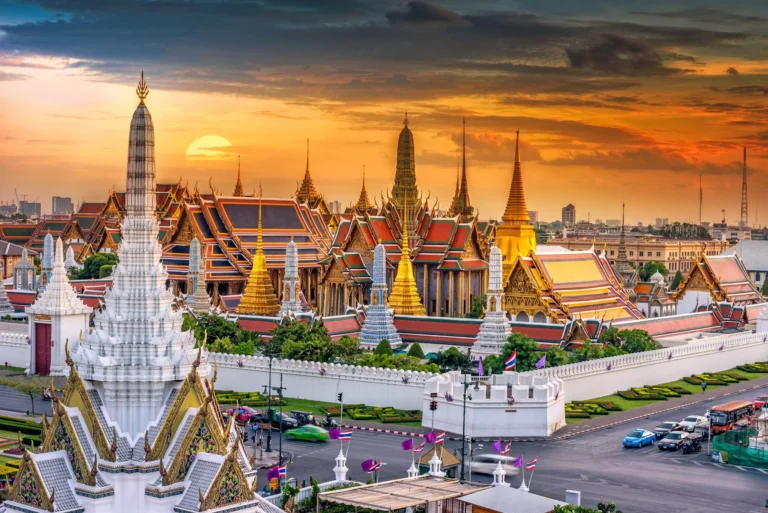
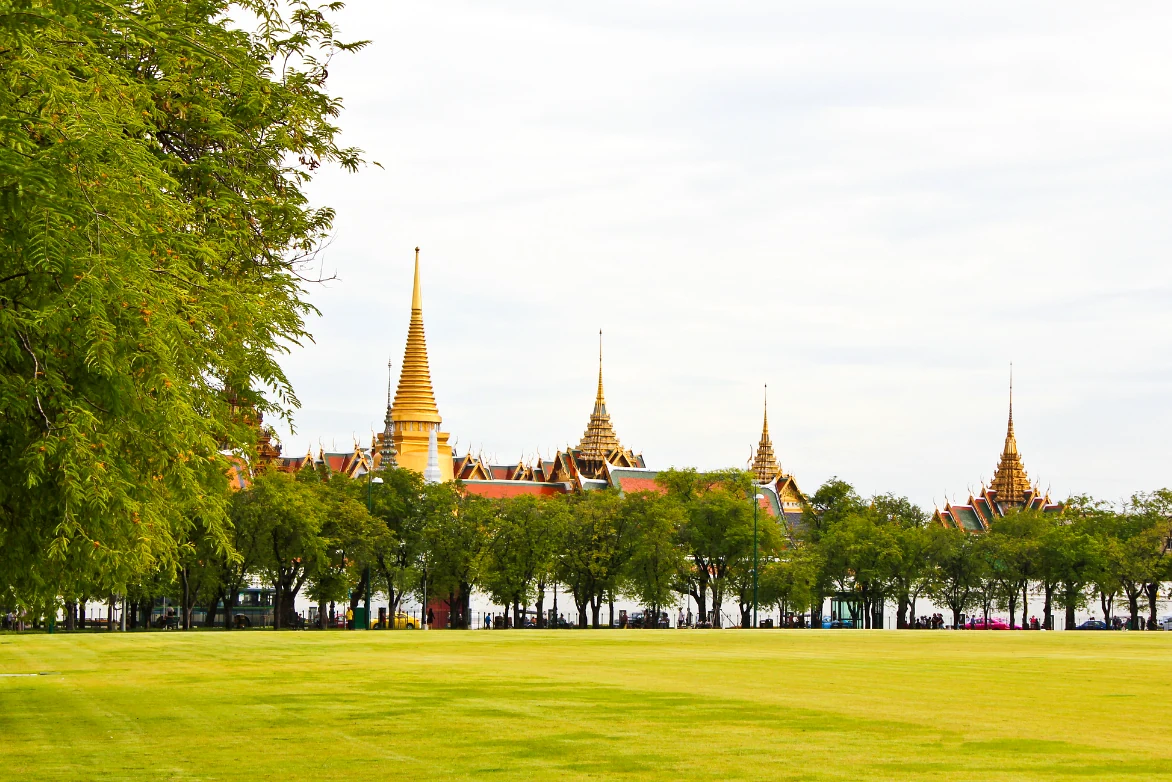
To complete this auspicious “coiling dragon and crouching tiger” topography, the royal court excavated the strategic Khlong Rop Krung canal system around the eastern perimeter, turning the entire Rattanakosin district into a fortified island surrounded by water. Spanning over 218,400 square meters, the complex grounds were painstakingly leveled atop millennia-old alluvial deposits to form a solid foundation for its iconic monuments. Viewed from above, the entire royal citadel is enclosed by crisp white crenellated walls stretching over 1,900 meters, punctuated by bastions and watchtowers. Its spatial layout strictly adheres to traditional cosmological diagrams, positioning Wat Phra Kaew in the northeastern corner to welcome auspicious morning vitality, symbolizing Mount Meru—the sacred axis of the universe where spiritual energy converges to protect the kingdom.
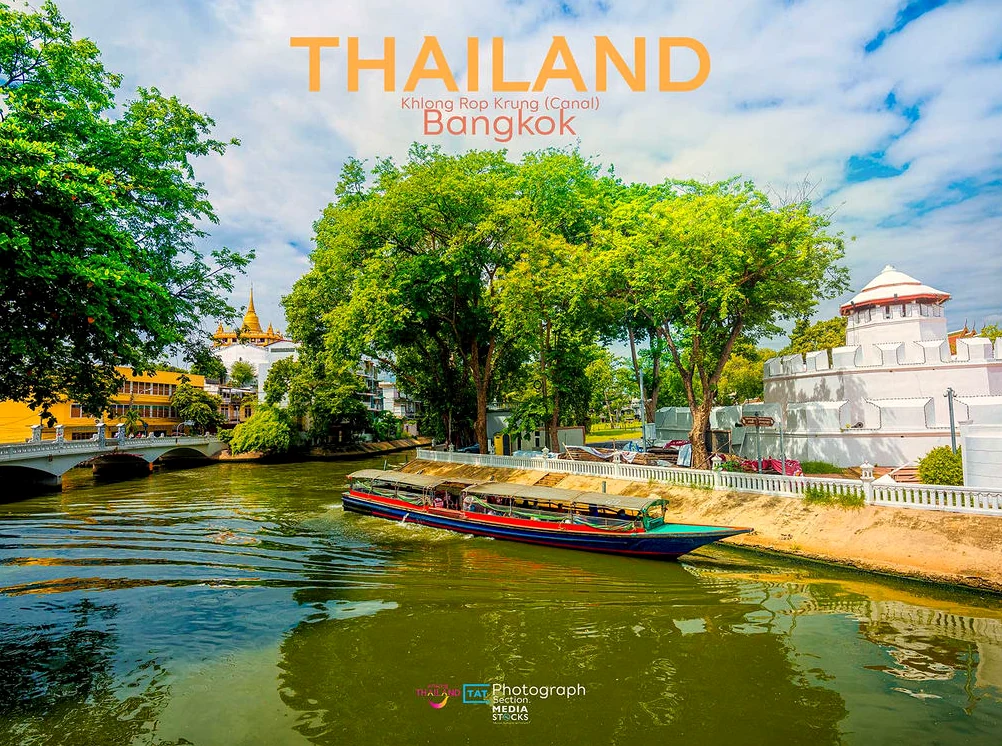
Inside the compound, the landscape weaves together hierarchical royal authority and supreme visual artistry. The entire layout is clearly divided into three primary zones: the Outer Court housing royal administrative offices and military headquarters; the Middle Court dominated by grand state audience halls like Chakri Maha Prasat, where Western Renaissance facades meet tiered, spire-tipped Thai roofs; and the Inner Court, once the strictly secluded residence of the royal consorts. The striking contrast between immaculate whitewashed brick walls, polished granite courtyards, and glazed roof tiles shimmering in turquoise, emerald green, and saffron gold under the tropical sun transforms the grounds into an awe-inspiring open-air architectural museum. Punctuating these monumental structures are towering club-wielding Yaksha demon guardians, the golden stupa of Phra Si Rattana Chedi piercing the blue sky, and an intricate sandstone scale model of Angkor Wat.
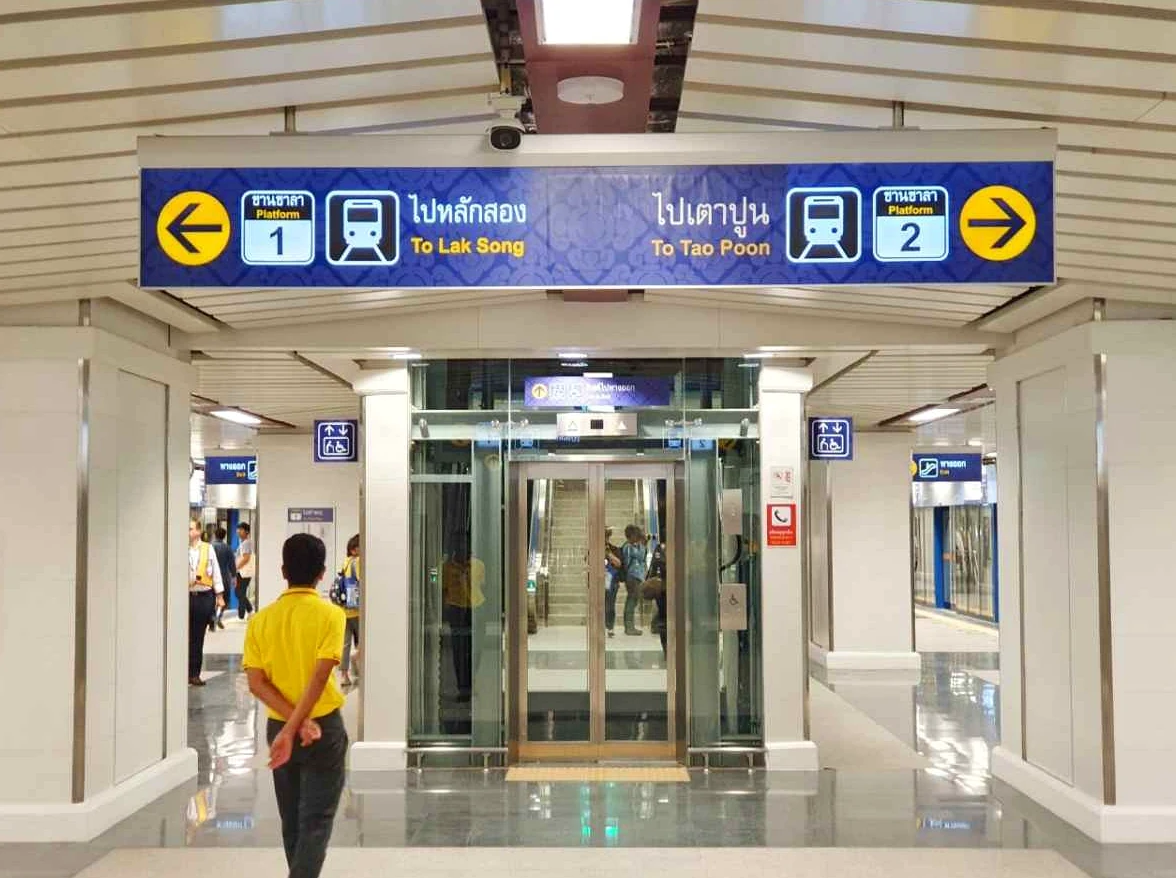
Beyond the palace walls, the grounds connect seamlessly to the lush green canopy of Saranrom Park to the north, creating a tranquil buffer separating royal serenity from Bangkok’s bustling urban pulse. Today, visitors can experience this riverine geomancy firsthand by boarding a Chao Phraya Express Boat or tourist ferry to N9 Tha Chang Pier, located just a short stroll from the palace gates past historic shophouses selling handicrafts and amulets. Alternatively, arriving from below ground via the modern MRT Blue Line brings travelers to Sanam Chai Station—widely hailed as Thailand’s most beautiful subway station, featuring interiors modeled after an opulent royal throne hall—from which a leisurely walk through Saranrom Park unveils the glittering golden spires right ahead.
Encompassing roughly 218,000 square meters enclosed by nearly two kilometers of fortified walls curving beside the Chao Phraya River, the Grand Palace and Wat Phra Kaew complex is an urban planning masterpiece modeled after Buddhist and Hindu cosmology. Divided meticulously into the Outer Court, Middle Court, Inner Court, and the independent sacred precinct of Wat Phra Kaew, each structure serves not merely a secular or religious purpose, but acts as a microcosm of sacred Mount Meru, where soaring multi-tiered roofs symbolize the celestial realms of the deities, creating an ensemble both deeply solemn and breathtakingly ornate.
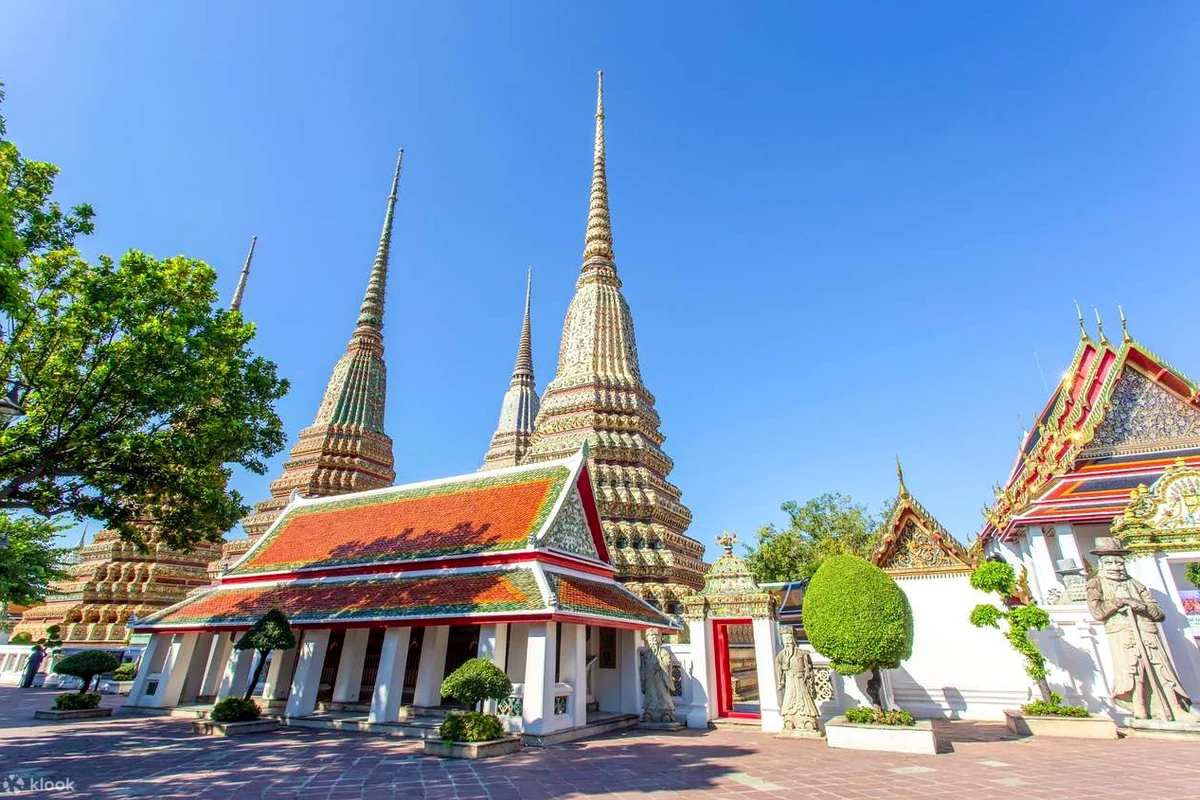
The supreme spiritual focal point of the entire complex culminates in the Phra Ubosot, a majestic ordination hall crowned with a classic three-tiered sloping roof. Its surface is blanketed in contrasting glazed tiles of burnt orange and emerald green, edged with undulating Naga serpent ridges. The gable pediment showcases a dazzling gilded relief of the deity Vishnu mounted on the mythical Garuda bird set against a mosaic of sapphire-blue glass. Surrounding the hall is a colonnade of slender, fully gilded pillars inlaid with intricate colored glass mosaics. Most astonishing of all are the massive wooden doors, gilded and inlaid with mother-of-pearl to absolute perfection, illustrating episodes from the Ramakien epic crafted using renowned seashell inlay techniques from the reign of Rama I. Inside, the monolithic dark-green Emerald Buddha sits enthroned atop a towering multi-tiered golden Busabok altar, radiating an aura of mystery amidst wall murals covering all four sides that depict the path to enlightenment and the realms of rebirth.
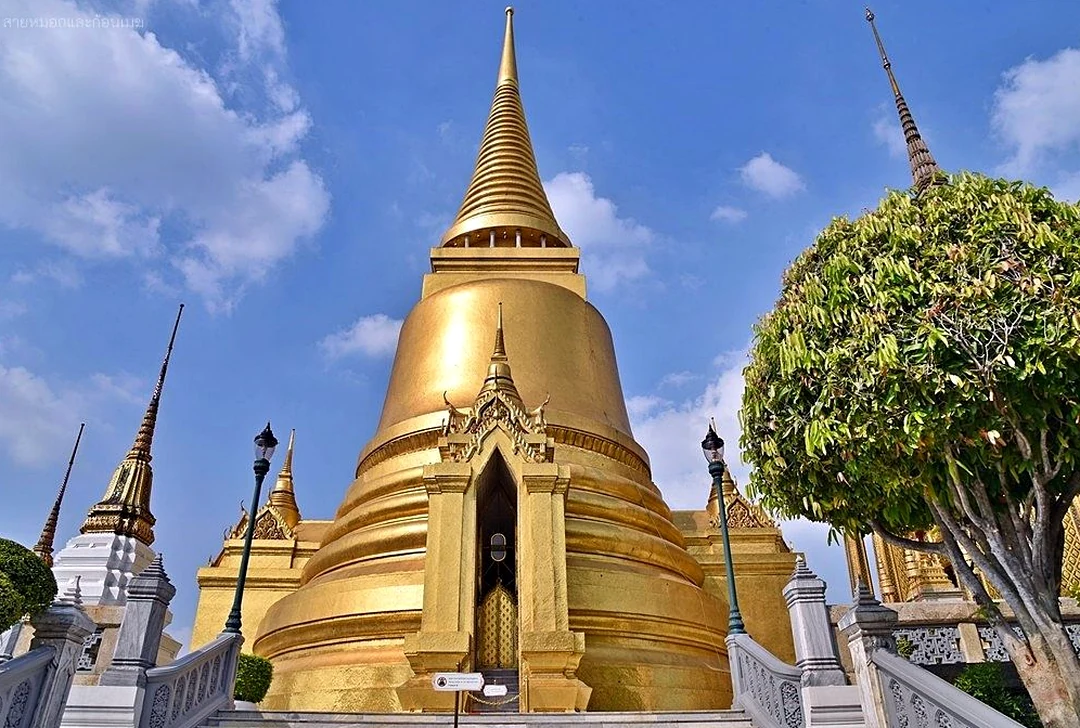
Adjacent to the ordination hall, the structures atop the Upper Terrace of white marble showcase extraordinary goldsmithing and relief sculpture through the silhouette of Phra Si Rattana Chedi. Built in the classic Sri Lankan bell-shaped style, this reliquary stupa rises proudly, its entire surface sheathed in pure gold leaf and millions of tiny gold-glazed mosaic tiles. Under the brilliant tropical sun, it blazes with golden radiance in harmonious symmetry alongside the Phra Mondop scripture repository housing the Tripitaka canon and the Royal Pantheon, Prasat Phra Thep Bidon. Together with five-meter-tall Yaksha gatekeepers clad in colorful ceramic armor and rows of gilded half-human, half-bird Kinnari statues, the terrace conjures a serene, otherworldly celestial realm in the heart of the capital.
Transitioning from the sacred Buddhist precinct to the seat of Siamese royal authority, the Chakri Maha Prasat Throne Hall stands as an extraordinary architectural testament to East-West cultural dialogue. Commissioned during the reign of King Chulalongkorn, the building’s lower structure exhibits stately European Neo-Renaissance architecture with imposing Corinthian columns, arched stone porticoes, and symmetrical Western-style windows. Yet instead of topping the edifice with a European dome, the royal court crowned it with traditional three-tiered Siamese roofs and towering Mondop spires piercing the sky. This bold fusion earned the structure its affectionate local nickname: “a Westerner wearing a Thai Chada crown.” Far more than an aesthetic triumph, it stood as a profound political manifesto of a nation eager to embrace modern civilization while fiercely safeguarding its cultural roots and sovereign independence.
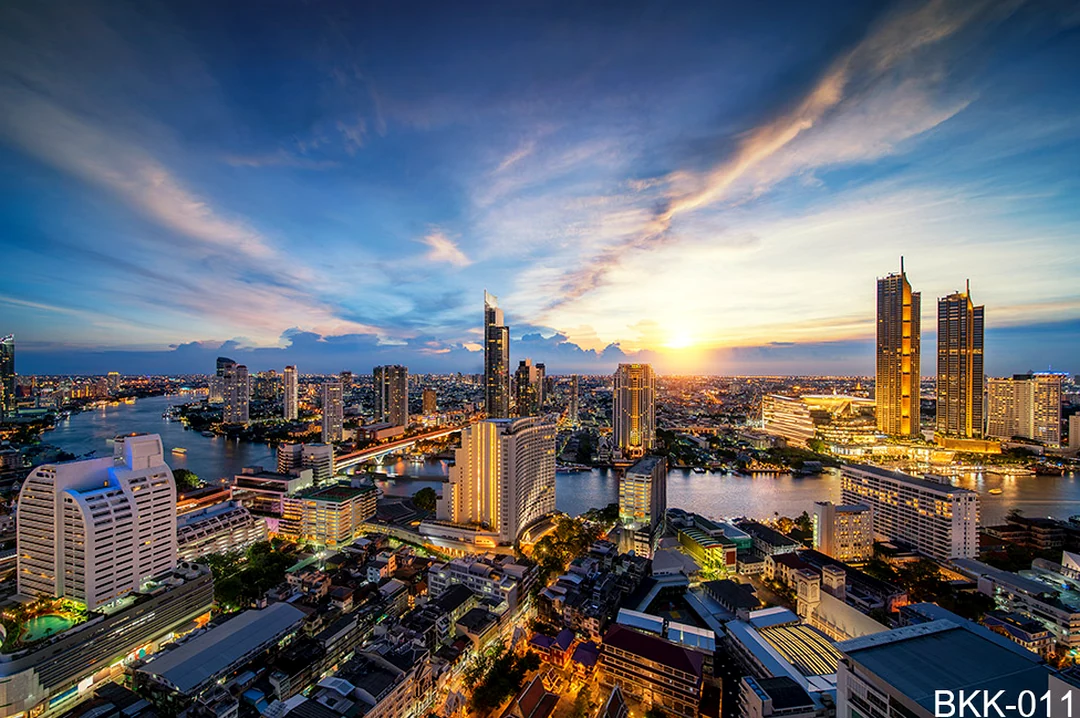
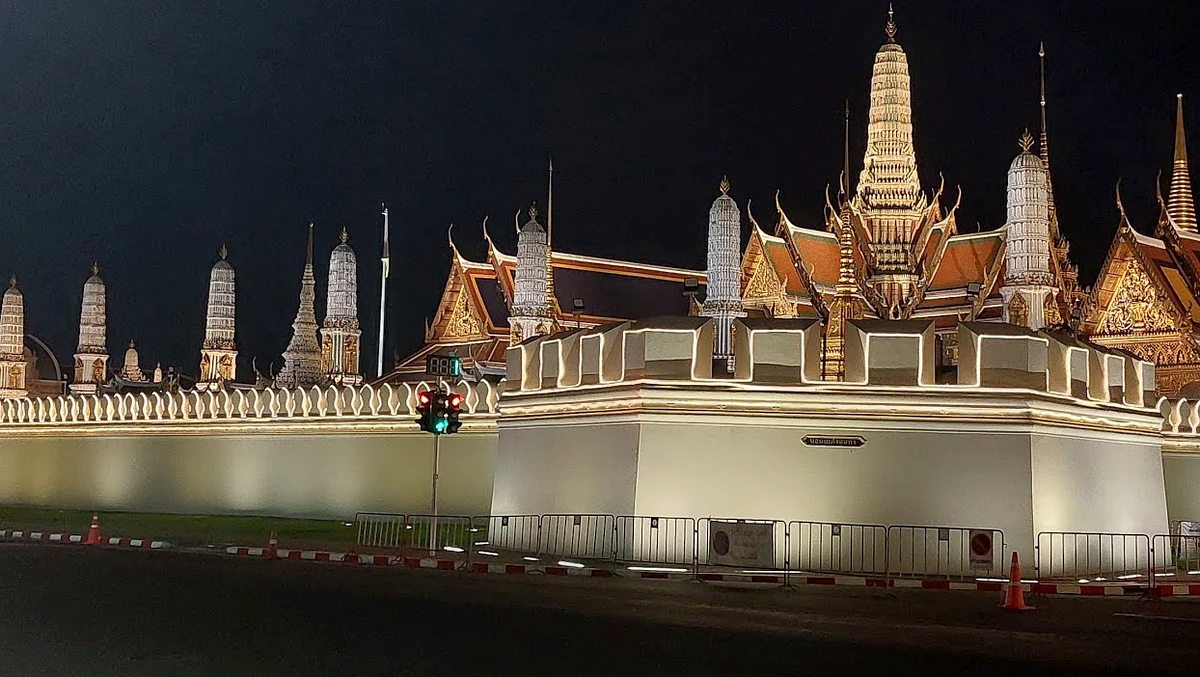
As the crimson sunset dips behind the legendary Chao Phraya River, the gilded wooden gates of the Grand Palace and Wat Phra Kaew close for the day, restoring solemn tranquility to the royal sanctuary of Rattanakosin. Although the throne halls and the Ubosot do not admit visitors inside after dark, this 21-hectare complex enters an entirely new visual life through masterfully engineered architectural lighting. Replacing the daytime crowds of pilgrims and travelers, the entire perimeter framed by nearly two kilometers of historic whitewashed walls illuminates brilliantly against the night sky, creating a breathtaking interplay between classical Siamese architecture and contemporary illumination.
High-intensity spotlights tucked discreetly along the base of the walls and garden corners awaken every gilded carving and intricate silhouette. The bell-shaped Phra Sri Rattana Chedi, covered in millions of delicate gold leaves, transforms into a luminous spiritual beacon radiating a warm halo against the velvety night sky. Beside it, the multi-tiered roofs of Prasat Phra Dhepbidorn clad in deep green and terracotta glazed tiles shimmer with polychromatic reflections, accentuating the proud, sweeping Garuda-shaped Chofa finials. The lighting design highlights the dramatic contrast between the pristine whitewashed brick walls of the early Chakri era and the sparkling mother-of-pearl and colored glass mosaics adorning the stupas, turning the entire royal citadel into a colossal jewel box glowing at the historic heart of the capital.
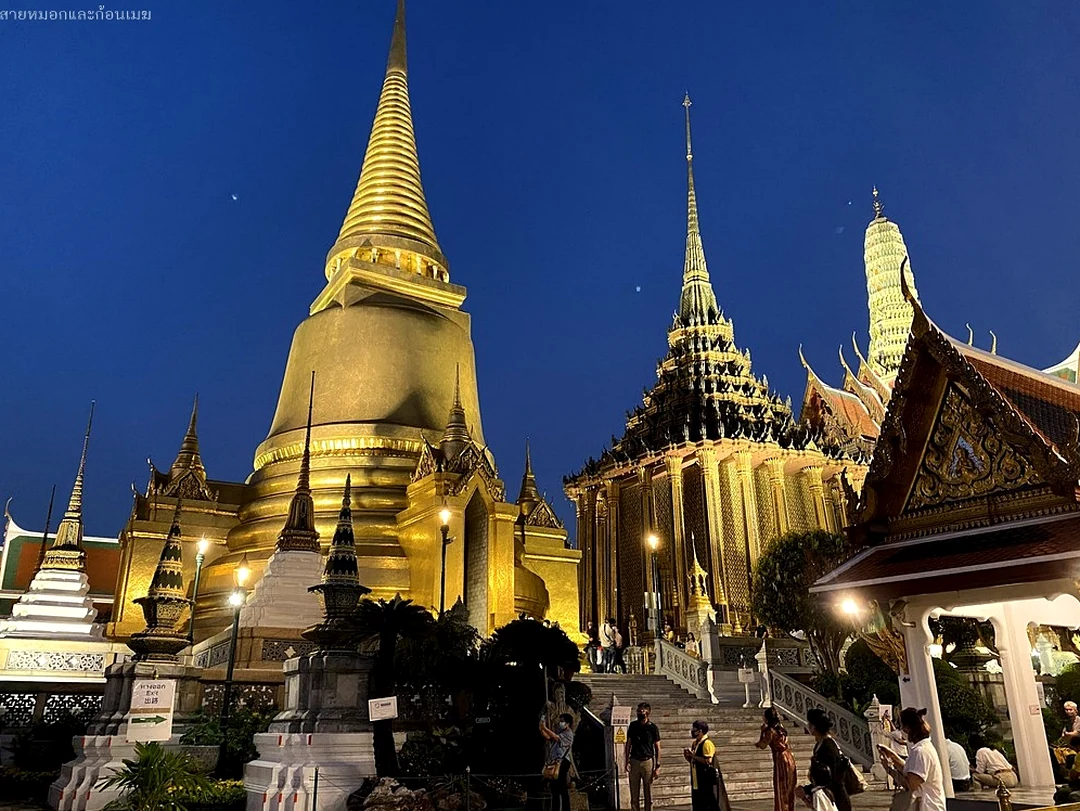
To take in this spectacular nocturnal panorama, cultural connoisseurs gravitate toward the historic Tha Maharaj Pier and the Tha Tien waterfront along the river’s eastern bank. From the breezy riverfront balconies of restaurants serving royal Siamese cuisine, diners can sip chilled chrysanthemum tea or savor fragrant, creamy lotus-seed Massaman curry while gazing out over an unmatched riverside vista. From this vantage point, the glowing silhouette of Wat Phra Kaew on the left bank shimmers across the rippling water in poetic dialogue with the towering, porcelain-encrusted Prang spire of the Temple of Dawn, Wat Arun, illuminated on the right bank. The interplay between the warm golden glow of the royal palace and the ethereal silver radiance of Wat Arun creates a spatial depth both regal and infused with ancient meditative calm.
As night deepens, the surroundings of the Grand Palace settle back into the near-original stillness of an eighteenth-century royal capital. Strolling along Sanam Chai Road beneath rows of ancient tamarind trees brings an extraordinary sense of peace. Under classic golden streetlamps casting long shadows across stone pavements, tiny wind bells hanging from the eaves of Wat Phra Kaew’s stupas chime softly in the river breeze, mingling with the subtle fragrance of frangipani blossoms drifting from the royal gardens. This is the golden hour for reflective souls to listen to the quiet, enduring heartbeat of Bangkok’s history, where royal heritage and Buddhist devotion stand timeless across the ages.
Stepping beyond the crisp white walls and golden splendor of the Grand Palace and Wat Phra Kaew brings travelers straight into the historic culinary heart of Rattanakosin Island. Not only has this royal quarter served as the supreme seat of the Chakri Dynasty since 1782, it has also nurtured and preserved centuries-old royal palace recipes alongside humble street-food traditions. Winding lanes, historic piers along the Chao Phraya River, and concentric canals circling the old citadel form a vibrant gastronomic landscape where Siamese culinary artistry shines through its philosophy of balancing five essential flavors: sour, spicy, salty, sweet, and a delicate aromatic bitterness.
Along Maharaj Road running parallel to the historic riverfront, the Old Town branch of culinary icon Thipsamai Pad Thai draws devoted food lovers eager to taste Thailand’s quintessential national dish. Born from a mid-twentieth-century movement to forge a unified cultural identity, the stir-fried noodles here are elevated to an art form with royal-style egg-wrapped Pad Thai Sen Chan. Roaring flames sear renowned Chanthaburi rice noodles (Sen Chan) to chewy-tender perfection, infused with a rich heirloom tamarind sauce, sweet sea prawns, golden tofu, and preserved radish. Culinary mastery reaches its peak as the chef swirls a paper-thin sheet of beaten egg across a blazing wok like a golden silk veil, neatly folding the steaming noodles inside like a royal parcel. Breaking through the glossy egg wrap releases an irresistible aroma complemented by crushed roasted peanuts, crisp bean sprouts, and fresh banana blossom.
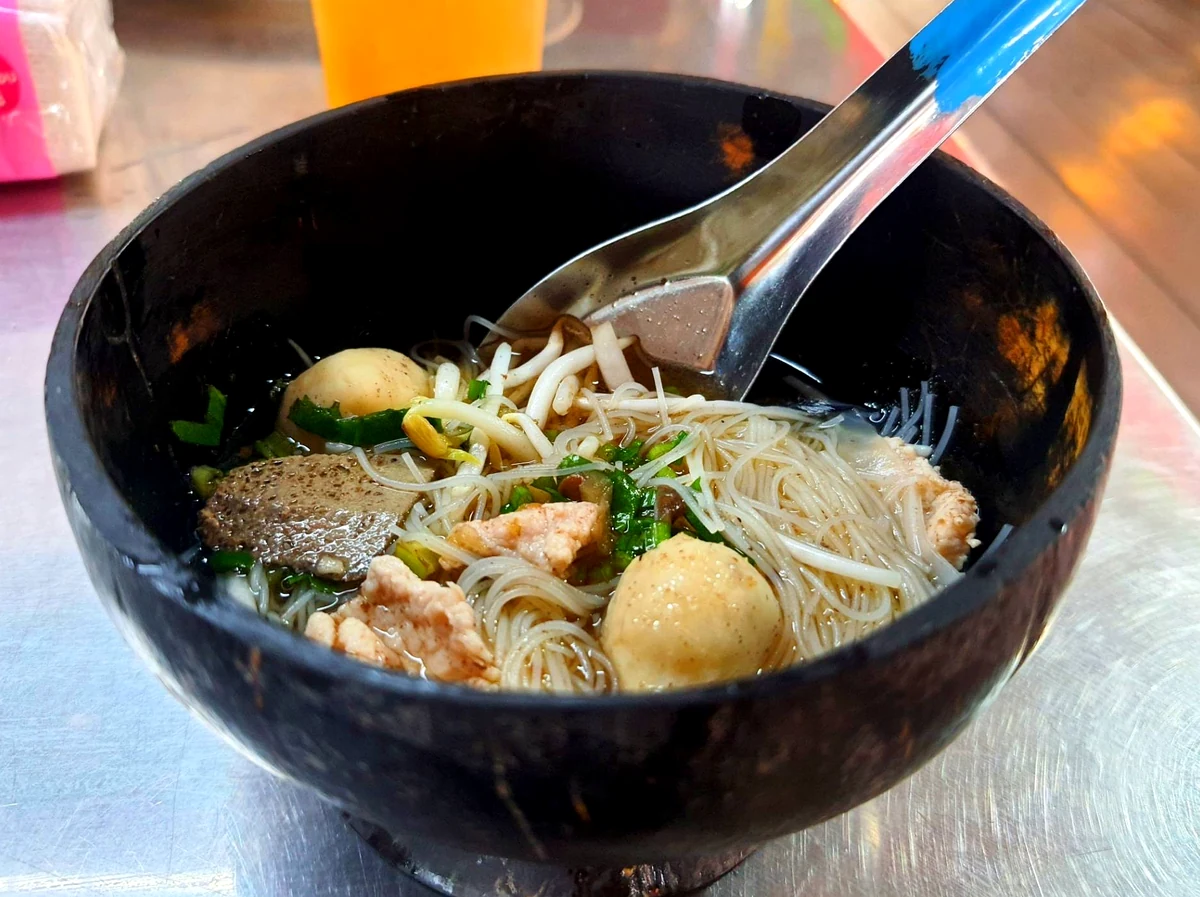
Tucked along the edges of the old city canals—once the bustling aquatic trade arteries of Siam—tiny, steam-shrouded kitchens serving traditional boat noodles (Guay Tiew Reu) tell a vivid story of everyday life in the early capital. Originally served in small ceramic bowls so vendors could easily balance and hand them across narrow wooden sampans without spilling on rippling canal waters, Guay Tiew Reu owes its magnetic allure to a broth simmered for hours from pork or beef bones, enriched with fresh blood and an aromatic blend of cinnamon, star anise, coriander seed, and secret herbs. Silky rice noodles swim in this dark, deeply savory broth alongside tender rare beef, bouncy meatballs, crispy pork cracklings, and fiery vinegar-pickled chilies, creating a bold symphony that awakens every taste bud.
Stopping by historic Tha Tien Pier, once a bustling trading port directly across the river from Wat Arun, the local culinary canvas reveals colorful delights like traditional Thai crispy crepes, Khanom Buang. Originating in the Ayutthaya period and flourishing during the reign of King Rama II, these crescent-shaped crepes cooked on flat brass griddles captivate with crisp rice-flour shells fragrant with coconut milk. Fillings split into two classic varieties: sweet crepes piled with airy white coconut meringue and golden Foi Thong spun egg-yolk threads, and savory crepes topped with peppery stir-fried shrimp and vibrant orange-tinted shredded coconut. The nostalgic charm of Tha Tien continues gracefully at Blue Whale Cafe, tucked inside a heritage shophouse painted in ocean hues, where travelers unwind over vibrant emerald-blue Butterfly Pea lattes swirled with velvety milk after exploring the sacred sanctuaries of the Land of Smiles.
To step inside the sacred precincts of Wat Phra Kaew and the Grand Palace smoothly, choosing the right route makes all the difference to your sightseeing experience. Rising majestically on historic Rattanakosin Island embraced by the silt-laden Chao Phraya River, the palace complex is easily reached via the MRT Blue Line to Sanam Chai Station, followed by a pleasant ten-minute stroll beneath the ancient shade trees of Saranrom Park to the main entrance. Another scenic, quintessentially local route is hopping aboard an orange- or green-flag Chao Phraya Express Boat, breezing past riverfront landmarks before disembarking at Tha Chang or Tha Tien Pier. The moment you step off the gangplank, pure white fortress walls crowned with lotus-bud battlements rise dramatically before you, instantly transporting you far away from the traffic and clamor of modern Bangkok.
The complex opens its gates daily from 08:30 AM to 03:30 PM. The undisputed golden hour to begin your visit is arriving right at the Wiset Chai Si Gate at 08:30 AM, when early morning sunbeams first ignite the gilded Phra Si Rattana Chedi and cool breezes still linger across the courtyards. After 10:00 AM, the open marble plazas absorb intense tropical heat while large international tour groups arrive in waves, making exploration considerably more crowded and warm. Admission is priced uniformly at 500 THB for foreign visitors. This ticket grants entry not only to the Temple of the Emerald Buddha and the royal throne halls, but also includes admission to the Queen Sirikit Museum of Textiles right beside the main gate, showcasing exquisite royal garments woven with traditional Mudmee silk techniques.
The reverence surrounding the Chakri Dynasty and Theravada Buddhist traditions mandates a strictly enforced dress code for anyone crossing the sacred threshold. Royal guards stationed at the security checkpoints will refuse entry to visitors dressed inappropriately. Men must wear long trousers covering the ankles paired with a sleeved shirt or polo; shorts, cropped pants, and sleeveless tops are strictly prohibited. Women must wear skirts or dresses extending well below the knee or full-length trousers, paired with modest tops that completely cover the shoulders and chest—sheer fabrics, sleeveless blouses, and tight leggings are not permitted. Should you arrive in unsuitable attire, you will need to queue at the official booths outside the entrance to purchase traditional sarongs or elephant-print wrap pants before being admitted into the inner grounds.
A vital tip for independent travelers is staying alert to persistent scams operating around the perimeter of Sanam Luang Square. Friendly tuk-tuk drivers or neatly dressed individuals claiming to be official guides frequently approach tourists, claiming the Grand Palace is temporarily closed for a Buddhist holiday or royal ceremony before offering to whisk them away to alternative temples alongside stops at gem factories or bespoke tailor shops. These are purely commercial traps; the Grand Palace opens reliably every day during posted hours, and official ticket booths are located exclusively inside the palace walls.
After spending peaceful moments before the sacred Emerald Buddha and marveling at every brushstroke of the epic Ramakien murals, you can wander out into the historic lanes surrounding Tha Tien Pier for a steaming plate of fresh-prawn Pad Thai or a fragrant, spicy-sour bowl of Tom Yum Goong. To immerse yourself effortlessly in Siam’s rich cultural heritage without worrying about ticket queues, complex transit routes, or unexpected expenses, booking a curated all-inclusive tour package led by knowledgeable heritage guides is the ideal way to make every step of your journey seamless and memorable.