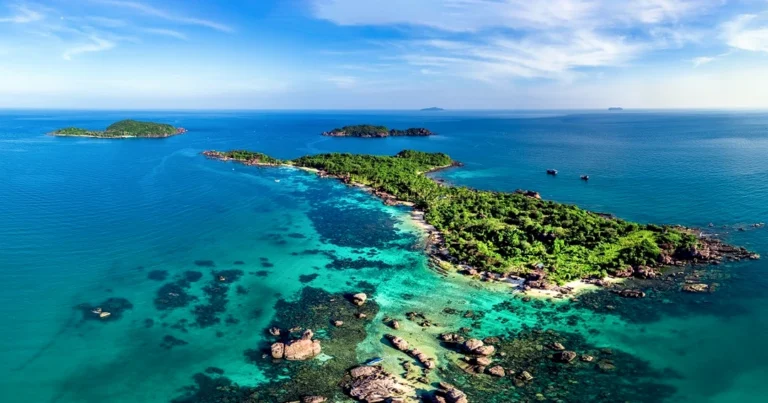
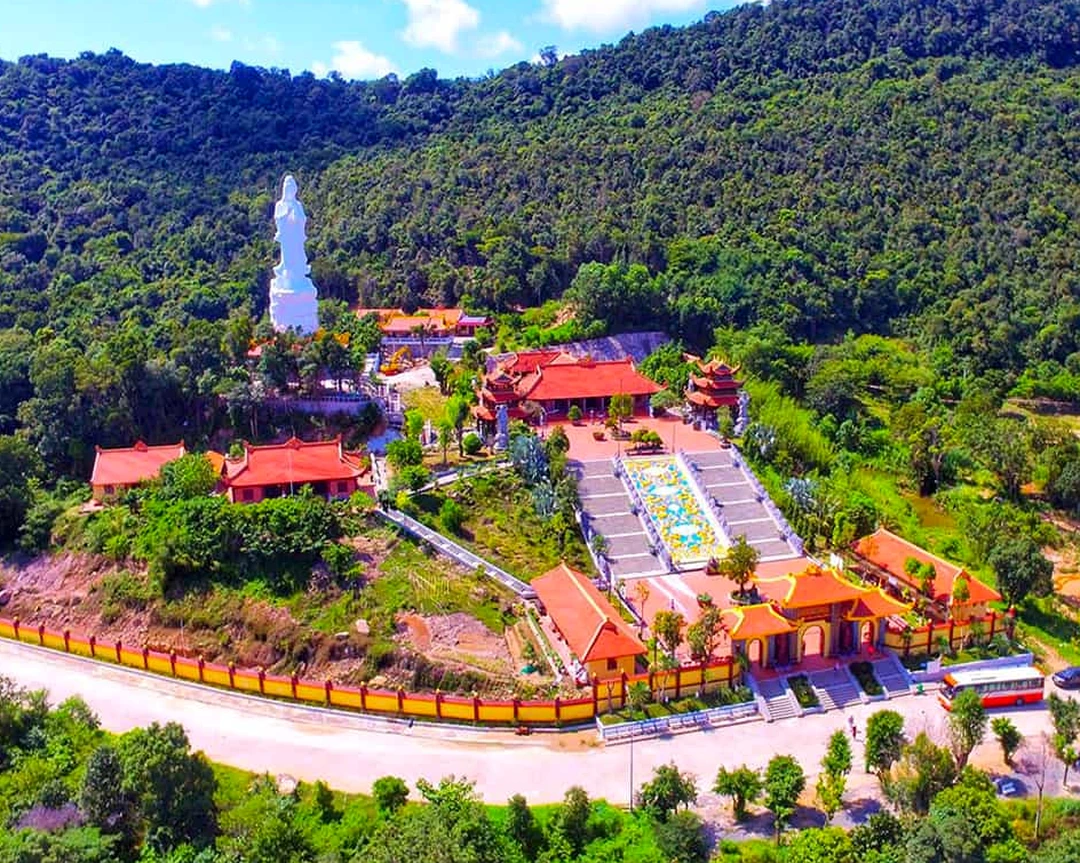
Set apart from the bustling center of Duong Dong Ward, Truc Lam Ho Quoc Zen Monastery—affectionately known by locals as Ho Quoc Pagoda—stands as a tranquil interlude amid the vibrant symphony of Phu Quoc, the Pearl Island. Located in Suoi Lon Hamlet, Duong To Commune, this monastery is more than just a spiritual sanctuary; it is an architectural masterpiece set in one of the most prime geographical locations on Kien Giang’s tourism map. Commanding an unobstructed panorama over the vast Gulf of Thailand, the pagoda rests proudly on a high mountainside, where its “mountain-backed, water-facing” terrain not only carries feng shui significance for stability and longevity but also creates a rare aura of peace and serenity for everyone who visits.
The history of Truc Lam Ho Quoc Zen Monastery represents a proud new chapter in the flow of Vietnamese Buddhist culture along the maritime frontier. Construction began in 2011 and was inaugurated just a year later, standing as a testament to the deep bond between spirituality and patriotism. The name “Ho Quoc” (Protecting the Nation) carries profound meaning regarding national defense, guarding the island borders, and affirming Vietnam’s sacred sovereignty over the southwestern waters. Although it is a modern structure, its design philosophy draws from centuries-old heritage, subtly emulating the architectural style of the Ly–Tran dynasties—the golden age of Vietnamese Buddhism. The fusion of intricate carvings, gracefully curved tiled roofs, and expansive open spaces creates a harmonious whole where national history is vividly brought to life through every bas-relief and rare ironwood pillar.
In terms of geology and landscape, Ho Quoc Monastery is nestled within a vast ecological complex spanning up to 110 hectares, where primeval forests embrace the sacred structures, forming a “green lung” that regulates the climate for the entire region. Cultural experts and local tourism authorities have long recognized it as a flagship destination on the “spiritual heritage tourism” route. The pagoda’s presence not only enriches the spiritual life of island residents but also serves as a cultural anchor preserving traditional values, such as the worship of the Three Patriarchs of Truc Lam, the veneration of the 18 Arhats, and the depiction of origin legends like Lac Long Quan and Au Co. The intricately carved bas-reliefs on raw stone are far more than mere ornamentation; they are pages of history etched in rock, telling future generations about the nation’s roots, spirit of unity, and determination to protect the homeland.
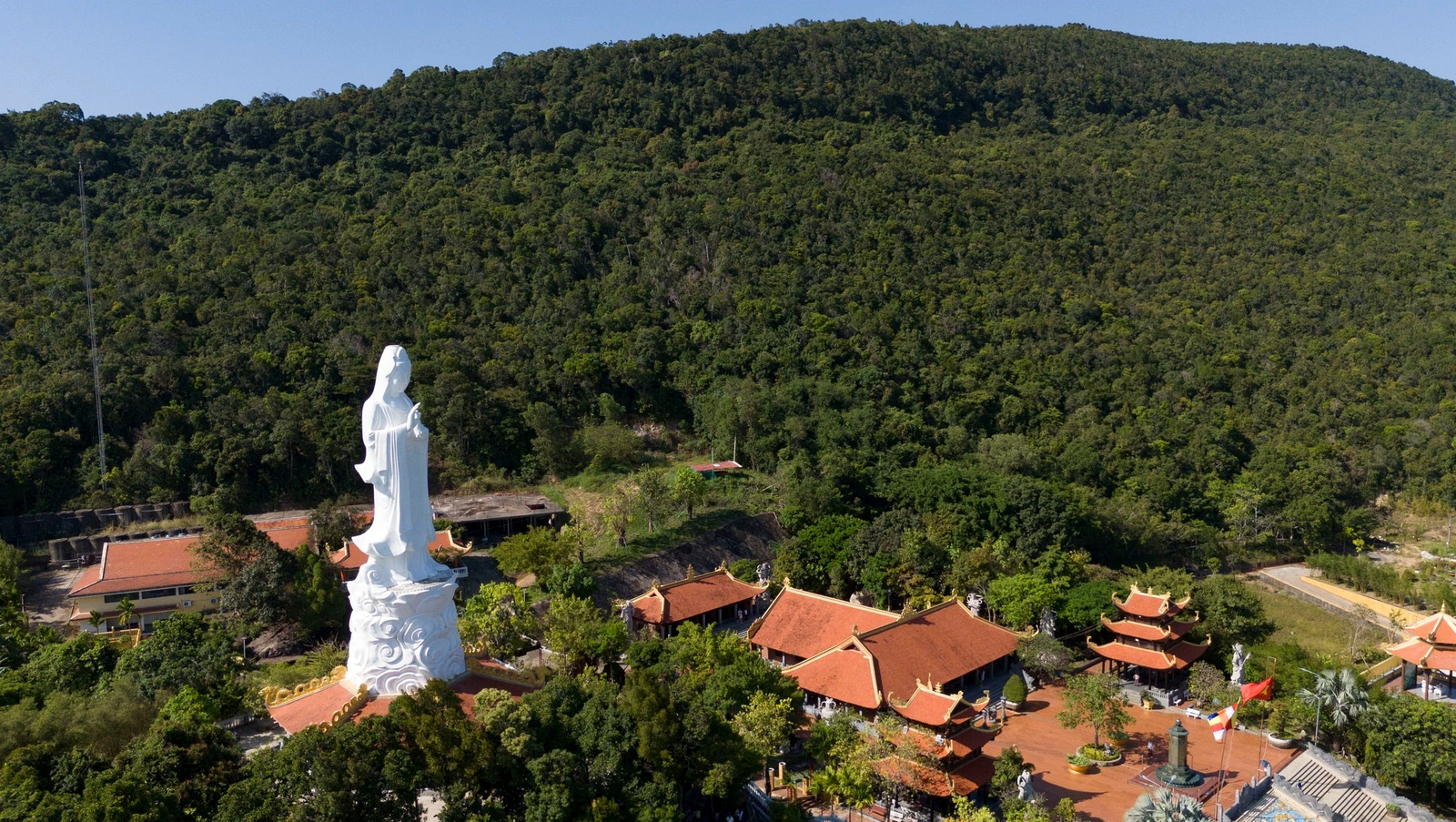
Standing on the second-tier courtyard of the pagoda, visitors can clearly appreciate the beauty of its local topography: on one side lies the deep green wilderness with ancient trees rustling in the breeze, and on the other stretches the boundless sea and sky of the Gulf of Thailand, where waves gently lap against white sandy shores. This very intersection of majestic mountains and welcoming ocean has transformed Truc Lam Ho Quoc Zen Monastery into an unrivaled vantage point where people can find balance between the finite nature of human life and the infinite expanse of heaven and earth. It is not merely a scenic stopover, but a living heritage space where every brick and statue carries the breath of history and the Vietnamese aspiration for peace on these distant islands.
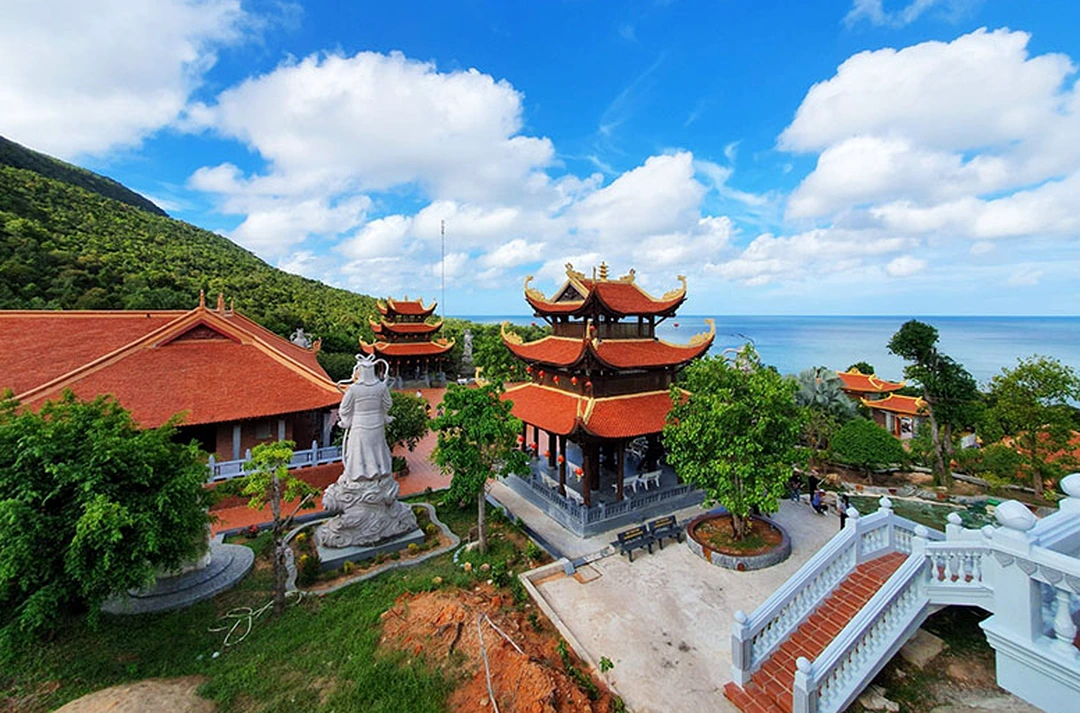
Truc Lam Ho Quoc Zen Monastery is not simply a religious site, but an architectural triumph seamlessly blending human craftsmanship with the grandeur of nature. Situated on an auspicious “mountain-backed, water-facing” site, the pagoda leans against lush dark-green mountains while facing directly toward the expansive Gulf of Thailand, creating a commanding and steadfast feng shui posture. The moment visitors step through the Tam Quan (Three-Entrance Gate), they are enveloped in a sense of calm radiating from architectural lines steeped in the spirit of the Ly–Tran dynasties. Its sweeping, curved roofs, clad in deep crimson glazed tiles, stand out vividly against the azure sky of the Pearl Island, evoking a golden era of Vietnamese Buddhist culture.
Stepping into the Main Hall grounds, the first impression is the imposing grandeur of rare, intricately carved ironwood columns paired harmoniously with enduring natural stone flooring. Inside the Main Hall, the atmosphere is deeply contemplative, centered around a monolithic jade Buddha statue emitting a gentle radiance that brings instant stillness to the mind. Lining both sides of the pathway leading to the Main Hall is a row of 18 Arhat statues featuring expressive, lifelike faces—each statue telling a distinct story and capturing a unique spiritual nuance, sculpted down to the finest detail by master artisans. Particularly noteworthy is the grand bas-relief depicting the legend of Au Co and Lac Long Quan alongside Dong Son bronze drum motifs, serving not just as an artistic focal point but as an affirmation of national heritage that stirs deep pride in every Vietnamese visitor.
To capture the “million-dollar views” at Ho Quoc Pagoda, photographers and travel vloggers typically favor two prime camera angles. The first is from the second-tier courtyard looking straight out over the bay. Here, your lens captures an artistic contrast: ancient curved tiled roofs on one side, and the deep blue ocean stretching all the way to the horizon on the other. The ideal time for this shot is at sunrise, when the first rays of the day gild the surface of the sea, creating an ethereal, pure atmosphere. The light at this hour is soft, highlighting the intricate carvings along the pagoda roofs without overexposing the frame.
The second prime spot is around the majestic statue of Avalokiteshvara Bodhisattva (Quan The Am). Shooting from a low angle upward, the pure white statue stands out strikingly against the blue sky and tropical forest canopy, forming a dramatic composition. If you prefer photographs with a more contemplative, serene mood, visit the pagoda at sunset. As the sun dips behind the mountain range, the light shifts to brilliant shades of orange and crimson, reflecting off the statues and pagoda roofs to conjure a mystical, poetic spiritual ambiance. This is also when cool sea breezes drift inland carrying faint wisps of incense, offering the fullest visual and emotional experience.
The marriage of ironwood architecture, massive stone foundations, and refined sculpture set amidst Phu Quoc’s unspoiled wilderness has turned this site into an “open-air art museum.” Every corner of Ho Quoc Pagoda, from the bell tower and drum tower to the gently sloping road leading up to the temple, offers a picture-perfect frame. Whether you are a Buddhist devotee seeking inner peace or an aesthete looking to capture artistic moments, Truc Lam Ho Quoc Zen Monastery is undoubtedly an unmissable stop on your Pearl Island itinerary.
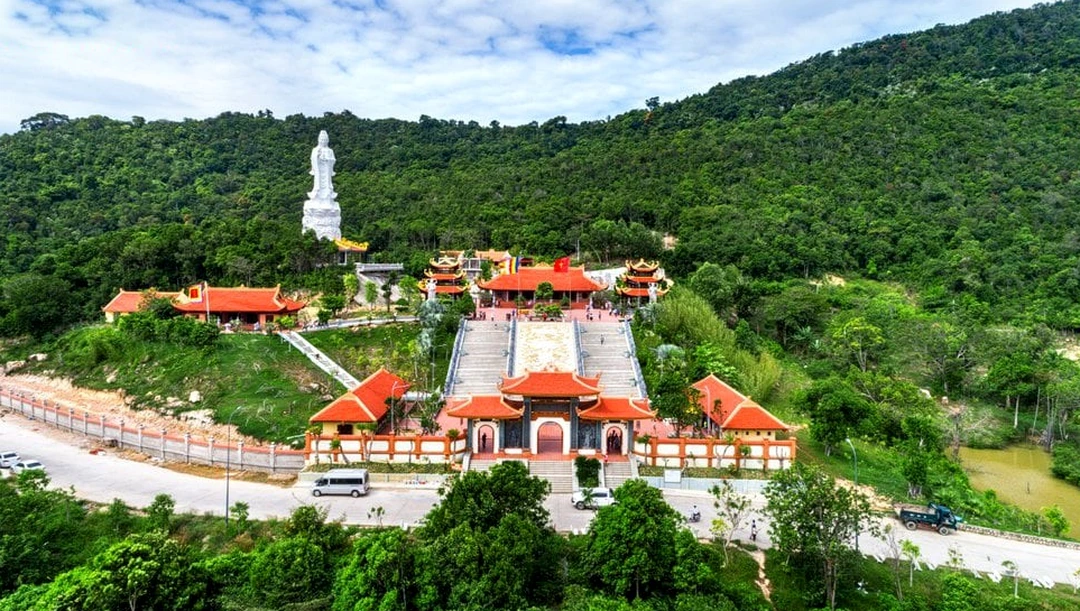
Climbing the stone staircases leading up to Truc Lam Ho Quoc Zen Monastery, visitors are not merely going sightseeing—they are embarking on a journey of spiritual purification amidst magnificent nature. The most rewarding experience here is the sense of ascending to new heights. After climbing hundreds of stone steps, the fresh mountain air mingles with the salty tang of sea breezes to create a crisp, pure atmosphere that seems to wash away all the fatigue of a long journey. Standing on the second-tier courtyard and gazing out into the distance, you will be awestruck by the breathtaking natural panorama: on one side stands the dark-green mountain range, solid as a fortress wall, and on the other lies the vast Gulf of Thailand, its mirror-calm waters shimmering beneath the golden sunshine of the Pearl Island.
Worshiping and paying respects at the pagoda brings a profound sense of stillness. Amid the quiet surroundings, the resonant tolling of the temple bell blends with the gentle murmur of waves at the foot of the mountain, composing a symphony of tranquility. Visitors often take time to offer incense before the monolithic jade Buddha statue, admire the exquisite craftsmanship of the 18 Arhats, or quietly observe the finely chiseled bas-reliefs depicting the nation’s origins. This blend of stately Ly–Tran architecture and untamed natural beauty creates a peaceful sanctuary completely detached from the rush of daily life, where anyone can find a quiet moment to reflect within.
After letting go of worldly worries within the temple grounds, your exploration of local culture continues along the scenic coastal road leading to the pagoda. If time permits, you can also rent a boat from local fishermen at nearby beaches to admire the entire monastery from offshore. From this vantage point, Ho Quoc Monastery rises majestically like a steadfast spiritual anchor watching over fishing vessels heading out to sea. It is in moments like these that you truly grasp the meaning of the name “Ho Quoc”—the enduring bond between Buddhist teachings and the nation’s destiny on the maritime frontier.
Your visit would not be complete without sampling the renowned local specialties of the Suoi Lon area and its surroundings. After descending the mountain, stop by small roadside eateries to try the famous bun quay (stirred noodle soup) or fresh seafood prepared in the rustic style of the islanders. The delicate sweetness of the broth and the freshness of just-caught shrimp and fish, paired with a hint of aromatic Phu Quoc black pepper, will awaken all your senses. Sitting in a cozy local eatery, enjoying regional delicacies while chatting with residents about the legends tied to the pagoda, you will discover that local culture here resides not only in the scenery, but also in every warm smile and the genuine hospitality of its people.
The awe of standing before the boundless ocean, the serenity of hearing Buddhist chants echo through the mountains, and the warmth of savoring local cuisine weave together into an unforgettable tapestry of experiences. Ho Quoc Pagoda is far more than a photo check-in spot; it is a place where travelers can touch the very soul of Phu Quoc, where spiritual architecture and the majesty of nature unite, leaving every visitor with sweet, lasting memories of a deeply meaningful journey.
To make your exploration of Truc Lam Ho Quoc Zen Monastery as fulfilling and meaningful as possible, having the latest practical information is essential. As one of the most sacred spiritual destinations on the Pearl Island, Ho Quoc Pagoda serves not only as a place of worship but also as a breathtaking “observation deck” set amidst grand natural scenery. Below are tried-and-true tips gathered to help you enjoy a smooth and respectful visit.
Regarding opening hours and admission fees, Truc Lam Ho Quoc Zen Monastery welcomes visitors daily from 06:00 to 18:00. A major plus that keeps drawing crowds is its completely free admission policy—you won’t have to pay any entrance fee when visiting. However, because this is a solemn Buddhist sanctuary, visitors should pay special attention to dress code. Opt for modest, respectful attire and avoid overly short or revealing clothing out of respect for the sacred space. Additionally, since the pagoda sits on a mountainside with numerous stone staircases, wear flat shoes or sneakers with good grip rather than high heels to stay safe and comfortable while walking.
As for transportation and routes, it takes about 30 to 40 minutes to cover the roughly 20 km distance from the center of Duong Dong Ward. The top choice recommended by travel vloggers and seasoned visitors is renting a motorbike. Riding yourself not only gives you complete flexibility over your schedule, but also lets you soak in the stunning coastal road leading into Suoi Lon Hamlet. From the town center, follow Nguyen Van Cu Street (Provincial Road 46) heading south. This route is relatively open and scenic, winding past patches of primeval forest and coastal stretches that offer a feast for the eyes. If you are traveling in a large group or with elderly family members, taxis or private cars are safe and convenient alternatives.
The best time to visit the pagoda is during the dry season, which runs from November to April of the following year. This is when Phu Quoc is at its finest, boasting clear blue skies, golden sunshine, and calm seas. Such weather not only makes the journey up to the pagoda much easier, but also provides ideal conditions for admiring the panoramic sweep of the Gulf of Thailand from the Main Hall’s second-tier courtyard. Photographs taken from this vantage point in the early morning or at sunset always possess an ethereal, tranquil beauty found almost nowhere else.
Finally, keep in mind that Ho Quoc Pagoda is an active Zen monastery where monks and nuns practice and reside. While visiting, maintain order, speak softly, avoid making loud noises, and never touch artifacts, Buddha statues, or architectural structures without permission. Please help keep the grounds clean and refrain from littering to preserve the pagoda’s green, clean, and pristine landscape. With thoughtful preparation in attire, transport, and temple etiquette, your visit is guaranteed to be a peaceful retreat that refreshes your spirit in the heart of Phu Quoc Island.
To enjoy a seamless vacation and take in the full splendor of Ho Quoc Pagoda without the hassle of arranging transportation, booking tickets, or planning itineraries, travelers can choose VDS Travel’s premium all-inclusive Phu Quoc tour packages. Every itinerary is thoughtfully timed for photo stops when the scenery is at its most radiant, accompanied by knowledgeable local guides well-versed in regional culture alongside top-tier hotel and dining standards.