Located in the heart of the bustling southern port metropolis of the Formosa Island, Liuhe Night Market (Chinese: 六合夜市) carries a profound historical depth intertwined with the defining turning points of Kaohsiung. The origins of this culinary and cultural space trace back to the late Japanese colonial period and extended into the early years following World War II. At that time, the area was an alluvial plain belonging to a settlement known as Dagangpu (大港埔). A historic turning point occurred in the 38th year of the Republic of China era (1949), when the Kuomintang government relocated to Taiwan. A massive influx of both military personnel and civilians from the mainland poured into Kaohsiung, creating intense population pressure while simultaneously sparking a surge in local commerce and livelihood needs. Along Liuhe 2nd Road (六合二路)—the corridor wedged between today’s Zhongshan Road (中山路) and Zili Road (自立路)—itinerant street hawkers began to gather, kindling the very first sparks of a vibrant nocturnal marketplace.
The organic proliferation of roadside stalls soon called for standardized oversight from municipal authorities. By the 47th year of the Republic era (1958), the Kaohsiung City Government officially zoned and legalized the area as a centralized commercial hub, initially naming it the Dagangpu Night Market (大港埔夜市). Entering the 1960s, under the leadership of Mayor Chen Chi-chuan (陈启川)—a prominent figure hailing from one of the region’s most distinguished families—the Dagangpu Night Market underwent a sweeping infrastructure overhaul. Mayor Chen decisively spearheaded strategies to widen the roadway, clear congested zones, and reshape the district’s commercial layout. This strategic intervention not only resolved severe traffic bottlenecks but also carved out an expansive, well-ordered commercial avenue, laying a rock-solid foundation for the takeoff of Kaohsiung’s nighttime economy over the decades that followed.
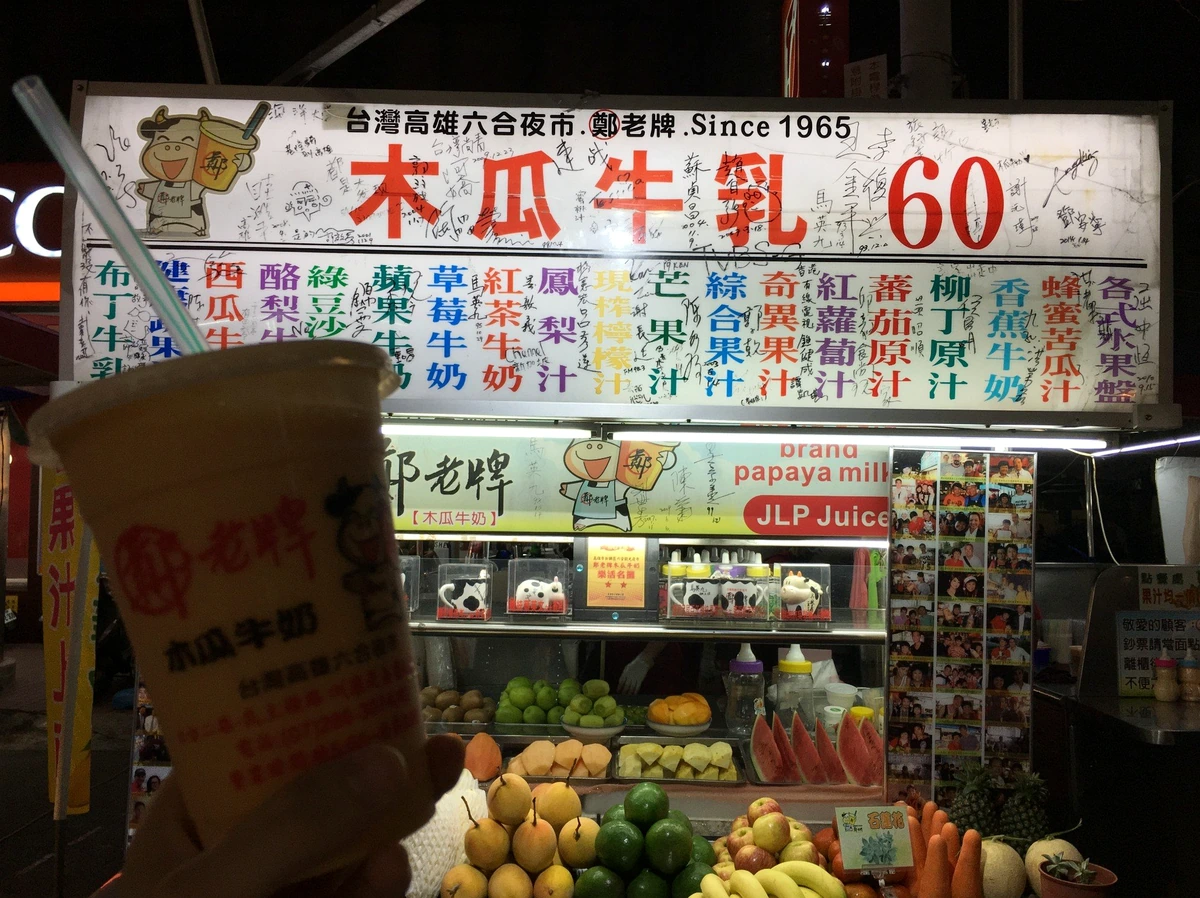
Having undergone multiple phases of transformation, in the 78th year of the Republic era (1989), the market was officially renamed the “Liuhe International Tourist Night Market” (六合国际观光夜市), marking its leap from a local neighborhood bazaar to an internationally recognized landmark. The 1980s and 1990s witnessed Liuhe’s most dazzling golden era, as it became the undisputed epicenter of Southern Taiwanese culinary culture. The night air at Liuhe during this period was perpetually thick with aromatic steam rising from stir-fried seafood stalls (re chao – 熱炒) serving fresh catches straight from Kaohsiung Harbor, alongside the curiosity-piquing specialty snake meat shops and the rich, creamy sweetness of heirloom papaya milk (木瓜牛奶). These flavors not only captivated generations of travelers but also crystallized into an inseparable culinary heritage icon of the southern port city.
Faced with the demands of modernization and global integration in the new century, around the late 2000s (circa 2010), the Kaohsiung City Government launched a large-scale initiative titled the “Liuhe Night Market Splendor Regeneration Project” (六合夜市风华再生). This landmark project completely transformed the market’s spatial appearance: all vendor signage was redesigned and standardized to modern aesthetic criteria, the roadway was paved with specialized stone tiles dedicated to pedestrian traffic, and advanced underground wastewater treatment and environmental protection systems were installed. This seamless fusion of preserving long-standing historical and cultural values with civilized infrastructure upgrades laid the groundwork that turned Liuhe into a model international tourism icon, where every inch of pavement and every stall tells the proud story of Kaohsiung’s evolution as a commercial port.
Viewed through the lenses of both modern urban planning science and traditional Eastern feng shui geomancy, Liuhe Night Market occupies a classic strategic launchpad. Stretching neatly along the east-west axis of Liuhe 2nd Road (六合二路), this commercial corridor cuts directly across Kaohsiung’s earliest urban development spine—the intersection between Zhongshan Road (中山路), now the vital artery of the Kaohsiung MRT Red Line, and Zili Road (自立路). Its placement within this grid forms an extraordinarily balanced urban geometry measuring roughly 380 meters in length and approximately 15 meters in width. This expansive linear layout serves not merely as a transit thoroughfare, but as an architectural and cultural buffer zone where modern city rhythms and traditional East Asian mercantile life seamlessly converge.
Delving deeper into the principles of traditional geomancy (feng shui), Liuhe’s topography fulfills the classic ideal of “backing onto Yin while embracing Yang, with an energy mouth welcoming water”—a quintessential wealth-accumulating terrain in historic port cities. To the west of the market, the poetic Love River winds gracefully past, carrying an abundant flow of aquatic energy. According to folk geomantic wisdom stating that “water governs wealth,” the living current flowing from the west not only tempers Southern Taiwan’s tropical heat but also acts as an open ceremonial courtyard (ming tang) that draws in prosperous energy. The synergy between the Love River and the Liuhe 2nd Road axis creates a “treasure-gathering basin” effect, trapping and concentrating vital energy and visitor footfall within the night market’s boundaries, turning it into an enduring hub of prosperity across decades.
In terms of infrastructure engineering and landscape organization, Liuhe Night Market stands as a textbook case of the agile “Linear Market” model smartly adapted into a rectangular commercial zone. The hallmark of its urban management lies in its time-based spatial conversion mechanism: “a thoroughfare by day, a marketplace by night”—functioning as an unobstructed vehicular avenue during daylight hours before instantaneously transforming into a bustling pedestrian promenade at dusk. This flexible spatial swapping resolves the acute tension between scarce urban land resources in central Kaohsiung and the massive commercial concentration required by an international tourist destination.
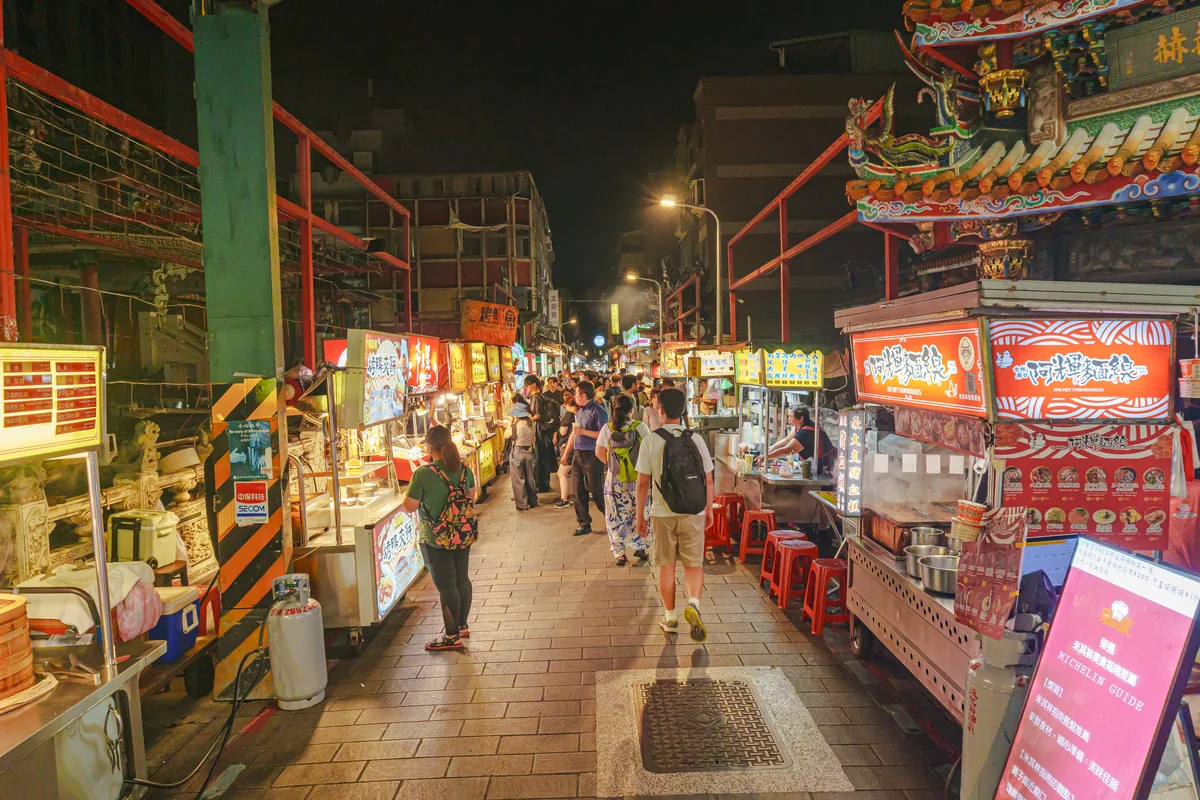
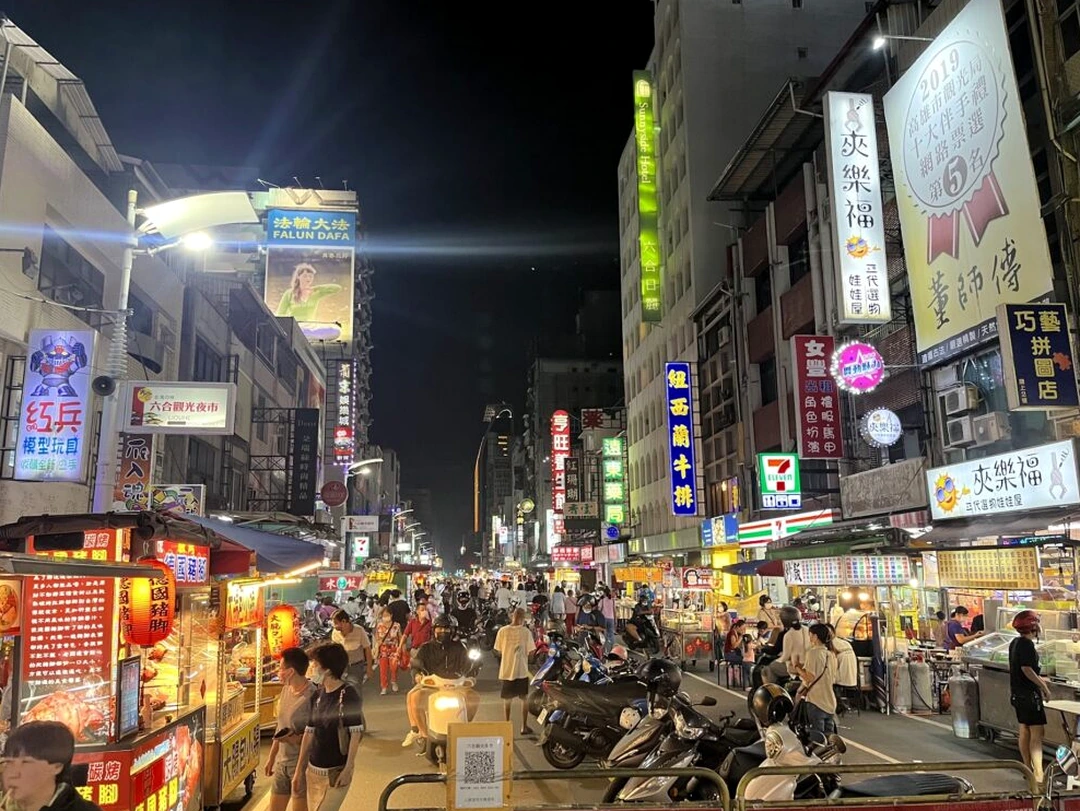
Liuhe’s signature streetscape is defined by orderliness and scientific precision while retaining an authentic grassroots warmth. Two symmetrical rows of mobile vending carts line the edges of the street, leaving a generous central walkway for strolling crowds. Brilliant illumination from hundreds of multicolored neon signs reflects off asphalt scrubbed spotless every single night, weaving a captivating urban light matrix. Underground utility management, paired with on-site waste treatment and ventilation systems integrated beneath the roadway, eliminates the stuffiness often associated with open-air food markets. Everything harmonizes into a dazzling visual tableau that honors classical geomantic planning while meeting contemporary tourism standards.
From an urban morphology perspective, Liuhe Night Market features a distinctive composite spatial structure driven by the rhythmic interplay between fixed Shophouse Façades (街屋立面) and Mobile Vending Carts (移动式摊车). Running along Liuhe 2nd Road in Sinsing District, both sides of the street are framed by continuous rows of two- to five-story terraced buildings constructed of reinforced brick and reinforced concrete (RC). The defining architectural feature of these blocks is the “Qilou” (骑楼 – Arcade), known in the local Hokkien dialect as “Lo-kha-thau.” This continuous covered colonnade links adjacent buildings, acting as a transitional threshold between private residences and public space while offering a shaded pedestrian walkway that shields visitors from sudden tropical downpours and Southern Taiwan’s sultry heat.
The craftsmanship and arrangement of the stalls at Liuhe showcase a remarkable evolution from the rudimentary shoulder-pole hawkers of early days into a modernized kiosk system that preserves its traditional soul. Each mobile cart is a miniature feat of mechanical engineering, meticulously built with a primary frame of rust-resistant high-grade stainless steel (不锈钢) to uphold strict food hygiene standards in humid conditions. The front and sides of the carts are typically clad in natural wood decorative panels (木质装饰板) to evoke a warm, inviting aesthetic. To capture passersby’s attention amid the luminous southern night, vendors invest heavily in glowing acrylic signage (亚克力发光招牌) paired with heat-resistant tempered glass display cases (强化玻璃展示柜). These transparent glass enclosures keep ingredients fresh while turning the cooking process itself into a lively culinary performance.
Beyond visual appeal and retail functionality, the hidden infrastructure behind every stall at Liuhe Night Market stands as a testament to urban ingenuity and modern planning. Complying strictly with Kaohsiung’s environmental regulations, the entire fleet of mobile carts has been standardized into self-contained units. Every stall preparing grilled, fried, or stir-fried dishes is mandated to install commercial range hoods (抽油烟机) integrated with electrostatic precipitator exhaust systems (静电油烟处理机). This technology traps virtually all grease particles and smoke before venting air outside, keeping the market’s atmosphere remarkably fresh and breathable. Beneath each cart sits a compact grease trap and wastewater interceptor tank (小型废水截留槽), ensuring all graywater is collected locally and pre-treated before entering the city’s underground drainage network.
The true scale of Liuhe Night Market lies not in endless sprawl, but in the concentrated cultural energy and density of offerings packed along a finely tuned linear axis. As twilight settles, the daytime vehicular roadway transforms overnight into a spacious pedestrian boulevard. Spatial allocation follows a strict symmetrical order: two long rows of vending carts stretch down the street with ample room in between for leisurely strollers, while the two flanking “Lo-kha-thau” arcades serve as secondary pedestrian lanes and seating areas for sit-down dining. This synthesis of sturdy twentieth-century architecture and agile modern mobile equipment creates a breathing urban organism that preserves Kaohsiung’s historical memory while operating like a finely oiled tourism engine.
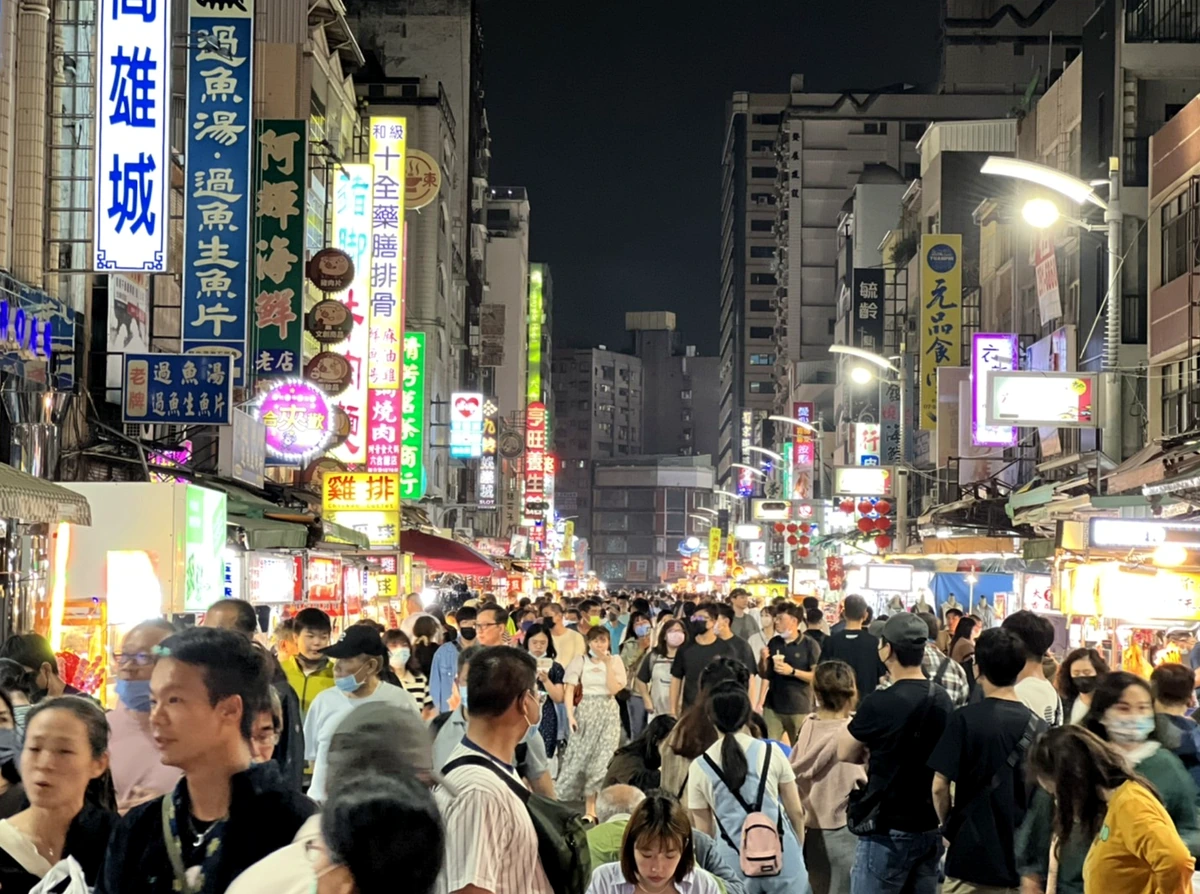
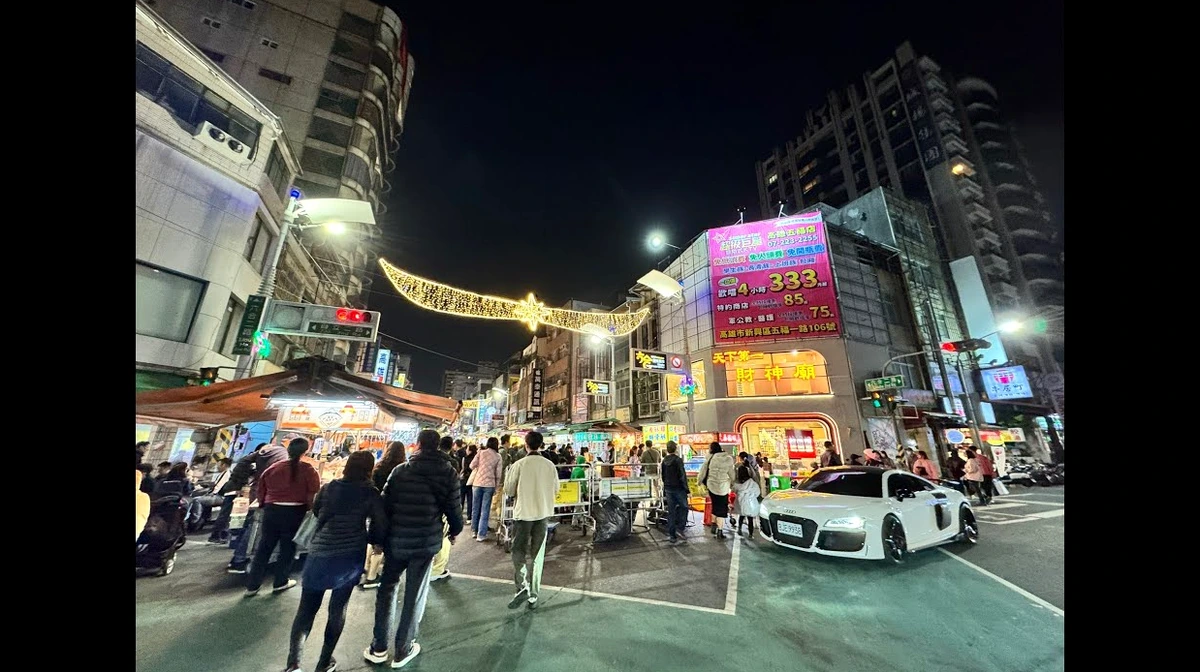
Once sunset falls over the port city of Kaohsiung, Liuhe Boulevard takes on an entirely new persona, transforming into a captivating open-air live stage. The nighttime lighting landscape renovation at Liuhe Night Market (六合夜市) places high-luminance, high-saturation signage at the core of its spatial design. Traditional neon tubes and lightboxes have been uniformly upgraded to energy-efficient LED illuminated lettering paired with dynamic digital displays. The rhythmic interplay between warm golden hues and crisp white light creates a dazzling visual effect, striking an artistic balance between vibrant futuristic cyberpunk aesthetics and the earthy, smoke-wreathed charm of a time-honored neighborhood night market. Suspended overhead along the length of the pedestrian street, permanent installations of East Asian red lanterns intertwine with overhead LED canopies, weaving a luminous ceiling that guides visitors through an enchanting nocturnal realm.
Beyond this feast of visual color, nocturnal life at Liuhe is vividly defined by a multi-layered, emotionally resonant soundscape. Stepping into the market immediately immerses visitors in an energetic symphony of everyday life: the crisp sizzle of fresh meats and seafood hitting scorching teppanyaki iron griddles; the metallic clatter of spatulas against woks accompanied by roaring flames producing fragrant “wok hei” (鍋氣) at high-heat seafood stalls; and the rhythmic, booming calls of heritage stall owners hawking their wares in both local Taiwanese Hokkien and Mandarin. Meanwhile, visitors’ senses of smell and taste are continually awakened by the intoxicating aroma of scallion-oil grilled seafood, crispy deep-fried stinky tofu, and creamy specialty teas, turning a simple evening stroll into an authentic multi-sensory immersion.
In terms of experiential layout, the pedestrian street incorporates thoughtfully placed artistic breathing spaces. Around the central section of the market and at major intersections, the management committee welcomes officially licensed street performers to play and interact with crowds. Mellow saxophone melodies and acoustic guitar strums drift through the night air alongside traditional folk art performances, infusing the bustling commercial atmosphere with refined cultural flair. This resonance between contemporary music and traditional artistry not only softens the rush of passing crowds but also deepens the historical and cultural texture of the space. Visitors can stroll leisurely with a cup of famous papaya milk in hand, pausing at a street corner to enjoy a lyrical ballad beneath the canopy of lights and savor the seamless blend of modern urban sophistication and Southern Taiwan’s grassroots civic spirit.
More than just a thriving open-air commercial hub, Liuhe Night Market serves as a living encyclopedia of Southern Taiwan’s signature culinary heritage. Over decades of evolution, it has refined a gastronomic philosophy that is both unpretentious and sophisticated, marrying pristine seafood straight from Kaohsiung Harbor with the agricultural bounty of the southern plains. The family-run stalls at Liuhe do more than sell food—they pass down living history and the dedication of artisan families who have spent lifetimes safeguarding handcrafted recipes. From the mouthwatering aroma wafting off glowing charcoal grills to rich, velvety fruit smoothies, every step along this avenue leads to nostalgic flavors and local culinary masterpieces.
When speaking of Liuhe’s most iconic refreshment, no name stands taller than the heritage brand Zheng Lao Pai Papaya Milk (郑老牌木瓜牛奶). The secret behind its multi-generational acclaim lies in uncompromising standards when sourcing the freshest local ingredients. Tree-ripened papayas harvested directly from fertile Meinong are blended with premium fresh milk from the Tainong dairy. Rather than relying on artificial sweeteners, the makers painstakingly slow-cook pure cane sugar syrup according to a closely guarded family ratio. This union yields a papaya milk smoothie of velvety, ultra-smooth consistency, brimming with natural fragrance and a clean, creamy sweetness that never feels cloying.
The harbor city’s deep-rooted seafood culture shines through its guiding maxim: “eat only in season, cook only at peak freshness.” Two must-try dishes topping the list here are delicately steamed salted shrimp and the celebrated ocean seafood congee. The broth for the seafood congee is simmered for hours from sweet pork marrow bones, enriched with the deep umami of dried flatfish and dried shrimp. Only when the broth reaches a rolling boil does the vendor swiftly add the day’s freshest catch—plump oysters, crisp squid, juicy clams, whole tiger prawns, and thinly julienned fresh bamboo shoots. Served piping hot with wisps of aromatic steam, the bowl delivers the pure, sweet essence of the sea balanced by the delicate crunch of mountain bamboo shoots, leaving an unforgettable impression on every diner.
Late-night energy at the market grows even more enticing with the irresistible smoke drifting from Kao Rou Zhi Jia (烤肉之家 – Home of Barbecue), a stall dedicated to preserving traditional direct wood-charcoal grilling. Unlike modern electric grills, skewers of meat and seafood here are cooked directly over glowing hardwood embers, absorbing warm, natural woodsmoke. Before hitting the grill, ingredients are meticulously marinated in a secret family blend of aged soy sauce, crushed garlic, and five-spice powder. While fanning the coals, the grill master repeatedly brushes the skewers with maltose glaze and specialty house sauce. Continuous hand-turning chars the exterior to a glossy, caramelized crispness while locking in tender, succulent juices inside, striking a mouthwatering harmony of savory, sweet, and smoky notes.
Liuhe’s local culinary portrait is crowned with pride by wild-caught mullet roe (Wu Yu Zi – 乌鱼子) and Southern Taiwan’s celebrated Du Hsiao Yueh danzai noodles. Wild mullet roe—revered as the “black gold” of Taiwan’s southern waters—is soaked in high-proof Kaoliang sorghum liquor and deftly seared over a blue flame until its outer membrane blisters lightly and releases a rich, nutty aroma. Thinly sliced pieces are served alongside crisp white radish slices and fresh green garlic shoots. Each bite pairs the dense, chewy richness of the roe with the sharp, refreshing crunch of garlic shoots and radish, creating a sophisticated explosion of flavor. This union of humble street snacks and prized coastal delicacies elevates Liuhe Night Market into an irreplaceable culinary heritage paradise.
Experiencing Liuhe’s nocturnal food scene is an invigorating dive into local culture that rewards smart timing. The night market opens daily from 5:00 PM until 2:00 AM the following morning. However, according to field observations by urban culture researchers, the golden window to soak in its peak vibrancy, dazzling lights, and energetic culinary pulse runs from 7:30 PM to 9:30 PM. During these hours, every neon sign glows at full brilliance, fresh seafood stalls send up clouds of fragrant steam, and crowds reach their liveliest flow. As an open commercial zone situated along a public pedestrian street, Liuhe Night Market charges zero admission fees, allowing visitors complete freedom to wander, sightsee, and graze without any administrative barriers.
In terms of transit connectivity, Kaohsiung’s modern infrastructure makes reaching Liuhe Night Market effortless. Travelers arriving from northern or central Taiwan via the Taiwan High Speed Rail (THSR) will disembark at Zuoying Station (左營站). From there, simply transfer to the Kaohsiung MRT Red Line heading toward the city center and alight at the central interchange hub, Formosa Boulevard Station (美麗島站, Station Code O5/R10). After admiring the famous “Dome of Light”—the kaleidoscope stained-glass masterpiece gracing the station’s main concourse—follow signs to Exit 11. The moment you step out of this exit, the lively expanse of Liuhe 2nd Road unfolds directly before your eyes.
To make the most of sightseeing and sampling local delicacies, planning your walking route pays off. Travel experts recommend starting at the intersection of Zhongshan Road (中山路) and Liuhe 2nd Road, right outside the Formosa Boulevard Station exit. From this bustling junction, stroll westward down Liuhe 2nd Road all the way to its intersection with Zili Road (自立路). This multi-hundred-meter stretch packs together decades-old food kiosks offering everything from charcoal-grilled seafood and beef noodle soup to papaya milk and fresh tropical fruit platters. Once you reach the Zili Road crossroads, simply turn around and stroll back along the opposite side of the street so you don’t miss a single Southern Taiwanese specialty.
Payment methods and budgeting at Liuhe Night Market reflect a seamless blend of tradition and modern convenience. While cash (New Taiwan Dollars – NTD) remains the most widely used and preferred form of payment at most family-run stalls, digital payments have swept across the district. Many vendors now readily accept popular mobile payment platforms such as LINE Pay, JKOPay (街口支付), and Taiwan Pay. Street food items typically range from 40 to 150 NTD per dish, making it easy to manage your budget. To enjoy a generous feast featuring fresh seafood, signature beverages, and iconic snacks, an average budget of 300 to 500 NTD per person is plenty to satisfy your appetite.
Alongside indulging in great food, dressing smartly and practicing basic street awareness will ensure a smooth visit. Kaohsiung has a tropical monsoon and maritime climate characterized by warm breezes and high humidity, especially during the warmer months of the year. Visitors are advised to wear lightweight, breathable, moisture-wicking clothing paired with comfortable walking sneakers for navigating the long stone-paved avenue. Additionally, during peak evening crowds, keeping expensive electronics, cameras, wallets, and identification secure in a front-worn crossbody bag or waist pack is a smart safety precaution.
All told, Liuhe Night Market is far more than a culinary hotspot—it is a living chronicle of the cultural depth and warm hospitality of Kaohsiung’s port community. Knowing how to get there, when to visit, and what practical tips to keep in mind will make your journey through Southern Taiwan smoother and far more memorable. To turn your dream of exploring Kaohsiung’s vibrant nightlife and connecting seamlessly with iconic heritage landmarks across the island into reality, consider browsing all-inclusive Taiwan tour packages thoughtfully curated for a effortless travel experience.