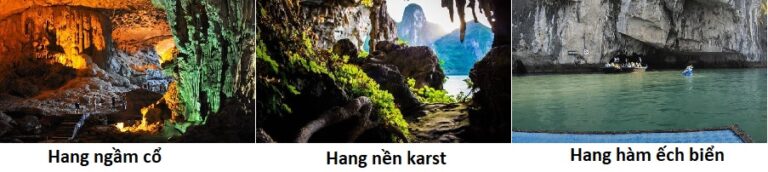
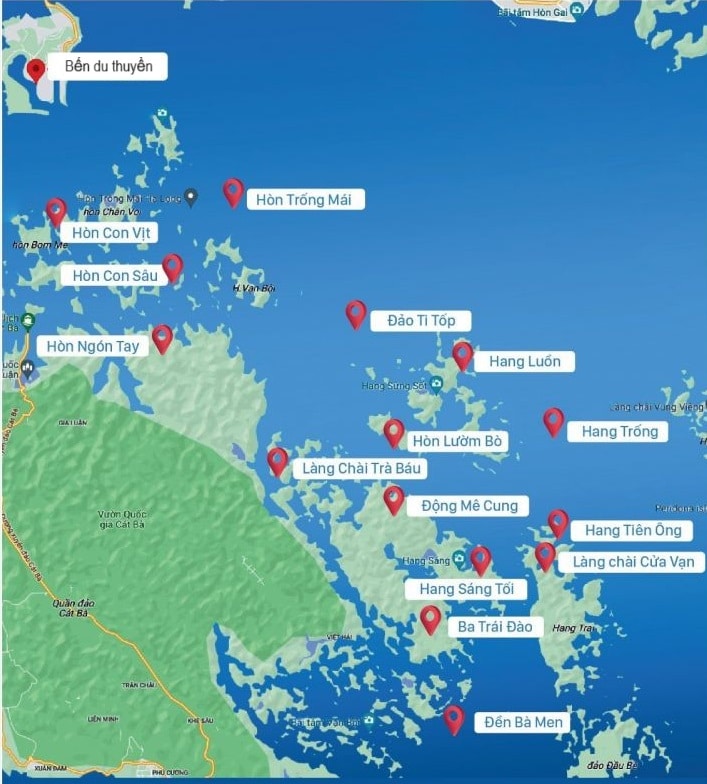
Standing out among the many captivating caves in Ha Long Bay, Dau Go Cave is renowned as one of the largest and most beautiful, attracting a vast number of tourists every year. It is often said that your journey cannot be considered complete without visiting this famous cave. Follow the article below for a comprehensive look at Dau Go Cave.
See more: Explore the most beautiful caves in Ha Long Bay and their formation history
Location and origin of Dau Go Cave
Dau Go Cave is one of the most beautiful caves in Ha Long Bay, famous for its many strange and magical limestone formations. Covering an area of approximately 5,000m2, it is located at an altitude of 27m above sea level, nestled within a limestone mountain range on Dau Go Island, in Ha Long City, Quang Ninh Province. Compared to other caves in Ha Long Bay, Dau Go is the third largest, following Sung Sot Cave and Thien Cung Cave (located 300m away). The cave acts like a giant air conditioner; while it is warm inside during winter, the interior remains a cool 20-22°C even when it is scorching hot outside in the summer.
According to scientists, Dau Go Cave was formed approximately 2 million years ago, around the same time as Thien Cung Cave, during the late Pleistocene epoch. During this period, seawater eroded the limestone, creating cracks on the mountain’s surface. Wind and rain also contributed to the erosion, forming cavities that gradually expanded and connected to create large, deep caverns.
There are various explanations for the name “Dau Go,” reflecting the rich history, culture, and nature of the region. One theory suggests that Dau Go Cave was where the Tran Dynasty soldiers hid wooden stakes used to build the defensive stake trap against the Mongol invaders in the 13th century. After the victory, the soldiers took most of the wood with them, leaving only a few pieces behind. From then on, the cave was called “Giau Go” (Hidden Wood), which later evolved into “Dau Go.” However, folklore researcher Tong Khac Hai noted: “I remember around 1960, experts from the Institute of Archaeology burned torches to search the cave for any wood fragments to verify the legend of Tran Hung Dao’s stakes, but they found nothing. Perhaps, out of national pride and patriotism, some people have associated that legend with the cave’s name.”

Folklore researcher Tong Khac Hai states that no traces of wooden stakes were found at Dau Go Cave
Mr. Tong Khac Hai believes that the name “Dau Go” leans toward a second explanation: it is simply the name of the mountain itself. If you travel from Cat Hai (Hai Phong), you will see that the mountain resembles a log with two holes, so fishermen called it “Dau Go” (Wooden Log) Mountain. The cave on the mountain was then named Dau Go Cave.
Finally, another explanation is that the arc-shaped Dau Go island chain creates a sheltered bay in front of the cave. Fishermen would often gather here during storms, or after long fishing trips, they would anchor, live in the area, and repair their boats, leaving behind many wood scraps.
Historical landmarks of Dau Go Cave
In 1918, King Khai Dinh and the French Governor-General Albert Pierre Sarraut took a trip to Ha Long Bay and visited Dau Go Cave. Moved by the ethereal beauty of the cave, King Khai Dinh composed a poem and a preface praising the landscapes of Ha Long and the cave itself. The stele recording these praises is currently placed on the left side of the cave entrance. The stele is decorated with two dragons flanking the sun at the top and base, featuring cloud and fire motifs in the royal art style of the Nguyen Dynasty. In his preface, King Khai Dinh named Dau Go Cave “Ngu Sac Tuong Van” (Five-Colored Auspicious Clouds), likely comparing its beauty to the Tuong Van Pagoda in Hue, which was built in 1843.
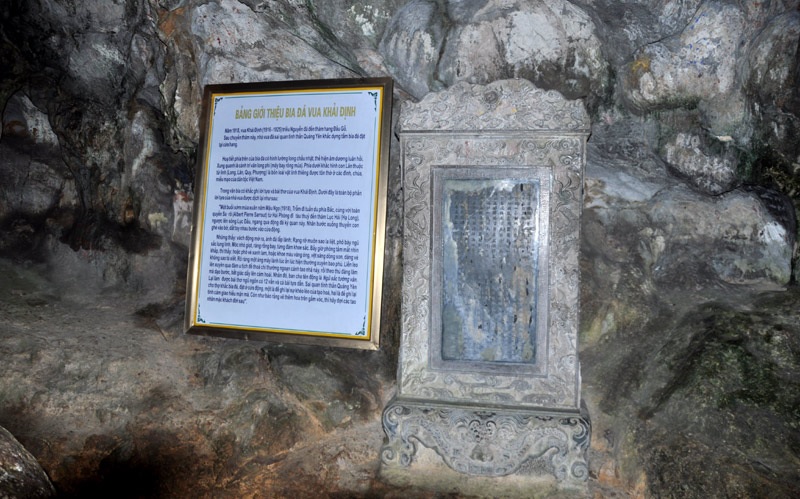
King Khai Dinh’s stone stele at Dau Go Cave today
On October 5, 1957, Uncle Ho visited Ha Long Bay and toured Dau Go Cave. Upon reaching the entrance, he told his companions: “You must be sightseers like me to truly enjoy this. One person cannot convey such beauty to many others. All of you must enjoy it with me.”
In 1938, Dau Go Cave was mentioned for the first time in a French travel magazine called *Merveille de Monde* (Wonder of the World). The article introduced the magical and pristine beauty of the cave, as well as its legends and history. The author used flowery language to praise Dau Go as *Grotte des Merveilles* (Cave of Wonders). This article sparked curiosity and interest among international travelers, especially the French, regarding Dau Go Cave and Ha Long Bay.
How to get to Dau Go Cave
There are two main ways to reach Dau Go Cave:
- Option 1: You can purchase a day-trip ticket for Ha Long Bay and choose Route 1, which includes stops such as Thien Cung Cave, Ba Hang Fishing Village, Hon Trong Da (Fighting Cock Islet), and Dau Go Cave. Tickets can be purchased at cruise ports like Bai Chay or Tuan Chau. The price for this route is 440k/person (including bay entrance fees and boat fare). You can search for and book a Route 1 bay tour here.
- Option 2: You can book a Ha Long Bay cruise to experience various exciting activities on the bay, such as dining, overnight stays, fishing, scuba diving, and more. Cruise tours typically last from 2 to 3 days, with many options regarding vessel types and pricing. You can search for and book a cruise here.
Exploring Dau Go Cave
After departing from the cruise port, it takes about 2 hours for the boat to reach Dau Go Cave. Visitors will need to travel from the cruise ship to the cave entrance, which is a few hundred meters away. The path is quite easy as it has been well-maintained and kept clean; however, the entrance requires climbing a set of stairs, so individuals with limited mobility should take this into consideration before visiting.
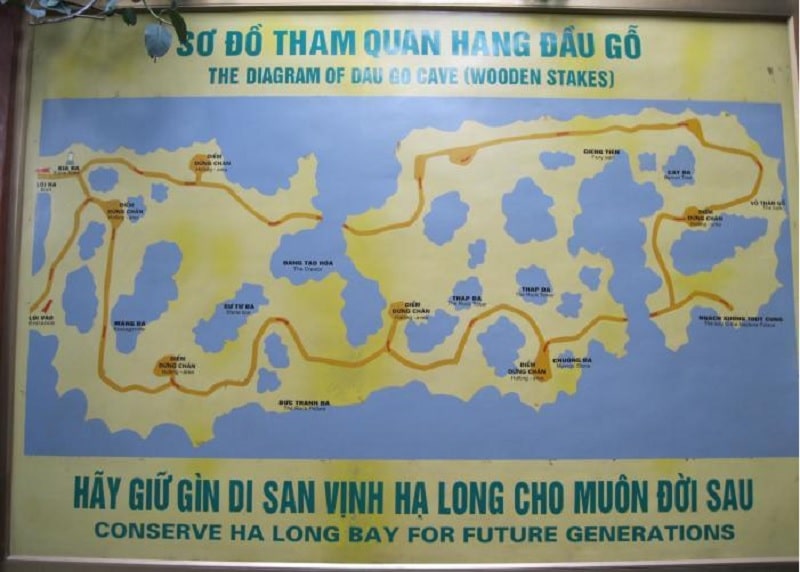
Dau Go Cave tour map
Dau Go Cave covers an area of approximately 5,000 m2, with an entrance 17 meters wide and 12 meters high. Its architecture is unique and distinctive, considered a remarkable natural masterpiece. The cave is divided into three chambers, each with its own unique and captivating features.
The first chamber: This is the largest area, where natural light floods in, creating a dreamlike natural painting. The ceiling of the cave resembles a collection of magical images, allowing viewers to imagine many interesting things. At times, you might see elephants grazing, fierce tigers, pure white swans, or bees and butterflies fluttering about. The ancient stalactites formed by nature come in diverse shapes—some resemble palm trees, others look like sharp swords, and some appear like a dense forest, with the sound of trickling water echoing like birds chirping or gibbons calling. The ceiling is also covered with a soft “velvet carpet,” shimmering with light from stalactite “chandeliers,” along with stone statues of lions, pythons, turtles, and fighting cocks… all coming to life in a fantastical world.
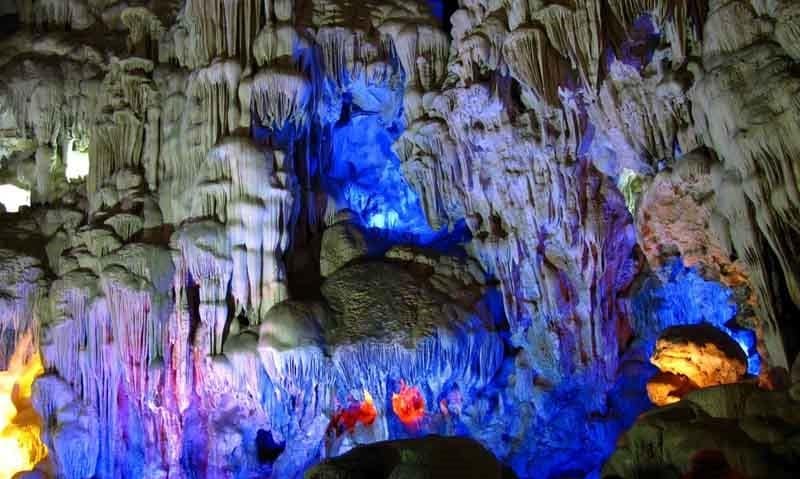
Strange stalactites make Dau Go Cave even more magical
The second chamber: The middle chamber is much darker but impresses with its crystalline structure. When the lights are turned on, it transforms into a magnificent kaleidoscope, mesmerizing every visitor and sparking curiosity about the picturesque images. The silhouettes of rocky islands rising above the waves are also clearly depicted in this scene, evoking a sense of wonder and awe at the beauty of Ha Long Bay.
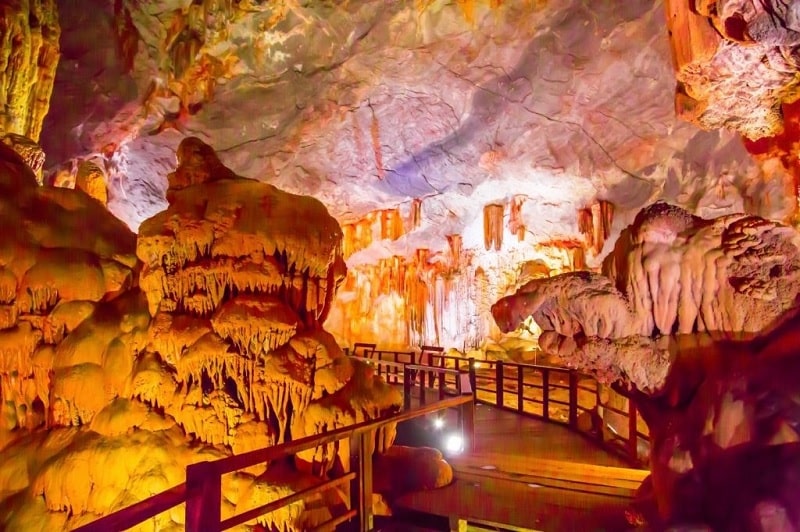
Corridor between chambers in Dau Go Cave
The third chamber: After walking along the 1.4m wide path, visitors will reach the third chamber, featuring colorful stalagmites and stalactites. There are also many giant stone pillars created by nature in this area. These pillars are neither rough nor rigid, but rather delicate and smooth, adding a sense of refinement and artistry for visitors.
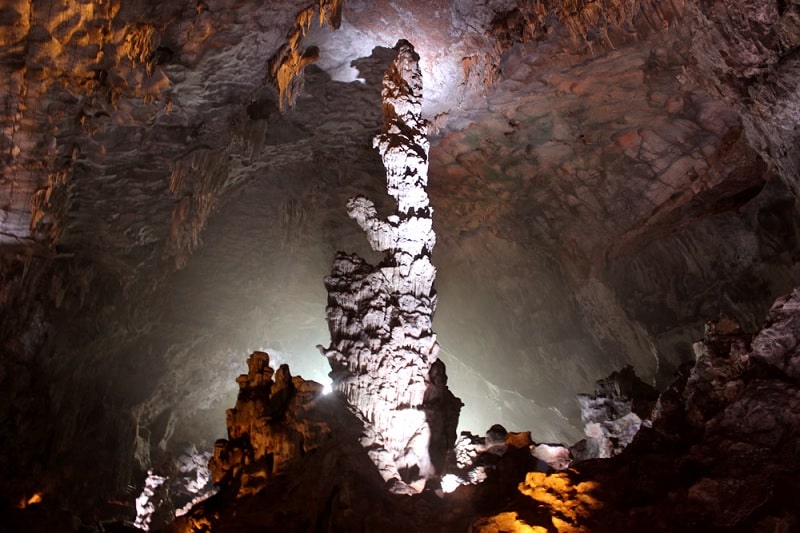
Giant stone pillar in Dau Go Cave
Dau Go Cave is a limestone cave with a unique scale and architecture in Ha Long Bay. It is a horizontally developed cave with multiple chambers, showcasing variations in color, light, and the shapes of its limestone formations. According to scientists, Dau Go Cave is one of the oldest caves in Ha Long Bay, dating back to the same period as Thien Cung Cave. Dau Go Cave exudes an ancient, pristine, and tranquil beauty, with many stone columns, pillars, and stalagmites that reach high as if trying to touch the sky. These limestone works were created by the crystallization of minerals dripping from the ceiling to the cave floor, as well as the reflection of light from the entrance onto the pillars within.
Notes for visiting Dau Go Cave
Please keep the following in mind for a pleasant and rewarding trip:
- The best time to visit Dau Go Cave is between April and October, when the weather is pleasant, neither too cold nor rainy. You should avoid peak days such as weekends and public holidays to steer clear of crowds.
- To reach the entrance of Dau Go Cave, you must climb 90 steps. Therefore, those using wheelchairs should have someone accompany them to provide assistance.
- When visiting the cave, please follow the regulations set by the management board and your tour guide. Do not litter, touch the limestone formations, or make noise that disturbs others. Please help protect the natural beauty of the cave and respect this historical site.
Above is all the information regarding Dau Go Cave; we hope this article provides useful insights for your trip. If you would like to rent a boat to visit Ha Long Bay and explore this destination, please contact us for more details.