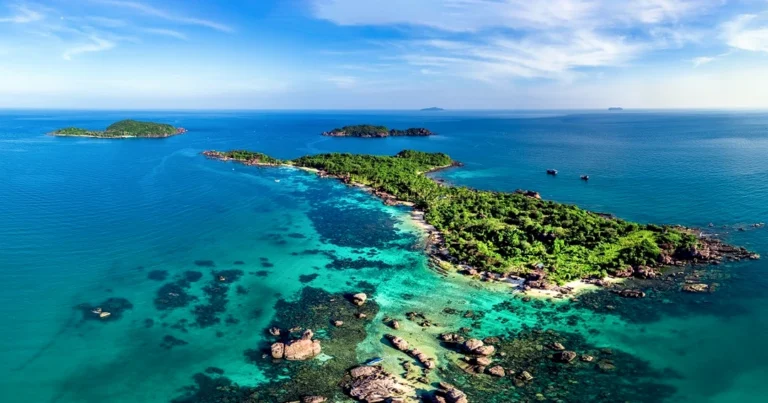
Located at the southernmost tip of Phu Quoc Island City, Kien Giang Province, the An Thoi Archipelago emerges as a singular maritime frontier where unique geological formations converge with the deep-rooted cultural and historical heritage of Vietnam’s southwestern sea. Comprising more than fifteen large and small islands of striking shapes—such as Hon Thom, Hon May Rut, Hon Dam, and Hon But Chi—this cluster of limestone and schist islands boasts extraordinary natural feng shui. Undulating mountain ranges embrace emerald-green bays to form sheltered coves, serving both as a strategic bulwark against the rough waves of the Gulf of Thailand and as an ideal haven for seafaring vessels since ancient times.
Nguyen Dynasty historical records and ancient maps, such as the Dai Nam Nhat Thong Toan Do (Complete Map of the Unified Great South), documented the An Thoi Archipelago (formerly known as An Thoi Nhu Dao or belonging to An Xuyen Canton) as a vital waypoint along the international maritime route linking the Gulf of Siam with the waters of Ha Tien. The region’s historical trajectory is closely tied to the arduous yet heroic southern expansion led by the Nguyen Lords and the Mac clan. From the 17th to the 18th centuries, under the strategic vision of Mac Cuu and Mac Thien Tich, the waters and islands of An Thoi were officially incorporated into the administrative and defensive system of Ha Tien Garrison, marking a defining milestone in establishing clear maritime sovereignty over the nation’s frontline waters.
Through the passage of time, An Thoi has preserved not only the pristine beauty of its untouched marine and island ecosystem but also deep layers of historical memory. During the French colonial era, and reaching a peak during the resistance war against the United States, the archipelago’s strategic position transformed it into a critical military zone. Notably, the presence of the Special National Relic of Phu Quoc Prison (An Thoi Prison) stands as a tragic yet heroic testament to an era of fire and blood. Having once imprisoned tens of thousands of revolutionary soldiers, the site has become a shining symbol of the nation’s indomitable and steadfast spirit, while enriching the tradition of honoring one’s roots and the intangible cultural heritage of southern Vietnam.
Today, in the eyes of researchers and travel journalists alike, the An Thoi Archipelago is celebrated as a dual-heritage space where majestic nature harmonizes with heroic history. From geological strata dating back millions of years that sustain some of Vietnam’s richest coral reef ecosystems to sacred “red addresses” that educate future generations on revolutionary traditions, An Thoi is rising as an emblem of revival and sustainable development. The archipelago not only preserves the sacred spirit of the land passed down by ancestors, but also opens up proud heritage journeys for generations today and tomorrow.

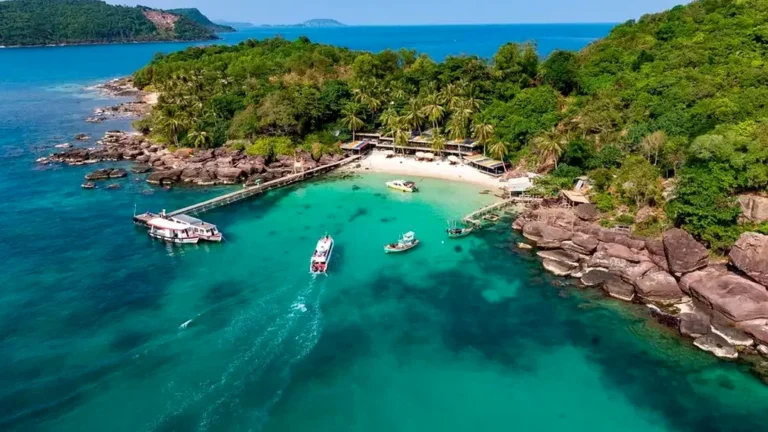
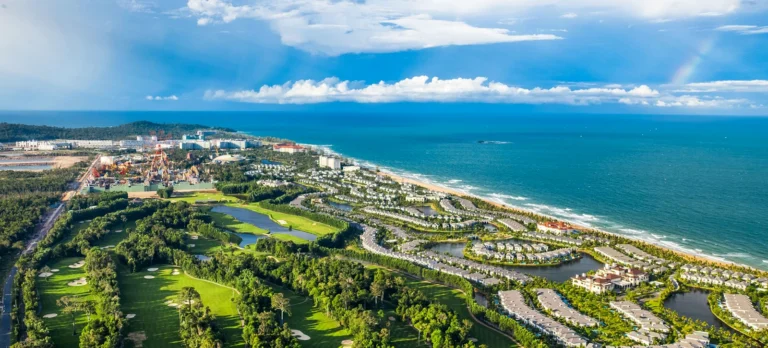
Situated at the southern extremity of Phu Quoc City, the An Thoi Archipelago stands as a remarkable union of nature’s handiwork and human ingenuity, bringing together unspoiled seascapes and contemporary architecture of international stature. Viewed from above, the cluster of fifteen large and small islands appears nestled amidst crystal-clear emerald waters, forming a natural yet commanding defensive formation. Major islands such as Hon Thom, Hon May Rut, Hon Dam, and Hon Roi feature dramatic limestone terrain weathered over millions of years, encompassing stretches of powdery white sand and some of Vietnam’s most diverse coral reefs. Gently curving coastlines paired with bizarrely shaped rocky outcrops carved by ocean waves create a vivid, breathtaking natural tableau that captivates every traveler who sets foot here.
Alongside its natural wonders, An Thoi boasts an architectural landmark that has completely transformed the face of Vietnam’s island tourism: the world’s longest over-sea cable car connecting An Thoi Town across the islands to Hon Thom, anchored by a departure terminal complex styled after classic Mediterranean architecture. An Thoi Station is intricately crafted with handcrafted terracotta brick walls, soaring vaulted arches, finely carved bas-reliefs, and colonnades evoking Italy’s iconic Colosseum. This masterful fusion of Western architectural sculpture and rugged tropical scenery has turned the complex into a grand open-air art gallery, where every wall corner, window frame, and staircase exudes romantic, classical, and nostalgic charm.
To capture the most prized moments in the An Thoi Archipelago, seasoned photographers and leading travel magazines frequently share two iconic vantage points not to be missed. The first is the panoramic view from the over-sea cable car cabin overlooking An Thoi Town and the archipelago at sunrise. At this hour, the day’s first rays break over the horizon, casting a golden glow across hundreds of fishing boats bustling at anchor in the bay below, composing a vibrant and poetic portrait of coastal life. The ideal window for this shot is between 5:30 AM and 6:30 AM.
The second million-view photo spot lies around the An Thoi cable car departure station and its Mediterranean-style streets as sunset descends. As the twilight shifts from brilliant orange to a mystical deep violet, the ancient-style brick walls and sea-facing archways reflect an enchanting light reminiscent of Italy’s romantic Amalfi Coast right in the heart of Phu Quoc. The golden hour to press the shutter is from 5:00 PM to 6:00 PM, when day meets night in the sky, allowing photographers to effortlessly capture frames of extraordinary artistic depth and profound emotion.

Arriving at the An Thoi Archipelago at the southern tip of Pearl Island Phu Quoc, visitors are immediately drawn into an untamed, majestic world bestowed by nature upon the southwestern sea. The journey of discovery begins aboard wooden boats slicing through crystal-clear emerald waters, where you can peer straight down to vibrant, multicolored coral reefs winding across the seabed. A wave of awe washes over you as you cast your gaze toward the horizon, taking in dozens of large and small islands rising out of the open sea like giant jade gems arranged across a vast tapestry woven by creation.
Beyond sightseeing on the water, invigorating physical adventures such as scaling dramatic limestone crags or trekking through lush primeval forest canopies awaken every sense. Standing atop the highest peak of an uninhabited island, taking in the sweeping panorama of the An Thoi Archipelago beneath an endless expanse of sky and sea—with waves lapping rhythmically against the cliffs and salty breezes whipping through your hair—visitors feel the humbling scale of humanity before grand nature while discovering an absolute freedom of the spirit.
Leaving the wild allure of sea and sky behind, the journey continues into a space of solemn, contemplative spiritual reverence. Stepping into ancient coastal shrines tucked beneath the shade of sea almond trees, or turning one’s heart toward the Special National Relic of Phu Quoc Prison in An Thoi, emotions settle into quiet poignancy. Amid a land now lush and peaceful, echoes of a heroic past and the steadfast sacrifices of revolutionary soldiers resonate through every artifact and strand of barbed wire, leaving every visitor with deep emotion and boundless gratitude.
And an exploration of An Thoi would never be complete without uplifting culinary experiences rooted in the region’s rich local food culture. Sitting along the breezy shoreline, savoring renowned island specialties such as fresh herring salad rolled in rice paper with wild herbs, fragrant grilled sea urchin topped with scallion oil, or freshly caught seafood brimming with the briny sweetness of the sea—each flavor harmonizes into an unforgettable gastronomic symphony. It brings a richly rewarding journey to a close, where generous nature, heroic history, and living local culture merge as one in every traveler’s memory.

The An Thoi Archipelago not only preserves profound historical and archaeological value, but also stands as the premier marine and island tourism paradise at the southern tip of Phu Quoc. To ensure a seamless and fulfilling journey through this island cluster, travelers should keep in mind essential practical details regarding timing, costs, transportation, and local guidelines when visiting.
As for the ideal time of year, the dry season (from October to April of the following year) offers the most favorable conditions for exploring An Thoi. During these months, the sea is calm, the water is crystal clear right down to the seabed, and bright golden sunshine creates ideal conditions for speedboat excursions and snorkeling at islands like Hon May Rut, Hon Thom, and Hon Dam, while ensuring optimal lighting for memorable photography and sightseeing.
Regarding transportation and routes, from central Phu Quoc City (Duong Dong Ward), travelers can head south along the main arterial road DT975 or the Duong Dong – An Thoi route, covering a distance of roughly 25 to 30 kilometers. Popular transport options include motorbikes, private cars, or taxis. Upon reaching An Thoi Port, visitors can charter a speedboat or tour boat to island-hop among the surrounding islets, or ride the world’s longest over-sea cable car system to Hon Thom Island.
Specifically for the Special National Relic of Phu Quoc Prison (An Thoi Prison), the site is open daily to visitors from early morning until late afternoon (typically from 7:30 AM to 5:00 PM). Admission to the relic site is currently completely free of charge for all domestic and international visitors coming to learn about history and offer incense in remembrance.
Additionally, because an itinerary in An Thoi combines marine ecotourism with visits to historical and spiritual landmarks, travelers should plan their attire thoughtfully. When visiting Cay Dua Prison (Phu Quoc Prison) or coastal temples and shrines, dress respectfully and modestly—wearing long pants or outfits that cover the knees—to show reverence and solemnity. Conversely, when participating in beach and sea activities, opt for lightweight, comfortable clothing, bring a hat, sunglasses, and reef-safe sunscreen, and wear athletic shoes or non-slip strapped sandals for safe footing across hilly trails and rocky shorelines.

To enjoy a seamless getaway and take in the full splendor of the An Thoi Archipelago without worrying about arranging transportation, booking entrance tickets, or planning itineraries, travelers can choose VDS Travel’s premium all-inclusive Phu Quoc tour packages. Each itinerary is thoughtfully curated to maximize photo opportunities when the scenery is at its most radiant, accompanied by knowledgeable local guides and top-tier hotel and dining standards.