Flowing down the thousand-year course of the Nile River into the ancient region of Lower Nubia, where the barren desert fringe meets the vast expanse of modern-day Lake Nasser, the Abu Simbel temple complex stands majestically like an immortal epic of divine power and majestic royalty of ancient Egyptian civilization. This architectural masterpiece, carved deep into the sandstone mountain, began construction in the thirteenth century BC, spanning two golden decades from approximately 1264 to 1244 BC during the Nineteenth Dynasty of the New Kingdom period. The ruler who ordered the creation of this geological and artistic wonder was none other than the most brilliant Pharaoh in the history of the Nile valley: Ramesses II, the illustrious monarch honored by posterity as Ramesses the Great and immortalized in classical Western poetry under the name Ozymandias. In the geopolitical landscape of the time, the land of Nubia was a source of pure gold, precious gems, ebony, and skilled mercenary troops, but simultaneously a hazardous frontier region that frequently erupted in uprisings against the court of Thebes.
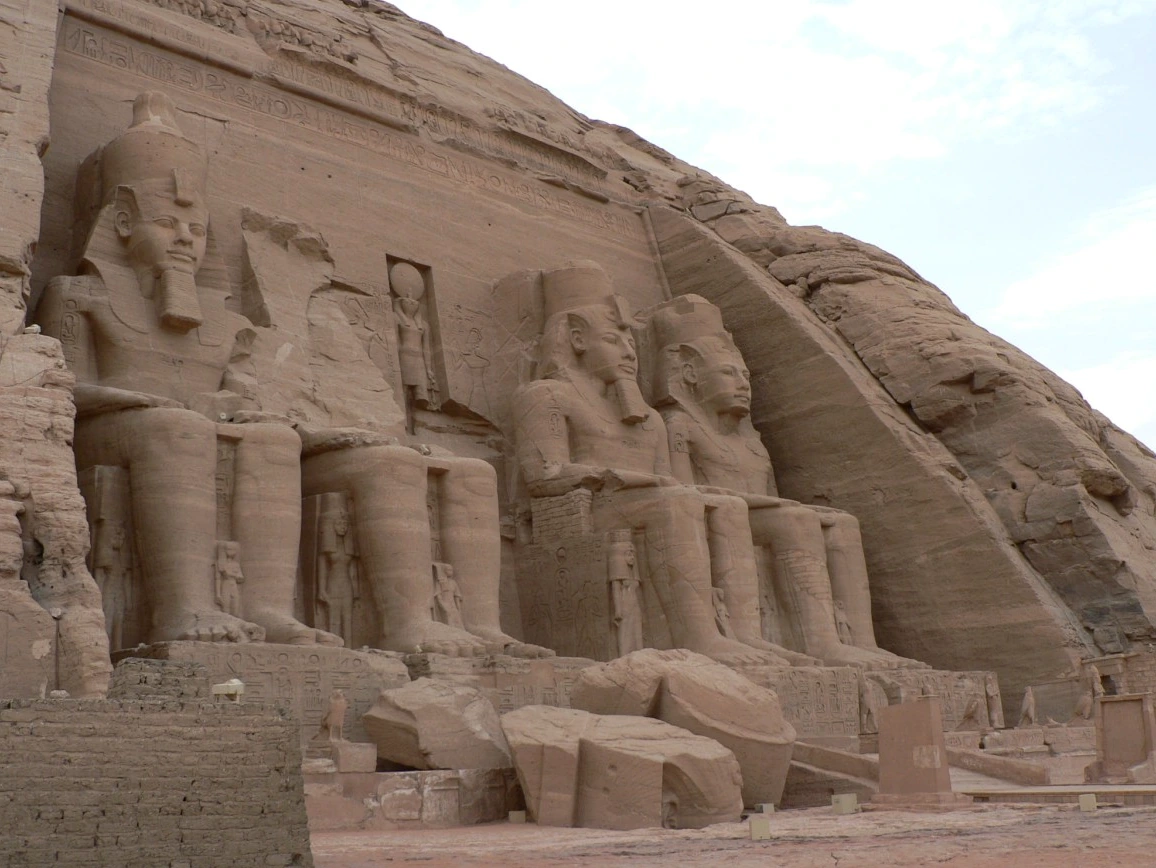
To establish enduring dominance and assert Egypt’s supreme power in the Nubia region, Ramesses II decided to create an unprecedented work: hollowing out the sacred heart of Mount Meha on the western bank to build a sanctuary carrying profound deterrence and assimilation significance. In ancient hieroglyphic inscriptions carved into the rock walls, this complex bears the official title “Temple of Ramesses Mery-Amun,” meaning “The Temple of Ramesses, Beloved of Amun.” This place not only served the triad of great deities protecting the empire including Amun-Ra of Thebes, Ra-Horakhty of Heliopolis, and Ptah of Memphis, but was also where Ramesses II self-divinized, placing his own cult statue on an equal footing with the supreme creators. Four colossal statues depicting the Pharaoh seated on his throne on the towering facade, gazing majestically southward, became a powerful deterrent symbol against all Nubian delegations, merchants, or prisoners of war as they sailed past the mighty waters.
Through the violent vicissitudes of history, as the Ramesside dynasty gradually waned and foreign empires successively flooded into the Nile valley, the temple complex gradually fell into a millennial slumber amidst the wilderness. Blazing desert winds from the vast Sahara patiently buried each step, obscuring the entire Osiris pillared hall and leaving only the heads and shoulders of the giant statues protruding from the fiery red sand dunes. Throughout many centuries of the Middle Ages, the existence of the wonder was almost erased from human consciousness, lingering only as an illusory legend passed down by word of mouth among local nomadic tribes.
It was not until the spring of 1813 that the veil of secrecy shrouding the temple was officially lifted when Swiss explorer and orientalist scholar Johann Ludwig Burckhardt set foot on this remote strip of land. The fascinating twist that forms one of the most delightful anecdotes in archaeological history is that the modern name “Abu Simbel” actually derives from the name of a local boy. It was this young Nubian teenager, well-versed in desert geography, who guided Burckhardt across rolling sand dunes to approach the crown of the statues buried deep underground. Four years later, in 1817, Italian archaeologist Giovanni Battista Belzoni completed excavating the layer of sand dozens of meters thick to throw open the doors leading into the heart of the sacred mountain. From that historic moment, the name of the anonymous boy Abu Simbel became eternally linked with the grand work of Ramesses the Great, connecting the glorious past of an ancient empire with humanity’s endless treasure trove of heritage.
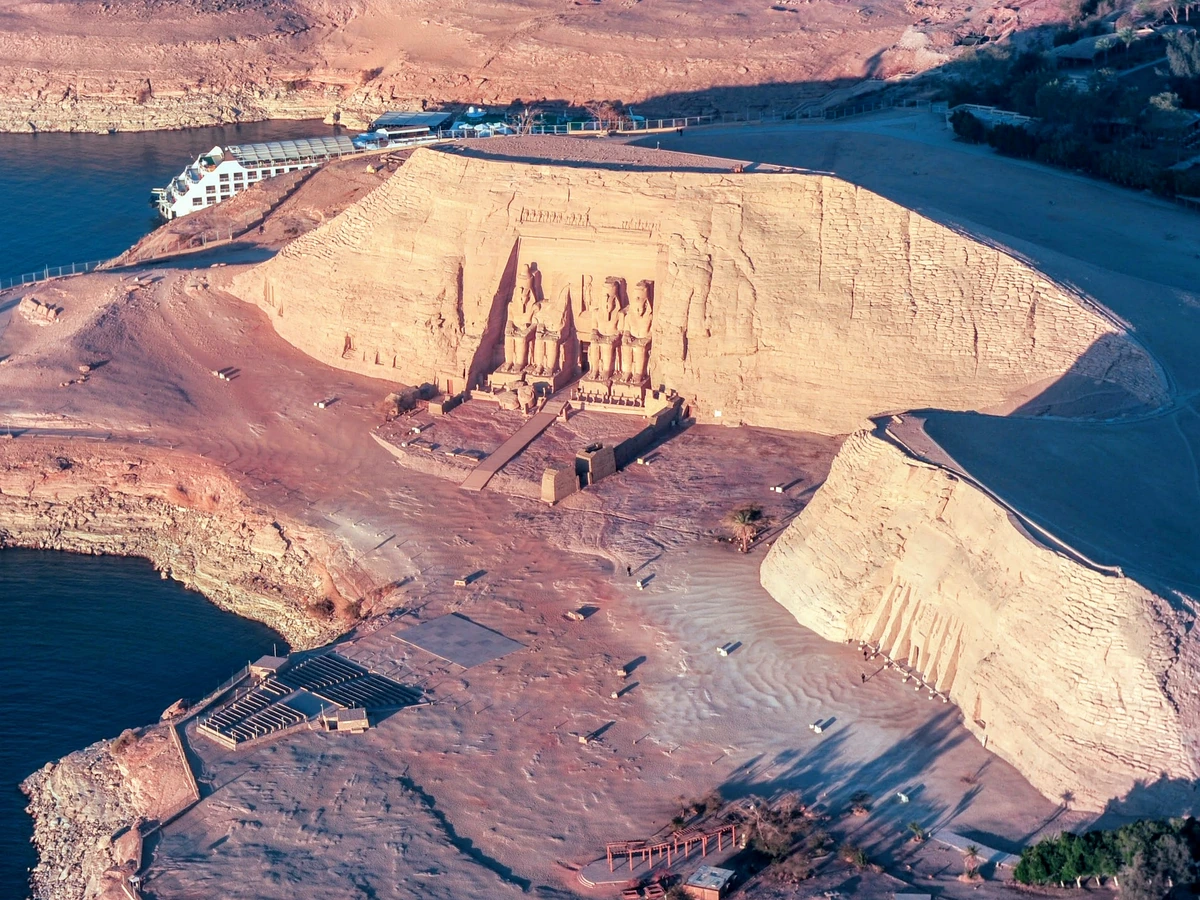
Located in ancient Nubia within the territory of modern-day Aswan province, the rock-cut temple masterpiece of Abu Simbel reigns on the western bank of the mighty Nile River, now the calm glassy surface of the vast artificial Lake Nasser. The geomantic location here was chosen by royal astronomers and architects under Pharaoh Ramesses II of the Nineteenth Dynasty during the New Kingdom period of ancient Egypt with thorough calculation down to every geographic orientation. Nestled within a harsh wilderness filled with red sand and scorching winds, the complex was carved directly into a towering sandstone strip along the water’s edge, creating a posture of relying on the mountains and facing the waters that served as supreme military fortification at the southern frontier belt of the empire, while expressing the aspiration to achieve eternity alongside the sun and moon of the great monarch.
Regarding geological and construction engineering, the work represents the pinnacle of the rock-cut cave architecture genre (speos) in the ancient world. Instead of gathering and stacking discrete stone blocks like the common temple style of Thebes or Memphis, the entire Abu Simbel structure was sculpted progressively from the outside in, directly intervening in the homogeneous Cretaceous sandstone mass of the sacred mountain Meha. The facade of the great temple rises 33 meters high and 38 meters wide, acting as a giant relief with four Colossi statues depicting Pharaoh Ramesses II seated majestically on a throne, each statue reaching a height of over 20 meters. From this vertical surface, ancient Egyptian artisans used red copper tools, diorite stone hammers, and hard chisels to scale away layers of stone, carving a path over 60 meters deep into the heart of the mountain, creating the magnificent Hypostyle hall with eight pillars portraying the king in submission before the god Osiris, alongside subsidiary rooms containing sacrificial goods arranged in perfect symmetry along the central axis.
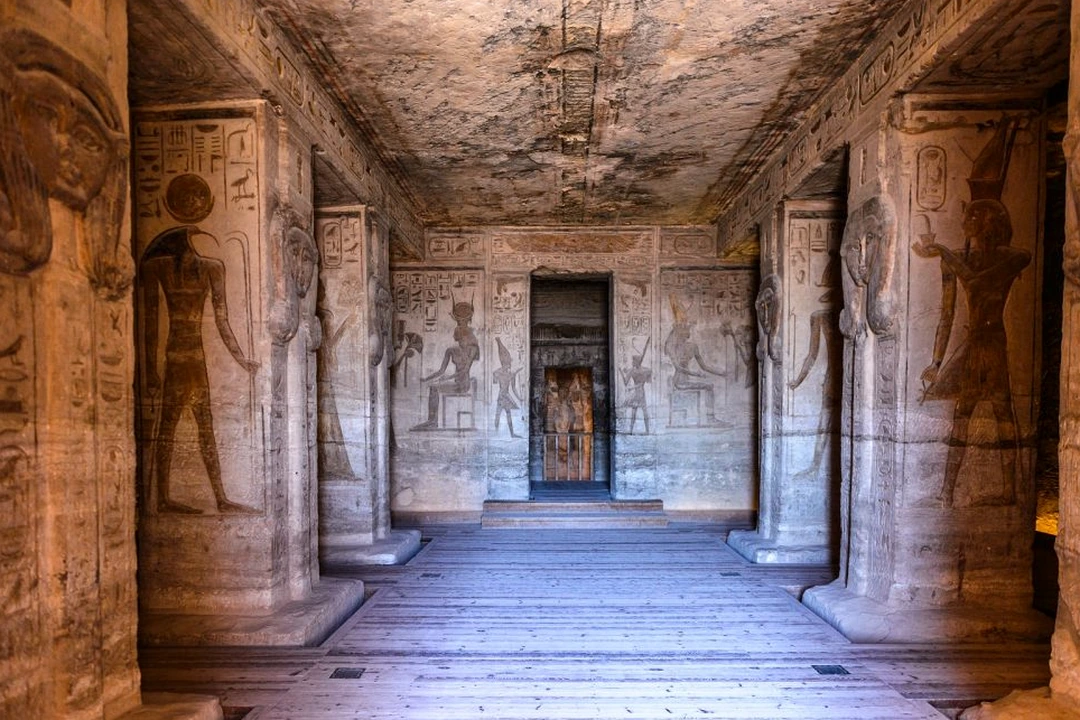
The most distinctive wonder at Abu Simbel is the transcendental combination of underground architecture and the operational laws of celestial bodies. The central axis of the great temple is precisely aligned with the azimuth of the rising sun, creating a spectacular optical phenomenon that occurs only twice a year, precisely on February 22nd and October 22nd. During these two magical moments, when the sun just rises from the eastern desert shore, pristine morning light rays shine directly through the narrow entrance, spanning the entire length of the antechamber and vestibule, to brightly illuminate the innermost sanctuary located deep at the base of the mountain. This cosmic light beam bathes radiance upon three divine statues seated on stone pedestals: the sun god Ra-Horakhty, Pharaoh Ramesses II himself divinized, and the supreme god Amun-Ra of Thebes; only the fourth statue—the god Ptah, lord of the underworld and eternal darkness—remains permanently seated in the gloomy shadow of the sanctuary.
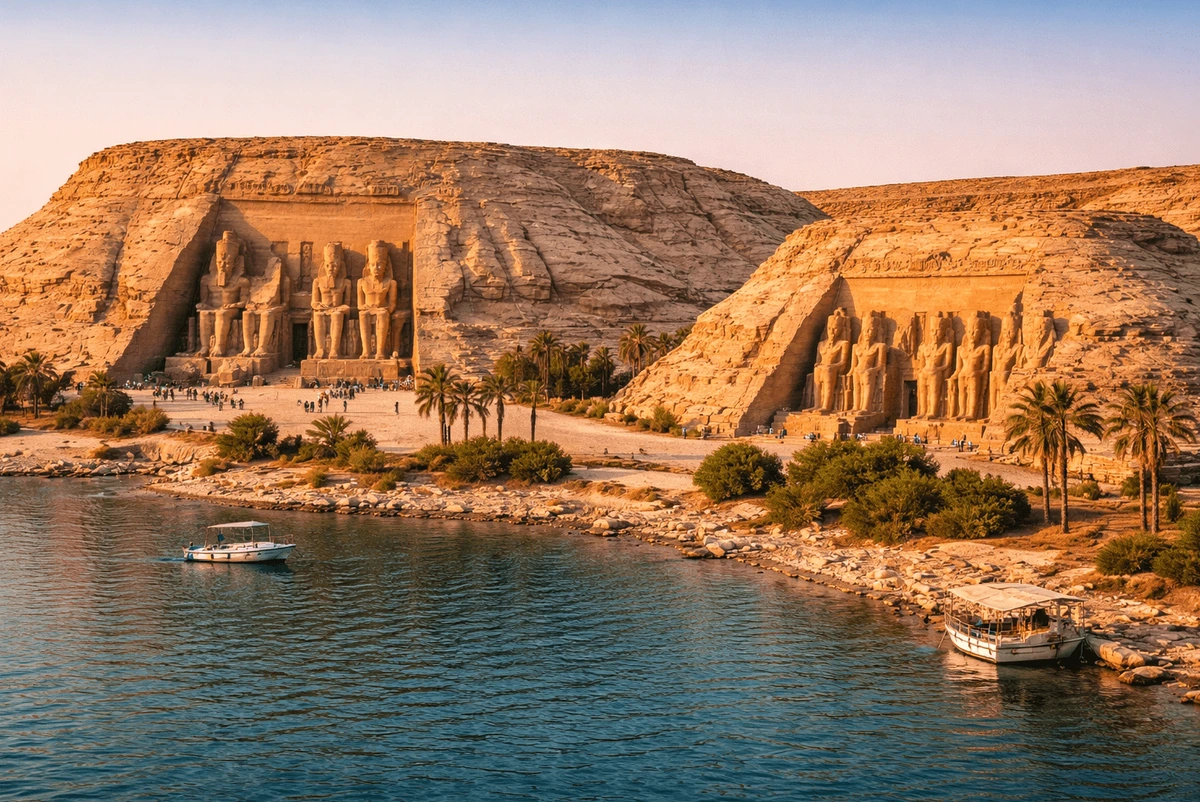
The natural landscape surrounding Abu Simbel is a magnificent blend of the vibrant gold of Nubian sandstone and the azure blue of the vast Lake Nasser waters adjacent to the Sahara desert. About one hundred meters north of the king’s great temple is the small mountain of Ibchek, impressively present beside a second, smaller temple dedicated to his most cherished wife—Queen Nefertari—combined with the worship of the goddess of love and beauty, Hathor. The master plan of these two temple clusters establishes an absolute balance between stern royal authority and the soft, elegant beauty of divinity, permanently engraving the imprint of a brilliant civilization along the banks of waters that have nourished a parched African land for millennia.
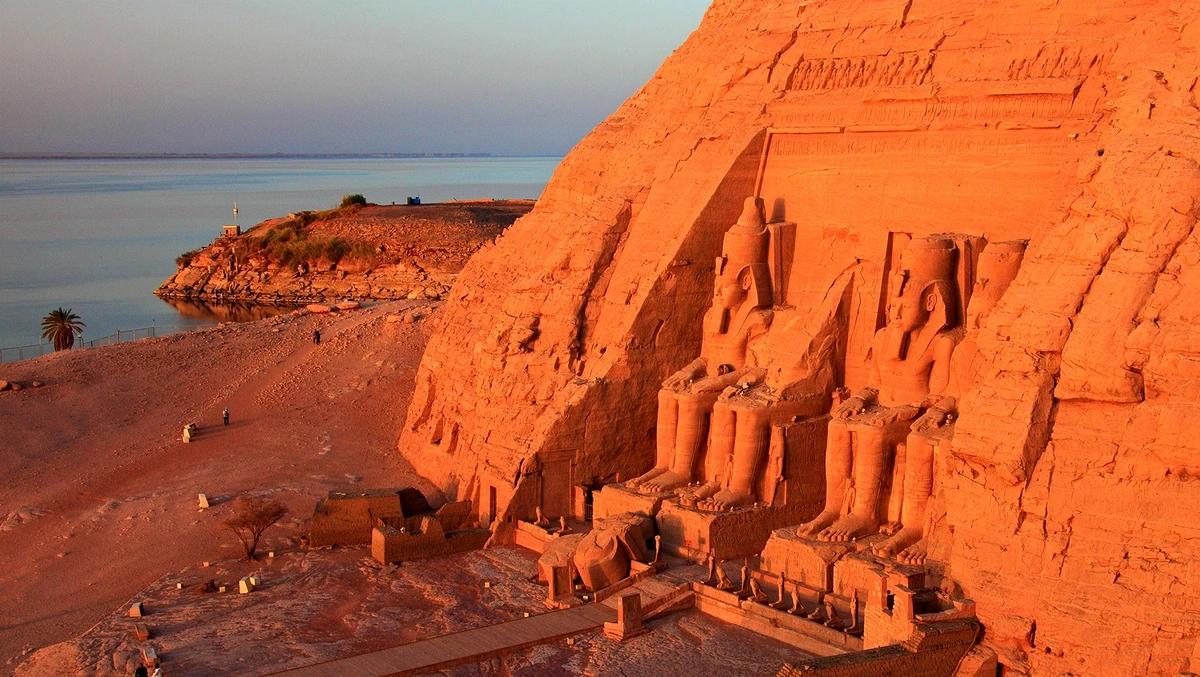
Worshipping at Abu Simbel is witnessing the absolute peak of “speos” architecture—the archaeological term originating from Greek to designate temples entirely chiseled and carved hollow into the core of monolithic sandstone cliff walls. Under the hands of master engineers and sculptors of the New Kingdom period, the brownish-red mountain ridge along the legendary Nile River was transformed into a monument of superhuman power belonging to the Nineteenth Dynasty. The facade of the Great Temple of King Ramesses II is a magnificent structure up to 33 meters high and 38 meters wide, guarded by four colossal statues of the Pharaoh seated on thrones approximately 20 meters tall. Each statue depicts the great king wearing the double crown Nemes symbolizing the unification of the Upper and Lower Egypt dual lands, with a majestic demeanor, eyes fixed eternally for millennia toward the eastern horizon to welcome the reborn sun each morning.
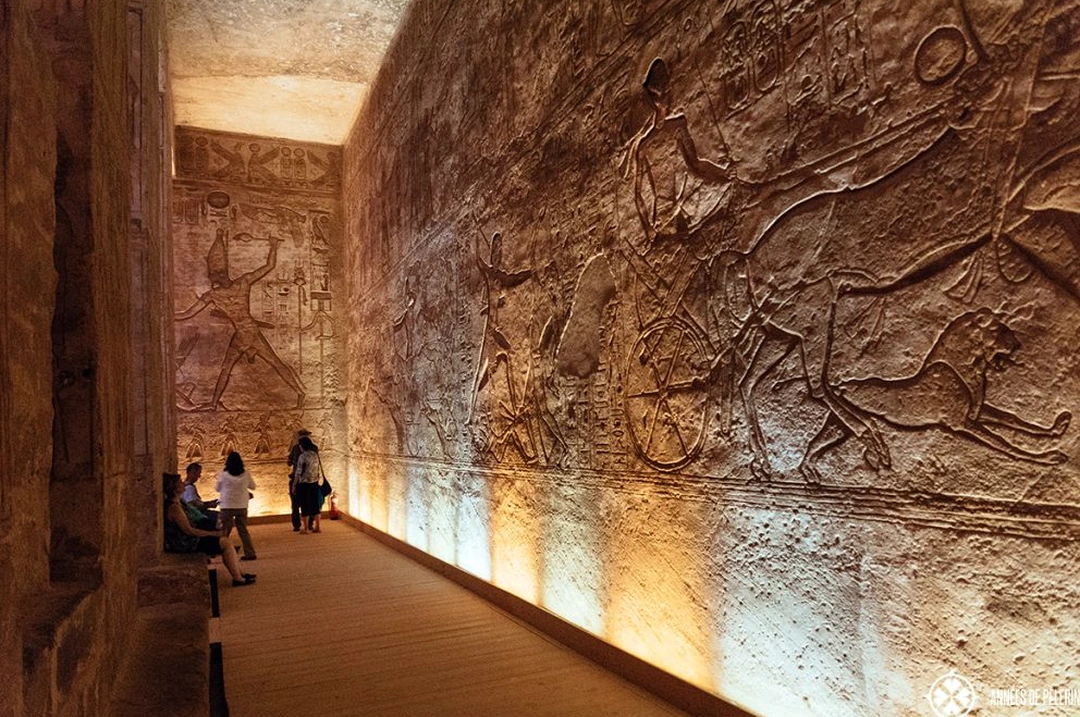
Advancing deep through the monolithic stone doorway, the interior space unfolds along a solemn linear axis penetrating over 60 meters into the mountain’s heart. The first room is the Hypostyle Hall supported by eight massive pillars portraying Pharaoh Ramesses II incarnated as the god Osiris, lord of eternity. The surrounding sandstone walls are completely covered with the finest carved reliefs in ancient Egyptian history, notably the epic scene recreating the illustrious Battle of Kadesh along the banks of the Orontes River, where the king alone maneuvered his chariot to confront the fierce Hittite army. Passing through subsidiary antechambers and sacred offering rooms, the spatial axis terminates at the innermost Sanctuary. Here, four divine statues rest peacefully on ancient stone pedestals including Amun-Ra of Thebes, the light-protecting god Ra-Horakhty, the deified King Ramesses II, and Ptah, the god of the underworld—a statue that remains permanently shrouded in eternal darkness even when optical light illuminates the sanctuary.
About a hundred meters northeast of the Great Temple stands the Small Temple, a work of more delicate and graceful aesthetic beauty, commissioned by King Ramesses II as a dedication to his beloved wife, Queen Nefertari, and the Goddess of Love, Hathor. The facade of this temple is a startling exception to all ancient pharaonic artistic canons: six standing statues over 10 meters tall at the entrance are evenly distributed, wherein Queen Nefertari’s statues are sculpted with dimensions precisely equal to those of Ramesses II himself. This is a unique privilege in the history of Egyptian royal sculpture, because according to traditional conventions, images of spouses or princesses were only depicted humbly as tiny reliefs near the feet or never exceeding the king’s knees. Inside the temple, the central hall is decorated with columns bearing the head of the goddess Hathor with characteristic cow ears, reflecting the grace and sacred religious power of the queen.
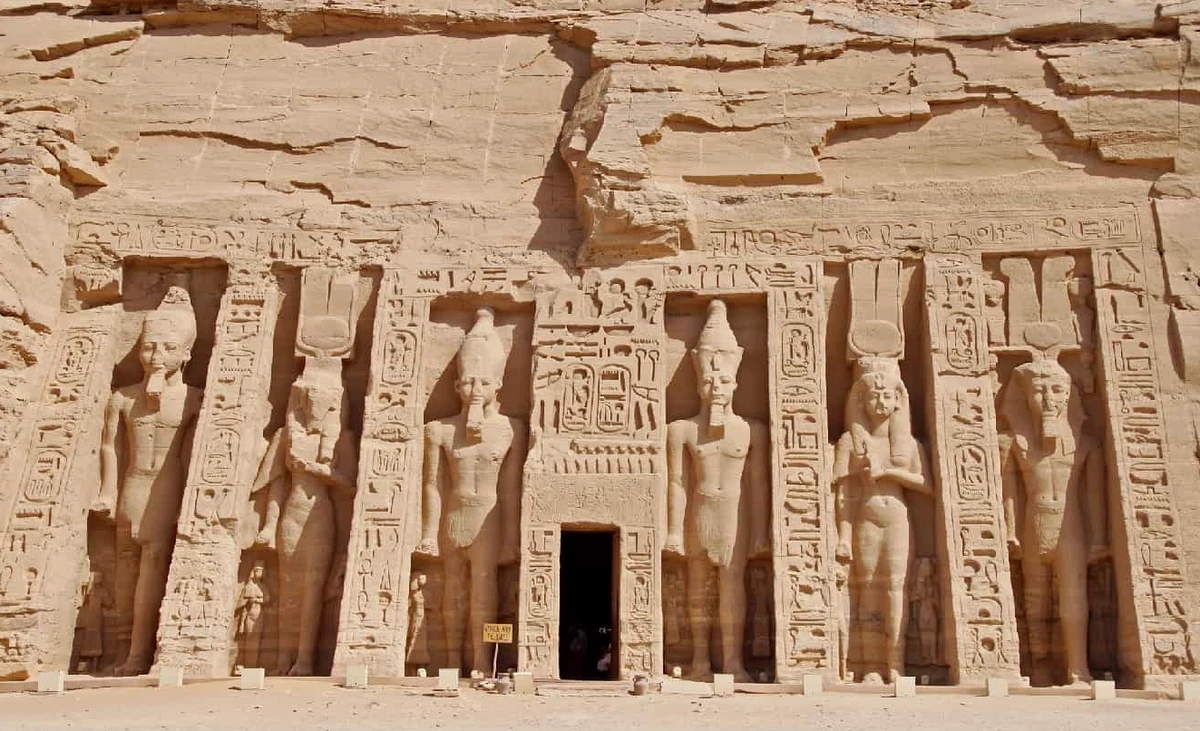
The grand stature of the Abu Simbel complex does not stop at antiquity but is reaffirmed through an extraordinary engineering feat of the twentieth century. As Egypt proceeded with the construction of the Aswan High Dam, the colossal rising waters of Lake Nasser threatened to permanently submerge the two millennial temples to the deep waterbed. Between 1964 and 1968, a large-scale multinational archaeological rescue campaign unprecedented under UNESCO patronage was activated with a massive budget equivalent to hundreds of millions of USD at modern values. The entire cliff and interior of the two temples were precisely cut by experts into over a thousand monolithic sandstone blocks, each weighing between 20 and 30 tons. These blocks were then craned and transported 200 meters further inland and elevated 65 meters higher than their original position, before being perfectly reassembled inside a massive artificial reinforced concrete dome, faithfully recreating the natural hill shape while absolutely preserving the miraculous astrological angle of the ancients.
When dusk casts its heavy shade across the vast mirror of Lake Nasser, the final rays of sunlight paint a layer of blood-red gold leaf over the four colossal seated statues of Pharaoh Ramesses II, and the pristine Nubia desert expanse begins entering another magical dimension. Amidst the nearly absolute silence of Egypt’s southern frontier, as darkness drapes a pitch-black velvet curtain over the sedimentary Meha rock cliff, the Abu Simbel sanctuary sheds its daytime static majesty to transform into a wondrous visual cathedral. The quiet space is broken by the sophisticated harmony of modern lighting technology, kicking off a live-action show recreating the golden past of the brilliant Nineteenth Dynasty.
The light and sound art show takes visitors traveling back through thousands of years of history via elaborate digital projection techniques onto the monolithic sandstone facade standing over thirty meters high. Beams of cold and fiery color spectrums sweep across the facial features of the great monarch in turn, bringing to life the epic tale of the legendary Battle of Kadesh between the Egyptian empire and the Hittites, alongside the earliest carved peace treaty in human history. Deep, resounding tones echo throughout the rock valley, combining with flexible shifting light streams to not only highlight every finely carved relief on the temple walls but also honor the profound love the Pharaoh held for the Great Royal Wife Nefertari, making the small temple dedicated to Goddess Hathor beside it glow with pristine beauty under the windswept desert sky.
Nightlife vitality at Abu Simbel reaches its emotional climax during the Sun Alignment Festival occasions, when the sacred moment bringing daylight straight into the deep holy rock is about to occur. Before that fateful night, the entire settlement area around the temples overflows with an enchanting indigenous Nubian cultural atmosphere. Beneath the glittering African starry dome, campfires are lit, illuminating the gentle smiles of proud Nile residents. The hypnotic rhythmic beating of traditional tar frame drums blends with the resonant tunes of classical oud lutes, guiding visitors into the endless whirl of the famous Aragid dance. Flowing white galabeya robes fluttering together with rhythmic footsteps matching ancient tempos create a strong community bond, erasing all boundaries between locals and distant travelers.
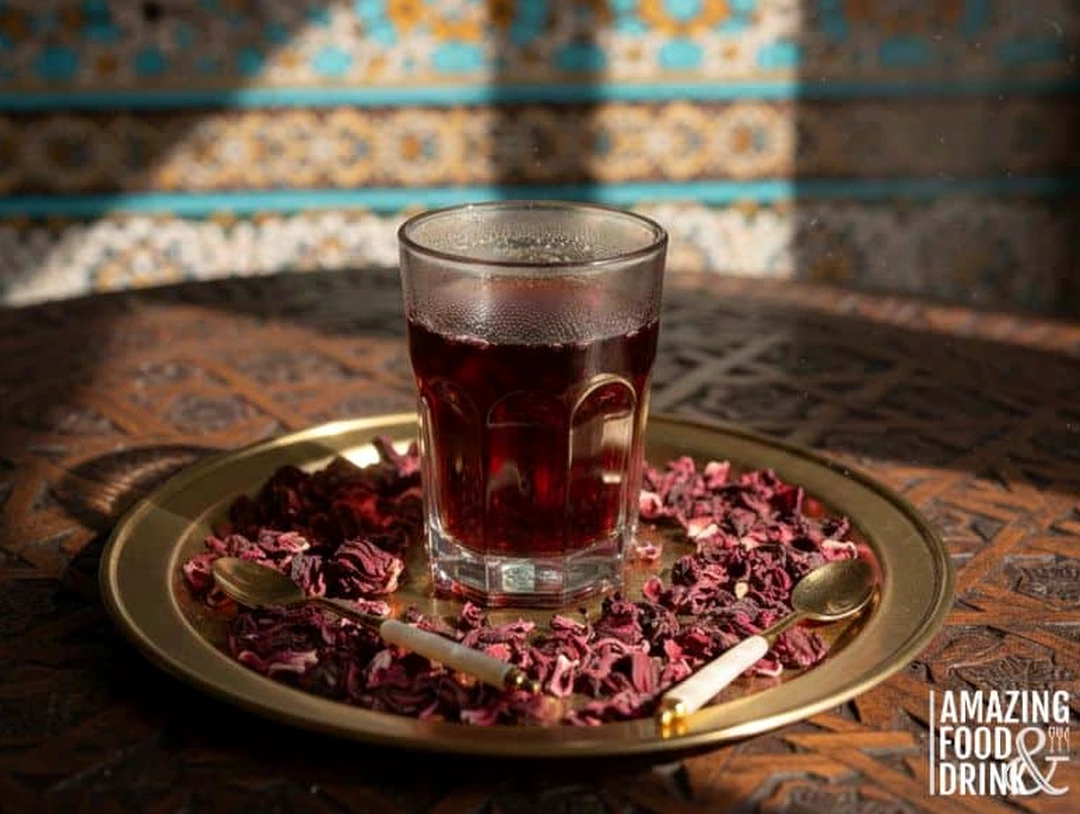
The night viewing space along the shores of Lake Nasser also settles into culinary flavors steeped in the sun-baked winds of the dark continent. In resting shelters built of reeds and terracotta in traditional Nubian domed architecture, people pass around glasses of deep red Karkadeh hibiscus tea infused with refreshing tartness, or piping hot black tea fragrant with wild mint and cardamom. The aroma of desert acacia charcoal-grilled herb-marinated lamb meat blends with the rich scent of freshly baked eish shamsi round bread, delivering an unforgettable authentic flavor experience. Amidst the dead of night, when the music quiets and the show lights fade, sitting back by the waterfront, gazing at the Milky Way stretching overhead across the four giant stone deities is an absolute meditative moment, where modern man can deeply feel the eternal breath of one of humanity’s most brilliant civilizations.
Leaving the majestic shade of the four stone cliff statues bearing the likeness of Pharaoh Ramesses II and Queen Nefertari’s Hathor Temple, travelers step into a quiet cultural buffer zone in the desert adjacent to the blue waters of Lake Nasser. This southernmost land preserves not only the architectural heritage of the Nineteenth Dynasty but also shelters an ancient Nubian cuisine, where culinary flavors are imbued with the survival philosophy and warm hospitality of the Nile tribes. Inside terracotta houses painted in bright blue wash nestled against sand slopes, the hearths of Nubian families never go out, maintaining heirloom recipes passed down through dozens of generations despite the changing geography and history of building the Aswan Dam.
The soul of the traditional local meal originates from the famous thin flatbread named Doka, an enduring symbol of the skilled hands of Nubian women. On a large, flat round iron griddle placed directly over a wood fire, liquid fermented sorghum or wheat batter is smoothly spread in a flash using a palm ladle. The thin bread, crispy at the edges yet chewy in the center, evokes a smoky aroma and serves as the perfect vehicle to dip into Wika—a thickened dried okra soup deeply characteristic of Upper Egypt cuisine. Bamia okra pods, after being thoroughly dried under the scorching desert sun, are pounded into powder and slow-cooked in lamb broth with generous fried garlic, parsley, and Egyptian cumin, creating a smooth dark green texture with an elegant savory richness and herbal aroma lingering on the palate.

During sacred festivals or when hosting distinguished guests visiting the Abu Simbel tombs, the tables of local residents cannot lack the majestic presence of Nubian Fatta. Unlike the Cairo lowland version of Fatta which leans toward pungent tomato sauce, Fatta in the Nubian borderlands highlights the refinement of rich bone broth blended with layers of crispy baked Doka bread pieces arranged at the bottom of a terracotta pot. The top layer is covered with a bed of glossy long-grain white rice, drenched in an alluring fragrant garlic vinegar sauce, before tenderly stewed lamb or beef chunks are solemnly placed on top. Each spoonful of Fatta is a synthesis of crispy texture soaking up authentic savory sweetness, carrying the breath of grand banquets welcoming ancient pilgrim fleets.
Concluding the culinary experience by the vast waters is the ritual of enjoying beverages imbued with Nubian hospitality customs, beginning with glasses of Karkadeh tea as deep red as desert hibiscus petals. This refreshing beverage, brewed from dried hibiscus calyxes steeped with Kom Ombo sugar cane, delivers a pleasant tartness that immediately dispels the suffocating heat of a foreign desert noon. After the meal, locals often gather in the shade of palm-frond thatched eaves to perform the Gabana coffee-brewing ritual. Green coffee beans are roasted on the spot over glowing coals in a small pan, ground in a stone mortar with green cardamom pods and warm fresh ginger, and boiled in a traditional jebena long-necked clay pot. The thick, slightly spicy, steaming coffee poured into handleless earthenware cups not only stimulates the olfactory senses but serves as a blessing of peace, connecting distant travelers with the timeless free souls of the stone-carved land.
The journey to approach the Abu Simbel rock wonder in Egypt’s southern frontier begins the moment the archaeological site’s gates open to welcome the first desert winds at 06:00 AM and close as dusk falls over the waters of Lake Nasser at 17:00 PM daily. To step into the sacred space preserving the glory of the Nineteenth Dynasty, travelers need to prepare entry tickets in advance through the official electronic portal of the Egyptian Ministry of Tourism and Antiquities or buy them directly at the ticket counter right in front of the complex entrance. A crucial point to note is that the ticket office system here has completely transitioned to cashless payment, requiring visitors to have a valid credit card or international payment card ready for smooth transactions, avoiding journey disruptions amidst the wilderness.
The path leading to the sacred land of Pharaoh Ramesses II and Queen Nefertari now opens up two contrasting transportation options. The fastest and smoothest route is domestic flights departing from the capital Cairo, transiting in Aswan and landing at Abu Simbel airport just about five kilometers from the temple cluster. Meanwhile, the nearly three-hundred-kilometer road route skirting the Western Desert edge from downtown Aswan is a spectacular epic for adventure lovers. Tour vehicles usually depart between three and four in the morning, speeding through the silent darkness of Nubia to arrive at the base of the cliff precisely at sunrise. The three-hour journey across a flat highway allows travelers to witness desert mirages and watch the blazing red sun rise from the vast desert horizon.
When stepping past the doorway carved into the millennial sandstone block, preserving ancient heritage becomes an honorable code of conduct for every visitor. The entire system of reliefs depicting the heroic Kadesh Campaign and natural mineral layers of ochre, sulfur, and copper blue crafted meticulously during the reign of Ramesses II are extremely sensitive to artificial light. Therefore, regulations strictly prohibiting camera flash use or phone auxiliary lights are rigorously monitored by local antiquities inspectors. Although the ancient mountain rock interior boasts good thermal insulation, the outdoor area is deeply affected by the harsh desert climate. Visitors should prioritize clothing woven from cotton or rustic, lightweight linen fibers, which are both modestly dignified and optimally absorbent, accompanied by wide-brimmed hats and specialized sunglasses.
This land not only harbors the memories of monarchs but is also the cradle nurturing a warm and proud Nubian culture. After the temple pilgrimage journey, stopping by small oasis cafes to enjoy a refreshing glass of deep red Karkadeh tea brewed from desert hibiscus calyxes, or tasting local clay pot grilled fresh fish rich in indigenous flavors will be an unforgettable sensory experience. When wishing to capture portraits of locals with bright eyes and gentle smiles, a nod, bow, and polite permission in native Arabic are always the master keys unlocking sincere connections. To fully grasp the cultural depth and enjoy attentive care across every travel route in the African frontier, partnering with an all-inclusive ancient Egypt tour package will be the perfect choice, helping travelers rest assured as they immerse themselves completely in the millennial legend of the land of pharaohs.