In the final years of the nineteenth century, when the Australian continent was still under the protection of the British Empire and standing on the threshold of historic federation, the dense subtropical forests of the Dandenong Ranges remained a wild, rugged realm almost entirely detached from the rising prosperity of Melbourne. Amidst the backdrop of early pioneers laboriously clearing the land and hauling timber, temperate fruits, and farm produce along muddy tracks, the vision of a transport artery cutting through the mist-shrouded mountains began to take shape. To conquer the steep terrain and dramatic curves without blowing through a contemporary budget that could not afford large-scale tunneling or mountain excavation, Chief Engineer Maurice E. Kernot proposed a groundbreaking solution: constructing an experimental narrow-gauge railway measuring just two feet six inches, or 762 millimeters, wide. This ingenious design not only minimized civil engineering costs but also allowed the train to wind gracefully along the undulating contours of deep, shadowy gorges.
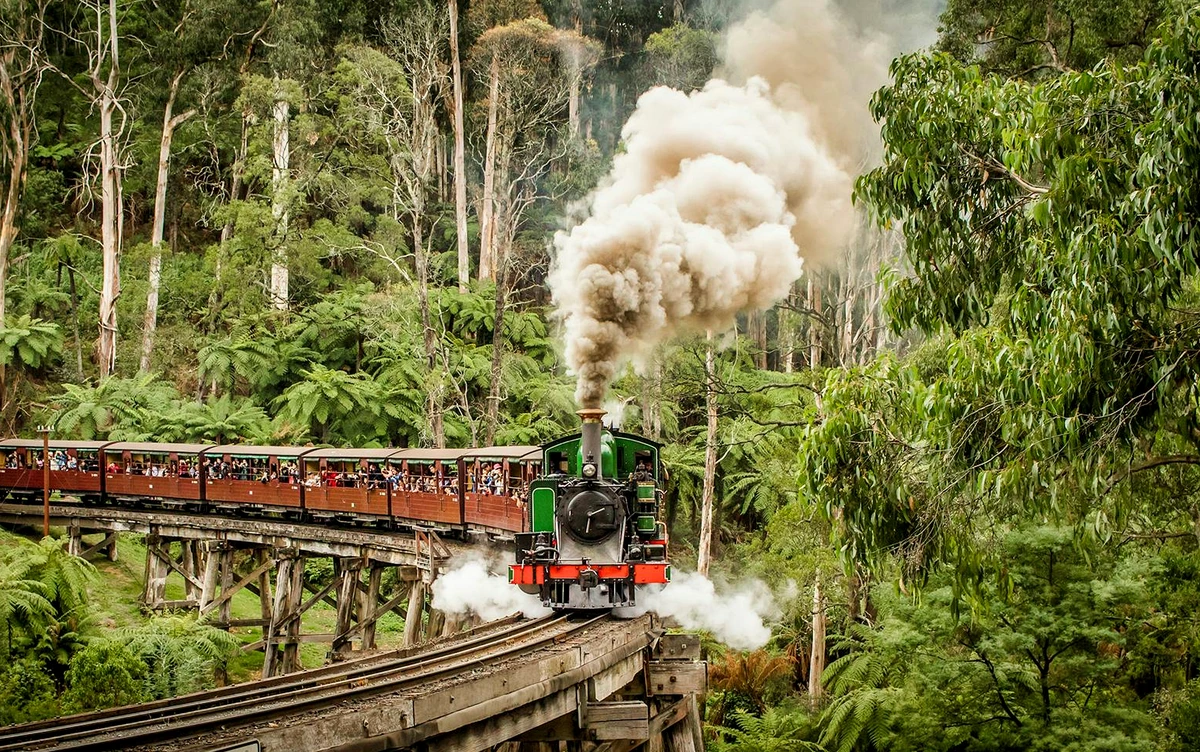
Following months of grueling construction powered by manual labor and rudimentary explosives, December 18, 1900, entered the annals of Victoria’s transport history when the narrow-gauge line connecting Upper Ferntree Gully Station to the township of Gembrook officially opened to the jubilant cheers of the local community. This steel artery spanning over thirty kilometers ushered in a new golden era, transforming an isolated valley into a thriving breadbasket supplying timber and agricultural goods to the surrounding region. The true soul of the railway in those early days was its fleet of classic NA-class steam locomotives, led prominently by engine 6A—intricately crafted from cast steel and brass at the renowned Newport Workshops. The rhythmic, chugging puffs of exhaust steam, reminiscent of a gentle giant breathing heavily as it climbed the steep grades, inspired the affectionate nickname “Puffing Billy”—a humble moniker brimming with the deep devotion felt by generations of locals for this storybook steam train.
Yet the shifting tides of fortune were never entirely smooth for this mountain railway. Entering the mid-twentieth century, the rapid rise of road networks and private motor vehicles gradually pushed narrow-gauge rail into decline, causing freight and passenger revenues to plummet. True tragedy struck on a fateful day in 1953, when a massive landslide along a treacherous section between Selby and Menzies Creek buried dozens of meters of steel track beneath a tangle of mud and boulders. Prohibitive repair costs compounded by post-war economic pressures forced the Victorian government to officially close the line, leaving the steam locomotives to gather dust to the immense sorrow of those whose hearts were woven into the fabric of the Dandenongs.
Nevertheless, an undying love for heritage among the local community sparked one of the most remarkable revivals in world railway history. Refusing to let a cultural icon fade into scrap and ruin, a group of retired engineers, mechanics, and passionate residents banded together in 1955 to form the Puffing Billy Preservation Society (PBPS). Dedicating tens of thousands of hours of tireless volunteer labor, they dug through the landslide debris by hand, replaced rotting sleepers one by one, and meticulously restored every rusted mechanical component. Under the firm legal backing and management of the Emerald Tourist Railway Board ever since, consecutive sections of track from Belgrave through Menzies Creek and Emerald all the way to Gembrook were progressively reopened. Once again, fires roared inside Puffing Billy’s fireboxes, sending billows of white steam drifting into the ancient fern canopy and cementing this time machine as an invaluable tangible and intangible cultural treasure of Australia across more than a century of triumphs and trials.
Located roughly forty kilometers east of Melbourne’s urban core, the Dandenong Ranges rise like a pure, blue-green rampart framing the fertile Yarra Valley. The geomorphology here is characteristic of ancient alluvial hills blanketed in rich basalt soil and carved by deep ravines that sustain a year-round humid microclimate. Laying a railway across such rugged, steep terrain with sharp switchbacks hugging the mountainsides reflected an engineering philosophy grounded in absolute respect for the natural topography. Rather than leveling hills or brutally carving into geological strata, the route was precisely plotted along natural contour lines, nestling into the folds of the valleys to forge a seamless harmony between early modern mechanical engineering and primeval wilderness.
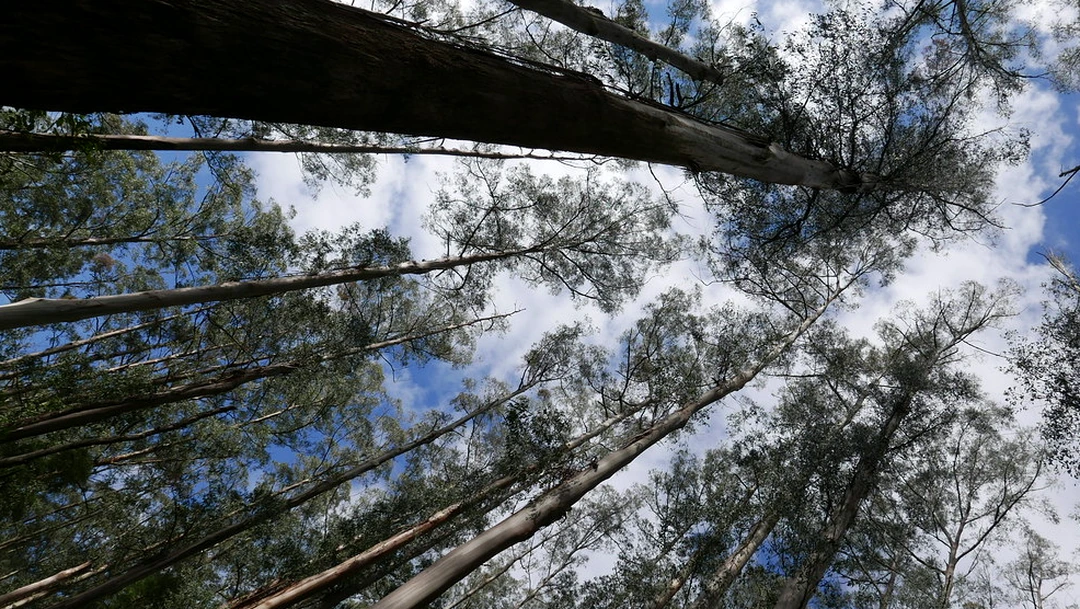
Dominating this majestic landscape is a sprawling temperate rainforest, whose undisputed monarch is the giant Mountain Ash eucalyptus (Eucalyptus regnans). Celebrated as the tallest flowering plant on Earth, its arrow-straight trunks soar to heights of nearly one hundred meters, forming an overarching canopy that shelters an extraordinarily rich understory ecosystem. Beneath the drifting mountain mist and dappled shade of the eucalypts, vast groves of ancient tree ferns unfurl velvety fronds alongside wild forest orchids and clinging native vines. The scenery shifts magically with every plume of white steam expelled from the locomotive’s chimney: warm vapor billows and weaves past silvery-white tree trunks, catching diagonal shafts of sunlight filtering down into the damp valley and evoking the surreal sensation of journeying back to prehistoric times.
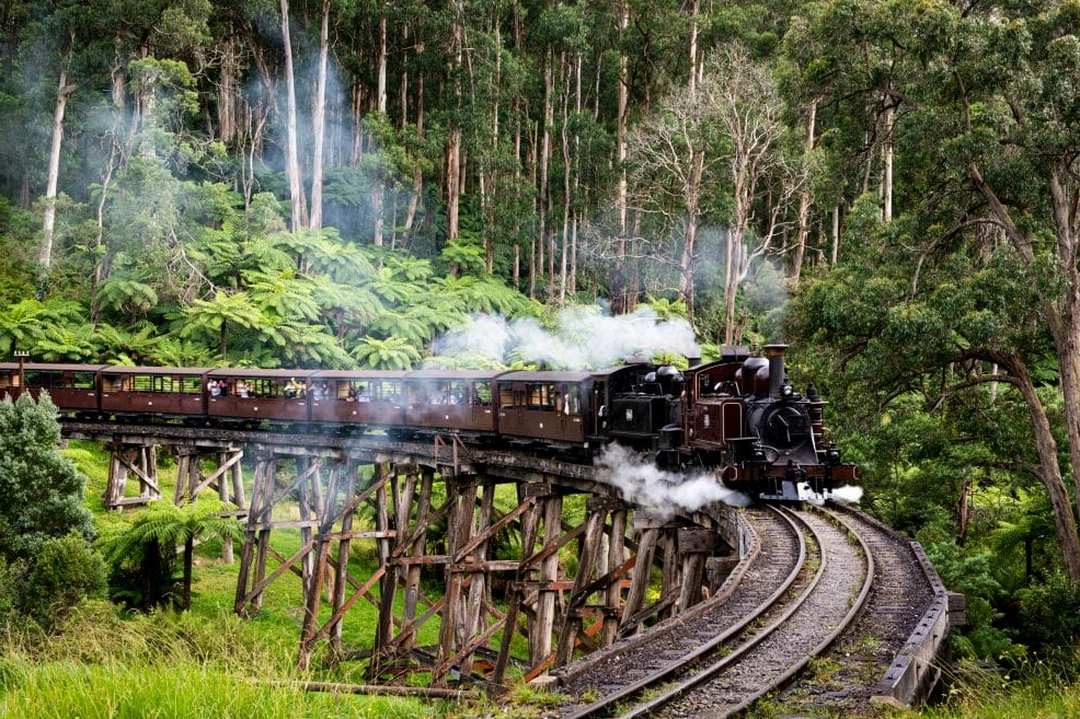
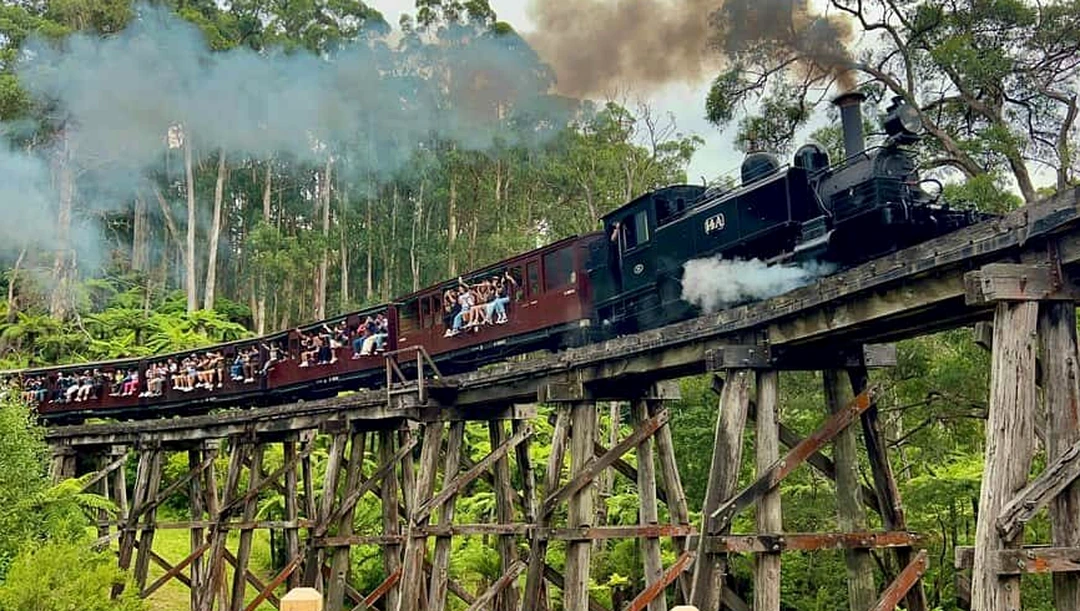
To navigate treacherous gorges and rushing forest streams, the 762-millimeter narrow-gauge track engineering was utilized to maximize the train’s cornering grip and hill-climbing capability. The pinnacle of civil engineering along the route is encapsulated in the Monbulk Creek Trestle Bridge, a masterpiece of curved native timber construction spanning a deep gully. Its multi-tiered supporting framework, crafted entirely from remarkably strong local hardwoods, effortlessly bears the multi-ton weight of the steam locomotive and open-sided wooden carriages while standing as an organic architectural icon in total harmony with the dense creek bed below. As the train glides smoothly around the bridge’s sweeping curve, passengers can take in sweeping views down into the fern-filled ravine, vividly experiencing the union of human craftsmanship and natural terrain.
Despite its idyllic beauty, the sclerophyll forest ecology of the Dandenong Ranges is acutely vulnerable to bushfires. The biological makeup of Mountain Ash trees contains high concentrations of volatile oils, which—combined with thick accumulations of shed bark, leaves, and dry twigs—turns the forest floor into a highly combustible environment during hot, dry weather. Consequently, the technical operation of the steam train adheres strictly to top-tier fire prevention and ecological conservation protocols. Every locomotive is fitted with specialized spark-arresting screens to prevent hot embers from escaping into the air. Alongside mobile patrol crews stationed along the tracks to monitor dry grass temperatures, safety procedures place respect for nature above all else: on extreme weather days when local fire authorities declare a Total Fire Ban, traditional steam services are immediately suspended or replaced by auxiliary diesel locomotives to safeguard the green lungs of the mountain range.
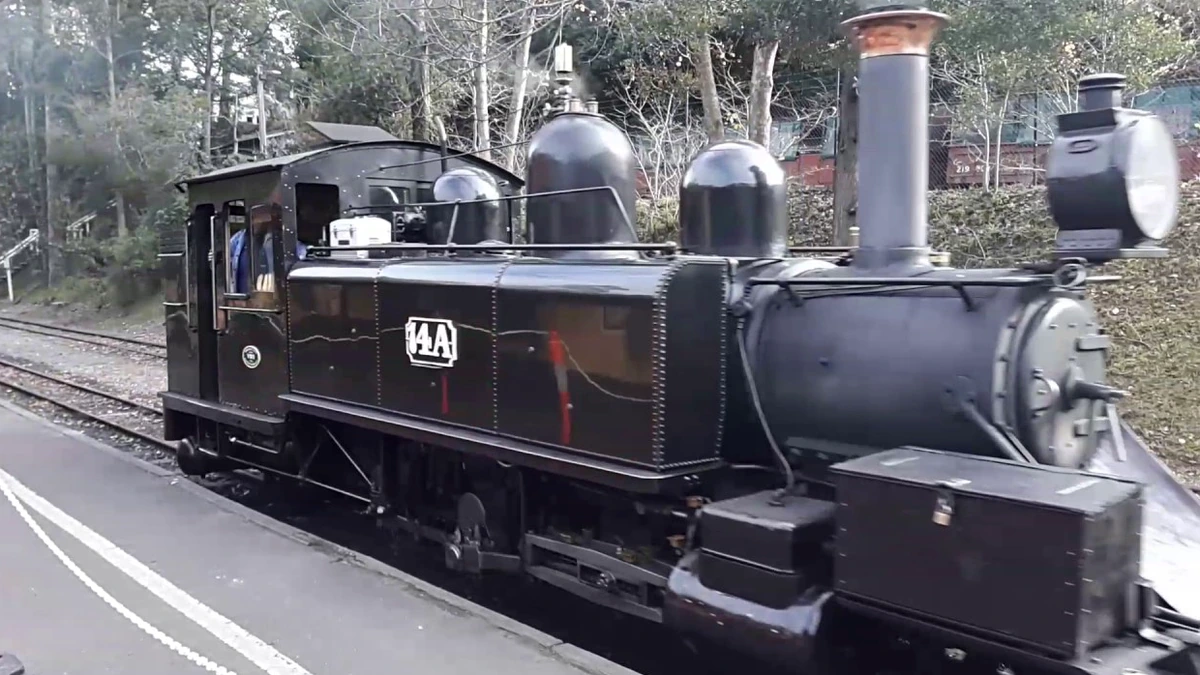
Set amidst the rocky escarpments and dense valleys of the Dandenong Ranges, the operational triumph of the Puffing Billy steam railway was first shaped by the master mechanical minds of the late nineteenth century. At the heart of this 762-millimeter (two-foot six-inch) narrow-gauge line is the legendary NA-class steam locomotive, a metalwork marvel originally built by the Baldwin Locomotive Works in Philadelphia, Pennsylvania, USA. To tame the steep mountain grades of up to 1-in-30 and tight hairpin bends, Baldwin engineers adopted a 2-6-2T wheel arrangement with highly flexible axle articulation. Its compact chassis packs tremendous tractive effort, paired with an original coal-fired, high-pressure boiler that enables the train to climb punishing inclines without wheel slip or pressure loss—transforming tens of tons of iron and steel into an agile creature gliding through the deep forest.
Hand in hand with locomotive engineering is the pre-industrial art of terrain-crossing civil construction. Winding across gentle hillsides, the series of timber trestle bridges—exemplified by the curved wooden bridge near Menzies Creek—stands as a living testament to Victorian-era timber architecture. Erected entirely from rock-hard native eucalyptus trunks, the multi-tiered lattice piers angled diagonally not only absorb the immense dynamic loads of an NA-class locomotive rounding a bend, but also provide remarkable resilience against localized earth tremors and groundwater erosion. Every hand-forged steel tie rod and deeply recessed mortise-and-tenon joint—constructed without complex modern bolting—reflects pragmatic surveying ingenuity elevated to high art, suspending the train dozens of meters above a sea of ancient ferns.
The true scale of the nearly twenty-five-kilometer heritage corridor running from Belgrave through Emerald Lake to the Gembrook terminus is equally evident in the craftsmanship of its passenger carriages. The signature open-sided carriages built from milled pine and cedar retain their windowless frames, allowing passengers to sit with their legs dangling over the edge beneath smooth wooden safety bars. Meanwhile, the interiors of the first-class carriages exude vintage aristocratic elegance, featuring diamond-tufted leather upholstery, gleaming polished brass handrails, and intricately carved wooden partitions. Every operational element—from mechanical steel lever point switches and cable-operated semaphore signals to cast-iron water columns—has been preserved to the exact specifications of archival blueprints dating back to 1900.
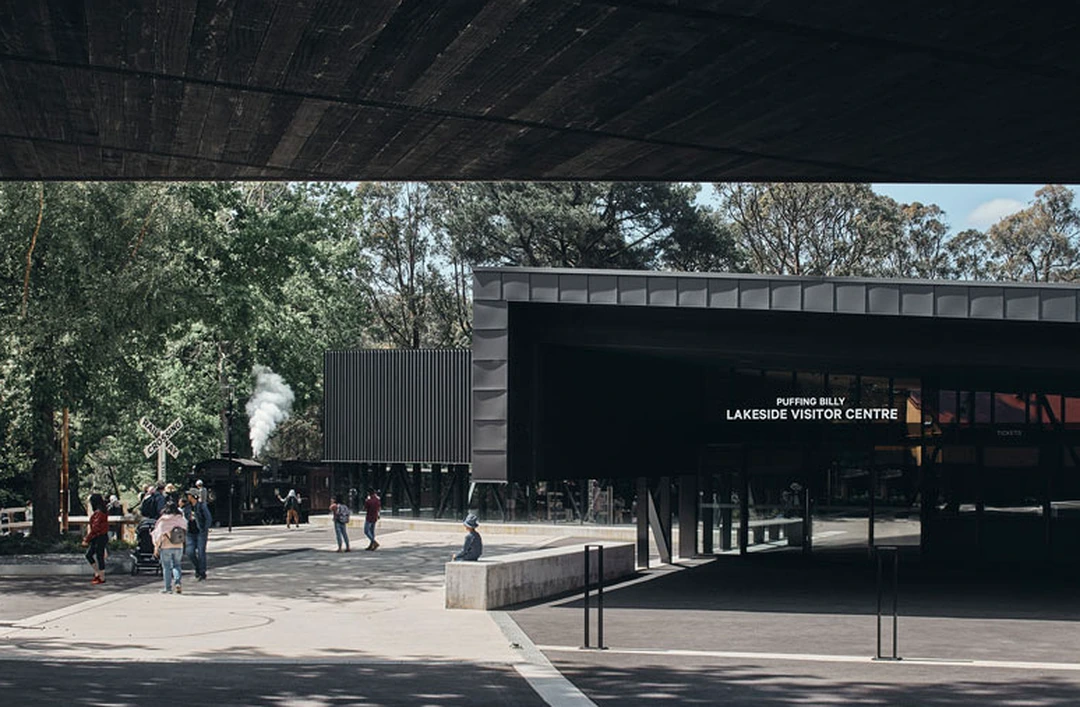
Notably, the continuity of architectural language across generations is vividly captured by the Lakeside Visitor Centre, standing impressively along the shores of Emerald Lake. Contrasting with the colonial nostalgia of gray corrugated-iron stations, this contemporary landmark is a symphony of sustainable materials and untamed nature. Its sweeping facade is clad in timber reclaimed from decommissioned railway sleepers, paired with expansive structural glass walls that mirror the towering Mountain Ash trees outside. A gently sloping canopy roofline mimics a plume of locomotive steam drifting skyward, creating an airy transitional space that both houses rare heritage locomotives on display and serves as a refined rest stop—affirming the thoughtful investment and enduring legacy of one of Australia’s oldest railway wonders.
As the amber glow of dusk fades behind the towering Mountain Ash forests of the Dandenong Ranges, the lively daytime bustle gives way to a living spectacle of shadow, steam, and visual artistry. The legendary 762-millimeter Puffing Billy narrow-gauge railway does not simply go to sleep; instead, it takes on the grand persona of a mesmerizing open-air mechanical theater. Nighttime experiences along this heritage corridor open up an entirely different sensory dimension, where warm-spectrum LED lighting—precisely calculated for optical angles—illuminates every sinewy contour of the late-19th-century NA-class steam locomotive. Soft golden light washes over riveted steel plates and catches thick billows of white steam surging from the funnel, transforming a multi-ton mass of metal into a living, breathing mechanical titan striding through the damp primeval forest.
The lighting design has been painstakingly choreographed by Victorian heritage engineers to celebrate the authentic structure of the steam train without intruding upon the wild darkness of the Monbulk Valley. Beams of light highlight core moving parts: gleaming pistons pumping in steady rhythm, steel driving wheels glowing from the fiery cracks of the coal firebox, and the historic Monbulk Creek Trestle Bridge spanning the gorge. As the train rolls slowly across this storied bridge, light spilling from the carriage sides illuminates century-old tree ferns below, creating a breathtaking contrast between heavy industrial mechanics and serene nature. More than merely lighting up a night train, this is a living visual restoration that revives the glorious memory of Victoria’s colonial railway era, when glowing coal fires stood as proud symbols of exploration and progress.
Moreover, nighttime aboard Puffing Billy offers a one-of-a-kind acoustic experience shaped by the basin topography and dense foliage of the native temperate rainforest. The shrill single-tone steam whistle pierces the thick mist, stretching out and echoing off moss-covered sandstone cliffs with a haunting resonance. As the locomotive vents high-pressure steam to conquer steep inclines, the natural sound-absorbing and amplifying qualities of the Mountain Ash forest turn raw mechanical noise into a wild open-air symphony. The steady clack of steel wheels on rails, the deep chug of pistons, and the rustle of leaves in the night breeze weave together a rich soundscape that draws passengers into a state of deep nostalgia, completely detached from the fast-paced digital world.
Inside solid-timber dining carriages meticulously restored from original 1900s to 1920s designs, an intimate and refined evening dining atmosphere unfolds. Beneath the soft golden glow of vintage lamps, guests savor premier regional cuisine showcasing Victoria’s finest agricultural bounty, including tender grilled Angus beef, artisanal cheeses, and celebrated Shiraz red wines aged in the neighboring Yarra Valley hills. Open carriage windows let in cool night breezes carrying the crisp scent of eucalyptus resin and rich coal smoke, completing the nostalgic immersion. Seated in the cozy carriage, swirling a glass of wine while watching illuminated plumes of steam drift past the dark forest canopy, every traveler feels transported back to a moving soirée of the past century’s aristocracy, where the journey itself is celebrated as a high art form.
A journey aboard the Puffing Billy steam train does more than awaken the eyes with endless expanses of deep green ferns; it also leads discerning travelers into a rich culinary adventure where indigenous terroir meets Victoria’s colonial dining heritage. From the very first years the narrow-gauge railway carved its path through the Dandenong Ranges, local food culture evolved around the abundant harvests of the temperate rainforest and adjacent fertile farmlands. The culinary tradition tied to these historic rails honors the authentic sustenance of southern Australian life while blending effortlessly with refined British afternoon tea customs—creating a gastronomic identity that is at once rustic and remarkably elegant.
The ultimate culinary emblem tied to nostalgic memories of steam train travel is the famous Railway Pie. Originating as the hearty, warming meal eaten by coal stokers and railway workers braving the chilly mountain slopes in the early twentieth century, this handmade savory pie has become an enduring piece of living heritage. Tucked beneath a golden, flaky puff-pastry crust fragrant with rich butter is a filling of coarsely minced Australian beef slow-simmered in a velvety, black-pepper-infused brown gravy, occasionally accented with native forest herbs evoking traditional bush tucker flavors. Holding a steaming hot pie amidst the cool, thin mountain mist of the Dandenongs and taking a bite bursting with savory meat juices connects travelers directly to the humble yet resilient spirit of the workers who laid every sleeper through the wilderness.
Complementing this hearty staple is the refined charm of traditional afternoon tea, headlined by freshly baked scones crafted from time-honored family recipes. The scones boast a light, tender crumb fragrant with pure butter and lightly crisp along the edges. Their crowning glory lies in the classic local accompaniments: a dollop of rich clotted cream hand-whipped from famed Yarra Valley dairy farms, paired with slow-cooked mulberry or wild blueberry jam harvested from the sprawling orchards ringing the foothills. As the pure sweetness of berry jam melts into velvety cream and warm pastry—followed by a sip of smoky, full-bodied black tea—the dining experience feels like stepping straight into a classic period film.
When the train pauses at Emerald Lake Station, the Lakeside Visitor Centre unveils a contemporary dining space dedicated wholly to farm-to-table philosophy. Here, the finest artisanal produce from both the Yarra Valley and Dandenong Ranges comes together under one roof. Discerning diners can sample platters of naturally aged cheeses from local family creameries—ranging from creamy goat cheese to sharp aged cheddar—served alongside dried figs and roasted mountain chestnuts. Notably, the beverage list proudly spotlights world-renowned cool-climate wines, including elegant Pinot Noir bursting with red berry notes and crisp, mineral-driven Chardonnay that faithfully captures the misty terroir of the surrounding valleys.
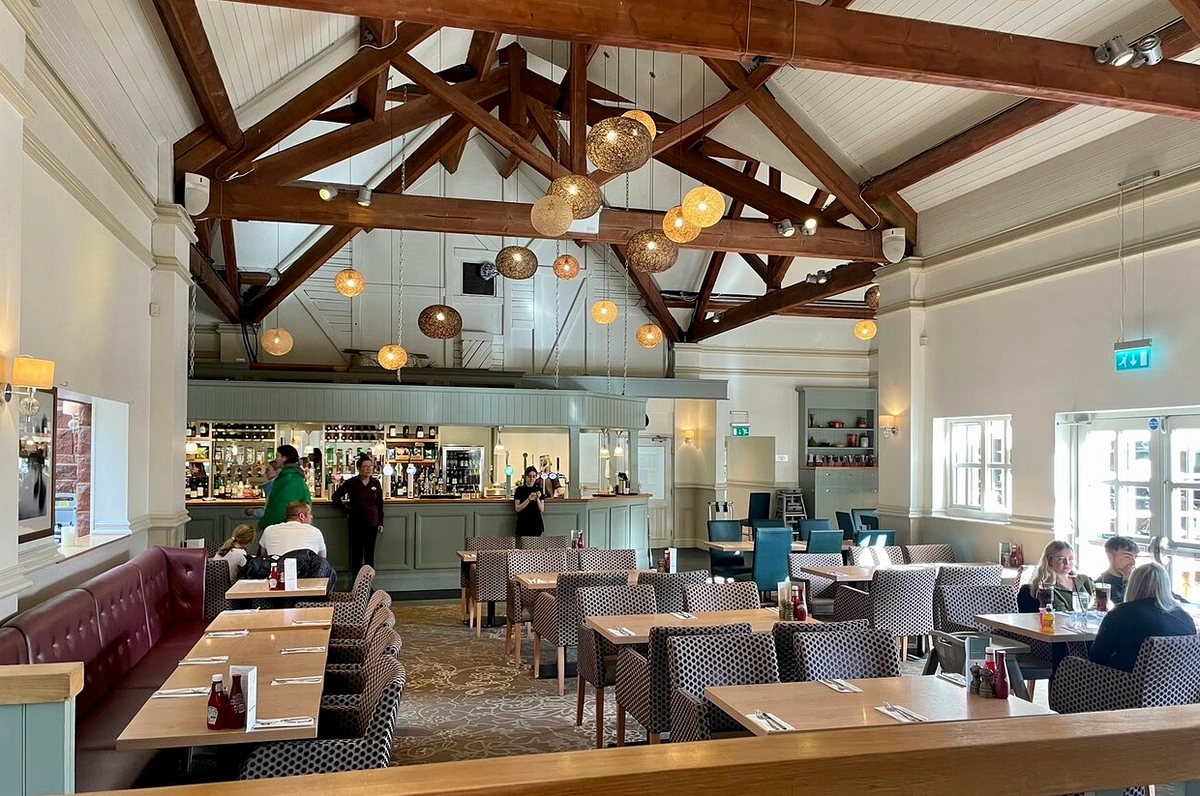
The pinnacle of indulgence along this heritage railway belongs to the premier Steam & Cuisine dining service, where enclosed, cedar-paneled heritage carriages are transformed into opulent rolling banquet halls evoking the glamour of the 1930s. Beneath warm golden lamps and the gentle clink of intricately engraved silverware, guests are treated to multi-course gourmet menus prepared with care against the rhythmic sway of the train. Few experiences rival swirling a glass of fine wine while savoring melt-in-your-mouth braised lamb or fresh seafood from Victoria’s coast as towering ancient trees and emerald farm valleys glide past polished wooden windows like an endless pastoral poem.
To step aboard this journey back in time on Puffing Billy’s legendary wooden carriages, travelers should familiarize themselves with the specific operating guidelines set by the Emerald Tourist Railway Board (ETRB). The Puffing Billy steam train runs daily year-round, closing only on Christmas Day when the entire Dandenong Valley settles into the quiet stillness of the festive season. The first train of the day typically sounds its whistle and departs Belgrave Station at 10:30 AM, sending plumes of white steam billowing into the primeval forest canopy. Because of its iconic global appeal and strict seating limits designed to preserve the historic carriages, management requires visitors to book tickets online well in advance, avoiding walk-up ticket attempts at the station counter during peak periods.
Getting from downtown Melbourne to the departure station is remarkably straightforward thanks to Victoria’s well-connected public transport network. Travelers simply board a Metro Trains service on the Belgrave Line from major central hubs such as Flinders Street Station or Southern Cross Station. After a roughly seventy-five-minute ride winding through leafy eastern suburbs, the modern commuter train arrives at the Belgrave terminus. From the suburban station platform, a winding paved walkway shaded by eucalyptus trees and a short pedestrian footbridge lead visitors straight into the 19th-century charm of the historic Puffing Billy Station, where the scent of burning coal and hissing steam signals that adventure is about to begin.
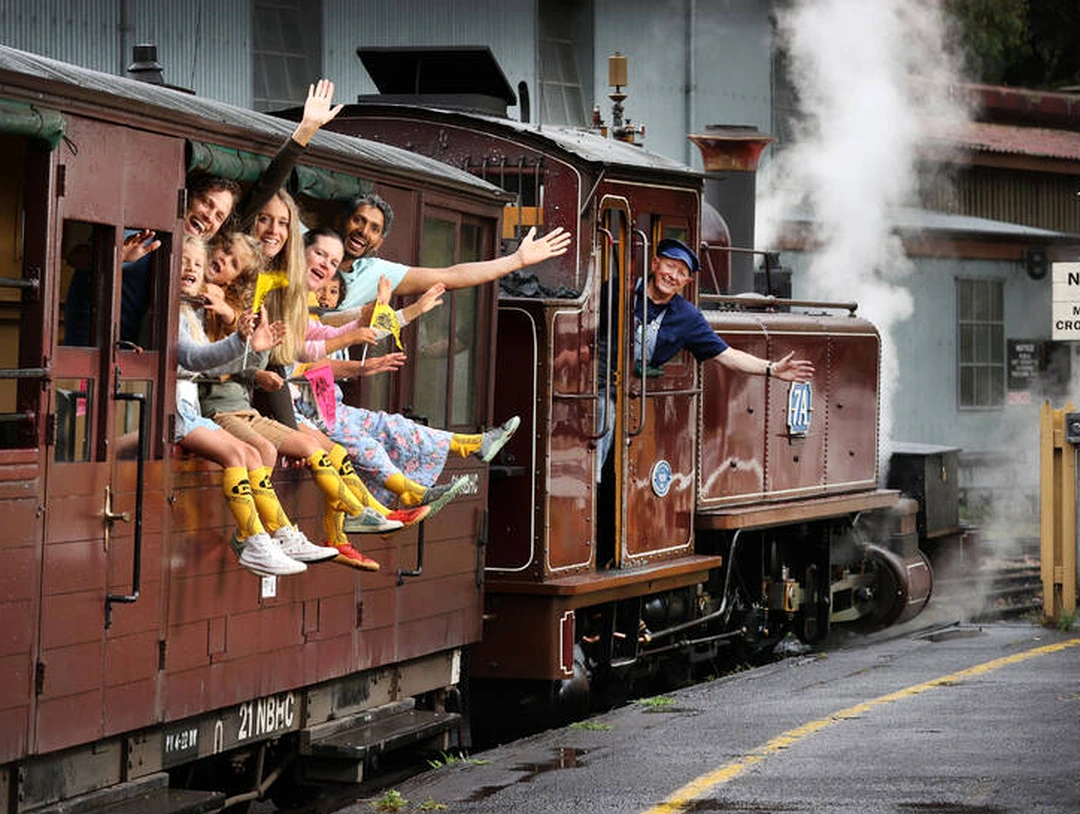
Depending on available time and curiosity, travelers can choose a thirteen-kilometer round-trip excursion between Belgrave and Lakeside, or ride the full twenty-five kilometers all the way to the lush farming township of Gembrook. Ticket prices vary according to route length, optional lunch packages aboard the classic Nissen dining car, and family pass tiers. To drink in the full majesty of Australia’s wilderness, the golden rule is to opt for the open-sided excursion carriages. Their open-air design lets cool mountain breezes scented with eucalyptus oil and damp pine sweep through your hair, erasing every barrier between passengers and the magnificent flora of the Dandenongs.
While riding in open carriages, passengers must strictly follow safety regulations aligned with Australian Occupational Health and Safety (OHS) standards. Although sitting on the wooden window sills with legs dangling freely in the open air across the Monbulk Trestle Bridge has long been an iconic tradition beloved by generations, this privilege is now carefully regulated under the supervision of experienced railway volunteers and permitted only on designated carriage sections and for eligible age groups. Additionally, the temperate rainforest microclimate of the Dandenong Ranges typically runs three to six degrees Celsius cooler than central Melbourne, often accompanied by sudden rain showers or dense valley mist. Dressing in warm layers paired with a scarf and windproof jacket is essential to ensuring a comfortable, unforgettable excursion.
Gliding through endless expanses of ancient green tree ferns aboard a century-old steam locomotive is far more than a simple sightseeing excursion—it is an intimate encounter with living heritage and unrivaled pre-industrial mechanical craftsmanship. To savor every magical moment of this journey without worrying about itinerary logistics or securing heritage train tickets, travelers can effortlessly opt for an all-inclusive Sydney – Melbourne Australia tour package and immerse themselves in the untamed beauty of the Land Down Under in complete comfort and ease.