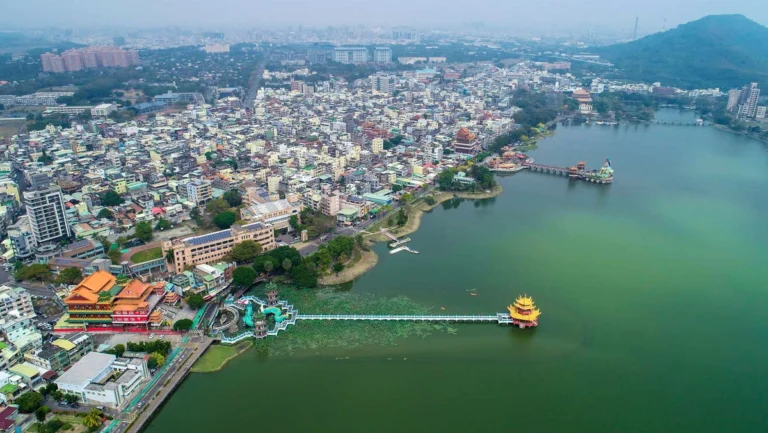
Nestled alongside the winding Gaoping River in Dashu District, on the northeastern edge of the port city of Kaohsiung, Fo Guang Shan Monastery stands tall as an enduring symbol of East Asian spiritual and cultural heritage. Tracing back to the years before curved temple roofs touched the clouds, this land was originally known as Tangli—a rugged, thorny stretch of wilderness belonging to the ancient Dashujiao region. Few could have imagined that this barren hillside would be destined to become a sacred sanctuary uniting millions of devotees from across the globe, opening one of the most magnificent chapters in modern Buddhist history.
The genesis of this monumental creation is inextricably linked to the life and boundless bodhisattva vows of Venerable Master Hsing Yun, an eminent Buddhist monk born in 1927 in Jiangdu, Jiangsu Province, China. Amidst the turmoil and political upheaval of the mid-twentieth century, the Master crossed the ocean to the island of Taiwan, carrying with him the seeds of Dharma revival. Rather than choosing a path of world-weary seclusion deep in remote mountains, he wholeheartedly championed the philosophy of “Humanistic Buddhism”—a visionary reform aimed at weaving the core values of compassion deeply into every breath of secular life, utilizing education, culture, charity, and self-cultivation to purify human consciousness.
The historic milestone that propelled Fo Guang Shan onto the world stage as a global Buddhist capital originated from an extraordinary Dharma affinity in 1998 in India. During a mission to transmit precepts in Bodh Gaya, the sacred site of Shakyamuni Buddha’s enlightenment, Venerable Master Hsing Yun met the renowned Tibetan Vajrayana master Kunga Dorje Rinpoche. This revered Lama had secretly safeguarded the priceless Buddha Tooth Relic for nearly thirty years, braving the treacherous passes of the snow-capped Himalayas to preserve the sacred treasure through turbulent eras of conflict. Recognizing Master Hsing Yun’s vast merit and global Dharma outreach, the Lama sincerely offered this sole remaining sacred relic, harboring a great vow to find a peaceful, solemn land where a stupa could be built to enshrine it as an eternal sanctuary for all humanity.
The enshrinement of the Buddha Tooth Relic was far more than a pure religious ceremony; it marked a historic transmission of the Dharma lineage from its ancient Indian cradle, across the majestic snow peaks of Tibet, to converge and flourish on the shores of Taiwan. To construct a monastic realm worthy of this millennia-old relic, the Fo Guang Shan Buddha Museum broke ground in 2003 right at the foot of the main Fo Guang Shan Monastery complex. After nearly nine years of dedicated construction under the southern sun and wind, the project reached completion and celebrated its grand inauguration on December 25, 2011, drawing tens of thousands of monastics, dignitaries, and scholars from around the world.
From the once-desolate hills of Tangli, a cultural and philosophical exchange center of global stature has risen in majesty. This complex not only vividly chronicles over twenty-five centuries of Buddhist history, but also stands as an epic testament to unwavering faith—a living monument to the timeless vision of Venerable Master Hsing Yun before his passing in 2023, leaving behind a monumental spiritual legacy that continues to radiate the light of compassion and wisdom.
Situated on gentle foothills bordering the Pingtung Plain, the Fo Guang Shan complex occupies a rare geomantic position among modern Buddhist monasteries in East Asia. The terrain here is shaped according to the classical feng shui principle of “mountains embracing and waters encircling,” embodying the auspicious configuration of backing onto mountains while facing water. Behind the complex, the rolling ridges of the Fo Guang Shan mountain range curve gracefully in layered tiers, cradling the buildings like the unfolding petals of a giant lotus supporting the sacred halls. In the foreground, the alluvial Gaoping River—historically known as the Xiadanshui River or Nine-Bend River during early settlement eras—sweeps abundantly through the valley, bringing rich water energy that gathers vitality and prosperity, establishing a rock-solid geomantic foundation for the flourishing of the order.
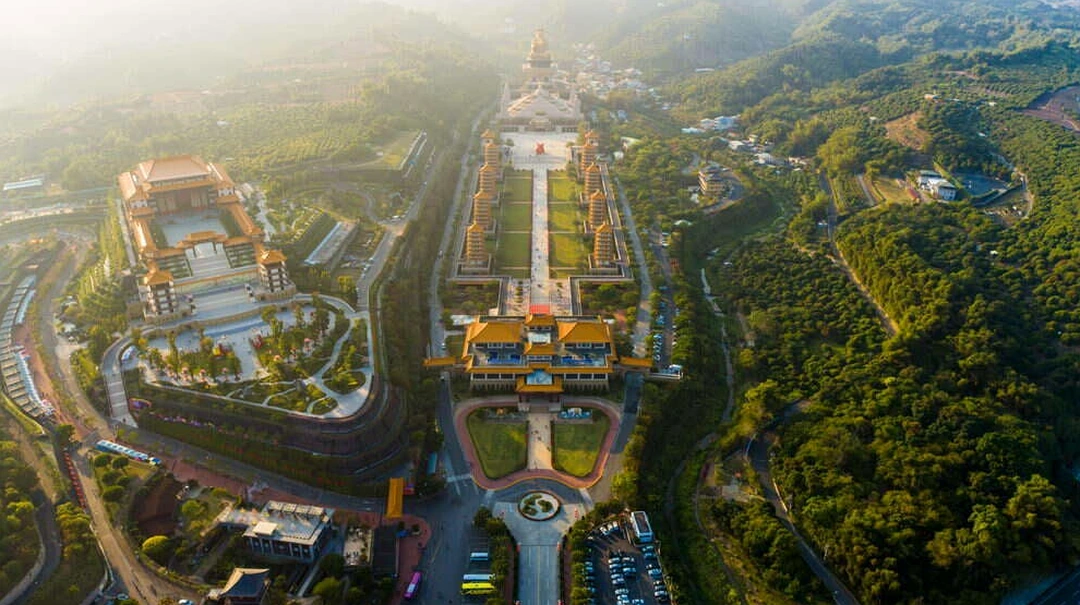
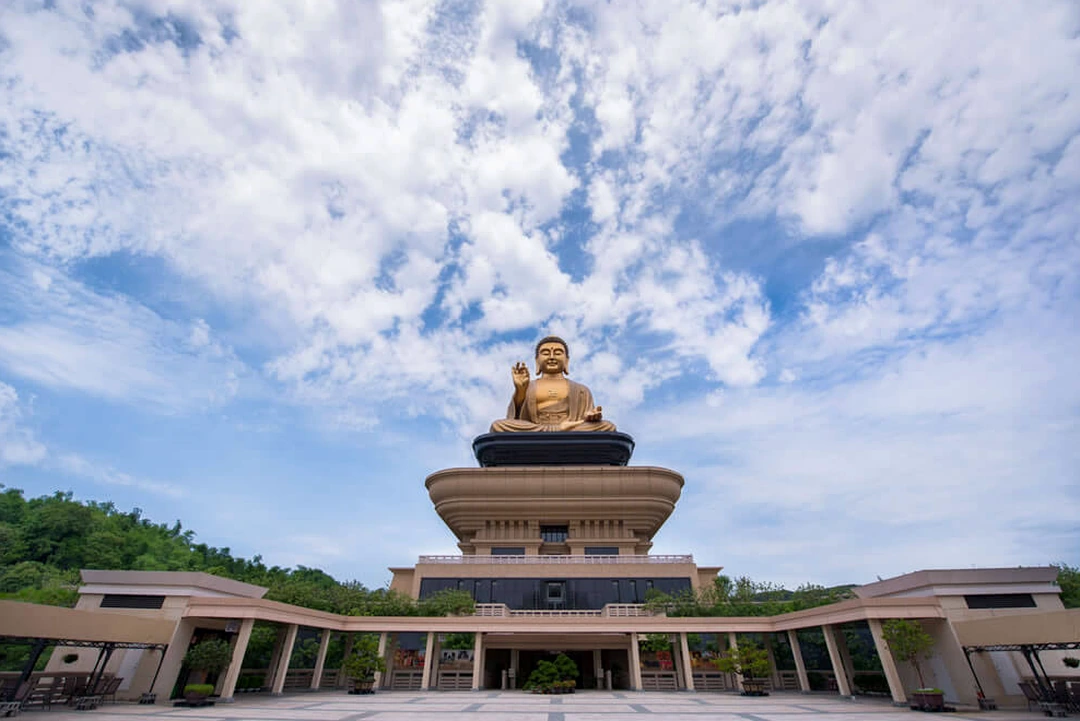
The defining axis of the museum and monastery grounds is the Great Path to Buddhahood, stretching 240 meters in length and 113 meters in width, oriented strictly along a west-to-east axis. Facing entirely eastward not only adheres to traditional religious canons—welcoming the pure light of dawn to dispel the darkness of ignorance—but also establishes an unbroken visual corridor from the Front Hall, across the expansive plaza, straight through the imposing Main Hall, and culminating at the lotus throne of the Fo Guang Big Buddha. Every elevation across the natural slope was meticulously terraced, creating a steady spatial ascent that gently guides pilgrims from the clamor of the secular world into a serene Pure Land without any abrupt or overwhelming transition.
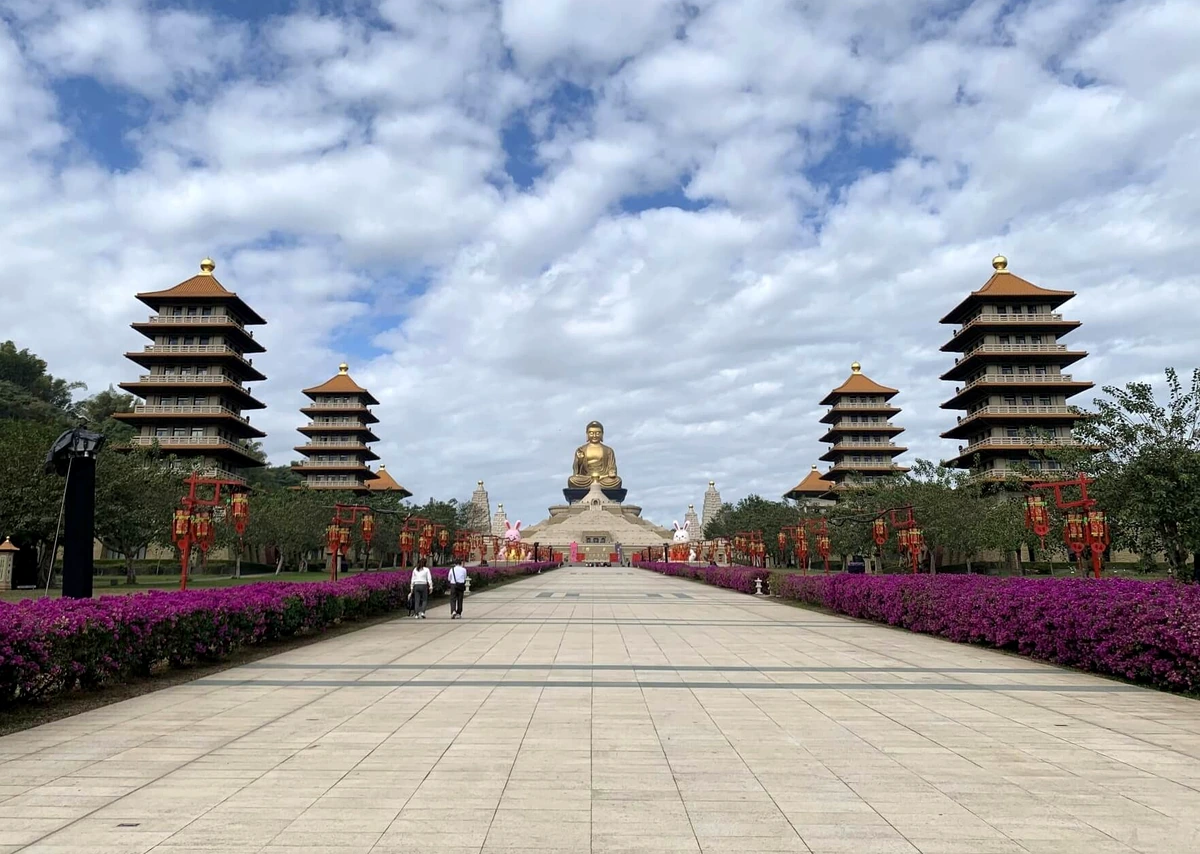
Breaking away from the traditional stereotype of ancient temples hidden away in remote, inaccessible mountains, the landscape engineering at Fo Guang Shan fully embodies Master Hsing Yun’s socially engaged philosophy of Humanistic Buddhism. Engineers and architects skillfully graded the barren hillsides and reinforced complex geological foundations to craft an open, welcoming space accessible to the general public. This organic harmony between humanity and nature shines through sweeping expanses of lush green lawns, integrated with a natural convective ventilation system that channels cool breezes from the Gaoping River up the slopes—reducing mechanical energy consumption while maintaining a refreshing microclimate across the sun-drenched southern plaza year-round.
Flanking both sides of the central avenue in symmetrical alignment stands the towering ensemble of the Eight Pagodas, sequentially named One Community, Two Truths, Three Goodness, Four Givings, Five Harmonies, Six Perfections, Seven Admonitions, and Eightfold Path. These eight stately brick-and-tile pagodas not only establish a rhythmic visual cadence and anchor the vast plaza spatially, but are also linked by long covered walkways that shield pedestrians from tropical sun and rain while acting as geomantic walls that retain positive energy. Native flora such as bodhi and banyan trees blend seamlessly with granite reliefs engraved with Buddhist sutras, transforming what was once a rugged hillside into an architectural masterpiece uniting large-scale civil engineering with classical East Asian geomantic aesthetics.
Spanning a grand master plan of over one hundred hectares along the banks of the Gaoping River, the entire Fo Guang Shan Monastery complex appears like a sacred sanctuary on earth, with the Fo Guang Shan Buddha Museum alone occupying more than fifty hectares. The architecture represents an extraordinary synthesis of classical Eastern feng shui planning and cutting-edge modern structural engineering. Following a strict symmetrical axis facing east with mountains at its back and the southern plains ahead, the buildings were engineered to endure for centuries using high-strength structural steel frames paired with specialized reinforced concrete—capable of withstanding the severe seismic activity common along the Pacific Ring of Fire while preserving the graceful, sweeping curves of traditional palatial architecture.
Stepping through the Front Hall, the Great Path to Buddhahood opens into a breathtaking expanse that draws the eye straight toward the majestic Buddha statue on the horizon. The most profound artistic and philosophical highlight along this central boulevard is the Eight Pagodas, arranged symmetrically with four on each side. Rising thirty-eight meters high, each pagoda features a slender seven-story pavilion design inspired by Tang and Song dynasty architecture, named after core Buddhist principles and the Noble Eightfold Path: One Community, Two Truths, Three Goodness, Four Givings, Five Harmonies, Six Perfections, Seven Admonitions, and Eightfold Path. Beyond structuring the landscape, each pagoda houses distinct functional spaces—storing tens of thousands of sutras, hosting cultural exhibitions, welcoming guests, and offering tranquil meditation halls—achieving a seamless union of practical utility and spiritual depth.
The journey continues across the vast Bodhi Wisdom Concourse to reach the central Main Hall, a remarkable architectural fusion of Asian Buddhist civilizations. Contrasting with the curved-tile roofs along the approach avenue, the Main Hall takes the form of a monumental stone-clad stupa inspired directly by the Mahabodhi Temple in Bodh Gaya, Bihar, India. Guarding its four corners are four Diamond Stupas symbolizing the Four Noble Truths, evoking the original birthplace of the Dharma. This graceful transition from flourishing Tang-dynasty Chinese pavilions in the foreground to ancient Indian stupa architecture in the background creates a poetic spatial dialogue tracing the transmission of Buddhism from India to East Asia.
Crowning the highest peak of the Main Hall is a pinnacle of contemporary bronze casting: the colossal Fo Guang Big Buddha. Depicting Shakyamuni Buddha seated in the full lotus posture with a serene, compassionate smile against the azure sky, this monumental sculpture reaches an astonishing total height of one hundred and eight meters—roughly equivalent to a modern forty-story skyscraper. The seated bronze figure itself stands fifty meters tall, resting atop a fifty-eight-meter lotus pedestal and stupa base. To complete this engineering marvel, master foundries smelted and assembled between 1,720 and 1,872 metric tons of pure bronze and high-grade alloys. The entire metallic surface underwent specialized anti-corrosion metallurgical treatment, enabling the bronze exterior to withstand humid subtropical weather and fierce ocean typhoons while maintaining its dignified, radiant luster under the southern sun for generations to come.
As the crimson sunset fades behind the Dashu hills, Fo Guang Shan sheds the bustling pace of daytime pilgrims and drapes itself in an enchanting nocturnal lighting design crafted by international visual specialists. Rather than aiming for worldly extravagance, the nighttime illumination is calibrated as a solemn exercise in visual meditation. Using wall-washing techniques paired with recessed linear lights discreetly concealed beneath granite ledges along the sacred axis, the pathway leading from the Front Hall toward the Bodhi Wisdom Concourse glows like a soft ribbon of radiance, guiding each peaceful footstep through the quiet night air.
Along this grand boulevard, the Eight Pagodas shine brightly like eight colossal beacons dispelling the darkness. Narrow-beam spotlights with high color accuracy accentuate every tier of curved roof tiles, sweeping eaves, and carved lotus reliefs, highlighting the architectural dialogue between Tang-dynasty palatial elegance and contemporary Buddhist artistry. At the ultimate focal point, the towering bronze Fo Guang Big Buddha is illuminated from below by specialized high-output floodlights. Warm beams of light envelop the colossal golden form, accentuating its compassionate expression, serene brow, and flowing kasaya robes draped like rippling water. Weighing thousands of tons, the statue seems to transcend all physical gravity, appearing as a luminous, weightless presence suspended beneath the starry sky of southern Taiwan.
Moving beyond the stillness of a traditional monastic sanctuary, nighttime at Fo Guang Shan is brought to life through large-scale multimedia productions where Buddhist teachings blend seamlessly with modern technology. On auspicious occasions, the grounds of the Buddha Museum transform into an open-air stage for laser water-screen projections paired with immersive surround sound. Fine mist disperses multicolored beams of light, conjuring vivid images of blooming thousand-petaled lotuses, turning Dharma wheels, and episodes from the life of the Buddha floating in midair. High above, synchronized drone light shows featuring hundreds of unmanned aircraft weave auspicious symbols, swastika motifs, and shimmering blessings across the night sky, offering visitors a surreal and awe-inspiring aesthetic experience.
This nocturnal artistry reaches its dazzling peak during the Lunar New Year with the Festival of Light and Peace, celebrated throughout the first lunar month. Tens of thousands of vibrant handcrafted lanterns—intricately painted with auspicious creatures and blooming lotuses—illuminate the slopes, covered walkways, and temple courtyards from the foothills to the sacred summit. Pilgrims stroll leisurely through a sea of glowing lanterns, exploring intangible cultural heritage exhibitions, admiring traditional paper-cutting and auspicious calligraphy, or pausing at the Dishui Tea House to savor a warm cup of fine tea in the crisp evening air. Drifting incense mingles with the delicate sweetness of glutinous rice balls and traditional vegetarian pastries, accompanied by the resonant tolling of the great temple bell echoing from the pagodas—creating a tranquil Pure Land on earth where modern light art and spiritual stillness meet in perfect harmony.
Vegetarian cuisine at the sacred grounds of Fo Guang Shan goes far beyond mere culinary sustenance; it is elevated into a profound practice of mindful contemplation, reflecting the spirit of Humanistic Buddhism championed by Master Hsing Yun. Within the serene halls of the Pilgrim’s Lodge, traditional monastic meals in the dining refectories are observed in complete silence, encouraging diners to cherish every grain of nourishment with gratitude and mindfulness. Menus strictly uphold natural nutritional principles, minimizing oil and completely avoiding synthetic seasonings. Standing out among these pure flavors is the clear Arhat Noodles, simmered with wild highland mushrooms, sweet white radish, tender lotus seeds, and silky tofu skin—delivering a clean, delicate sweetness on the palate and a soothing sense of lightness for body and mind after a long walk up the temple grounds.
The monastic dining experience at Dishui Fang embodies a spirit of deep gratitude inspired by the ancient proverb: “A single drop of kindness should be repaid with a gushing spring.” Here, the essence of vegetarian gastronomy is captured in the signature Master’s Noodles, a humble dish whose recipe was personally passed down by Master Hsing Yun. This celebrated dry noodle dish features renowned Guanmiao noodles from southern Taiwan, crafted from premium wheat flour and naturally sun-dried to achieve a signature springy chew that industrial noodles can never replicate. Tossed in a rich, aromatic shiitake mushroom soy sauce, drizzled with cold-pressed artisanal sesame oil, and finished with a sprinkle of toasted sesame seeds, every strand awakens the senses with nuanced depth. Accompanying the noodles is a plump Fo Guang Vegetarian Bun, boasting a cloud-soft fermented dough wrapper filled with crisp wood ear mushrooms, sweet young bamboo shoots, and delicately stir-fried seasonal vegetables.

Stepping outside the solemn boundaries of the monastery, the culinary map immediately expands into the fertile agricultural heartland of Dashu District surrounding the foothills, nourished by the rich alluvial soils of the Gaoping River. This sun-drenched southern region is famous as the home of the Golden Diamond pineapple—known agriculturally as Tainung No. 17—prized for its brilliant golden hue, honey-sweet juicy flesh, and remarkably tender, fiber-free core. For generations, Dashu locals have preserved the intricate craft of fermenting traditional pineapple bean paste. Ripe pineapples are meticulously peeled, thickly sliced, and aged in earthenware jars alongside premium soybeans, licorice root, and sea salt under the open sun and moon for months. The naturally fermented paste develops a glossy amber sheen and a balanced sweet, tangy, and savory profile, serving as the indispensable soul of southwestern Taiwan’s famous pineapple bitter melon chicken soup—where the gentle acidity of fermented pineapple softens the bitterness of the melon and enriches the savory broth.
Beyond rolling pineapple fields, Dashu’s terroir is equally celebrated for its ancient longan orchards and prized Yuhebao (Jade Purse) lychees, renowned for their thin shells, tiny seeds, and thick, fragrant, ultra-juicy flesh. Every summer during peak harvest, local farmers fire up traditional brick kilns scattered across the hillsides to produce their one-of-a-kind wood-smoked dried lychees and longans. Hand-selected fresh fruit is slow-smoked continuously over aged longan wood fires for several days and nights, shrinking the pulp into a rich amber jewel that concentrates its natural sugars without drying out. Its deep, caramelized sweetness infused with an earthy, rustic woodsmoke aroma makes an exquisite accompaniment to a pot of high-mountain Oolong tea as dusk settles beneath the silhouette of the giant Buddha.
To welcome pilgrims and travelers from around the world, the Fo Guang Shan Buddha Museum maintains regular opening hours from 09:00 to 18:00 Monday through Friday, extending until 19:00 on weekends (Saturdays and Sundays) as well as during major Buddhist festivals such as Buddha’s Birthday. True to Master Hsing Yun’s philosophy of Humanistic Buddhism—dedicated to sharing the Dharma freely with society—admission to the entire complex is completely free of charge. This spirit of selfless service transforms the sanctuary into a rare open cultural space where boundaries between religious devotion and architectural appreciation dissolve into equal hospitality for every visitor.
Kaohsiung’s modern public transit network makes reaching the monastery straightforward and convenient. The fastest and most popular option for independent travelers is taking the Taiwan High Speed Rail (THSR) or Taiwan Railways (TRA) to Xinzuoying Station. From the station concourse, head to Bus Exit 2 to board the Ha-Fa Express (Harvard Express, Route E02). This direct highway shuttle travels straight from the bustling urban hub to the entrance plaza of Fo Guang Shan in just 30 to 40 minutes. Travelers departing from neighboring areas can also opt for E-DA Bus Route 8501 or the Dashu Sightseeing Bus to enjoy scenic views of Dashu District along the way.
For visitors wishing to absorb the philosophical depth and symmetrical grandeur of the complex within a limited timeframe, a focused three-hour itinerary offers the classic route. Begin at the Front Hall, the welcoming gateway where visitors transition from the secular world into the serene temple grounds. Passing through its doors, your view opens onto the sweeping Great Path to Buddhahood, flanked by the Eight Pagodas representing the Noble Eightfold Path, leading directly toward the Main Hall. Inside, the highlight of the visit is paying homage to the priceless Buddha Tooth Relic enshrined in the Jade Buddha Shrine, followed by exploring the 48 Underground Palaces preserving time capsules of contemporary cultural treasures. Conclude your walk out on the expansive Bodhi Wisdom Concourse, gazing up at the towering bronze Fo Guang Big Buddha against the blue sky while listening to wind chimes resonating softly in the stillness.
A cultural visit to this peaceful sanctuary would be incomplete without sampling its renowned vegetarian cuisine. Right on the ground floor of the Front Hall and inside the monastic dining halls, travelers can savor a comforting bowl of traditional vegetarian noodles rich with pure vegetable broth, or enjoy a generous vegetarian buffet prepared from fresh local produce. When exploring the monastery grounds, guests are kindly asked to maintain respectful decorum by dressing modestly with shoulders and knees covered. To preserve the sacred atmosphere and protect spiritual heritage, photography and filming are strictly prohibited inside core shrines such as the Jade Buddha Shrine and the Golden Buddha Shrine. The entire Fo Guang Shan complex enforces a strict ban on smoking and littering, upholding green ecological living and absolute tranquility for the soul.

A pilgrimage to southern Taiwan’s Buddhist capital offers a lasting sense of inner calm, deeply rejuvenating the spirit after busy days in the city. For a seamless journey exploring Taiwan’s cultural landmarks with well-planned itineraries and logistics, travelers can explore more details in our all-inclusive Taiwan travel tour packages.