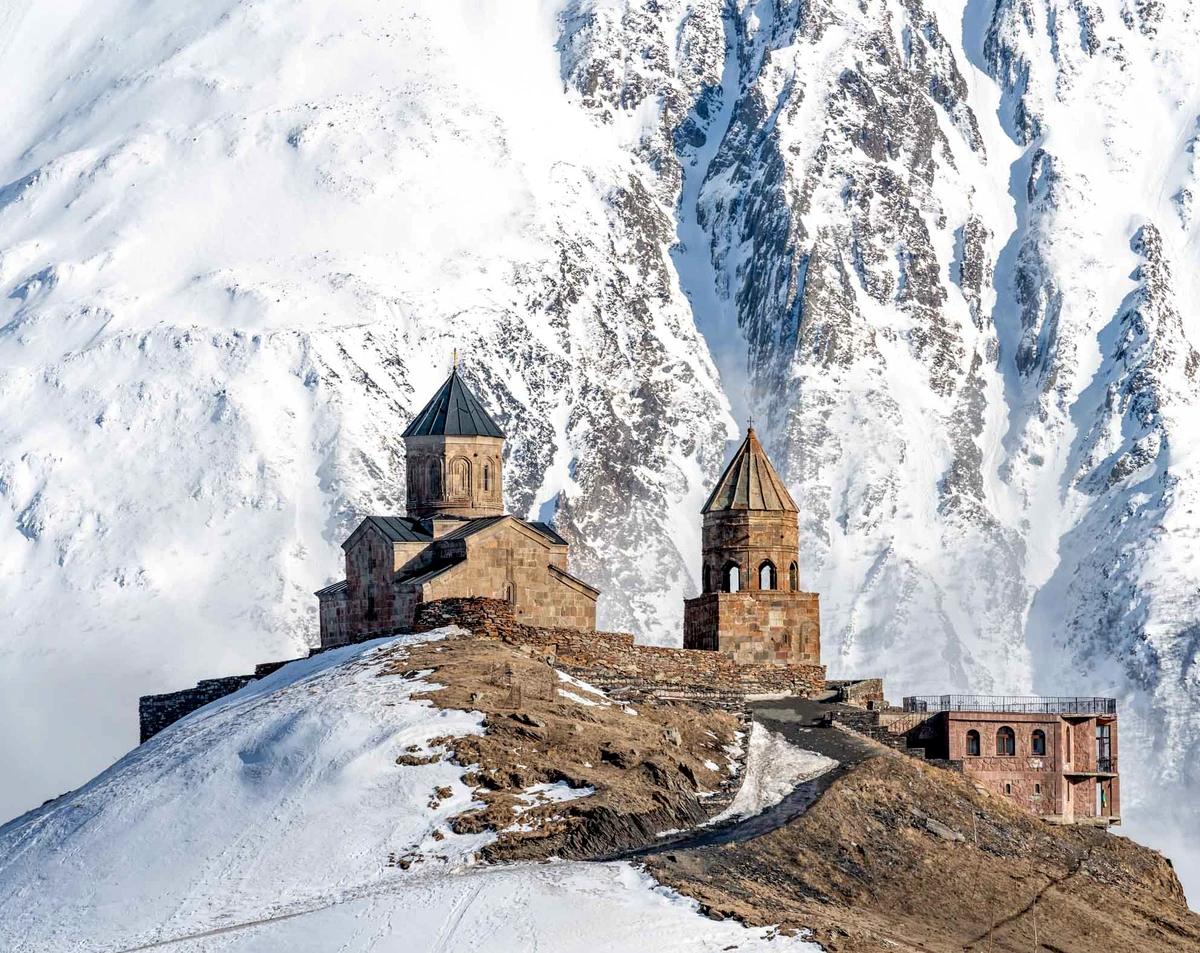
Amid the undulating expanse of the Greater Caucasus range, where the perpetually snow-capped peak of Mount Kazbegi pierces through layers of silver-gray clouds, the Gergeti Trinity Church stands majestically as an eternal emblem uniting the earthly realm with Georgian Orthodox faith. This extraordinary religious monument, crafted from ash-gray basalt, was erected around the 1330s during the 14th century, coinciding with one of the most brilliant periods of renaissance in the Kingdom of Georgia under the reign of King Giorgi V the Magnificent, celebrated in history as Giorgi Brtskinvale. This remarkable monarch succeeded in reunifying the realm after decades of internal strife while consolidating royal authority across the rugged borderlands. Alongside the central court, the local nobility of the Khevi valley—under the jurisdiction of the Zakaria Mkhargrdzeli lineage—played a pivotal role in providing financial patronage and recruiting the finest stonemasons to erect an imposing sanctuary at an elevation of 2,170 meters above sea level, standing sentinel atop a sheer cliff overlooking the Chkheri valley.
Choosing an isolated vantage point on Mount Gergeti stemmed not merely from the desire to establish an otherworldly monastic retreat, but also from a vital strategic calculation in the face of turbulent, blood-soaked times. Over centuries of upheaval, when fertile plains such as the Kartli and Kakheti valleys or the sacred ancient capital of Mtskheta were repeatedly leveled by brutal sweeps of Mongol cavalry and powerful Persian invading armies, Gergeti transformed into an impregnable national treasury. Shielded by sheer thousand-foot cliffs, shrouded in snow and ice year-round, and accessible only via treacherous mountain trails impassable to enemy warhorses, the site became a fortress safeguarding the holiest relics of the Georgian Orthodox Church. Among the countless treasures that once found refuge beneath the sanctuary’s freezing stone vaults, the most sacred emblem was the Cross of Saint Nino—the founding relic of Christianity in the Caucasus region, fashioned from wild grapevine branches and bound together with the patron saint’s own hair.
Entering the 19th century, as the Caucasus was annexed into the Russian Empire along the vital artery of the Georgian Military Highway, the outpost of Stepantsminda at the foot of Mount Kazbegi became an endless source of inspiration for Western intellectuals and Romantic poets. The surreal beauty of the stone sanctuary suspended amidst a sea of pure white clouds captivated the great poet Alexander Pushkin in 1829, inspiring him to pen his poetic masterpiece The Monastery on Kazbek, in which he likened the edifice to Noah’s Ark soaring near the threshold of heaven. Shortly thereafter, another titan of Romantic literature, Mikhail Lermontov, also found intense emotional resonance amidst these untamed gorges to weave his immortal epic poem The Demon and portray the complex psychological depths of his novel A Hero of Our Time.
However, it was the critical realist writer Alexander Kazbegi—an aristocratic author descended from the very hereditary lords who governed the Stepantsminda region—who indelibly carved the resilient identity of this land into Georgia’s cultural consciousness. Through monumental literary works depicting the steadfast lives and age-old customs of the Khevi mountain people, the image of Gergeti Church rising against the white snows of Kazbegi transcended the boundaries of a mere religious monument to become the supreme symbol of liberty and unyielding spirit against all forms of subjugation. Enduring the vicissitudes of history, from feudal upheavals to periods of strict closure during the Soviet era, the church and its three-tiered bell tower have stood tall as a spiritual beacon, enduring the mountain winds and frost through more than seven hundred years of worldly change.
Perched at a dizzying elevation between 2,170 and 2,200 meters above sea level, the Gergeti Trinity monastic complex (known locally as Gergetis Tsminda Sameba) occupies an unparalleled geomantic, geoeconomic, and military position within the historical space of Khevi. Resting directly upon a protruding limestone plateau that serves as a natural pedestal above the administrative center of Stepantsminda, the complex sits beside the mighty ramparts of the Greater Caucasus range, absorbing the sacred energies rising from the deep Terek River valley. In the urban planning philosophy of Georgia’s medieval master architects, selecting this solitary mountain spur was not purely for secluded contemplation, but rather a masterstroke of topographical strategy. The church’s vantage point acts as a strategic watchtower commanding the entire treacherous Dariali Gorge—both a vital trade chokepoint and the most critical pass along the arterial route linking the Transcaucasian plains with the vast steppes to the north.
The spiritual anchor for this entire spatial composition is Mount Kazbek, revered by local residents under the name Mkinvartsveri (meaning “Glacier Peak”), a dormant stratovolcano soaring to a height of 5,054 meters. In the folklore of ancient Iberia, Mount Kazbek is inextricably linked to the epic of the hero Amirani—a figure paralleling Prometheus in Western mythology—who was chained to its freezing cliffs for bestowing divine fire upon humanity. Viewed from the valley below, the harmonious proportion between the rustic stone architecture of the church and the colossal, snow-blanketed ice cone of Kazbek creates a breathtaking optical illusion. The church appears like a quiet speck amidst the mortal world yet serves as an anchor tethering the earth to the infinite sacred realm, transforming human smallness into an eternal focal point against the overwhelming majesty of untamed nature.
The engineering process required to bring such an architectural masterpiece to fruition at these harsh coordinates in the 14th century was an extraordinary feat of civil engineering ahead of its time. Amid steep terrain and unpredictable weather, local artisans had to transport thousands of dark gray schist blocks and volcanic tuff stones from nearby ancient quarries up to the summit using sheer human labor and packhorses navigating treacherous, rocky slopes. The exterior stone blocks were meticulously chiseled with precision mortise joints and bound together using a coarse lime mortar mixed with natural additives capable of flexing and reinforcing structural bonds against the frequent seismic tremors of the Caucasus fault belt. The signature conical dome structure and the dense system of load-bearing arches inside the sanctuary not only symbolize the helmet of a Georgian warrior, but also serve as a brilliant mechanical solution to dissipate the immense weight of thick snow accumulating over long winter months while deflecting the tearing force of cyclonic winds surging upward from the Terek gorge to elevations exceeding two thousand meters.
Surrounding the sacred site is a spectacular ecological landscape clearly stratified between the alpine and subalpine vegetation zones characteristic of the Caucasus Mountains. During the warmer months, the barren rocky slopes awaken as carpets of Caucasian rhododendron (Rhododendron caucasicum) burst into ivory-white blossoms edged with pink against lush green alpine meadows, interspersed with resilient dwarf birches bending with the mountain gales. Yet this serene beauty abruptly gives way to stark severity when gazing west and northwest, where perennial glaciers such as Gergeti and Ortveter creep down from the summit’s ice cap into rugged mountain gullies. These crevassed, emerald-blue masses of glacial ice continuously exhale currents of bone-chilling air, generating a mystical temperature-inversion fog that swirls beneath the foot of the monastery. This seamless fusion of resilient human craftsmanship and rugged glacial topography has sculpted a one-of-a-kind geo-cultural landscape, where Gergeti Church stands resolute as an enduring monument defying a millennium of time and blizzards.
Set against the expansive, untamed wilderness of the Khevi region on the eastern slopes of the Greater Caucasus, the Gergeti Trinity Church stands as an extraordinary testament to the zenith of medieval Georgian religious architecture. Built around the 14th century, the edifice holds a unique distinction as the sole representative of the cross-in-square domed architectural style perched at an elevation of 2,170 meters above sea level. Rather than relying on the support of prosperous urban centers, the anonymous architects of that era boldly placed a classical design demanding absolute geometric precision atop a lonely rocky peak, forging a magnificent harmony between human hands and the harsh laws of nature.
The entire sanctuary is constructed exclusively from dark gray andesite blocks quarried from nearby volcanic slopes, interwoven with monolithic basalt renowned for its high resistance to extreme weather. Each massive stone slab was hand-hewn to a smooth finish with remarkably crisp, right-angled edges. Ancient Georgian craftsmen employed a tight dry-stone masonry technique using virtually no binding mortar at key load-bearing junctures, harnessing the sheer gravitational weight of the megalithic blocks and absolute friction to create elastic resilience. This ingenious structural solution enabled the sanctuary to withstand centuries of violent earthquakes along the Caucasus tectonic fault zone, as well as endure the relentless battering of year-round snowstorms howling down from Mount Kazbegi.
The layout of the monument complex is organized according to the model of a fortified, enclosed monastery, reflecting the precarious realities of a historical era when the site served both as a sacred place of worship and a vault safeguarding the priceless relics of the Georgian kingdom during foreign invasions. At the heart of the complex lies the cruciform main church, crowned by a central dome rising atop a cylindrical drum pierced by narrow windows. Standing detached at the southern corner is a two-story stone bell tower added around the late 16th or early 17th century. The ground floor of the bell tower features a solid, cubic masonry structure functioning as a miniature bastion, while the upper level houses an open-arched belfry supported by pillars, allowing the resonant chimes of its bronze bells to carry above the clouds and echo all the way down into the Stepantsminda valley.
The craftsmanship and stone carvings adorning the exterior of Gergeti Trinity are steeped in the symbolic language of Eastern Orthodoxy. Against the somber, textured backdrop of andesite stone, the eastern and southern facades are accented with bas-reliefs depicting the Bolnisi cross—a four-armed cross with flared extremities originating in the 5th century that symbolizes the undying faith of the Georgian people. Scattered along the arched window moldings are intricate motifs of scrolling grapevines and stylized depictions of mythical beasts. Notably, several wall sections preserve ancient inscriptions deeply carved into the stone in Asomtavruli—the oldest script of the Georgian alphabet, characterized by rounded, monumental lettering—recording dates of restoration alongside the names of the venerable abbots who once presided over the sanctuary.
Stepping across the low arched threshold into the heart of the sanctuary, the interior opens into a solemn, contemplative atmosphere completely insulated from the roaring gales outside. The cross-in-square layout divides the floor plan into four cruciform arms converging beneath a central, heaven-like dome. The liturgical space is bathed in a mystical dimness, illuminated solely by slender shafts of sunlight filtering through narrow lancet windows slotted along the drum. The interior stone walls remain largely unadorned, retaining only faint remnants of frescoes darkened by centuries of candle smoke, which frame the dark oak iconostasis bearing ancient sacred icons and generating a profoundly tranquil and pure spiritual presence.
As the sun dips behind the jagged folds of the Greater Caucasus range, Mount Kazbegi—the majestic stratovolcano revered by Georgians as Mkinvartsveri, meaning “Glacier Peak,” towering 5,054 meters above sea level—transforms into a grand natural theater directed solely by Mother Nature. At this hour, the optical phenomenon of alpine afterglow unleashes its most enchanting visual magic across the eternal snowfields. Sunlight refracted through the atmosphere bathes the primeval cliffs in an ever-shifting symphony of colors: transitioning from the crisp, icy white of daytime into radiant rose-pink, igniting into fiery burnt orange, and finally settling into a lustrous burnished gold. The solemn silhouette of the Gergeti Trinity Church stands strikingly alone atop its 2,170-meter perch against the twilight sky like a steadfast witness to history, bridging the mortal world with eternity.
Once the final rays of twilight fade, nightfall descending upon the Stepantsminda valley brings not static monotony, but the awakening of a deeply meditative and sacred atmosphere. Nocturnal life in these highlands is defined by the vast stillness of the wilderness—a pure acoustic vacuum broken only by intermittent gusts of wind whistling through the sheer cliffs of the Dariali Gorge and the fierce, churning roar of the Terek River carving relentlessly through geological strata at the bottom of the chasm. Standing amidst the freezing mist on the slopes of Gergeti and gazing up at the Caucasian night sky encrusted with diamond-like constellations, travelers are effortlessly transported back to the epic tale of Amirani—the embodiment of Prometheus in ancient Georgian mythology—who was shackled to the icy cliffs of Kazbek for daring to steal sacred fire from the gods to gift to humankind.
In stark contrast to the bone-chilling cold and mystical solitude of the high summit, nightlife within the historic villages of Stepantsminda harbors a remarkably warm cultural space rich in local hospitality. Here, illumination is neither loud nor ostentatious, instead glowing modestly through warm golden hearth-light spilling from the oak-framed windows of traditional stone houses. Inside living rooms fragrant with burning pinewood smoke, people gather around a traditional supra feast orchestrated by a tamada (toastmaster) offering deeply philosophical toasts. Diners replenish their energy with piping-hot mountain khinkali dumplings brimming with rich, black-pepper-spiced meat broth, savor freshly baked khachapuri stuffed with creamy, melted sulguni cheese, and raise glasses of potent chacha brandy or velvety Saperavi red wine painstakingly aged in underground kvevri clay amphorae. The rustic melodies of the three-stringed panduri lute intertwined with unique polyphonic folk singing turn the highland night into an intoxicating celebration.
The harsh climate and rugged terrain of the mountainous Khevi region surrounding the base of Mount Kazbegi have forged a singular alpine culinary tradition, where every flavor is crafted to deliver abundant energy and warm the body against biting winds sweeping through the Dariali Gorge. The dining table of local residents in the Stepantsminda valley eschews exotic imported spices in favor of the rustic purity of indigenous ingredients nourished by glacial meltwater from the Greater Caucasus and untamed alpine pastures.
Topping the list of traditional local delicacies is Khinkali, the celebrated dumpling recognized worldwide as Georgia’s national culinary icon. Contrary to the common belief among travelers that khinkali originated in cosmopolitan Tbilisi, it was actually the rugged Khevi mountains and neighboring valleys that served as the original birthplace of this dish. Highland khinkali are typically larger than their lowland counterparts, featuring a thicker hand-kneaded wheat dough wrapper skillfully pleated into nineteen to twenty-eight concentric folds converging at a firm, round dough knob known as the kudi. The filling is a precise blend of coarsely minced mountain lamb or beef, back fat, onions, fiery chili powder, and a touch of wild caraway foraged from rocky slopes. When boiled in rolling water, the rendering fat and meat juices form a rich, deeply savory broth sealed tightly inside the pouch. Eating khinkali in Kazbegi requires proper technique: diners grasp the top knob with their bare hands, take a small bite to sip out the steaming broth before eating the fragrant meat filling, and strictly avoid knives and forks so as not to pierce the wrapper and spill its precious essence.
Alongside meat dumplings, Kobiani—a regional variation of baked cheese bread—exemplifies the ingenious adaptation of local inhabitants to snow-blanketed winters. Unlike traditional khachapuri from coastal or valley regions made solely with fresh cheese, kobiani combines a thin, crisp wheat crust baked directly on a cast-iron skillet with a hearty filling of creamy mashed potatoes blended with salted local cheese. The potato starch keeps the flatbread moist and piping hot for hours while supplying vital calories for shepherds traversing steep mountain trails. Accompanying kobiani is Guda cheese, an ancient culinary heritage of Caucasian nomads. Distinct from Dutch Gouda, Georgian highland Guda is crafted exclusively from fresh sheep’s milk from free-ranging flocks, pressed dry, and fermented inside inverted sheepskin bags for dozens of weeks. This unique anaerobic aging process yields a firm cheese dotted with tiny air pockets, boasting a pungent aroma, sharp saltiness, and a rich, wild pasture-fed creaminess that no modern industrial method can replicate.
Although the frigid high-altitude slopes around Gergeti cannot cultivate fruitful vineyards year-round, Stepantsminda serves as a gathering point for Georgia’s 8,000-year-old Qvevri clay vessel winemaking culture, brought up from the warmer wine regions of Kakheti and Kartli. Inky-dark Saperavi red wines with firm tannins and notes of ripe plum and damp earth, alongside crisp amber Rkatsiteli and Chinuri wines fermented on their skins and seeds in subterranean clay jars, seem to acquire even greater depth and resonance after making the journey over the treacherous Jvari Pass to the foot of Mount Kazbegi. A traditional Khevi Supra feast beside a crackling fire—guided by a respected Tamada leading sacred toasts to homeland, family, and the sacred mountains—offers travelers the finest gateway into the proud yet warm-hearted soul of a people living on the threshold between earth and sky.
The journey to Gergeti Sanctuary and snow-capped Mount Kazbegi typically begins in the historic capital of Tbilisi, tracing the legendary Georgian Military Highway northward for approximately 155 kilometers. This ancient trade and military artery winds across the dramatic Jvari Pass, unveiling breathtaking panoramas along the way, including the turquoise waters of the Zhinvali Reservoir and the moss-covered stone battlements of Ananuri Fortress. To cover this three-to-four-hour route, travelers can hop aboard the signature post-Soviet marshrutka minibuses departing regularly from Tbilisi’s Didube station, or hire a private car for the freedom to stop and admire the scenery at leisure. The final stop along the intercity route is the town of Stepantsminda, serving as a welcoming basecamp nestled beneath the towering peaks and offering cozy accommodations and local eateries before travelers embark on the final ascent.
From the center of Stepantsminda up to the 2,170-meter hilltop where the church stands, visitors have two contrasting modes of transport to choose from. The first option is a scenic hiking trail taking roughly two hours, winding past historic villages, whispering pine forests, and gentle grassy slopes carpeted with summer wildflowers; this is an authentic pilgrimage experience for souls wishing to feel every breath of nature and cleanse mind and body in the drifting mountain mist. The second option is hiring specialized 4×4 off-road vehicles driven by seasoned local drivers, powering boldly through sharp switchbacks and rugged gravel tracks in about twenty to twenty-five minutes. Even though a paved road now offers smoother access, the adventurous thrill of riding in rugged off-roaders remains an unforgettable hallmark of reaching this natural watchtower of the Caucasus.
The ideal time of year to visit the Kazbegi region spans from May to October, when the alpine climate turns mild, meadows turn lush green, and ribbons of white clouds drift lazily through the deep gorges below. October, in particular, is celebrated as the most radiant golden season, when beech and maple forests erupt into brilliant shades of gold and amber, creating a magical color contrast against the perpetually snow-white peak. Conversely, from November through April, the region enters a harsh winter marked by fierce blizzards; the Jvari Pass is frequently closed to traffic due to avalanche hazards, making access to the church exceedingly difficult and suitable only for professional mountaineers equipped with full technical winter gear.
The Gergeti Trinity Church welcomes visitors and devotees free of charge from sunrise until sunset, with no admission fee required. However, because it is one of the most sacred sanctuaries of the Georgian Orthodox Church, visitors must strictly adhere to traditional dress codes: men are prohibited from wearing shorts or hats inside the sanctuary, while women are required to wear a headscarf covering their hair and a long skirt extending past the ankles. Woven wrap-around aprons and scarves are conveniently provided at the church entrance for international visitors to borrow free of charge. Additionally, weather atop Mount Gergeti can shift dramatically in the blink of an eye; icy gusts sweeping off the glaciers can strike unexpectedly even on a sunny summer afternoon, making it essential for travelers to carry a windproof insulated jacket, sturdy high-traction footwear, and a flask of warm water.
After hours spent admiring the serene mountain scenery, the Kazbegi experience reaches its crowning moment when travelers stop by family-run eateries in Stepantsminda to savor the culinary heritage of the Khevi mountains. Steaming khinkali dumplings filled with finely minced beef infused with wild mountain herbs, paired with rich, cheesy khachapuri flatbread and a glass of robust wine aged in traditional qvevri clay amphorae, will swiftly chase away the highland chill. For a safe, culturally immersive journey without the hassle of navigating complex mountain passes and transport logistics, travelers can consider booking an all-inclusive Caucasus tour package (Georgia – Azerbaijan) thoughtfully crafted by specialists with deep local expertise.