Before the cold steel girders of industrial civilization spanned the windswept waters of Port Jackson, the fertile southern expanse known as Warrane was the sacred homeland of the Cadigal people, a distinguished clan of the Darug language group deeply bound to every tide and rocky headland here for over sixty thousand years. Indigenous hunters and Darug fisherwomen paddling bark canoes across the crystal-clear waters regarded the harbour as an inviolable living entity of the Dreamtime. The course of history began to turn on January 26, 1788, when the First Fleet under the command of Captain Arthur Phillip landed on the shores of Sydney Cove, raised the flag of the British Empire, and established the first European settlement on the Southern Hemisphere continent. Subsequent population growth and the expansion of the New South Wales colony quickly exposed a natural paradox: magnificent Port Jackson served as an ideal deep-water harbour sheltering merchant vessels, yet simultaneously acted as a watery barrier dividing the two shores, turning trade and travel between the bustling southern shore and the untamed northern shore into an arduous journey reliant entirely on ferries pitching across rough swells.
The bold concept of a harbour crossing linking both halves of the settlement was first sparked in 1815 by Francis Greenway, a brilliant English convict architect serving under Governor Lachlan Macquarie. With vision centuries ahead of his era, Greenway sketched the prospect of a grand bridge stretching across the water to unite the fledgling city, even though officials at the time dismissed it as a mad fantasy beyond the engineering capabilities of the early nineteenth century. It took more than a century of setbacks—marked by dozens of failed surveying proposals and fierce debates in the colonial legislature—before the ambition to unite both shores found its destined chief architect: Dr. John Job Crew Bradfield. As Chief Engineer of the Sydney Department of Public Works, Bradfield not only championed the design of a colossal load-bearing cantilever steel arch bridge, but also poured his heart and determination into turning blueprints into reality, rightfully earning the title as the father of modern Sydney’s skyline.
On July 28, 1923, the first pickaxe struck the sandstone bedrock, launching an epic nearly decade-long feat of labour against the looming backdrop of the global Great Depression. The construction contract was awarded to the renowned British firm Dorman Long and Company of Middlesbrough, England, with pivotal technical consultation from the gifted engineer Sir Ralph Freeman. Braving gale-force winds sweeping over the sea and working without modern safety gear, thousands of labourers and fearless riveters suspended themselves high in mid-air, assembling beams of steel imported from the United Kingdom alongside domestically produced steel from Newcastle. The climax of this engineering triumph occurred on the night of August 19, 1930, when the two massive halves of the steel arch—built simultaneously outward from Milsons Point on the north shore and Dawes Point on the south shore—closed the gap and locked together with millimeter precision, drawing gasps of astonishment from international mechanical observers.
The bridge’s crowning moment is forever intertwined with one of the most dramatic acts of political protest in modern Australian history on its opening day, March 19, 1932. Amid a crowd of over three hundred thousand spectators holding their breath for the traditional red-ribbon cutting ceremony presided over by New South Wales Premier Jack Lang, a cavalry officer of the paramilitary New Guard named Captain Francis de Groot unexpectedly charged through the crowd on horseback, drew his ceremonial sword, and slashed the honorary ribbon in the name of the Crown and loyal citizens to protest the left-wing administration. Although the captain was promptly arrested and the ribbon hastily retied so Premier Jack Lang could complete the official ceremony, that shocking sword slash etched itself into Sydney’s collective memory as a vivid testament to the turbulent political currents of a changing era. Weathered by sun, rain, and historical transformation, the structure was formally inscribed on the Australian National Heritage List on March 19, 2007, permanently cementing the steel arch bridge not merely as a vital transport artery, but as the soulful masterpiece of the Land Down Under.
Situated at a prime convergence point at the gateway of Port Jackson’s natural ocean currents, the Sydney Harbour Bridge functions like an open-air geomantic axis defining the waterways of the entire harbour metropolis. Viewed from a macro-geodetic perspective, the bridge aligns precisely along a north-south axis, spanning a narrow strait roughly five hundred meters wide to form an essential commercial lifeline between both shores. The southern terminus of its substructure rests on the historic promontory of Dawes Point—known for millennia to the indigenous Gadigal clans as Tar-ra—directly adjacent to bustling Circular Quay, once the maritime trade cradle of the entire colony. The northern end reaches Milsons Point, the ancestral territory of the Cameragal people, opening straight into the thriving residential precincts of North Sydney. Cleaving the sky with a single sweeping arch, the structure forms a natural geographic boundary separating the calm, wind-sheltered inner harbour to the west from the vast, wave-tossed expanse opening out toward the Pacific Ocean to the east.
The enduring vitality of this monumental structure stems first and foremost from the extraordinary geological foundation nature bestowed upon the harbour city. Its entire load of hundreds of thousands of tons of steel and concrete transfers directly down into solid Hawkesbury sandstone cliffs, a magnificent sedimentary formation laid down during the Pleistocene epoch millions of years ago. This honey-gold sandstone not only supplied durable facing stone for the four towering bridge pylons rising nearly ninety meters high, but also serves as an unyielding natural bedrock pedestal impervious to the swirling underwater pressures of surging tides. The original undulating terrain of both peninsulas, with their steep rocky ledges, was calculated and levelled to the millimeter by engineers of the era, creating a rock-solid stance supporting the colossal steel arch over fifty meters above water level and ensuring unobstructed passage for great battleships and ocean liners.
Delving deeper into its structural engineering, the steel arch of the Sydney Harbour Bridge is truly a masterpiece of climate-adaptive mechanics. Under the demanding continental weather conditions of New South Wales, where temperatures can swing dramatically between scorching summer afternoons and crisp winter nights, the massive steel frame is not rigidly locked in place; instead, it is engineered to continuously “breathe” in rhythm with the elements. At the core of this thermal stress-relief design lies a system of sliding hinged bearings and precision-tempered steel pins concealed directly inside the load-bearing abutment pedestals. This microscopic movement mechanism allows the entire arch frame to expand or contract freely with ambient temperature fluctuations, enabling the crown of the arch to rise or dip smoothly by up to eighteen centimeters (18 cm) over a single day-night cycle without causing any distortion or stress fractures to the central load-bearing girders.
Woven seamlessly into this colossal mechanical feat is a remarkably rich urban-marine ecosystem, transforming the waters and airspace around the bridge into a vibrant natural tableau rarely seen at the heart of a major metropolis. Beneath the deep blue channel where stone pier footings plunge into the swells, unique aquatic life flourishes around submerged rock reefs and soft corals, forming familiar hunting grounds for bottom-dwelling Port Jackson sharks alongside countless schools of brightly coloured marine fish gliding with the tides. High in the breezy airspace above, the steel arch framework serves as a resting perch for bold pelagic pelicans and flocks of seagulls wheeling in search of prey from dawn until dusk. Even atop the loftiest wind-whipped steel girders, fierce peregrine falcons—the fastest diving predators on the planet—regularly nest and scan for prey, creating an extraordinary symbiosis between an icon of human engineering and timeless wild vitality.
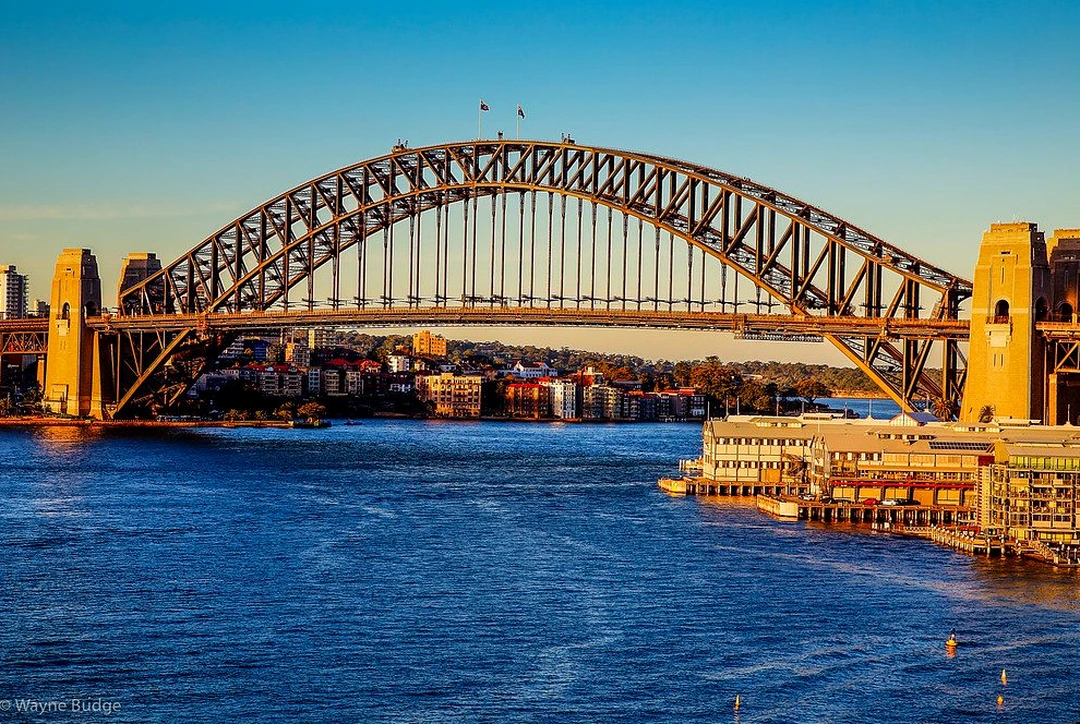
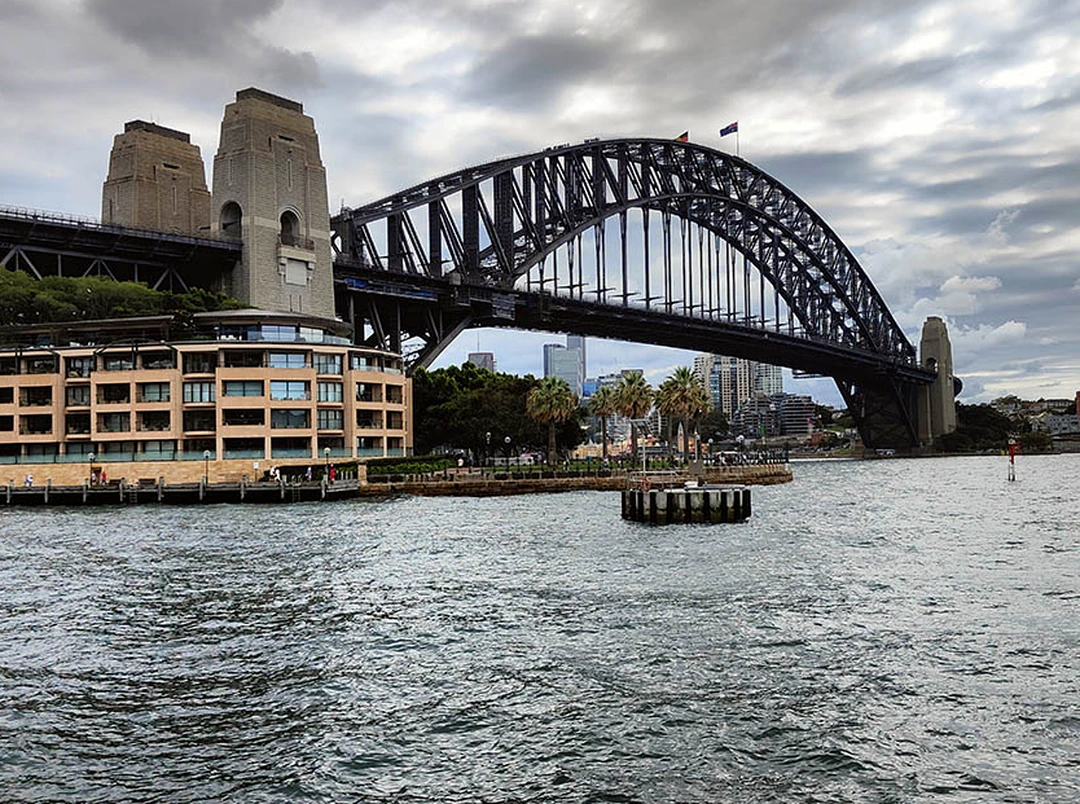
The Sydney Harbour Bridge stands as an exquisite fusion of pinnacle metallurgical craftsmanship and early twentieth-century industrial aesthetics. Structurally, the bridge was built as the world’s grandest through-arch bridge, its muscular steel curve sweeping boldly across the deep blue waters of Port Jackson. That unmistakable curved silhouette etched itself into local affection under the playful nickname “The Coathanger.” Its central steel arch boasts a span of 503 meters, bringing the total length of the entire structure—including the north and south approach viaducts—to 1,149 meters. At its apex, the steel arch rises 134 meters above sea level, while navigational clearance beneath the deck reaches 49 meters, allowing ocean-going vessels and heavy commercial ships to cruise effortlessly through the bustling harbour.
Spanning 49 meters in width, the bridge deck testifies to a multimodal infrastructure vision far ahead of its time. Across this expansive roadway, engineers ingeniously arranged eight lanes of busy vehicular traffic running parallel to two heavy railway tracks of the vital T1 North Shore Line linking the central business district with the city’s north shore. Honouring human presence amid a monumental mechanical work, the two outermost margins are clearly dedicated to everyday urban life: a dedicated eastern pedestrian walkway welcoming morning sea breezes and panoramic views toward the Sydney Opera House, balanced symmetrically by a segregated western cycleway, painting a harmonious and lively portrait of metropolitan movement.
The extraordinary load capacity and multi-century durability of the structure stem from high-tensile silicon alloy steel—a pivotal material that optimized structural weight while resisting gales and harsh coastal weather. The entire arch framework consumed between 52,800 and 53,000 tons of steel, fastened together by approximately six million hand-driven hot rivets to form a flawless, enduring mechanical web. Standing guard at both ends of the bridge are four 89-meter-tall granite-faced pylons crafted in classic Art Deco style by architect Thomas Wilmot Henwood Dobbie. Although they visually appear to support the bridge like colossal pillars, these four towers are purely architectural and aesthetic, playing no structural role in bearing the weight of the arch. To clad these towers in solemn grandeur, early stonemasons quarried and precision-cut 26,000 cubic meters of sturdy grey granite from the Moruya quarries located hundreds of kilometers down the south coast.
The raw industrial texture of the steelwork combined with the breathtaking altitude of the structure inspired the birth of the iconic BridgeClimb adventure. Conceived by entrepreneur Paul Cave and officially launched in October 1998 following years of rigorous safety testing, the experience outfits visitors in specialized protective jumpsuits and mechanical safety harnesses to ascend 1,332 steps winding along the upper curve of the steel arch. With every step higher, the intricate lattice of cross-bracing and historic rivet heads comes into sharp focus right beneath the climber’s hands, opening up an unobstructed 134-meter-high vantage point where the entirety of Sydney Harbour and the Pacific horizon unfold in ultimate splendour.
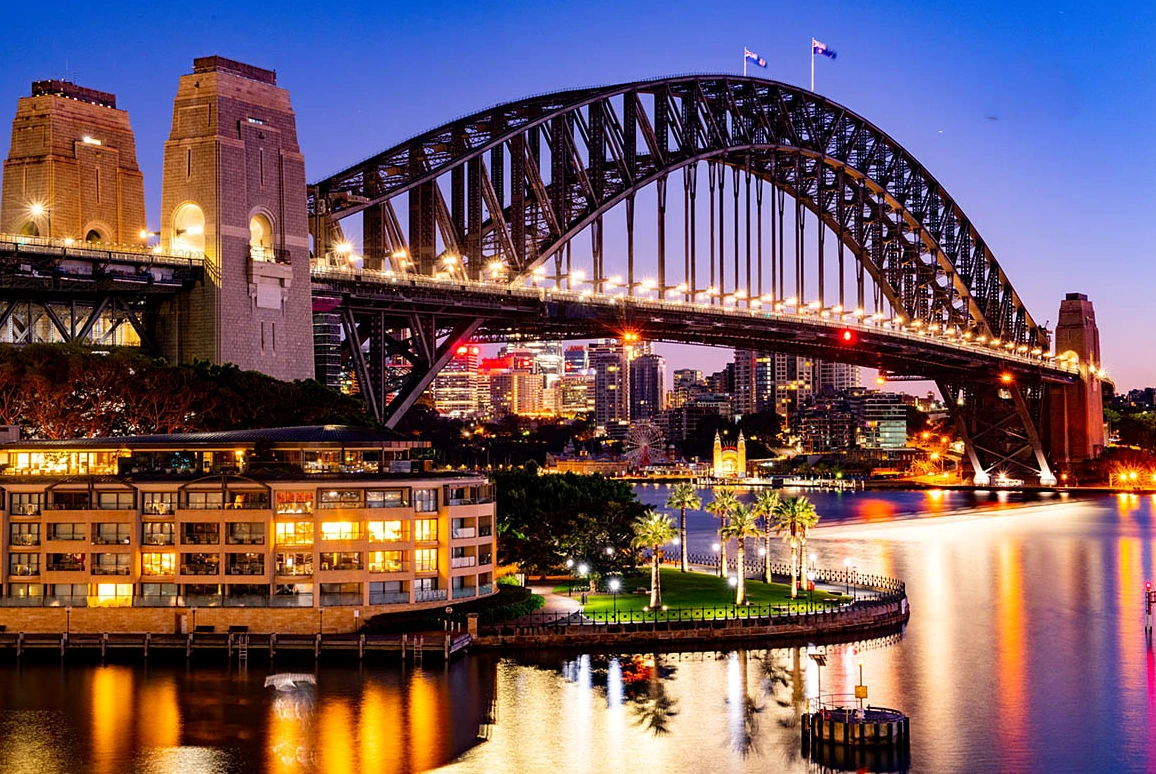
As twilight descends over Port Jackson, bathing the solemn granite blocks of the four pylons in fiery crimson, the Sydney Harbour Bridge sheds its rugged daytime industrial persona to undergo a dazzling nocturnal metamorphosis. At the heart of this visual transformation lies a next-generation programmable smart LED lighting system that hugs every sweeping curve of the colossal steel arch, traces the vertical hanger cables, and washes the sturdy Moruya granite surfaces in rich, shifting hues. Each span ceases to be a static mass of tens of thousands of tons of metal, turning instead into a luminous ribbon of continuous motion shimmering across the dark harbour waters—a splendid harmony between modern architectural marvel and the natural beauty of a world-famous bay.
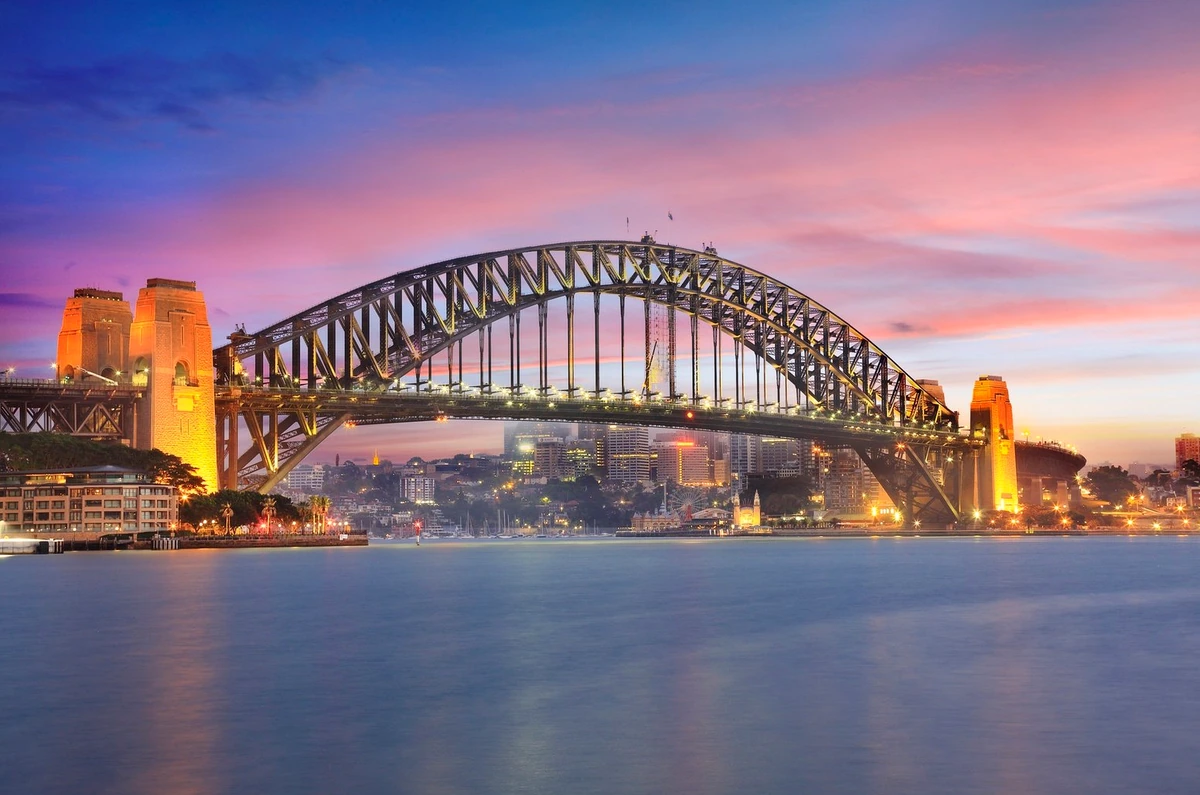
Contemporary visual artistry reaches its zenith during the seasonal transition from May to June each year, when the mega-festival Vivid Sydney officially opens. Throughout weeks celebrating the pinnacle of digital art, the Sydney Harbour Bridge serves as the central spatial anchor seamlessly linking the Light Walk art trail winding through the sandstone alleyways of heritage-listed The Rocks and along the Circular Quay waterfront. Millions of LED lights pulse in synchronized choreography, bringing to life visual narratives honouring the ancient culture of the indigenous Eora nations alongside futuristic digital aesthetics. High-powered laser beams shoot skyward from the crown of the steel arch to pierce the Southern Hemisphere night, turning the entire harbour basin into a breathtaking three-dimensional live stage where visitors stroll past nineteenth-century sandstone warehouses immersed in a sea of enchanting light.
Nightlife radiating around the base of the bridge offers an irresistibly atmospheric blend of culture and dining. Beneath the imposing shadow of the arch at Dawes Point or along the Campbell’s Cove promenade, travellers can step inside some of Australia’s oldest historic pubs, such as The Fortune of War, to sip traditionally brewed craft beer while listening to the deep horns of ferries echoing across the bay. Upscale seafood restaurants nestled right along the water’s edge serve signature ocean delicacies from the Land Down Under—from freshly shucked, briny Sydney Rock Oysters and garlic-butter grilled Tasmanian rock lobster to prime Wagyu beef paired with a crisp Semillon white wine from the breezy Hunter Valley. The clink of glasses mingling with the gentle lap of waves against moored hulls creates an evening ambiance that is refined, luxurious, and deeply rooted in local character.
The ultimate spectacle that catapults the Sydney Harbour Bridge onto the global media stage every year is the stroke of midnight during Sydney New Year’s Eve. At the sacred turn of the year, the entire bridge structure transforms into a colossal pyrotechnic launchpad suspended between sea and sky. World-renowned fireworks erupt simultaneously from the roadway deck and the crest of the steel arch, highlighted by the unmistakable cascading waterfall effect that pours millions of silver sparks streaming endlessly down from the bridge span into the glittering harbour below. Combined with surround-sound audio and synchronized artistic laser projections, the fireworks extravaganza creates a world-class live performance broadcast to billions of viewers across five continents, engraving Sydney’s proud steel arch into global consciousness as an enduring symbol of hope and boundless vitality.
As late afternoon shadows lengthen and sunset gilds the mighty steel girders of the Sydney Harbour Bridge, the precincts hugging its base at Circular Quay and historic The Rocks transform into an enchanting culinary haven. Dining here is far more than indulging in fine seafood and gourmet fare; it is a journey back through time where the ancient culinary philosophy of Indigenous Australian nations converges with waves of European immigrant heritage spanning centuries. Standing along the breezy waterfront, visitors can effortlessly taste the essence of the ocean intertwined with deep continental botanicals, forming a one-of-a-kind flavour map of the Land Down Under.
The cornerstone defining the authentic identity of harbourside cuisine around Sydney Bay is the native bush tucker pantry passed down over tens of thousands of years by Indigenous Australians. Taking pride of place on contemporary menus are world-famous Sydney Rock Oysters, harvested from the nutrient-rich brackish estuaries of the legendary Hawkesbury River. Each oyster’s rugged, time-worn shell conceals plump, creamy meat bursting with rich oceanic minerality. To awaken every layer of flavour, top chefs pair raw oysters with plump pearls of Finger Lime—affectionately dubbed “Australian botanical caviar”—which burst on the palate with a crisp, zesty tang. Native botanicals continue to shine through the fragrant citrus aroma of Lemon Myrtle leaves, the savoury crunch of coastal Saltbush, and vibrant green tips of Warrigal Greens lightly wilted in rich butter, vividly evoking the fertile ecology of the pre-colonial wilderness.
Stepping away from the salty sea breeze into the winding cobblestone lanes of The Rocks immediately immerses travellers in the historic pub culture that has anchored the city’s soul since the nineteenth century. Standing proudly at 19 Kent Street, The Lord Nelson Brewery Hotel—built in 1841—is celebrated as Australia’s oldest continually licensed pub brewery. Pushing open its heavy timber doors reveals the warm aroma of fermenting malt mingling with lively toasts beneath heritage pine ceilings, transporting guests back to the golden age of seafaring explorers. Just a short stroll away, The Hero of Waterloo Hotel—constructed in 1843 from golden sandstone blocks hand-hewn by convict labourers—still preserves a secret underground tunnel leading straight down to the harbour. Once notorious as a haunt for rum smuggling and press-ganging sailors, the tavern today serves hearty traditional roasts where woodsmoke blends with nostalgic, full-bodied ales.
At the pinnacle of Sydney harbourside gastronomy lies world-class haute cuisine. Gracing prime waterfront locations with sweeping views framing the Harbour Bridge arch, Quay and Bennelong stand as two iconic culinary temples of the nation. Beneath soaring sail-like vaults or behind floor-to-ceiling glass overlooking calm waters, master chefs elevate native Australian ingredients into works of visual and sensory art. Savouring herb-cured salmon accented with Indigenous warrigal oil seeds alongside a glass of oak-aged Shiraz from the Barossa Valley while gazing out at the illuminated wonder of the bridge offers a sublime taste of a culinary culture deeply rooted in heritage yet constantly reinventing itself.
To capture the full grandeur of this steel arch masterpiece in your travel memories, visitors can choose from several distinct ways to explore it, each offering its own pace and emotional perspective. The Eastern Pedestrian Walkway remains open twenty-four hours a day and is completely free of charge, guiding walkers up historic sandstone stairs from Cumberland Street in The Rocks directly onto the breezy bridge deck. Running parallel along the western edge is a dedicated Cycleway that also operates around the clock, forming a smooth green transit corridor connecting both sides of the harbour. Strolling dozens of meters above the water through open sky, every step past towering steel trusses evokes awe at the architectural scale that shaped Australia’s premier harbour metropolis.
For travellers fascinated by the engineering saga behind the bridge’s construction, the Pylon Lookout Museum inside the southeast sandstone pylon is an unmissable stop. Open daily from 10:00 AM to 5:00 PM, this exhibition space houses hundreds of artifacts, original archival photographs, and moving stories of the courageous workers who gave their sweat—and in some cases their lives—to quarry every block of granite and drive every steel rivet. After climbing the 330 timber steps winding up through the interior of the tower, the rooftop observation deck unveils a breathtaking 360-degree panorama encompassing Sydney Harbour, the North Shore peninsula, and the bustling skyline of the central business district.
The most exhilarating and unforgettable adventure of all is the BridgeClimb experience, operating 364 days a year across four atmospheric time slots: Dawn, Day, Twilight, and Night. Led by expert local climb leaders, participants suit up in specialized climb gear and clip their safety harnesses onto a continuous static cable to ascend step by step to the summit of the arch, 134 meters above sea level. To guarantee absolute safety for climbers as well as the busy traffic flowing below, strict protocols apply: every participant must pass a mandatory breathalyzer test with a strict 0.00% blood-alcohol reading, and no loose personal items—including personal cameras or mobile phones—are permitted on the climb.
Reaching the Harbour Bridge is effortless thanks to New South Wales’ extensive public transport network. Travellers can ride Sydney Trains and alight at Circular Quay Station on the south shore to begin exploring from The Rocks, or get off at Milsons Point Station on the north shore to admire the towering arch from harbourside parklands. Gliding across the waves aboard an Emerald-class public ferry passing directly beneath the bridge span—or riding the modern L2 and L3 light rail lines—also reveals captivating, ever-changing angles. Insider field experience shows that the golden hour for photography falls roughly one hour before sunset along the Eastern Pedestrian Walkway, when warm late-afternoon light gilds the sails of the Sydney Opera House and turns the harbour waters violet—just before you stroll down into Argyle Place to unwind with a craft beer beside the historic sandstone courtyards of Sussex Street.
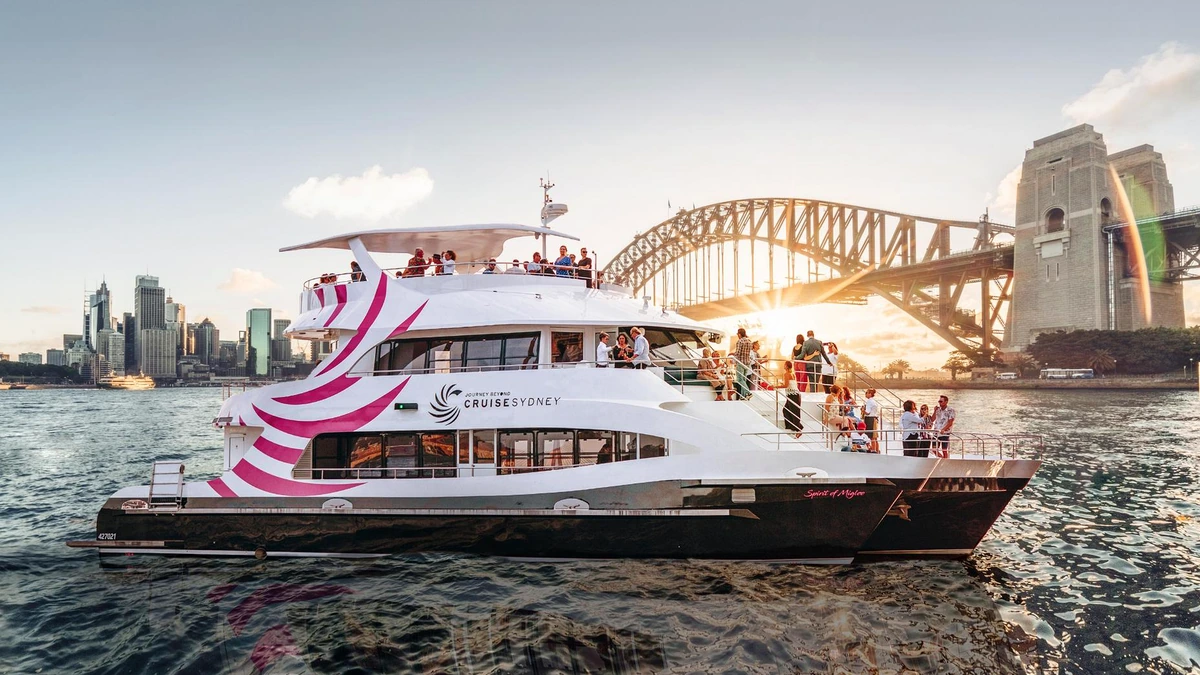
The seamless blend of pinnacle mechanical architecture and rich cultural heritage makes the Sydney Harbour Bridge a shining icon that beckons travellers from around the globe. To experience these breathtaking harbourside moments alongside curated, first-class travel experiences, choosing an all-inclusive Sydney – Melbourne Australia tour package is the ideal starting point for a journey filled with cultural discovery and the distinct flavours of the Southern Continent.