Nestled precariously along the slopes of Ruifang in northeastern Taiwan, overlooking the misty East China Sea, the name Jiufen carries a remarkably distinctive historical identity. The origins of this settlement trace back to the Qing dynasty era on the island, when this rugged mountain terrain was still a wild frontier shrouded in dense mist year-round. In the beginning, only nine courageous Han Chinese households settled here, living in quiet isolation amid the mountain forests. Because the steep terrain cut them off from the lowlands, traveling by bamboo raft or trekking across mountain trails and streams down to coastal markets for lamp oil, cloth, and provisions was an arduous undertaking. To share the burden, the nine families agreed to send a single representative down to gather supplies, and every item brought back up the mountain had to be divided evenly into nine exact portions—a custom locals referred to as “dividing into nine portions” (*Jiufen*). That humble expression of mutual aid gradually took root in local memory, becoming the enduring geographic name Jiufen across centuries of change.
The destiny of this remote mountain hamlet took a dramatic turn in 1890, during the Guangxu reign of the Qing dynasty. While constructing the railway line linking Taipei and Keelung, excavation workers chanced upon glinting flecks of alluvial gold in the bed of a nearby creek. News of this windfall immediately ignited a fierce gold rush across the island, drawing tens of thousands of prospectors, miners, and ore traders into the Ruifang hills in pursuit of fortune. Following the signing of the Treaty of Shimonoseki in 1895, Taiwan entered the period of Japanese rule. Recognizing the vast mineral deposits locked within the geological strata, colonial authorities swiftly transformed Jiufen into a major mining hub, granting large-scale industrial mining rights to the prominent Japanese conglomerate Fujita-gumi. Later, a landmark partnership between Fujita-gumi and Keelung’s Yan family—the influential mining dynasty led by Yan Yun-nian—accelerated extraction to unprecedented levels, turning the town into one of the richest gold-producing centers in East Asia.
Shimmering veins of ore pouring out of the earth rapidly transformed the quiet mountain hamlet into an extraordinarily prosperous hillside boomtown. During its heyday under Japanese rule, Jiufen was celebrated as “Little Shanghai” or the “City That Never Sleeps,” where glowing red lanterns illuminated the steep stone staircases from dusk until dawn. Along the precipitous steps, opulent wine houses, traditional opera theaters, upscale inns, and fragrant teahouses sprang up shoulder to shoulder, welcoming newly enriched miners and wealthy merchants eager to spend freely. Yet prosperity built on underground resources could not last forever. After World War II, mineral reserves dwindled sharply, and by 1971, once the gold veins were completely exhausted, the mining companies shut down one after another. Jiufen plunged into a bleak decline; residents departed in search of livelihoods elsewhere, leaving behind dark mine shafts and silent, empty lanes. For nearly two decades, the town slumbered in quiet obscurity, its dark tar-paper wooden roofs weathered by fierce sea winds and damp drizzle, seemingly on the verge of fading from memory.
Yet the very melancholy of a faded golden-age boomtown became the extraordinary catalyst that reawakened Jiufen’s soul. In 1989, acclaimed director Hou Hsiao-hsien chose the town’s atmospheric, timeworn streets as the primary setting for his cinematic masterpiece *A City of Sadness*. Nostalgic frames of steep stone stairways, rain-slicked tiled roofs, and vintage tones captured deep historical chapters of the island, earning the film the prestigious Golden Lion at the Venice Film Festival. The movie’s global acclaim not only marked a milestone for Taiwanese cinema, but also sparked a wave of nostalgic appreciation that rescued Jiufen from abandonment and reborn it as an international cultural and travel landmark—where mining history blends effortlessly with atmospheric teahouses and glowing Eastern lanterns.
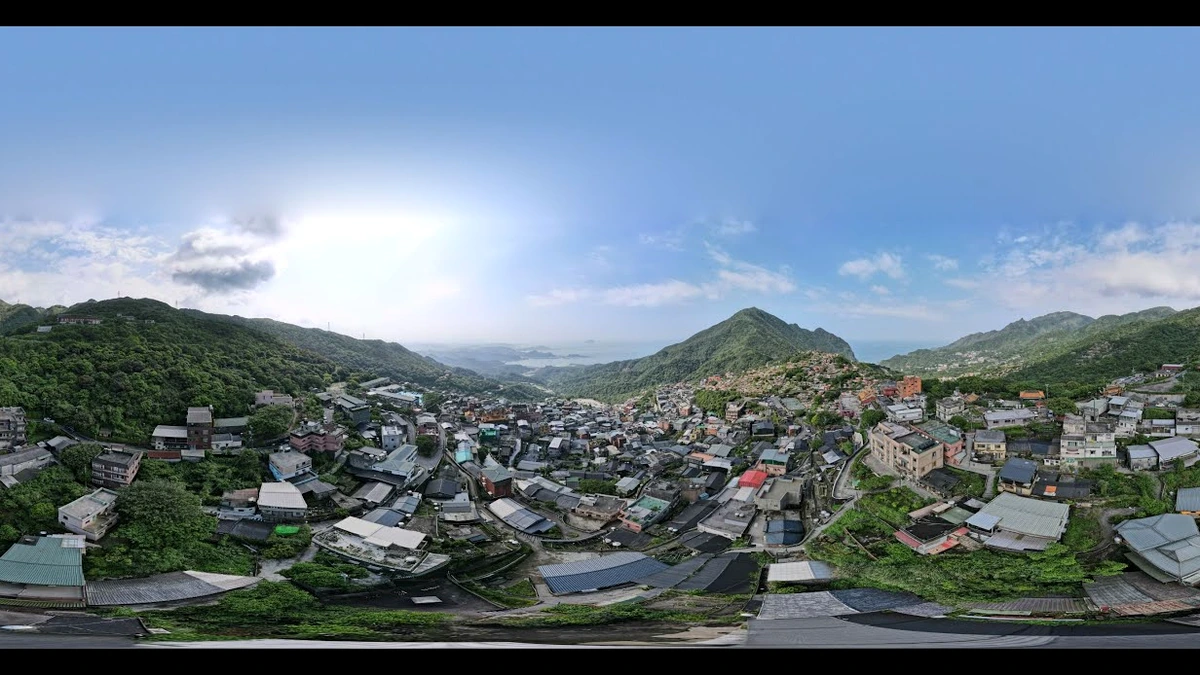
Perched along the northeastern flank of Mount Keelung within the ancient Keelung Volcano Group, Jiufen exhibits a distinctive spatial layout shaped by topography and traditional geomantic philosophy. When early settlers cleared the slopes and waves of gold miners followed, building sites were chosen in accordance with classic *feng shui* principles—backing against the towering mountain ridge for shelter from fierce northern gales while opening wide views toward Shen’ao Bay and the breezy East China Sea to welcome sunlight and vitality. To traditional geomancers, Jiufen sat within an amphitheater-like basin likened to a “golden basin scooping seawater”—an auspicious water-gathering formation seen as both a mystical sign of the rich gold veins hidden beneath the rock and a natural foundation for enduring settlement through centuries of change.
Confronting steep gradients and rugged slopes, local urban development bypassed conventional flat grid layouts in favor of asymmetric, stepped terraces following the natural contours of the mountain. Houses rise in tightly staggered tiers, where each sturdy stone foundation platform serves simultaneously as a retaining wall for the terrace above. These sharp elevation changes create a layered skyline in which the eaves of one home sit nearly level with the courtyard floor of its uphill neighbor. Adapted to year-round rainfall and the humid monsoon climate of the northeast coast, traditional construction paired hand-split local mountain stone bases with moisture-resistant cypress timber walls and gently sloped roofs sealed with dark tarred felt to withstand severe Pacific typhoons.
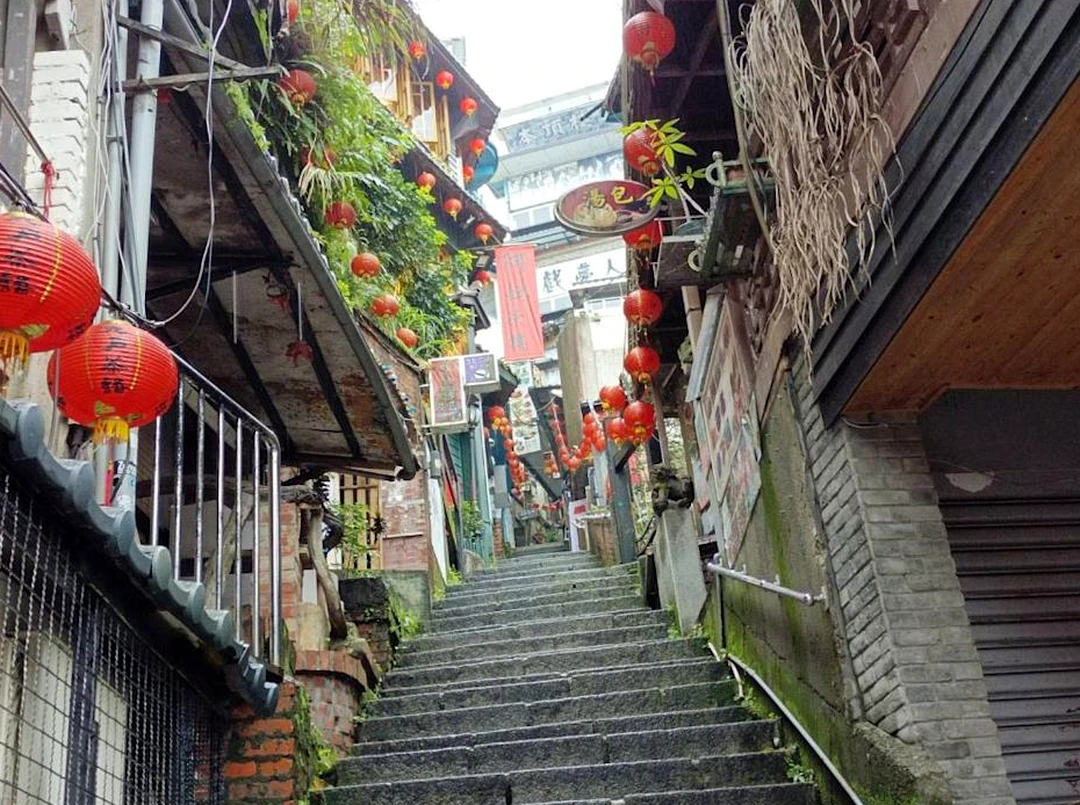
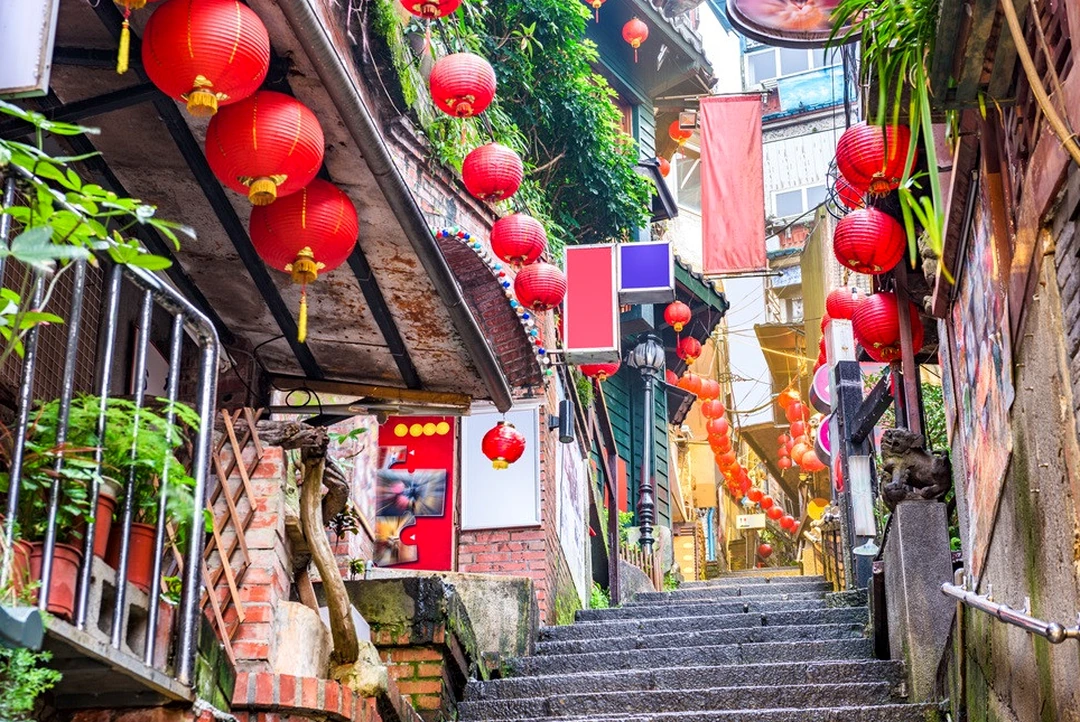
Serving as the vertical spine tying every tier of the village together is Shuqi Road, a steep artery climbing more than 300 weathered granite steps. This narrow passageway embodies the local architectural adage that “the road is the stairs, and the stairs are the road.” While Shuqi Road and its intersecting horizontal lanes—such as Jishan Street and Qingbian Road—appear dramatic at first glance, they represent a clever vernacular engineering solution to mountain weather. During torrential downpours, the steep stone steps double as natural drainage channels rushing rainwater straight down into the valley and preventing foundation flooding, while closely packed walls on either side break the force of gusty sea winds to create a sheltered, cozy microclimate within the old town.
This seamless union of dramatic natural terrain and human craftsmanship has forged a visual landscape of rare poetic beauty. When sea mist drifts across dark volcanic ridges, the tar-roofed hillside homes appear suspended in ethereal vapor like a classical landscape painting. Punctuating the gray stone and deep green mountain slopes, strings of red lanterns line the steep eaves of Shuqi Road, drawing the eye upward from the lower steps to the breezy ridge above. This vertical townscape not only preserves the resilient ingenuity of early mining communities, but also turns Jiufen into a living architectural organism woven directly into the folds of the mountain.
Clinging to the slopes of Mount Keelung overlooking the windswept East China Sea, Jiufen’s layout reflects a remarkable interplay between steep topography and layered cultural history. Rather than following a lowland grid, circulation traces the mountainside along three primary axes: Jishan Street running horizontally across the slope, Qingbian Road following the route of the former mining push-car railway, and Shuqi Road ascending vertically up hundreds of dark basalt and stone steps from the base of the village to the upper ridge. Along narrow alleys barely wide enough for two people to pass, the town’s architecture reveals three distinct historical strata: traditional Minnan brick-and-tile structures built by early Fujianese settlers during the Qing dynasty, refined timber framing from the Japanese era, and utilitarian load-bearing masonry from post-war reconstruction.
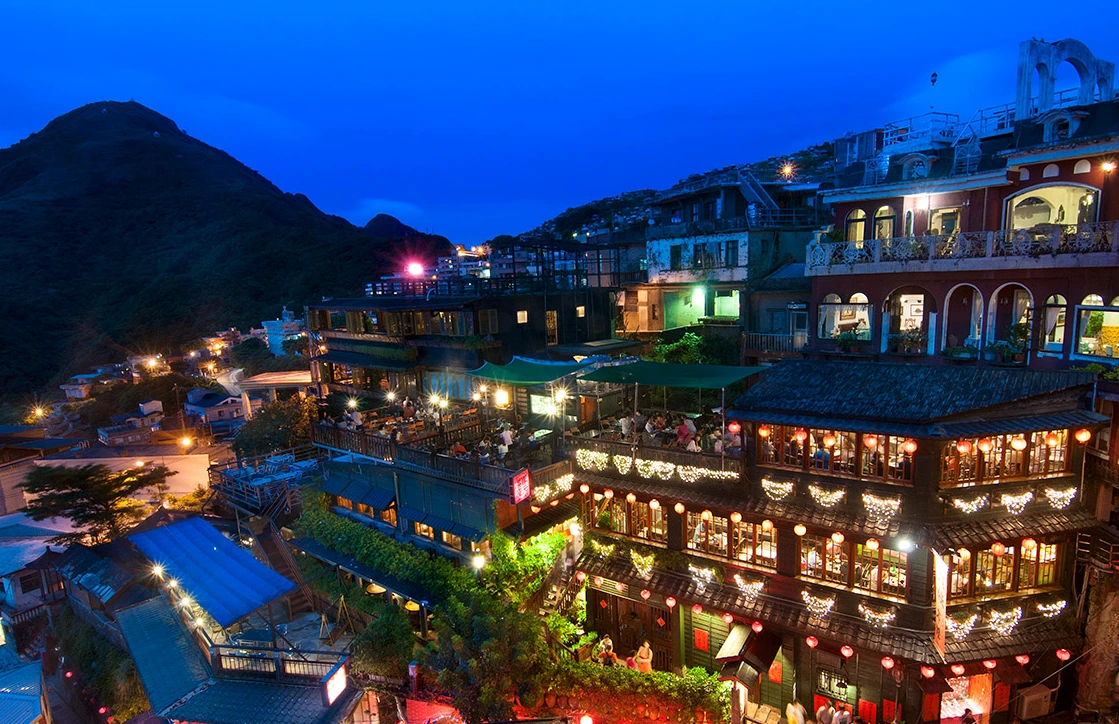
Commanding a prime vantage point along the steep ascent of Shuqi Road, A-Mei Teahouse stands as an iconic example of adaptive reuse and traditional timber craftsmanship. This striking three-story landmark originally operated as a rustic blacksmith workshop forging hammers, chisels, and gold-panning sluices for miners at the height of the gold rush. When converted into a grand teahouse, local artisans drew upon traditional hillside *diaojiaolou* (overhanging timber-frame) techniques, using the steep slope to cantilever wooden balconies boldly out over the mountainside. Its beams, pillars, and railings were joined using precision East Asian mortise-and-tenon joinery without relying on metal nails—allowing the structure just enough natural flexibility to withstand Pacific gales sweeping across the northeastern range while opening airy, multi-level spaces filled with mountain breezes and the lingering fragrance of oolong tea.
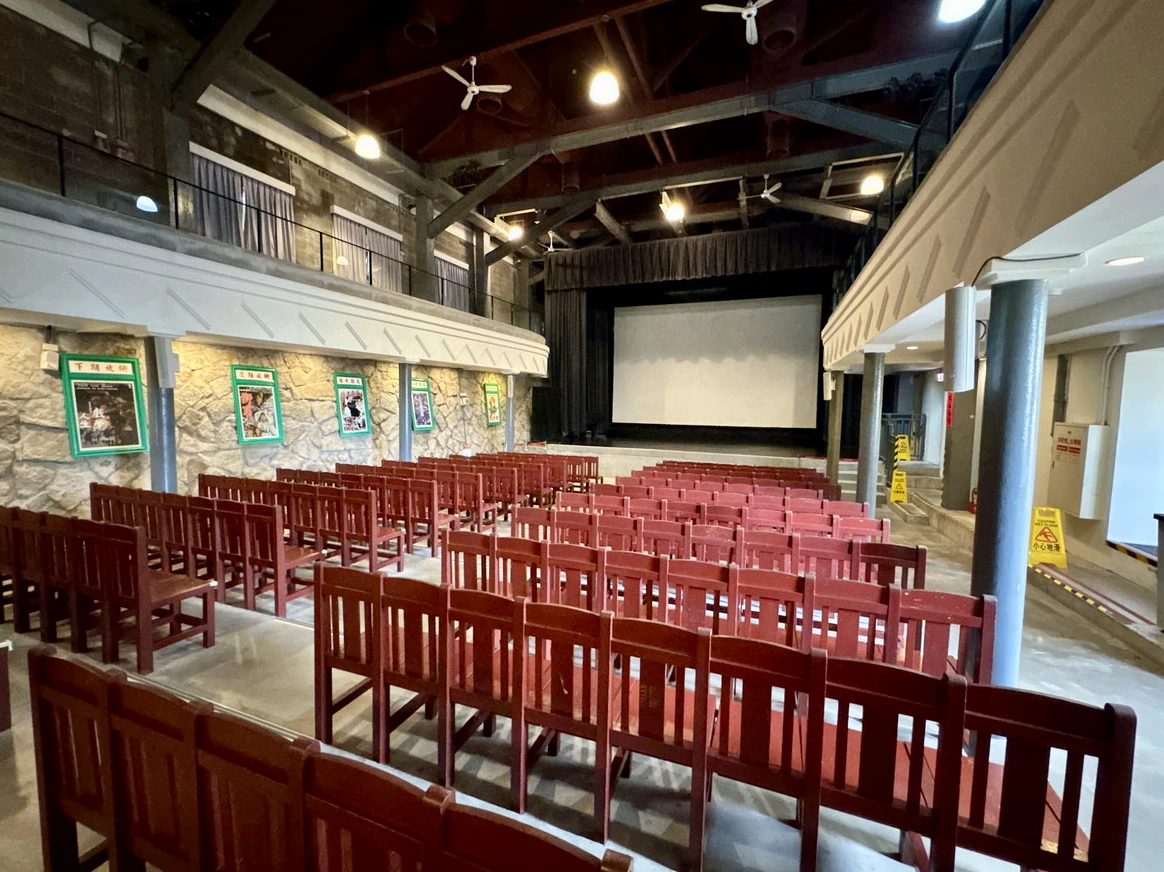
Dotting the dark wooden railings of the teahouses are hundreds of crimson silk lanterns arranged in symmetrical rows, casting a warm amber glow across damp, moss-covered flagstones. Alongside the refined elegance of its tranquil teahouses, Jiufen also preserves a monumental relic of its industrial mining civilization: Shengping Theater, standing prominently at the mountain town’s busiest crossroads. Constructed in 1934 during the Japanese colonial era, Shengping Theater holds the distinction of being the oldest surviving modern theater in Taiwan. Its facade showcases a modernized Showa-era Baroque aesthetic with graceful arches sculpted in rough cement plaster, contrasting strikingly with an interior structural frame built entirely from prime, solid Hinoki cypress harvested from native primeval forests.
At its peak, the theater seated more than a thousand spectators, engineered with a gently sloping auditorium floor and a specially curved ceiling to achieve optimal dome acoustics. This thoughtful design enabled the vocal projections of traditional Hokkien opera troupes and the soundtracks of golden-age silent films to carry clearly to the very back row without electronic amplification. The lavish presence of such a grand playhouse perched midway up a rugged mountain peak makes Shengping a living fossil, vividly reflecting the prosperous spiritual life and yearning to shake off coal dust among miners during the decades when Jiufen was hailed as “Little Shanghai” amid the misty highlands.
To adapt seamlessly to the heavy year-round rainfall of the Ruifang coast, Jiufen’s traditional builders also devised a distinctive tar-felt roofing technique. Sheets of jet-black asphalt-coated felt were nailed in overlapping layers across sloped timber roofs, creating a striking visual tapestry of dark rooftops emerging through drifting blue mountain mist and safeguarding the soul of this hillside town through decades of change.
As twilight fades behind the layered peaks of Ruifang District and the Pacific Ocean off Keelung Harbor deepens into indigo, Jiufen sheds its bustling daytime persona to enter an enchanting nocturnal transformation. Here, there are no artificial stages or scripted theatrics; instead, the entire steep slope of Mount Keelung becomes a living open-air theater. The visual heart of this transformation centers along Shuqi Road—a spine of more than three hundred moss-kissed granite steps climbing from the foot of the slope to the upper ridge of the town. Along wooden balustrades and beneath the curved yin-yang tiled eaves of historic teahouses, hundreds of red lanterns flicker to life simultaneously. Their warm vermilion glow is far more than an aesthetic ornament; it is a collective memory rooted in the height of the gold-mining boom, when lanterns guided exhausted miners home after overnight shifts underground while welcoming patrons to the taverns and entertainment houses that earned Jiufen its reputation as a gold-lavished “Little Shanghai” in the misty mountains.
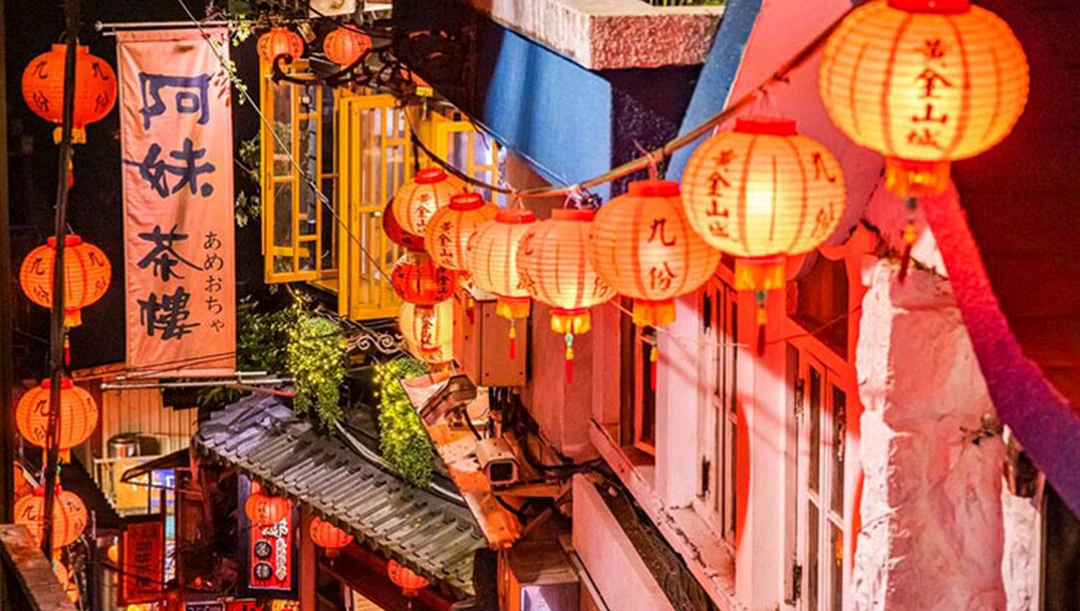
The microclimate of Taiwan’s northeastern coast regularly sweeps thin ribbons of fog and salt-tinged sea breezes down into the rocky valley. As damp mist drifts through narrow alleys and wraps around timber pillars, the interplay between warm lantern radiance and suspended water droplets creates an atmospheric Tyndall scattering effect. Beams of orange-red light pierce the translucent haze and slant across wet stone steps, producing a deeply cinematic, nostalgic visual field. Wandering these winding staircases at night feels like stepping into frames from Hou Hsiao-hsien’s acclaimed film A City of Sadness or drifting into a dreamlike realm of East Asian animation. Subtle notes of incense wafting from cliffside Fude Zhengshen shrines mingle with the sweet aromas of taro balls and herbal rice cakes carried on the cool evening breeze, awakening every sense on the mountainside.
Nightlife in Jiufen reaches its most refined expression inside time-honored teahouses such as A-Mei Tea House and Haiyue Teahouse. Seated beside cypress-wood windows overlooking the bay, guests experience gracious hospitality through traditional Gongfu tea ceremonies. Leaves of Dongding Oolong or Oriental Beauty Oolong are awakened with water heated to exact temperature in cast-iron kettles over glowing charcoal, releasing rich notes of wildflower honey and ripe orchard fruit. Inside, the tranquil atmosphere is woven from the lyrical strains of guzheng zithers and erhu fiddles, contrasting serenely with the vast ocean beyond the lattice windows. Looking out from this lofty vantage point reveals a dramatic panorama: below, crimson lantern light hugs the steep stone staircases, while far across Shen’ao Bay, hundreds of bright lights twinkle from Keelung squid-fishing boats on the night horizon. This convergence of hillside lanterns, offshore fishing lamps, and traditional strings turns Jiufen after dark into a timeless realm set apart from the modern world.
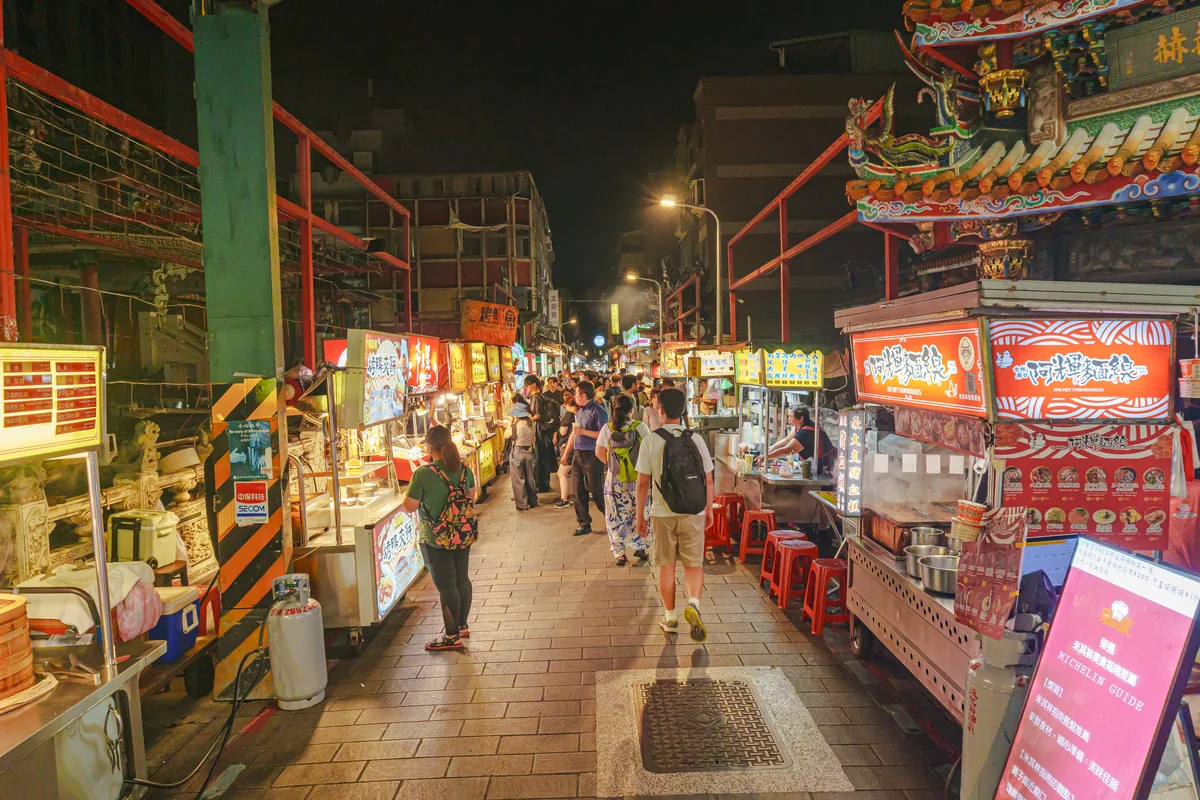
Year-round mist, sheer rocky cliffs across the Ruifang hills, and the grueling demands of deep underground mining directly shaped Jiufen’s distinctive culinary philosophy. Rather than emerging from elaborate royal courts or opulent banquets, local flavors grew out of physical endurance, nourishment, and close attunement to mountain weather. Across more than a century of evolution from a booming mining camp into a celebrated heritage town, humble specialties served along the steep lanes of Jishan and Shuqi Streets continue to preserve the collective memory of generations of highland residents.
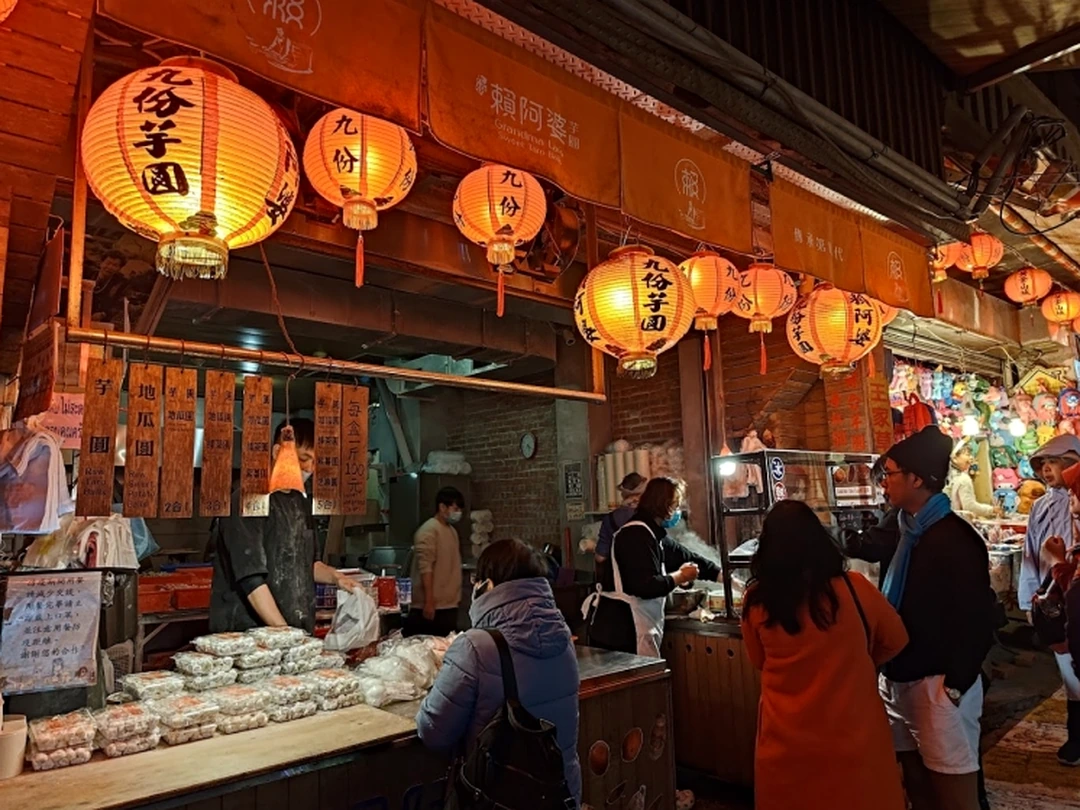
The village’s most famous culinary icon is its handmade taro and sweet potato balls, known locally as yuyuan. Behind these bite-sized golden sweet potato and pale-violet taro dumplings lies a time-honored mixing ratio perfected across generations to achieve what Taiwanese diners call “Q”—an ideal springy, chewy elasticity that bounces gently against the teeth while releasing the clean, natural sweetness of fresh root vegetables. Prime taro from Dajia and sweet potatoes from Jinshan are peeled, steamed until tender, mashed on wooden boards, and kneaded with sweet potato starch in exact proportions. Beloved institutions such as Lai Ah Po and Ah Gan Yi—perched near the highest steps of the old town—consistently draw long lines of eager diners. Whether enjoyed piping hot in warming ginger syrup on misty winter days or served over shaved ice on breezy summer afternoons, savoring chewy taro pearls while gazing out over Badouzi Bay and the East China Sea leaves an unforgettable impression.
Alongside taro balls, Caozaiguo (herbal mugwort rice cakes) offers an intimate window into the agricultural rhythms and seasonal traditions of Hakka and Hokkien settlers. These jade-green glutinous rice cakes draw their soul from wild mugwort or cudweed harvested from damp slopes around Mount Keelung. Picked in season, the tender shoots are washed, blanched, pounded into a paste, and kneaded directly into glutinous rice dough to form a smooth wrapper infused with wild herbal aroma and gentle bitterness. Tucked inside is a savory, richly seasoned filling of shredded dried daikon radish, minced pork belly, shiitake mushrooms, and shallots fried until fragrant in lard. Shaped by hand into ovals, rested on fresh banana leaves, and steamed in billowing bamboo baskets at heritage stalls such as Ah Lan on the old street, these cakes serve both as a comforting snack and as a traditional offering during Qingming tomb-sweeping rituals, expressing gratitude toward the mountain flora that sustained earlier generations.
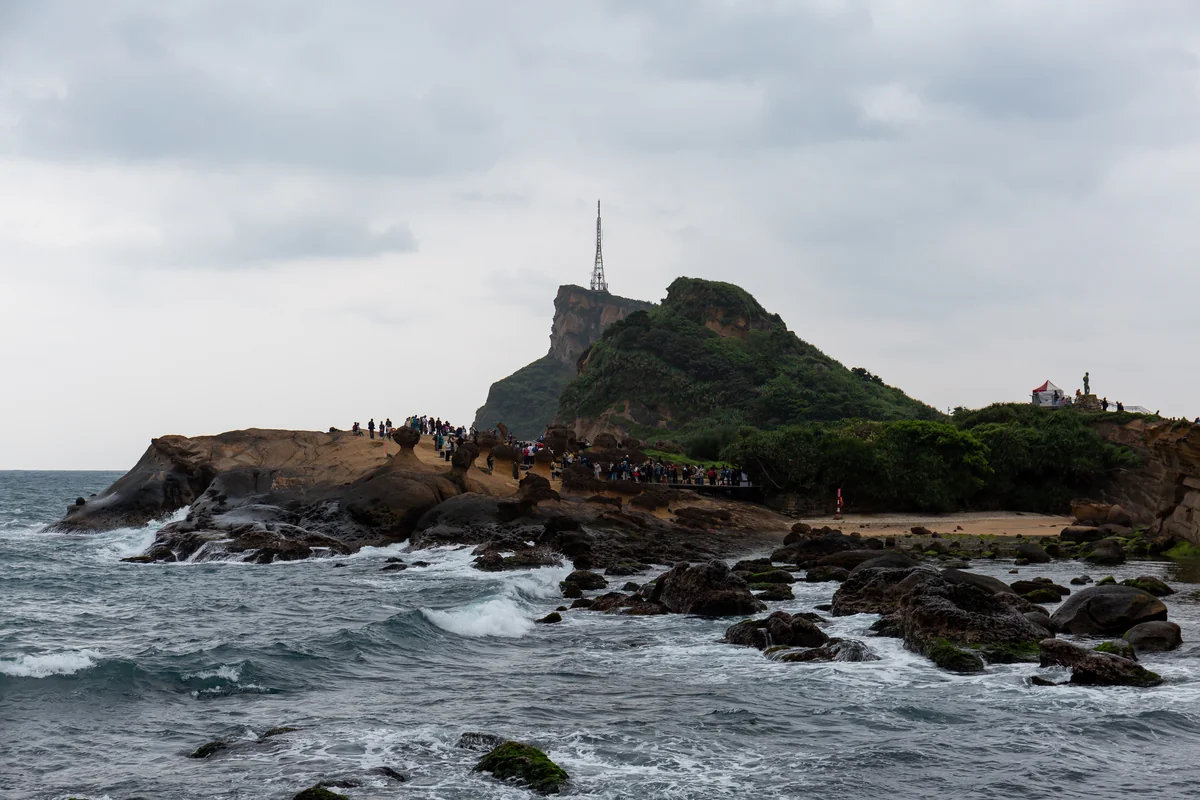
A scenic loop along Taiwan’s northern coast naturally pairs the winding lanes of Jiufen Old Street with a visit to the wind- and wave-sculpted sandstone formations of Yehliu Geopark.
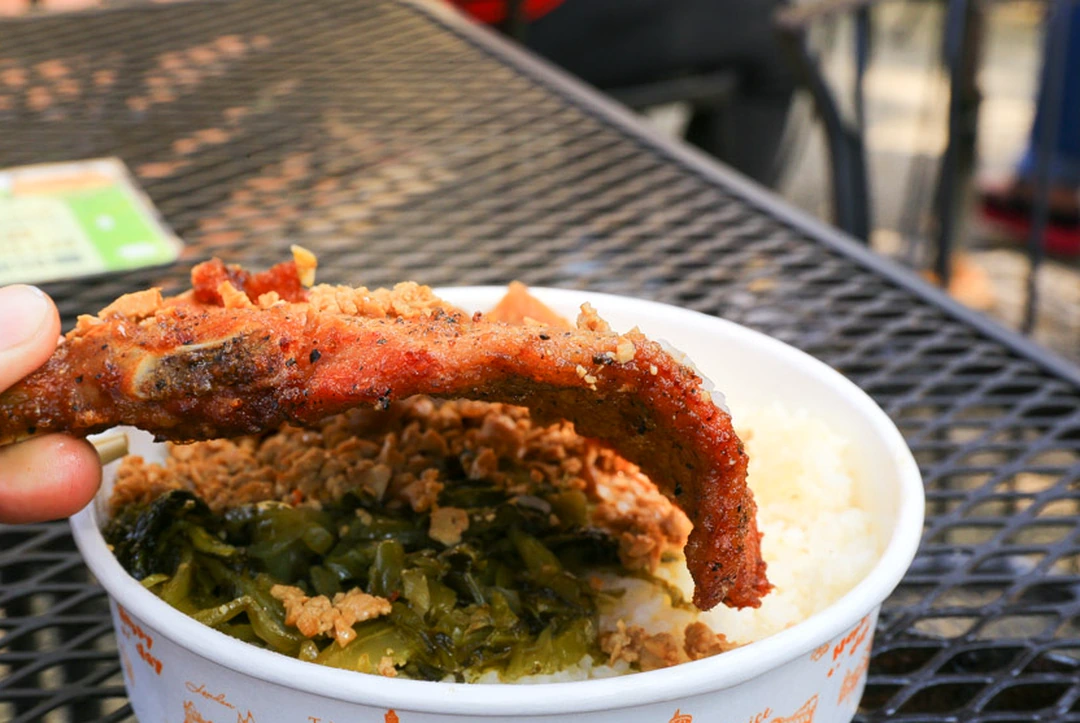
To grasp the daily hardship of the town’s historic miners, the traditional Miner’s Bento stands as the most vivid edible artifact still preserved today. Once relied upon as vital sustenance for tens of thousands of laborers working hundreds of meters below sea level, these meals were crafted with generous richness and savory seasoning to replenish salt and energy lost underground. A classic portion is packed tightly inside a round tin lunchbox, featuring a thick pork chop marinated in five-spice powder, seared over high heat, and braised until tender in rich soy broth alongside crisp pickled mustard greens, soy-braised egg, and savory spiced tofu. Once wrapped in blue floral cloth and carried into dark mine shafts, this metal lunchbox has evolved into a nostalgic culinary ritual connecting modern travelers with the gritty reality of Jiufen’s gold-rush past.
A tasting journey through Jiufen reaches its finest conclusion inside dark-timbered heritage teahouses such as A-Mei Tea House or Jiufen Teahouse. Fragrant leaves of Oriental Beauty or high-mountain Oolong steeped in pure spring water and poured from Yixing clay teapots into rustic ceramic cups create an oasis of calm above the bustling stairways. Lingering floral-honey notes on the palate, paired with cool sea breezes drifting through bamboo blinds, bring a fitting close to the warm, human culinary heritage of this village suspended in the clouds.
To make a visit to former mining town Jiufen smooth and relaxed, knowing local public transit and daily mountain rhythms in Ruifang helps a great deal. Set along steep slopes above Keelung looking out toward coastal waters, Jiufen has narrow hillside lanes, frequent mist, and limited parking, so driving a private car is often less convenient than using public transit. A straightforward route takes Taiwan Railways (TRA) from central Taipei to Ruifang Station, then connects via local buses such as Route 788 toward Jinguashi or Route 965 from Banqiao and Ximen directly up to Jiufen Old Street.
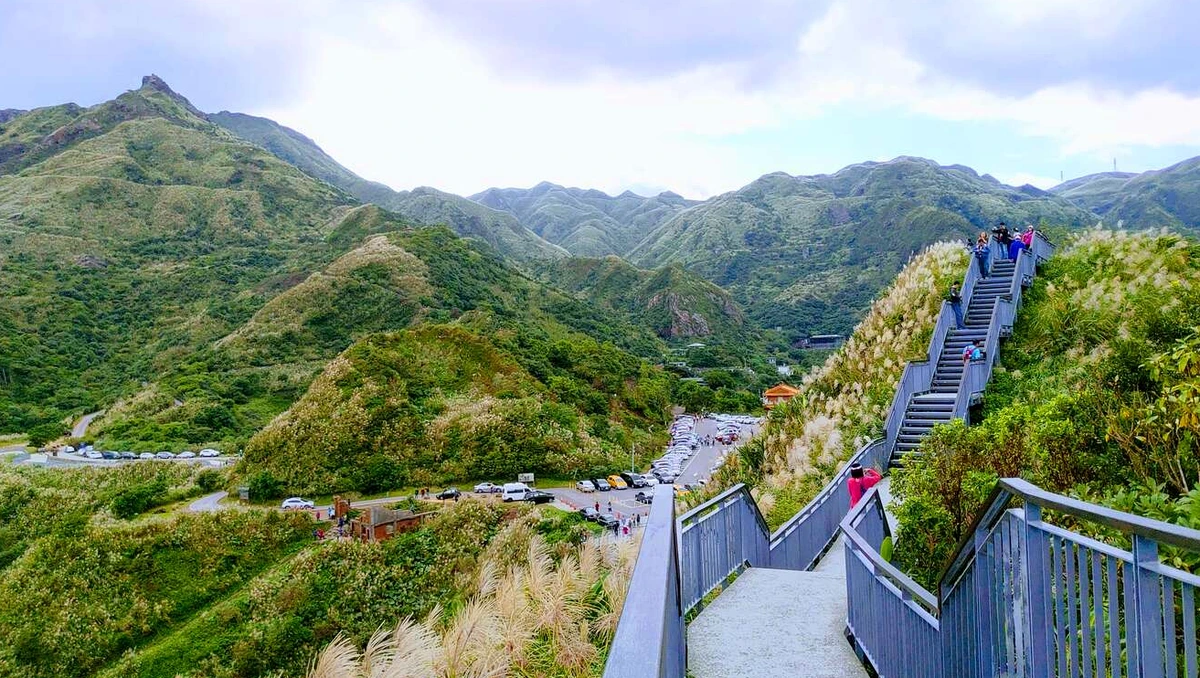
Daily hours follow a classic hillside pattern. Many street-food stalls along Jishan Street open around 09:00 AM and begin closing between 07:00 PM and 08:00 PM, while tea houses such as A-Mei Tea House often stay open later into the evening (around 10:00 PM). Late afternoon into early evening on weekdays—roughly 05:00 PM to 07:00 PM—offers a memorable shift from coastal twilight to glowing red lanterns without heavy weekend crowds.
A thoughtful walking route saves effort on steep stone steps. Starting along Jishan Street lets visitors sample local specialties like sweet taro balls (“taro balls” / “yu yuan”), herbal cakes, and savory fish balls before turning onto stepped Shuqi Road toward A-Mei Tea House and historic Shengping Theater—walking downhill along steps while taking in dark tar-paper roofs and hillside views.
Costs in Jiufen are generally modest: a seated tea service at a traditional tea house often runs around 400 to 600 TWD per person (including oolong tea and light snacks such as mung-bean sweets or preserved plums), while street snacks commonly cost around 50 to 100 TWD per item. Because northern coastal weather can bring rain and damp stone steps, a compact umbrella or light rain jacket and good-grip walking shoes are practical essentials.
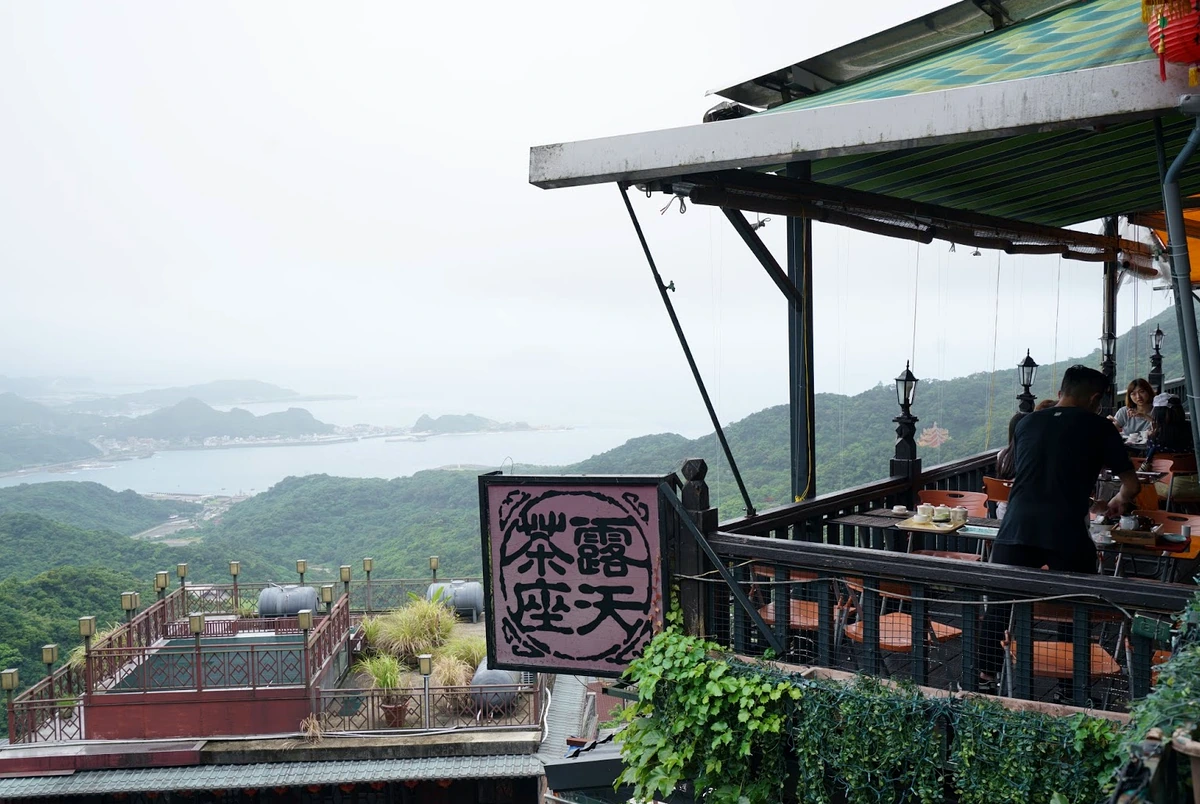
Beyond busy lanes, Jiufen’s quieter side shines inside traditional tea rooms—where speaking softly and keeping phones on silent helps preserve a calm atmosphere. For an organized trip with transport and local support handled, you can explore our all-inclusive Taiwan tour packages for a smooth, well-paced itinerary.