Tucked deep within the rugged folds of the majestic Xiangxi borderlands, Shibadong Village (Chinese: 十八洞村 – “Eighteen Caves Village”) in Shuanglong Town, Huayuan County, Xiangxi Tujia and Miao Autonomous Prefecture, Hunan Province, stands as an enduring testament to nature and history. The name Shibadong is far more than an administrative title; it originates directly from the dramatic karst geology behind the village, where eighteen natural limestone caverns of varying sizes pierce the mountainside. In local geographic consciousness, this interconnected cavern system serves both as a geological marvel sculpted over millions of years and as a natural fortress wall that sheltered the Miao community through centuries of upheaval—shaping a secluded living sanctuary brimming with extraordinary resilience amid mist-shrouded mountain valleys.
Tracing the historical chronicles back to the eighteenth century during the Qianlong reign of the Qing Dynasty, this rugged frontier was frequently engulfed in prolonged ethnic conflicts and widespread banditry across the deep mountain forests. Confronted by turbulent times and Qing imperial military campaigns, ancestral Miao settlers chose the formidable terrain of Shibadong as their refuge, turning the eighteen limestone caverns high on the cliffs into defensive bastions and life-saving sanctuaries. Whenever warfare swept through the valleys of Huayuan or bandits closed in, the entire village gathered their livestock and provisions and retreated deep into the stone caverns, relying on the treacherous rock labyrinth to preserve their bloodline. Across centuries of wind and frost, this karst landscape not only safeguarded lives, but also tempered an unadulterated Miao cultural identity insulated completely from the bustling world beyond the primeval forest.
Yet the very isolation that once protected Shibadong inadvertently turned it into an acutely impoverished enclave upon entering the modern era. For generations, a single treacherous, slippery cliffside footpath separated villagers from modern infrastructure and economic opportunity. The somber memories of those years were etched in stark statistics: prior to its awakening, the village languished in extreme hardship with a poverty rate hitting a staggering fifty-seven percent and annual per capita income of just 1,668 RMB. Local young men struggled to find brides, as few women wished to marry into a gray limestone valley lacking reliable electricity and running water, where farming was left entirely at the mercy of harsh weather and rocky soil.
That bleak chapter closed definitively to open an epoch-making turning point on November 3, 2013, when Chinese President Xi Jinping traversed steep mountain passes to visit the courtyards of local Miao villagers firsthand. Right beneath the eaves of a traditional wooden home in Shibadong, the national strategic concept of “Targeted Poverty Alleviation” (精准扶贫) was first articulated and launched into national policy. This historic milestone sparked a sweeping transformation, turning a remote village once on the brink of despair into a flagship model of rural revitalization—channeling ancient karst cavern heritage and vibrant Miao culture into community-based ecotourism and elevating Shibadong into a celebrated “Red Landmark” renowned across Xiangxi.
Nestled amid the rolling ridges of the Wuling Mountains in western Hunan Province, Shibadong commands an extraordinary geomantic plateau uniting the untamed grandeur and rugged majesty of Xiangxi. Built firmly against towering limestone cliffs while overlooking deep, cloud-veiled valleys below, the ancient settlement embodies the classic feng shui posture of “crouching tiger, hidden dragon.” Its topography is a hundred-million-year masterpiece of karst weathering, carving jagged stone pinnacles interspersed with deep gorges and endless expanses of lush primeval forest. This secluded setting once formed an island virtually detached from the outside world, preserving pristine natural beauty alongside the ancestral settlement traditions of the Miao ethnic people.
The defining feature giving soul to both the scenery and the name of the village is its magnificent system of eighteen natural karst caves penetrating deep into the limestone massif. Scattered across surrounding mountain slopes, these caverns vary dramatically in length and interior structure, adorned with countless stalagmites and stalactites sculpted over eons into forms resembling coiling dragons and dancing phoenixes. Beyond geological wonder, this subterranean network acts as an immense natural reservoir supplying pure, mineral-rich spring water that irrigates terraced rice paddies curving gracefully around the hillsides. The interplay of soaring peaks, deep ravines, dense forests, and underground caverns endows Shibadong with a distinct microclimate—refreshingly cool in summer and draped in ethereal mist throughout winter.
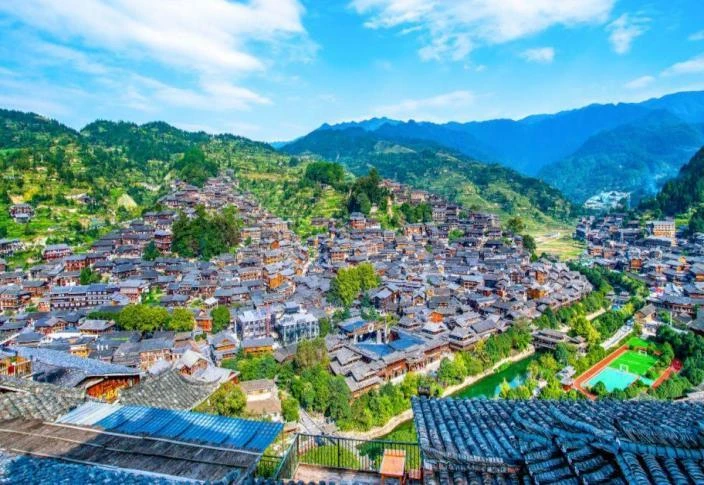
Shibadong’s spatial layout stands as a textbook expression of the indigenous Miao philosophy of “harmony between humanity and nature,” adapting to the landscape rather than forcibly reshaping it. The village is organized into smaller hamlets—including Feichong, Huangtao, Dangrong, and Zhuzi—linked by winding bluestone footpaths hugging the cliffside. Every Diaojiaolou stilted wooden house, crafted from fir timber and roofed with dark gray yin-yang tiles, rises gracefully along the natural slope of the hillside to form a rhythmic, tiered architectural symphony. This arrangement allows each dwelling to welcome cool, revitalizing breezes rising from the valley while sheltering the village from biting winter winds sweeping down from mountain peaks.
On the regional travel map, Shibadong occupies a strategic crossroads linking Xiangxi’s most celebrated heritage destinations. Driven by modern infrastructure—notably the Zhangjiajie–Jishou–Huaihua high-speed railway with its key hub at Jishou East Station, alongside the G56 Hangzhou–Ruili Expressway spanning dramatic gorges via soaring suspension bridges—the village’s centuries-old isolation has vanished completely. This prime location makes Shibadong an ideal bridge uniting the sandstone pillar wonders of Zhangjiajie to the north with the timeless riverside charm of Fenghuang Ancient Town to the south, weaving together the famed “Xiangxi Golden Triangle.”
Consequently, Shibadong’s natural beauty does not stand in isolation, but flows seamlessly into a multi-ethnic Miao and Tujia cultural corridor tracing the Tuojiang River and the Wuling Mountains. As travelers wind through cloud-draped mountain passes to enter Shibadong, they experience a dramatic shift in terrain—from towering limestone spires to serene terraced valleys where murmuring mountain streams mingle with the rhythmic clatter of brocade looms echoing from stilted wooden homes clinging to the mountainside.
Cradled amid towering karst limestone massifs in the heart of Xiangxi’s great forests, the Miao residential ensemble of Shibadong shines as a masterpiece uniting folk craftsmanship with natural survival wisdom. Dotting the steep slopes are traditional stilted wooden houses known as Diaojiaolou (吊脚楼)—a distinctive vernacular architecture born from deep adaptation to precipitous mountain terrain, misty humidity, and uneven ground. Rather than blasting cliffs to create flat lots, indigenous master carpenters turned rugged slopes into sturdy foundations by anchoring timber pillars that cantilever part of the living floor out over the valley—leaning securely against ancient rock faces while opening sweeping vistas over gentle mountain streams below.
The pinnacle of Diaojiaolou craftsmanship in Shibadong lies in its completely nail-free construction philosophy, eschewing iron nails or metal fasteners of any kind. Entire frameworks of aged fir and pine are assembled through intricate mortise-and-tenon joinery (榫卯结构 – Sunmao), a closely guarded craft passed down across generations of Miao master builders. Interlocking with millimeter precision, these load-bearing timber joints not only support heavy roofs of dark gray yin-yang tiles, but also provide flexible structural resilience against extreme highland weather shifts and mild seismic tremors. Walking along stone village lanes, visitors notice every massive wooden pillar resting atop hand-dressed stone plinths (shidun), insulating timber from ground moisture so buildings stand straight and true for centuries.
Spatially, each authentic Diaojiaolou in Shibadong typically follows a “three main bays and two side wings” layout, intelligently zoned vertically to suit highland ecology. The ground level—an open undercroft framed by support pillars—stores dry firewood for freezing winters, agricultural tools, and livestock pens, keeping living quarters upstairs dry, clean, and safely elevated above forest wildlife and reptiles. Above, the second floor serves as the true heart of family life, opening onto breezy verandas with curved wooden balustrades gazing directly over mist-filled valleys.
At the very core of every home sits the central hearth (火塘 – Huotang), a sacred, enduring symbol in Miao spiritual and domestic life. Far more than a stove for boiling water, cooking meals, or smoking pork over fragrant rice-husk embers, the hearth serves as a living altar to the Fire God where hosts welcome honored guests with warm bowls of corn wine. Gathered around embers glowing year-round, elders recount migration epics, pass down family genealogies, and teach ancestral customs to younger generations—turning physical architecture into a living museum of collective memory. Over decades, rafters above the Huotang acquire a glossy, jet-black patina of soot that acts as a natural preservative against wood-boring insects, bearing witness to an unbroken lineage of rural life.
Today, a thoughtful balance between authentic preservation and integrated infrastructure investment has revitalized Shibadong without compromising its soul. Footpaths linking village hamlets have been repaved with hand-hewn local bluestone whose mossy patina harmonizes seamlessly with weathered timber. Power lines, telecommunications cables, and drainage conduits are discreetly buried underground, eliminating modern visual clutter from heritage sightlines. Every Diaojiaolou restoration strictly honors traditional natural materials, turning the entire village into a model karst cultural landscape where vernacular timber artistry stands proud in the modern era.
As sunset fades behind the undulating limestone peaks of Xiangxi, Shibadong sheds its busy daytime rhythm to drape itself in nocturnal enchantment. Worlds apart from flashy tourist towns saturated with glaring neon, nightfall here weaves together the primal darkness of deep mountains with subtle contemporary landscape lighting. Beneath towering cliff walls, ancient fir Diaojiaolou homes glow softly under recessed warm-amber uplighting. Wooden footbridges, centuries-old moss-draped bluestone retaining walls, and winding hillside paths emerge like a living ink-wash painting—designed never to overpower nature, but to highlight carved eaves, traditional yin-yang roof tiles, and the timeless silhouette of mountain architecture.
Shibadong’s evening transformation reflects a forward-looking model of smart tourism paired with community conservation. Behind the village’s tranquil rustic appearance operates an intelligent lighting network that automatically calibrates brightness to visitor footfall and lunar cycles. Gentle pools of light guide footsteps along stone steps while preserving serene quietude for local families resting after a day in the fields. Bluestone walkways shimmer like silver ribbons leading travelers toward the central cultural square, where bonfires prepare to flare against the crisp highland chill.
The beating heart of Shibadong after dark centers on traditional folk gatherings around the blazing courtyard bonfire—a sacred emblem deeply tied to Miao cosmology and communal spirit. Surrounded by drifting night mist, visitors gather beside crackling logs to experience performances of traditional Miao Gaoqiang folk singing. This antiphonal courtship and storytelling vocal tradition soars in clear, resonant high notes echoing across deep valleys—carrying poignant tales of ancestral migration, romance, and prayers for bountiful harvests handed down across countless moons. The expressive melodies of the lusheng reed pipe—now rippling like a mountain brook, now surging like monsoon cascades—guide young Miao men and women dressed in shimmering silver-adorned brocade into lively flower dances, their hand-embroidered motifs glowing vividly in the firelight.
Alongside music and dance, evenings here are warmed by distinctive hearthside flavors inside traditional stilted homes. Guests sip sweet honey-infused herbal tea brewed from high-mountain leaves, sample fragrant corn wine steeped with traditional medicinal herbs, and savor slices of smoked bacon cured over aromatic pine and cypress smoke. Warm hospitality shared between distant travelers and open-hearted villagers creates an immediate bond where language barriers fade into genuine human warmth beneath Xiangxi’s starry skies.
Amid ribbons of blue mist drifting across Xiangxi’s peaks, Shibadong’s culinary tradition reads like a layered chronicle written in fiery spice, bright tang, and hearth smoke that has burned unbroken for centuries. Living high in rugged mountains where moisture clings year-round to jagged limestone, the Miao people forged an ingenious survival cuisine rooted in wood-fire smoking and natural fermentation. The family kitchen serves not merely to warm bodies, but as a living culinary treasury preserving the essence of earth and sky across generations.
Reigning supreme among the village’s heirloom delicacies is hearth-smoked cured pork, known locally as larou. Crafted exclusively from purebred Xiangxi black pigs raised free-range across lush mountain slopes—foraging daily on wild herbs, grasses, and roots—the meat boasts firm texture and an ideal balance of lean muscle and fat. Slabs of pork belly are rubbed generously with coarse sea salt, fiery chili powder, and numbing wild Sichuan peppercorns. Once deeply seasoned, the cuts are hung above hearths burning aged oak logs and pine sawdust year-round. Through freezing winter months, pungent woodsmoke and aromatic resin envelop the meat, turning the rind a rich mahogany brown and rendering the fat translucent amber like jade. Sliced thin and stir-fried with bitter bamboo shoots or early spring garlic sprouts, each bite releases intoxicating smoky aroma and rich savory depth without ever feeling heavy.
If smoked pork embodies the warmth of earthly fire, Miao Sour Fish (suanyu) represents the pinnacle of ancient fermentation craft. Fresh stream fish netted from swift rocky pools below Shibadong’s gorges are cleaned and stuffed with a time-honored blend of toasted upland glutinous rice flour, sun-dried chili powder, coarse salt, and secret mountain herbs. Layered tightly inside antique earthenware crocks, the fish are weighted down with smooth bamboo strips and sealed airtight with straw-tempered clay mud to block oxygen completely. After fermenting anaerobically for at least a month in the cool shadows of a stilted home, natural lactic fermentation softens the fish bones completely while infusing the flesh with gentle tang from glutinous rice and warm heat from mountain chilies—emerging firm, aromatic, and entirely free of fishiness.
Communal culinary culture reaches its grandest expression in the Long-Table Banquet, a centuries-old welcoming ritual staged along the historic stone lane linking village hamlets. Beneath the eaves of weathered wooden stilted houses, dozens of timber tables join end-to-end like an endless ribbon laden with mountain delicacies: steaming clay pots of free-range hill chicken stewed with wild shiitake mushrooms, Xiangxi stinky tofu fried golden-crisp outside and silky within, and fragrant grilled glutinous rice cakes. Interspersed among rich savory dishes are bamboo tubes of sticky rice roasted over glowing embers—peeled back to reveal tender, chewy rice wrapped in a delicate inner bamboo membrane infused with fresh morning mountain aroma.
The banquet truly ignites when graceful Miao maidens in traditional attire gleaming with silver ornaments step forward bearing intricately carved buffalo horns, raising clear, melodic drinking songs. Honored guests are welcomed with the exhilarating “High Mountains and Flowing Water” (Gaoshan Liushui) toast, where bowls of fragrant corn wine are stacked tier upon tier to pour a cascading golden stream into a buffalo horn held to the guest’s lips. Sweet-fiery herbal corn wine mingled with sincere highland hospitality transforms dining into a sacred communion with the enduring spirit of Xiangxi.
Nestled amid the rugged peaks of Xiangxi in Hunan Province, Shibadong transforms gracefully with the rhythm of four distinct seasons. Photography enthusiasts and cultural travelers often favor April through May, when terraced rice paddies fill with spring water, reflecting sky and clouds like giant silver mirrors cascading down the valley. From September through October, the village glows in golden autumn harvest hues, fragrant with freshly harvested rice mingling with evening woodsmoke. When winter arrives from December through February, ancient fir Diaojiaolou homes don blankets of pristine snow, creating a serene, poetic ink-wash landscape rarely seen in the modern world.
The most convenient route to Shibadong begins at Zhangjiajie Hehua International Airport or Jishou East High-Speed Railway Station, followed by a scenic road transfer winding through Huayuan County into the heritage core. The historic village welcomes visitors from early dawn until dusk settles across the slate-paved lanes. To preserve peaceful ambiance and protect the fragile ecology of Lotus Valley, private motor vehicles park at the central visitor reception center, where guests transfer onto eco-friendly electric shuttles gliding quietly between historic hamlets such as Zhuzi and Feihu.
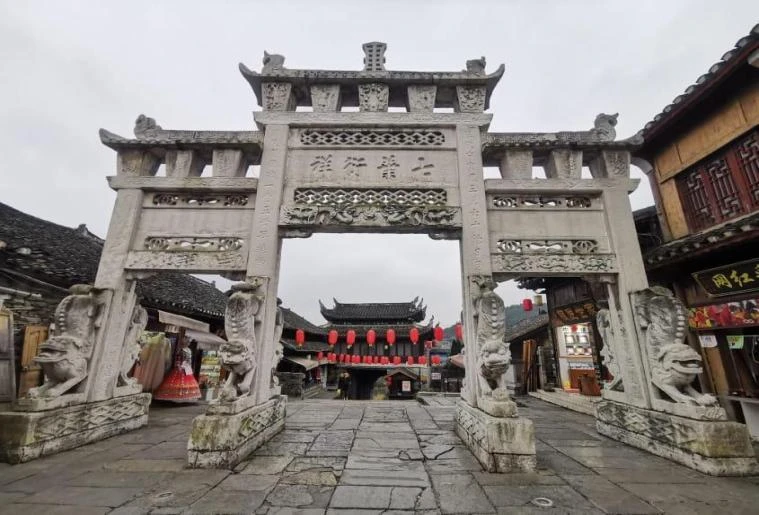
Mountain terrain featuring thousands of moss-kissed stone steps and winding trails calls for sturdy hiking footwear with reliable non-slip traction paired with a waterproof windbreaker to stay warm in highland mist. Upon arriving at the village gate, travelers are greeted by the heartfelt Miao tradition of Gate-Blocking Wine (Lanmenjiu). Beneath the timber archway, radiant young women in colorful embroidered attire and chiming silver collars sing traditional welcoming ballads while offering buffalo horns brimming with aromatic clay-jar corn wine. Regardless of drinking tolerance, taking a respectful sip honors local hospitality and receives blessings of safe travels from the people of the mountains.
A standout hallmark elevating Shibadong as a model cultural destination is its strict commitment to zero forced shopping, eliminating concerns over aggressive touts or commercial traps. Every authentic local specialty—from crimson slabs of hearth-smoked pork and misty high-mountain green tea buds to hand-embroidered Miao brocades crafted over months—carries transparent posted pricing alongside QR codes verifying origin, giving travelers complete peace of mind when selecting meaningful souvenirs.
Administratively, international visitors should secure a Chinese visa well in advance, ensure passports remain valid for at least six months, and complete standard temporary residence registration if staying overnight in traditional wooden homestays. For travelers wishing to immerse themselves in Xiangxi’s timeless heritage without worrying about mountain transport logistics or local language barriers, joining a thoughtfully curated all-inclusive China tour package offers the smoothest path to an enriching, unhurried, and unforgettable journey.