Beneath the thousand-year clouds of the Wei River, the imperial capital of Chang’an once stood as the pinnacle of East Asian civilization during the golden age of the Tang Dynasty, which spanned from 618 to 907. Drawing endless inspiration from renowned historian Ma Boyong’s acclaimed historical detective novel, the immersive cultural space “The Longest Day in Chang’an” was brought to life in Xi’an, transforming ancient texts into a vivid, detail-rich reality. It faithfully reconstructs the utmost splendor of the capital during the Tianbao era under the rule of Emperor Xuanzong, Li Longji. Stepping through the gates of this themed district, the boundary between reality and the past dissolves, opening a journey back to one of the most prosperous metropolitan cities on earth, where the finest art, architecture, and folk gastronomy merge into an exquisite epic.
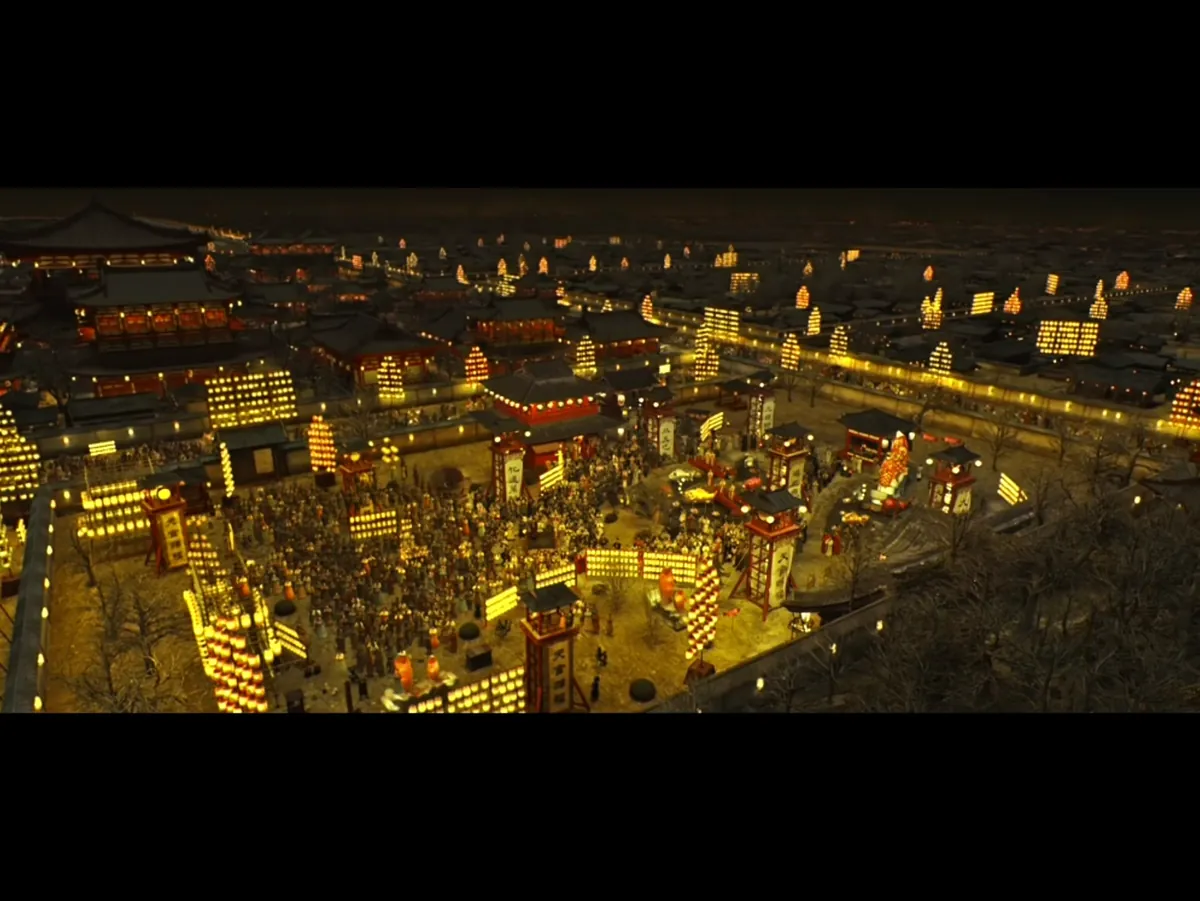
Viewing the entire district from above, the eye is instantly captivated by a sea of red and golden lanterns blooming across the night, casting reflections upon solemn, dark-brown timber towers. Multi-layered curved yin-yang tile roofs precisely emulate the proud bracketed dougong architecture of the flourishing Tang era. The bustling courtyard below teems with visitors clad in flowing Hanfu robes, strolling gracefully past vermilion-painted stalls and gilded balustrades. The luminous glow of countless lanterns falls across intricately carved window frames, illuminating a never-sleeping corner of the capital and perfectly recreating the atmosphere of a magnificent imperial banquet from a millennium ago.
History records that the Tianbao era began in 742, a time when the Great Empire of Tang reached its zenith in economy, military might, and poetry before violent upheavals of the An Lushan Rebellion shook the realm. In Ma Boyong’s work, the plot revolves around twelve breathless hours on the Shangyuan Festival of Tianbao’s third year, as the Jing’an Bureau—led by the brilliant youth Li Bi alongside the death-row inmate Zhang Xiaojing—races against time to shatter a conspiracy aimed at burning down the capital. This dramatic backdrop became the soul of today’s immersive experience, where every street corner, teahouse, and apothecary bears the imprint of the struggle between national destiny and the loyalty of courageous souls within the metropolis.
This space is also a microcosm of the celebrated ward system featuring Chang’an’s strict checkerboard grid of one hundred and eight wards. Back then, the West Market served as an international trade hub gathering Sogdian merchants, Indian monks, Persian envoys, and camel caravans laden with spices and glassware from the Silk Road; meanwhile, the East Market was a romantic haunt for aristocracy and literati such as Li Bai and Du Fu. This multi-ethnic cultural exchange not only shaped the tolerant, open-minded lifestyle of the Chang’an people, but also forged brilliant cultural artifacts passed down across centuries.
Spanning more than 24,000 square meters, this themed district is far more than a recreational restoration project; it functions as a living museum preserving the memory of a peak empire. By breathing life into historical currents through culinary arts, the Niangniang dance of costumes, and sumptuous attire, it stirs a profound nostalgia for a golden age. The vicissitudes of history may have buried ancient Chang’an’s city walls beneath the sands of time, but the proud spirit, magnanimity, and eternal beauty of Tang civilization remain intact, ready to greet every traveler seeking to discover and listen to the echoing heartbeat of the past.
Nestled at the heart of the fertile Qujiang district in Xi’an, the Chang’an Hot Pot culinary and cultural space occupies one of the most auspicious geomantic coordinates in the ancient capital. Viewed from the macroscopic geography of the Guanzhong Plain, it rests against the majestic Zhongnan Mountains of the Qinling range—the natural fortress shielding the thousand-year dragon veins of the Qin, Han, Sui, and Tang dynasties—while facing the fertile alluvial plain nourished by the Eight Waters of Chang’an. In classical feng shui treatises, this terrain configuration is designated as “mountains encircling and waters embracing,” where layered peaks and gentle streams converge cosmic energy to foster a regal land, shelter vital energy, and generate enduring blessings.
Since ancient times, the Qujiang area has served as an elegant imperial pleasure garden, beginning with Qin Shi Huang’s Yichun Garden, expanding into Qujiang Yuan under Emperor Wu of Han, and reaching its glorious zenith during the Kaiyuan and Tianbao eras under Emperor Xuanzong, Li Longji. The winding nine-bend waters of Qujiang Pool combined with the gentle swells of Leyou Mound formed a flawless natural diagram: topography that is serene yet not low-lying, expansive yet concentrating a tranquil trường khí (vital field). Today’s Chang’an urban district is precisely positioned where the imperial dragon vein meets bustling civic life, directly inheriting the flourishing vitality of Xingdao Ward and Qujiang Ward from Chang’an’s famed 108-ward map during the golden Tang Dynasty.
According to heritage networking structures, this space lies entirely within Xi’an’s core historical, cultural, and spiritual axis. To the north, it faces the Giant Wild Goose Pagoda at Da Ci’en Temple—a solemn Buddhist monument tied to Master Xuanzang’s journey to retrieve sacred scriptures; to the south, it borders the Datang Furongyuan complex and the clear waters of the Qujiang Pool Ruins Park; to the west, it connects with the dazzling prosperity of the Great Tang All Day Mall. This organic linkage is more than mere modern urban geography; it represents the continuation of the “unity of heaven and humanity” cultural axis. Placing a complex that recreates human culinary art and classical hot pot culture right at the center of this heritage axis balances the fiery element of hearth flames and culinary steam with the watery element of Qujiang Lake and the arboreal scenery of surrounding imperial gardens.
The topography planning here artfully transforms the constraints of an enclosed space into a layered landscape structure rich in metaphor. Relying on the natural slope of the gentle hillside, the entire district is organized under the concept of “heavens above within grottoes, capitals revealed below.” Borrowing from traditional Tang-era garden design, artificial landscaping simulates the harmonious seasonal shifts of mountains and rivers. Visitors’ pathways wind organically like the ancient Qujiang Flowing Wine Stream—where literati like Li Bai and Du Fu once sat beside waters releasing wine cups while composing poetry. Cool breezes from Qujiang Lake and clean breath from ancient maple and willow trees outside filter through wind-catching windows, mingling with the fragrant, rising steam of bubbling hot pot broths simmered with secret herbal spices, offering visitors the sensation of savoring a miniature ink-wash landscape painting in the heart of a millennium-old metropolis.
Standing from above and looking down at the panoramic view of the ancient town district, the traveler’s eye is instantly overwhelmed by a gorgeous symphony of light recreating an endless Shangyuan Festival night in the flourishing Tang era. Multi-layered dark timber towers soar high, canopied by millions of glowing red and gold lanterns casting reflections upon solemn, curved roof tiles and intricate timber corridors. The sweeping aerial perspective fully displays the multi-tiered layout of an imperial feast, where the bustling life of classical scholars and beauties merges with traditional Chinese architecture, creating a visual masterpiece that is both exquisite and profound, dripping with the poetry of a brilliant golden age.
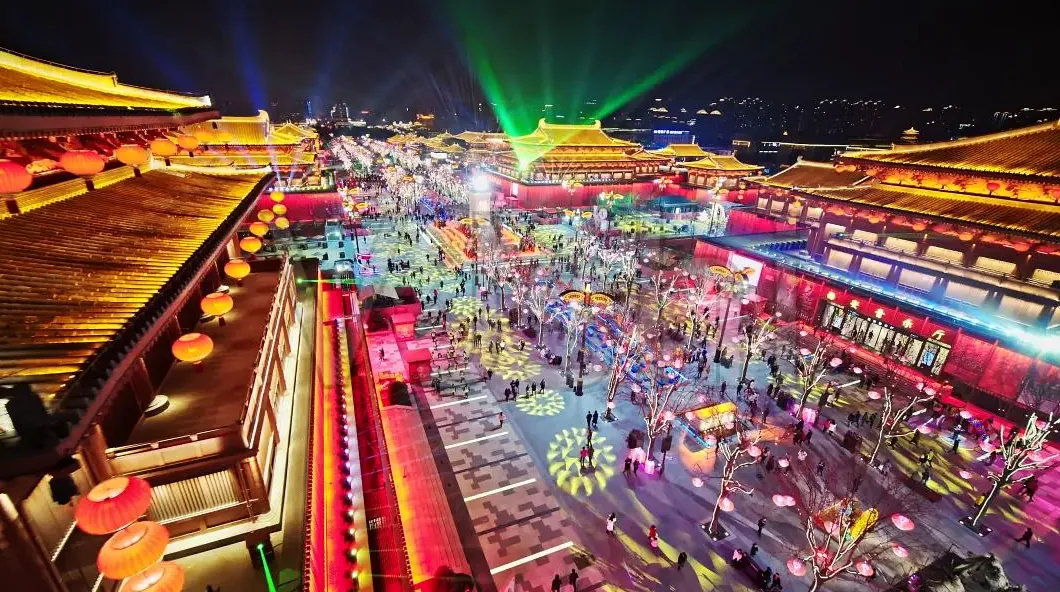
Delving into structural details, the project is a masterwork of heritage space restoration, faithfully upholding flourishing Tang architectural codes featuring sturdy bracket sets (dougong), raw timber load-bearing round columns, and nail-free traditional mortise-and-tenon joinery. The entire three-story interior spanning over 24,000 square meters is organized under inspiration from the characteristic ward-and-market structure of ancient Chang’an, specifically showcasing the magnificent synthesis between the bustling West Market and the prestigious East Market. Every detail—from carved lotus petals on stone column bases to cloud scrolls on crossbeams, moldings, and diamond-shaped lattice window panes—was chiseled by ancient architectural experts and veteran timber artisans based on archaeological data and murals excavated from imperial tombs. The delicate pairing of vermilion, imperial gold, and solemn walnut brown creates a majestic yet warm color palette, transporting posterity straight into the glorious Kaiyuan golden age.
The project’s spatial axis is divided into three functional tiers bearing poetic names inspired by classical allusions, elevating the venue from a conventional commercial floor into a living cinematic film set combined with an intangible cultural heritage museum. The central tier opens to a magnificent observation square, recreating the Tinghu Pavilion stage and the Niangniang Dance of Costumes music hall, framed by winding bluestone-paved alleyways. The space is far from static; it moves fluidly through lighting design that faithfully simulates all twelve double-hours (shichen), from crisp dawn light to the mysterious night of the Rat hour. Over a hundred handicraft stalls, Bodhi teahouses, taverns, and culinary wards featuring sesame flatbreads, soup cakes, and sweet jade wine are interspersed alongside scholarly studies and brocade-weaving workshops, offering an engaging, continuous visual feast.
Massive investment running into hundreds of millions of RMB stands as clear testimony to the spectacular evolution of multi-sensory immersive tourism. Acclaimed film art design teams directly directed set construction, guaranteeing absolute historical authenticity from the curvature of every eave to the drape of silk curtains embroidered with gold thread. Rather than confining artifacts behind lifeless glass cases, the seamless integration of high-end commerce and live interactive drama turns the entire district into a colossal, barrier-free stage. Travelers don Hanfu robes, exchange Kaiheng Tongbao copper coins for goods, converse with poets and patrolling guards, and experience firsthand the flourishing heartbeat of a millennium-old imperial metropolis pulsing vigorously through timber, tile, and radiant lantern light.
As dusk gradually settles over the Guanzhong plain, Chang’an Hot Pot sheds its daytime serenity to transform into a luminous “never-sleeping city,” plunging travelers into a magical world plucked straight from classic historical films. Lighting artistry here is far more than functional public illumination; it functions as an elite cultural restoration technique, perfectly recreating the romantic glamour and lavish lifestyle of what was then the world’s most prosperous metropolis. Every street corner, bridge, and multi-story pavilion is calculated with precise optical angles, generating a mesmerizing visual depth.
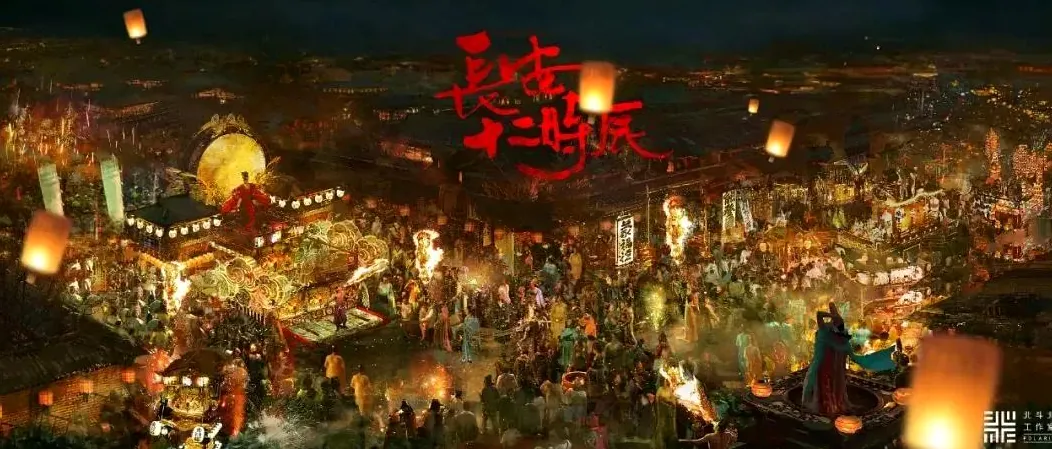
The visual canvas unveils a magical festive tableau of a flourishing capital, where countless floating lanterns and floral lamps hover across distant skies, casting reflections upon bustling throngs of festival-goers. Multi-story traditional Chinese architectural towers with upturned eaves, intricately carved timber rafters, and solemn red hues rise majestically amidst myriads of light rays. This digital and physical art installation captures the soul of the cinematic masterpiece “The Longest Day in Chang’an,” harmonizing serene antiquity with the bustling atmosphere of an Eastern metropolis.
The district is planned as an exemplary night-economy icon, maximizing commercial and tourism appeal through a series of experiences shifting across time. The golden window from 4:00 PM to 9:00 PM daily marks the most magical moment, corresponding to the transition from the Hour of the Rooster to the Hour of the Pig in ancient timekeeping. Thousands of paper-pouch lanterns, lotus lamps, and glazed lanterns ignite in unison, radiating warm light that gilds polished bluestone paving stones. The night market awakens with vendors’ cries, the rich aroma of spices and cinnamon from taverns, and pipa melodies drifting from administrative offices, sparking the exploratory instincts of every strolling traveler.
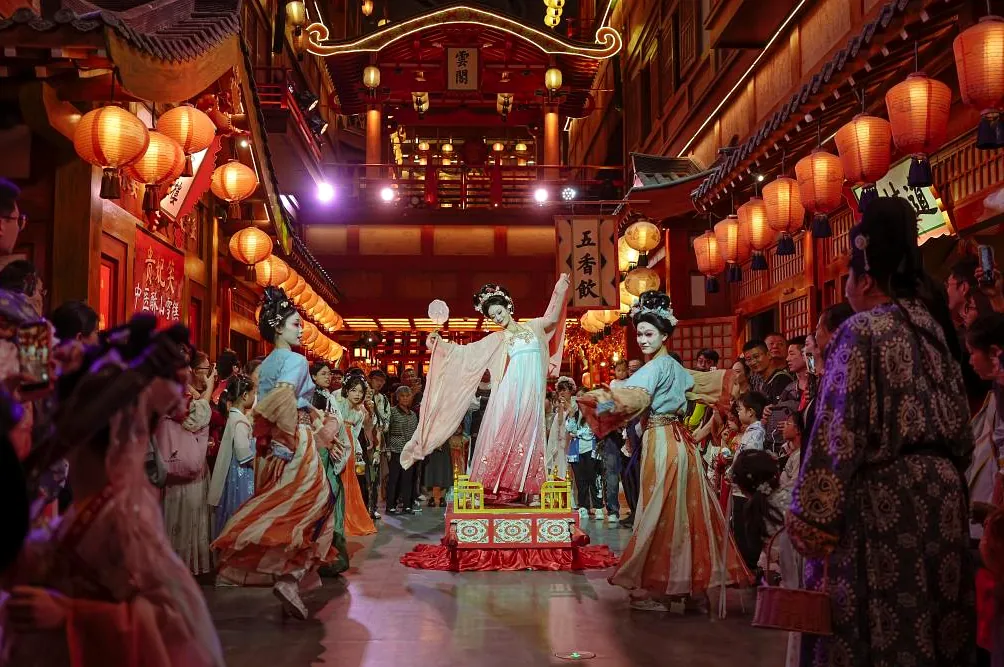
The core vitality retaining visitors overnight is a system of live performances unfolding continuously, completely erasing boundaries between stage and audience. At the central square and street turns, classic vignettes—such as the graceful Niangniang Dance of Costumes or Li Bai, the Banished Immortal, reciting bold poetry beside a jar of rice wine—are authentically recreated. Costumed artists in splendid Kaiyuan-Tianbao attire weave through crowds to interact and bow according to ancient court etiquette, ensuring total immersion into an open, tolerant, and poetic Tang society.
Beyond preserving nostalgic values, the lighting performance space here pioneers the integration of modern Augmented Reality (AR) and Virtual Reality (VR) projection technologies. Smart sensor systems allow visitors to use handheld devices to interact directly with virtual historical figures present right beside them in real space. The interweaving of traditional lantern light and next-generation digital spectra elevates Chang’an’s nighttime experience into a multi-sensory spacetime journey where a millennium of glorious past moves in step with modern creative vision.
Amid the splendid space recreating the ancient capital, culinary arts at Chang’an Hot Pot are not merely nourishment to stave off hunger; they form a time-traveling gastronomic voyage back to the golden age of the Tang Dynasty. Step into bustling wards, and visitors are easily captivated by rising steam from steamers, rhythmic thuds of wooden cutting blocks, and rich aromas of star anise, cardamom, and northwest chili peppers. Guanzhong culinary culture here gathers the heritage of the thousand-year Silk Road, merging the earthy, unpretentious boldness of grassland inhabitants with the delicate, elaborate refinement of imperial palaces.
Right along the bustling pedestrian axis, visitors frequently encounter breathtaking scenes of gorgeous Niangniang dances performed right beside traditional taverns. Beneath hundreds of glowing red lanterns suspended from dark wood balconies, graceful dancers clad in flowing silk robes sway to the rhythm of plucked pipa lutes. The ancient space glows brilliantly under warm candlelight, creating a living backdrop reflecting the ultimate prosperity of Tang-era metropolitan life, where boundaries between a court theater and a folk food market completely dissolve.
The pinnacle of Shaanxi’s flavor map is fully captured in Roujiamo, the celebrated meat sandwich hailed by culinary scholars as the world’s oldest hamburger. The Baijida crispy crust is crunchy on the outside yet fluffy and soft within, cradling braised pork belly simmered for hours in master stock containing over twenty precious herbs. Every morsel is infused with spices, rich yet not greasy, melting instantly on the tongue upon the first bite. Placed alongside it is Yangrou Paomo, a superlative lamb soup masterwork requiring diners to patiently crumble unleavened flatbread into corn-sized pieces inside a bowl before the chef pours clear mutton bone broth—fragrant with cilantro and fresh ginger—over top. Savoring Paomo cannot be rushed; hand-tearing the bread is how diners quiet their minds and appreciate every drop of essence from this harsh yet hospitable grassland.
No culinary journey through Chang’an is complete without chewy, wide Biangbiang Noodles. Hailed as one of Shaanxi’s ten wonders, each noodle is masterfully kneaded from Guanzhong Plain wheat flour and slammed repeatedly against stone tables with a distinctive crisp thud. Thick and wide like a belt, the noodles are blanched to perfection, then topped with bright red chili powder, minced garlic, scallions, and fresh greens. The crowning glory arrives when a ladle of sizzling hot rapeseed oil is poured directly over the bowl, sparking a joyful sizzle and releasing a fragrant, spicy aroma that spreads through the space, mingling with aged black vinegar to powerfully stimulate every sense.
The exploration of heirloom culinary arts in this ancient district closes with warm cups of osmanthus wine or refreshing silver-ear fungus sweet soup, leaving a lingering, nostalgic aftertaste. The cuisine thoughtfully restored here does more than satisfy hunger; it acts as an invisible thread connecting contemporary travelers with the bold, refined lifestyle of ancestors from over a millennium ago, preserving the undying soul of a capital that was once the brightest center of the Eastern world.
Resting impressively at the heart of the affluent Yanta District in Xi’an, the Chang’an 12 Shichen space opens a time portal connecting reality with the flourishing Kaiyuan-Tianbao era of the Tang Dynasty. To fully savor the flourishing life of the capital, travelers should note the operating hours cleverly arranged according to Yin-Yang diurnal rhythms. The themed district typically welcomes visitors from 10:00 AM to 10:00 PM daily, corresponding from the end of the Hour of the Snake through the Hour of the Pig in ancient timekeeping. This ideal window allows visitors to witness the spectacular transformation of light, as daytime market fires yield to thousands of glowing lanterns illuminating dusk.
Xi’an’s modern public transit network makes accessing this heritage complex exceptionally convenient. The optimal and most accurate choice for travelers is Xi’an Metro Line 4, alighting at Datang Furongyuan Station. From Exit D or A of the underground station, travelers enjoy a short walk across the Manta Plaza landscape axis straight to the gates leading down to the subterranean Chang’an restoration. Departing from Xi’an Xianyang International Airport, intercity rail combined with the metro brings visitors directly to the city center in about fifty minutes, crossing layers of historical strata across the Guanzhong Plain.
For international travelers holding valid passports, one of the most advantageous transit levers is the 144-hour visa-free transit policy enforced at Xi’an’s international ports. This regulation allows globetrotters to stay continuously for six full days within Shaanxi Province without securing a traditional tourist visa, opening a flawless opportunity to combine an exploration of Chang’an Hot Pot with nearby major heritage sites such as the Terracotta Army of Qin Shi Huang, the Giant Wild Goose Pagoda, and the Ancient City Wall of Xi’an. When completing immigration formalities at Xianyang Airport, travelers simply present an onward flight ticket to a third country or region within 144 hours alongside accommodation bookings to receive this special visa stamp.
To optimize the immersive experience within a living imperial city, an essential insider tip is visiting Hanfu costume restoration shops tucked quietly in the lobby area before passing security gates. Here, authentic Tang-era makeup is faithfully recreated through huadian floral brow decals, powdered foundation, and peony hair buns, helping every visitor gliding across Xu Hezhu Bridge or Fulu Teahouse blend naturally into the costumed crowds. Travelers should also activate international digital payment apps on smartphones to load and exchange internal bank notes modeled after Kaiyuan Tongbao coins, ensuring seamless dining across market wards.
Above all, out-of-town travelers should proactively steer clear of mass-market group tours burdened with forced shopping stops, which dilute emotional engagement and waste cultural exploration time. Choosing specialized itineraries designed around deep customization and flexibility allows travelers to unhurriedly immerse themselves in classic vignettes, admire live-action performances, and decode the profound dimensions of glorious Tang civilization. To realize a seamless, refined, and carefree journey through time, travelers can proactively explore and register for an all-inclusive China tour package carefully crafted down to every step of the journey.