Nestled amid a serene valley in Sattahip District, Chonburi Province, the towering cliff of Khao Chee Chan—widely known by the revered Vietnamese name Trân Bảo Phật Sơn (Buddha Mountain)—carries a tumultuous chronicle that reaches far beyond that of a mere pilgrimage site. Few realize that before becoming a supreme spiritual icon of the Land of Smiles, this solitary limestone peak suffered deep wounds inflicted by human hands during the fiery years of the Indochina War. In the 1960s and 1970s, as hostilities escalated and the nearby strategic U-Tapao Air Base was requisitioned for military operations, the cliff face of Khao Chee Chan was converted into an intensive industrial stone quarry under concession. Thousands of explosive charges were detonated around the clock, tearing away pristine layers of rock to supply construction materials for runways, piers, and barracks, leaving behind a jagged, barren sheer face like a colossal geological scar slashing across the eastern coastal sky.
This prolonged destruction of the natural landscape only came to a halt when it stirred the deep concern of Thailand’s senior Buddhist clergy and royal family. Faced with the threat of the mountain being completely leveled for roadbed gravel, His Holiness Somdet Phra Nyanasamvara—the 19th Supreme Patriarch of the Kingdom of Thailand—was moved by profound compassion, perceiving that a scarred land ought to be transformed into a wellspring of peace and blessings. With the enlightened vision of a virtuous master, he proposed a bold grand vow: to permanently halt the blasting of the mountain and turn the sheared vertical cliff face into a sacred sanctuary by engraving upon it the holy image of Shakyamuni Buddha. The intention behind transforming this site was not merely to prevent landslides and ecological depletion, but more profoundly to establish a spiritual bastion capable of dispelling restless thoughts, invoking serenity, and cultivating auspicious energy to protect the nation and bring peace to its people, serving as a supreme spiritual anchor for local devotees.
That grand spiritual aspiration reached its culmination in Buddhist Era 2539, corresponding to the year 1996. This was a momentous historical milestone across Siam as the nation jubilantly celebrated the Golden Jubilee (Kanchanaphisek), marking fifty glorious years on the throne of His Majesty King Bhumibol Adulyadej the Great (Rama IX)—a benevolent monarch who dedicated his entire life to the prosperity and well-being of his subjects. Under the supreme royal patronage of the Thai Monarchy combined with the spiritual guidance of the Supreme Patriarch, the cliffside Buddha engraving project was officially approved and launched, transforming Khao Chee Chan into a priceless gift of gratitude offered by the royal family and the nation to honor the King’s fiftieth year of reign. Every line carved into the rock face is thus not merely a triumph of contemporary engineering, but also the crystallization of deep faith, reverence for a compassionate sovereign, and the aspiration to etch an era of peace and prosperity into eternal stone.
Upon completion, the majestic image was personally bestowed by King Rama IX with the noble Sanskrit-Pali title Phra Phuttha Maha Wachira Uttamopat Satsada. In the classical lexicon of Theravada Buddhism, this sacred name signifies Shakyamuni Buddha—the Supreme Teacher possessing wisdom as radiant and brilliant as a diamond illuminating all directions. Depicting the Blessed One seated in the lotus posture in the Maravijaya attitude of subduing Mara on the very site once scarred by explosives carries profound symbolism of the triumph of compassionate light over destructive darkness, turning a place once ravaged by the tides of war into an indestructible focal point of meditation that endures alongside timeless wisdom.
Located in Na Chom Thian Subdistrict, Sattahip District, Chonburi Province, the Khao Chee Chan complex sits at geographic coordinates 12°45′ North latitude and 100°57′ East longitude, approximately fifteen kilometers south of bustling South Pattaya. From a geological perspective, this imposing rock mass is an ancient limestone anticline formed during the Permo-Carboniferous period, with sedimentary layers dating back hundreds of millions of years before the emergence of humankind. Rising roughly one hundred and fifty meters above sea level, the mountain once served as a large-scale quarry supplying military logistics and infrastructure development in the mid-twentieth century, leaving behind a rugged topographical wound with a deeply sheared vertical cliff face. Yet that very artificial scar became a rare feng shui blessing, as the entire natural surface of the cliff faces directly northeast. In traditional Siamese geomancy influenced by Vedic philosophy, the northeast symbolizes the most auspicious sector of vital energy, greeting the purest rays of dawn sweeping across the Gulf of Thailand to dispel stagnant air and usher in universal harmony.
The master landscape architecture surrounding the base of Khao Chee Chan exemplifies terrain engineering harmonized with deeply humane feng shui principles. To neutralize the harsh fiery energy and arid aura radiating from the exposed limestone after decades of quarrying, Royal Thai landscape engineers established an encircling water garden anchored by the Huai Tu Reservoir. This man-made lake not only revitalizes the native vegetative ecosystem and cools the sultry microclimate of the tropical coast, but also acts as a vast tranquil mirror. On clear mornings, the crystal-clear waters reflect the full silhouette of the majestic Shakyamuni Buddha high upon the cliff, forming an ideal “mountain-embraced-by-water” layout in which yin and yang achieve exquisite equilibrium. Along the lakeside embankments, year-round blooming lotus and water lily ponds mingle with lush groves of teak and oil palms, creating a serene buffer zone that completely insulates this contemplative sanctuary from the busy highways beyond the valley.
The groundbreaking highlight that earned Khao Chee Chan its reputation as a supreme wonder lies in the engineering process used to carve the seated Buddha directly into the living rock face. To transfer an artistic blueprint blending traditional Sukhothai and Lanna styles onto a rugged limestone surface measuring one hundred and thirty meters high and seventy meters wide, Royal Thai military engineers collaborated closely with international scientists to deploy state-of-the-art laser guidance technology. At night, when darkness enveloped the cliff, an ultra-high-powered laser projection system positioned from a distance beamed every intricate line of the Buddha portrait onto the sheer rock wall. Tracing optical beams accurate to the millimeter, teams of miners and engineers rappelled down from the summit along the precipitous face, painstakingly drilling and cutting deep grooves into the hard limestone to outline the framework of the masterpiece.
Once the network of stone grooves—averaging tens of centimeters in depth—was completed across the entire cliff, the precious metal inlay phase was executed with utmost precision. Pure 24-karat gold ingots were smelted and crafted into thin gold sheets and sturdy gold-plated bronze strips, which were then tightly inlaid and sealed into every carved groove using specialized high-temperature, marine-weather-resistant silicone adhesives. Hundreds of kilograms of pure gold were utilized in total, making the monument the largest open-air gold cliff-carved Buddhist sculpture in the world. Contrasting against the somber, moss-patinated gray stone, the gleaming gold outlines catch the light, radiating a transcendent halo whenever sunlight strikes the cliff—a testament to the pinnacle fusion of modern technology and boundless spiritual devotion.
Standing majestically amid the expansive landscapes of Chonburi, the colossal Shakyamuni Buddha carved into Khao Chee Chan is a masterpiece uniting classical Sukhothai sculptural aesthetics with contemporary artistic sensibility. Free of extraneous ornamental clutter, the image celebrates the canonical beauty of Siam’s Buddhist golden age, featuring a serene oval face, gracefully arched eyebrows, a prominent cranial protuberance (Ushnisha), and a sacred flame-shaped aura (Rasmi) blazing atop the crown. The figure is rendered in seated meditation in the Pang Maravijaya posture—the attitude of Subduing Mara, or Earth-Touching Mudra. The Blessed One’s right arm drapes gently over his knee with fingertips lightly touching Mother Earth to call her as witness to his supreme enlightenment, while his left hand rests palm-upward in stillness upon his lap, radiating absolute equanimity before all worldly vicissitudes.
The sheer physical scale of the monument leaves every visitor in awe of the grandeur achieved by human hands. The Buddha figure itself reaches a vertical height of 109 meters, and when measured in full from the lotus pedestal at the base to the tip of the uppermost flame halo, it spans approximately 130 meters, with a knee-to-knee seated width of exactly 70 meters. To bring a record-setting religious masterpiece to life upon a natural limestone cliff once heavily scarred by wartime explosives and industrial quarrying, an immense budget exceeding 150 million Baht—equivalent to more than 4.7 million USD at the time—was raised entirely through royal devotion and voluntary merit-making donations from the Thai public.
What gives Khao Chee Chan its singular value is its pioneering breakthrough in geological engineering and precision mechanics. Because the Khao Chee Chan massif consists of karst limestone riddled with complex fracture lines, conventional carving methods using jackhammers or mechanical blasting were strictly ruled out to prevent shockwaves from triggering a collapse of the entire mountainside. Military engineers working alongside leading scientists chose to apply the most advanced laser positioning technology of the mid-1990s. To avoid thermal refraction from daytime sunlight and ensure absolute optical contrast, high-powered laser beams were projected onto the sheer cliff only during calm nights, mapping out millimeter-accurate coordinate lines across the dark gray stone under the solemn supervision of geological engineers.
Once the optical coordinate grid was finalized, a perilous feat of manual craftsmanship unfolded over many grueling months. Master sculptors and rescue specialists suspended themselves on cable harnesses mid-air hundreds of meters above the ground, braving fierce mountain gusts to carefully drill and chisel each layer of rock. They carved recessed grooves measuring 10 to 40 centimeters deep and 30 to 40 centimeters wide along the exact laser outlines. Every groove was subsequently cleaned, rigorously waterproofed, and meticulously inlaid with pure 24-karat gold leaf totaling hundreds of kilograms. Beneath the brilliant tropical sun, these gilded contours reflect a dazzling metallic luster against the raw gray limestone, transforming a fractured mountain scar into an eternal emblem of wisdom, compassion, and undying faith.
As twilight slowly draws its curtain across the Na Chom Thian valley, the fiery orange-gold hues of the Gulf of Thailand fade behind coconut groves and tropical hills, ushering in a magical transformation at Khao Chee Chan. Official daytime visiting hours from 6:00 AM to 6:00 PM conclude with the resonant tolling of a ceremonial bell, awakening an entirely different persona of the Khao Chee Chan cliff. In stark contrast to its vibrant brilliance under the midday sun, the grounds shed their daytime tourist bustle at nightfall to don a mantle of tranquil spiritual depth, offering a breathtaking counterpoint to the neon-lit, high-energy nightlife of central Pattaya just twenty kilometers away.
The artistic centerpiece of nightfall at the foot of the limestone cliff is the illumination of a custom-engineered high-powered floodlight system. Focused beams of cool-spectrum, high-intensity light concealed beneath lawns and bordering foliage are calibrated to precise optical refraction angles so that their radiance sweeps cleanly across the 130-meter relief. Under this masterfully directed artificial illumination, every laser-carved groove inlaid with 24-karat gold begins to glow luminously, resembling veins of precious metal pulsing with vitality across the cool gray stone. The silhouette of Shakyamuni Buddha seated in lotus meditation with hands forming the Maravijaya mudra emerges crisp and surreal against the pitch-black canvas of the night sky, like a masterpiece of light hovering between reality and the ethereal realm.
The expansive landscaped park embracing the base of the mountain and the Huai Tu Reservoir basin in front becomes a rare natural amphitheater of peace. Steeped in the meditative philosophy of the Land of Smiles, the setting offers travelers a deeply reflective experience: the glassy surface of Huai Tu Lake acts as a giant mirror capturing the shimmering reflection of the gilded cliff, rippling gently whenever breezes sweep down from the Sattahip hills. In place of car horns and urban clamor, the night is filled only with the soft chirping of crickets mingling with the rustle of Bodhi leaves and ancient native trees, creating a serene energy field that soothes every sense.
Strolling leisurely along the stone-paved lakeside pathways after dusk, visitors can also pause at graceful perimeter rest pavilions to savor the rustic flavors of local culinary culture. The delicate, refreshing sweetness of roasted young aromatic coconut infused with pandan leaf or a chilled glass of butterfly pea flower tea scented with wild lemongrass brings welcome refreshment after a day of pilgrimage. Alongside these drinks, the rich, warming comfort of traditional banana simmered in coconut milk and sprinkled with toasted sesame seeds—prepared by local families around Nong Prue using tree-ripened lady-finger bananas from their home orchards—serves as a humble yet lingering culinary note that brings an evening of luminous artistry and peaceful contemplation beneath the legendary Golden Buddha Mountain to a fulfilling close.
A pilgrimage to Khao Chee Chan offers far more than spiritual awakening before the majestic presence of Shakyamuni Buddha; it also opens the door to a vibrant tapestry of distinctive local flavors. Strategically positioned at the crossroads linking traditional inland agricultural hamlets with the historic seaports of Sattahip District and Na Jomtien Bay, the area surrounding the foot of Khao Chee Chan is nourished by a refined culinary fusion. Here, the bounty of fertile orchards and farmlands merges seamlessly with abundant harvests from the sea, yielding layered flavors that are both rustic and deeply rooted in the coastal gastronomy of the eastern Gulf of Thailand.
The defining hallmark of local cuisine here is how residents prepare ultra-fresh ingredients caught according to the daily tides. From the traditional wooden boat landings of the historic fishing village of Ban Amphur just a short distance from the mountain, freshly landed mackerel are rushed straight into kitchens to prepare whole fresh mackerel Tom Yum soup (Tom Yum Pla Too Sod). Unlike the mainstream tourist versions made with shrimp or squid, the clean natural sweetness and richness of fresh sea mackerel combined with mature galangal, bruised lemongrass, aromatic kaffir lime leaves, and hand-pounded bird’s eye chilies create a fiery, invigorating broth that dispels the tropical midday heat. Right alongside it, deep-fried king mackerel glazed with artisanal fish sauce (Pla Insee Tod Nam Pla) captivates diners with its crispy golden-brown skin and thick, savory fillets coated in a fragrant caramelized fish-sauce reduction.
The abundance of orchards and fields around the base of Khao Chee Chan is vividly expressed in freshwater river snail curry simmered with wild betel leaves (Gaeng Kua Hoi Khom Bai Cha-plu). Local cooks skillfully simmer rich, freshly pressed coconut milk with crisp river snails, accented by warm spice and the distinctive herbal aroma of finely shredded young betel leaves, producing a velvety curry best enjoyed over steamed jasmine rice. Pairing naturally with it is charcoal-grilled king mackerel custard wrapped in banana leaves (Hor Mok Pla Insee Yang Bai Tong)—a dish demanding time-honored family craftsmanship in which fresh mackerel flesh is pounded smooth with red curry paste, egg, and coconut milk until elastic, wrapped securely in fresh banana leaves, and slow-grilled over glowing embers to seal in delicate herbal smoke.
For an authentic taste of traditional coastal dining, food enthusiasts frequently seek out family-run eateries that have kept their stoves lit for more than three decades in Ban Amphur fishing village and at Na Jomtien fish market. Long-standing culinary institutions such as Jay Nong Seafood and Pupen by the shore have long symbolized unpretentious authenticity, where blue swimmer crabs, bigfin reef squid, and blood cockles caught each morning are sold out the very same day, prepared simply by boiling, steaming with ginger and lemongrass, or grilling over charcoal to honor the pure sweetness of the ocean. Here, a family meal beside the sunset fading over the sea serves as a sweet continuation after visiting the tranquil Buddhist sanctuary.
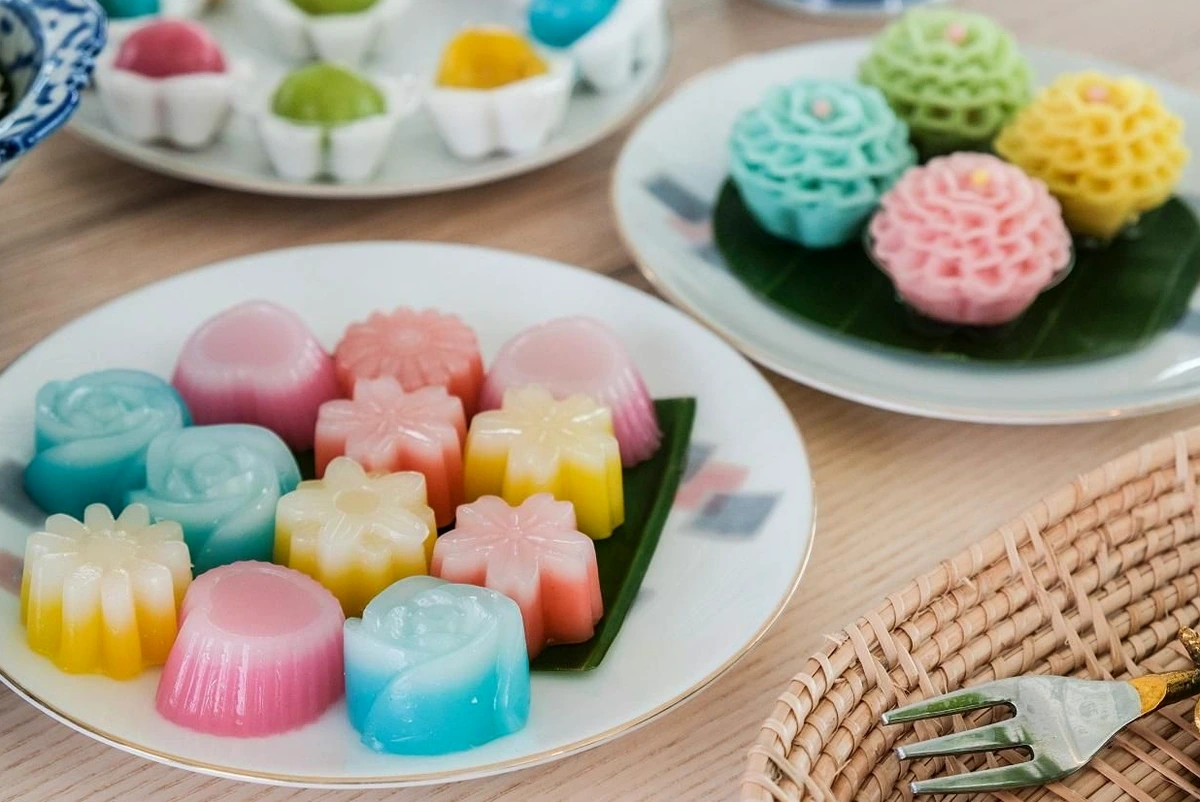
Beyond lavish seafood feasts, the open esplanade before the entrance to Khao Chee Chan also invites visitors to pause and savor humble street food traditions. Beneath the shade of native trees, local vendors display an array of time-honored Thai confections (Khanom Thai). Travelers can find fragrant bundles of charcoal-grilled sticky rice wrapped in banana leaves, creamy coconut-tapioca pudding topped with sweet corn, or sip refreshing roasted young coconuts freshly harvested from surrounding groves. Each simple flavor blends with the gentle chime of wind bells high upon the mountain, weaving a complete sensory and culinary memory that etches the soul of Thailand into the hearts of travelers from afar.
The sacred grounds of Khao Chee Chan welcome devout pilgrims and travelers from around the world daily between 6:00 AM and 6:00 PM. A remarkably rare feature for a national landmark of this stature is that local authorities charge no admission fee whatsoever, extending equal welcome to both Thai citizens and international visitors. This open-door policy deeply reflects the Theravada Buddhist spirit of generosity and universal compassion, making it effortless for anyone to come pay homage to the image of the Blessed One. Beneath the shade of sal trees and rustling sugar palms, the site management places dignified glass donation boxes where visitors may voluntarily make merit offerings; all proceeds go directly toward maintaining the 24-karat gold inlay on the cliff face and preserving the surrounding ecological gardens.
Reaching the sacred cliff in Na Jomtien Subdistrict, Sattahip District, Chonburi Province is remarkably convenient thanks to the modern transportation infrastructure of Thailand’s eastern seaboard. Departing from Bangkok, travelers can take the Motorway Route 7 expressway toward the Gulf of Thailand before merging onto the main Sukhumvit arterial highway (Highway 3) heading straight toward Sattahip, a journey taking approximately two hours. For those staying in bustling central Pattaya, the distance is a mere twenty kilometers. You can hire a taxi, book a ride-hailing vehicle, or hop aboard a traditional songthaew for a relaxed thirty-minute ride. Following Sukhumvit Road to the major intersection signposted for the royal monastery complex of Wat Yanasangwararam Woramahawihan and the scenic Silverlake Vineyard, simply turn right and continue a few kilometers until the towering cliff bearing the golden image of Shakyamuni Buddha rises radiantly on the horizon.
Although set amid the open embrace of mountains and forest, Khao Chee Chan retains the absolute sanctity of a revered Buddhist sanctuary. Consequently, dress codes are strictly enforced in accordance with traditional Thai religious etiquette. Pilgrims and visitors must wear modest, respectful attire; sleeveless tops, off-the-shoulder shirts, spaghetti straps, short shorts, and skirts above the knee are strictly prohibited. If you arrive in beachwear, traditional wrap-around sarongs can be rented at the service counter outside the side entrance to cover up before stepping onto the stone plaza. Upon entering the main esplanade facing the Buddha image, lowering your voice, walking unhurriedly, and refraining from boisterous behavior serve as essential expressions of reverence for the Buddha and respect for fellow visitors engaged in quiet prayer.
To ensure complete visitor safety, site management maintains a strict protective perimeter set at a safe distance from the base of the limestone cliff. Visitors must obey all warning signs and never climb over metal barriers or approach the foot of the cliff to take photographs, as rock strata exposed over many years to tropical sun and rain carry the potential risk of small falling stone fragments from heights exceeding one hundred meters. Because the expansive plaza has virtually no artificial shade structures, the midday coastal sun can be intense and glaring, easily causing fatigue for elderly visitors and young children. The ideal times of day to admire the breathtaking beauty of the relief are early morning, when the rising sun shines directly onto the gleaming gold contours, or late afternoon, when cool breezes arrive and lengthening twilight shadows cast a serene hush over the valley. To plan a seamless itinerary that harmoniously combines sacred cultural landmarks with premier leisure attractions, travelers can explore all-inclusive Thailand tour packages for a complete and worry-free journey.