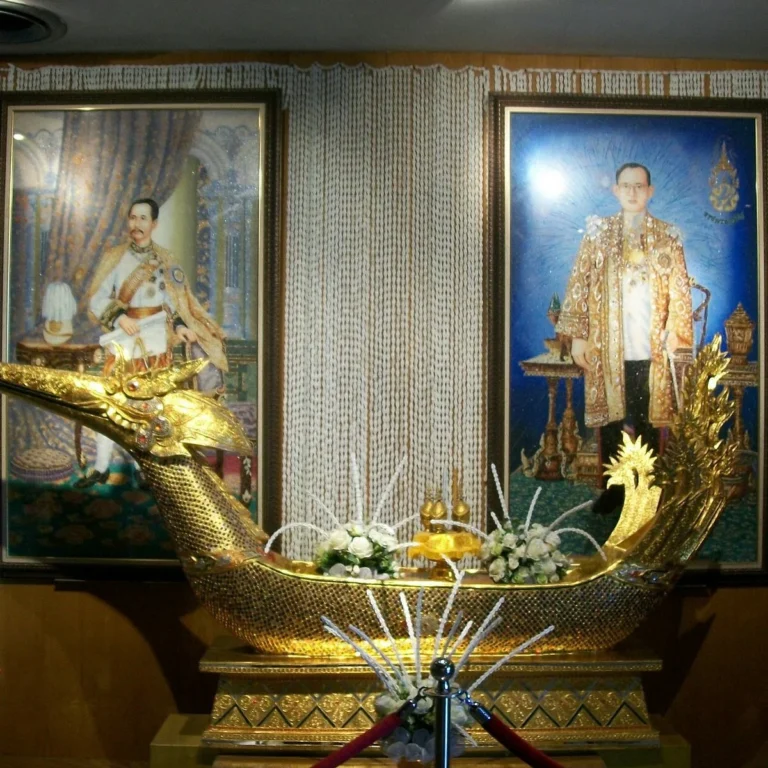
In the mid-19th century, as waves of international trade began knocking at the doors of the Gulf of Siam, the Rattanakosin Kingdom, under the wise reign of King Rama IV (Phra Chom Klao), faced urgent demands to restructure its irrigation and waterway networks and boost national economic potential. Recognizing that the low-lying, fertile alluvial delta wedged between the Tha Chin River basin in Samut Sakhon province and the tranquil Mae Klong River in Samut Songkhram province was isolated by marshes and dense mangrove forests, the King issued a decree with a century-spanning vision. It called for excavating a monumental artificial canal running straight across the central plains to break the isolation of rural communities while establishing a strategic waterway artery connecting the abundant rice and agricultural produce of the southwest directly to the seat of power in Bangkok.
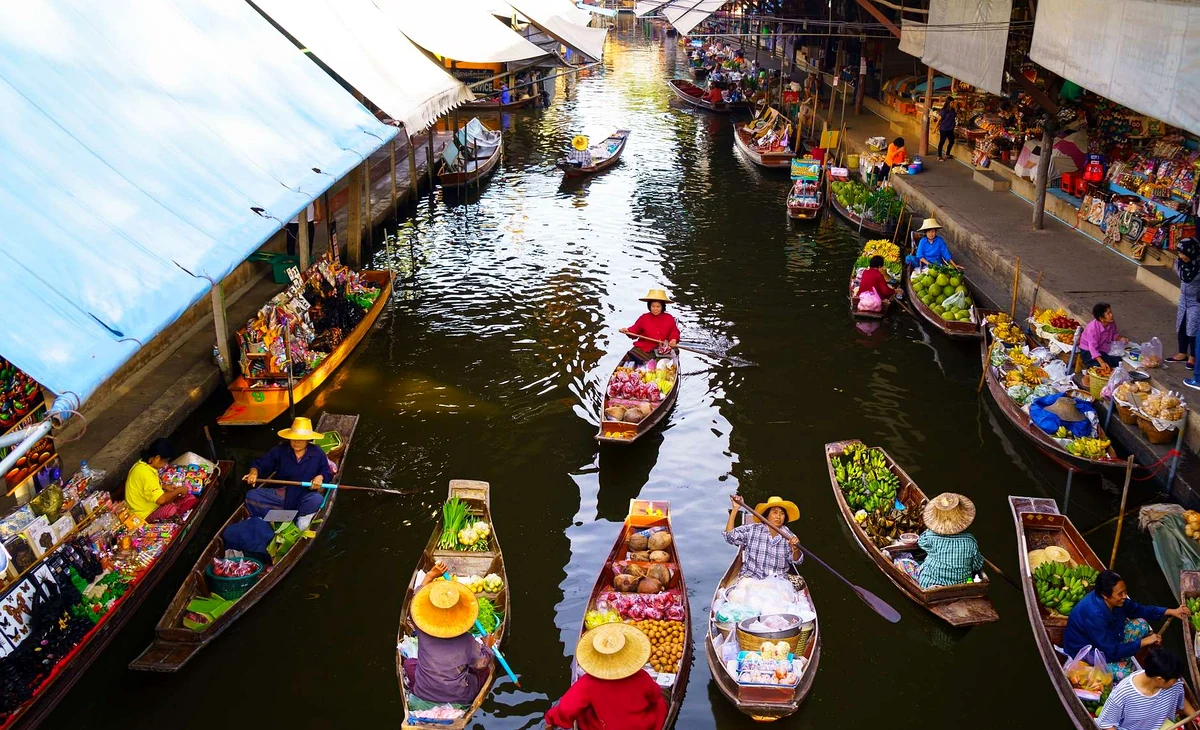
The project officially broke ground in the Buddhist Era 2409, corresponding to 1866 CE. The responsibility for directing and supervising this massive excavation was entrusted to Somdet Chao Phraya Sri Surawongse (Chuang Bunnag)—an eminent statesman serving as Grand Prime Minister (Samuha Kalahom) in charge of military affairs, who later became Regent during the reign of King Rama V (Chulalongkorn). Under Chuang Bunnag’s decisive and methodical command, tens of thousands of laborers overcame countless obstacles across the marshy terrain to complete the over-30-kilometer canal in Buddhist Era 2411 (1868 CE), right at the historic turning point of royal succession from King Rama IV to his heir, Chulalongkorn. The royal court bestowed upon this waterway the name Khlong Damnoen Saduak, carrying the profound symbolic meaning of “the canal of smooth and convenient travel.”
The creation of the artificial canal not only fundamentally transformed the geo-economic landscape but also sparked a vibrant, multicultural wave of migration. Along both banks of Khlong Damnoen Saduak, indigenous Thai communities began living in harmony alongside Mon migrants and resourceful overseas Chinese settlers of Teochew and Hokkien descent. Thanks to a gravity-fed irrigation system crisscrossing through branch canals, silt-rich fresh water turned wild marshlands into lush plantations stretching as far as the eye could see, filled with aromatic coconuts, green-skinned pomelos, sugarcane, and trellises of juicy grapes. Overseas Chinese settlers brought deep-ditch digging techniques and keen mercantile instincts, blending with the longstanding river-dwelling customs of the Thai people to forge a waterside farming method unmatched in Southeast Asia at the time.
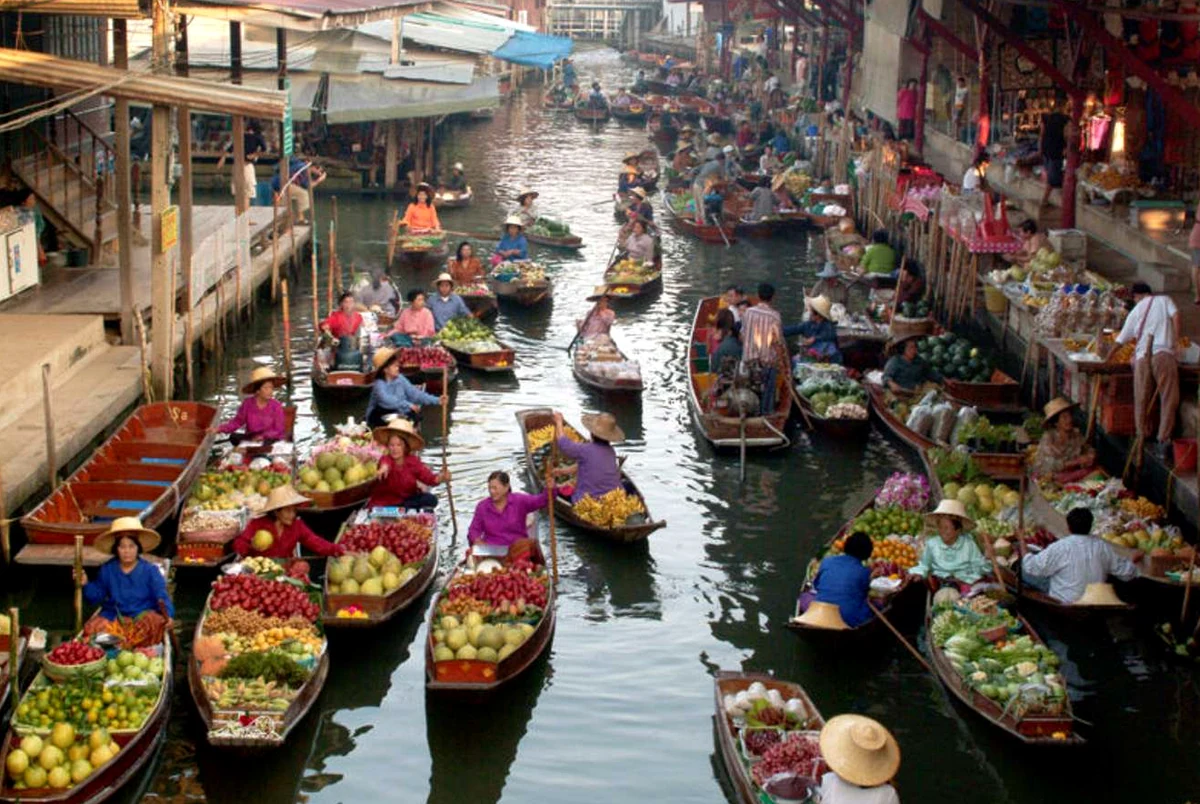
By the late 19th century, Khlong Damnoen Saduak rapidly transcended its original role as a military and agricultural irrigation canal to transform into a bustling, organic trading hub. Residents along both banks began utilizing their traditional wooden sampans as mobile transport vehicles and floating warehouses, gathering at canal junctions from dawn to barter agricultural produce, fermented fish, salt, and household handicrafts. Cooking smoke rising from steaming boat noodle stalls and the rhythmic splash of oars mingling with lively haggling in Thai, Teochew, and Mon dialects birthed the cultural cradle of the Damnoen Saduak Floating Market. Over a century of historical upheaval—from the modernization era of the Kingdom of Siam to the pace of modern life—has failed to dim the authentic soul of this historic waterway, where every drop of silt and every stroke of the oar still carries the memory of a grand achievement from the golden Rattanakosin era.
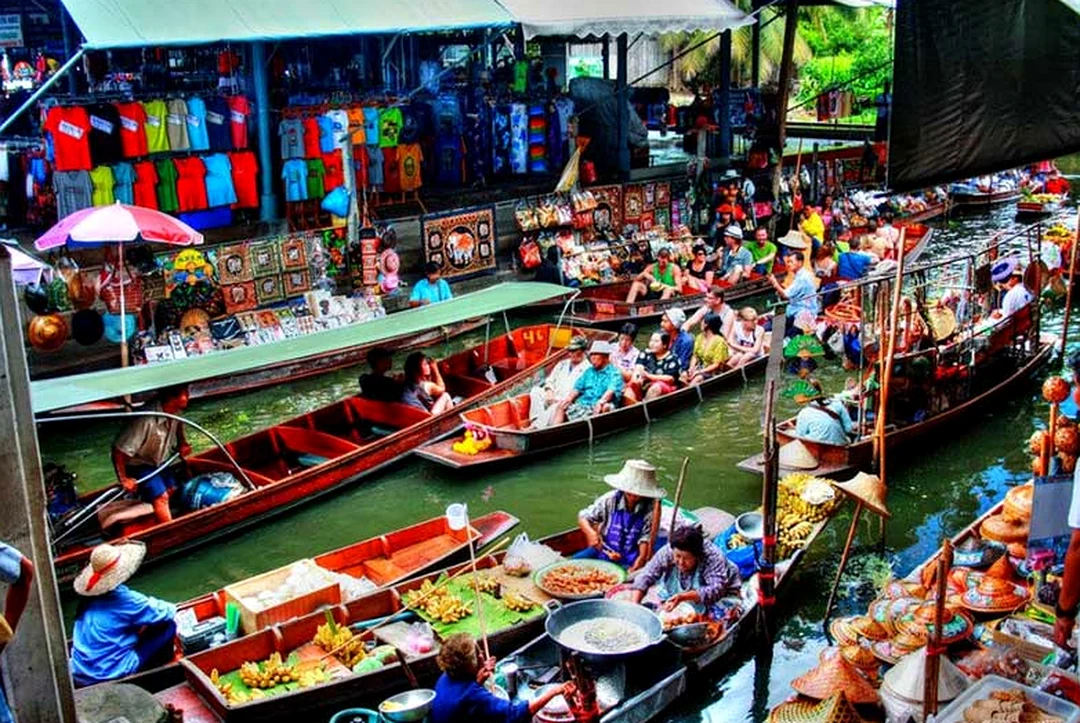
Viewed from the perspective of hydro-geography and the prosperous feng shui of Siam’s central delta, the flood-prone lowland wedged between the Tha Chin River basin in Samut Sakhon province and the Mae Klong River in Samut Songkhram province was regarded by ancestors as an unrivaled fertile agricultural dragon vein. Recognizing the immense strategic potential of opening up water flow to both regulate irrigation networks and link vital transport routes carrying rice and regional produce from the fertile heartland to the capital of Bangkok, King Rama IV, bearing the royal title Phra Chom Klao, issued a royal edict in Buddhist Era 2409 (1866 CE) to commence construction on one of the largest artificial waterway projects of the Rattanakosin dynasty. Under the far-reaching geopolitical vision of the royal court, the primeval marshland gradually transformed into a seamless water-and-land trade network, creating a water-gathering, wealth-generating terrain where abundant vitality from two great rivers converged in complete harmony.
The duty of chief engineer coordinating this landmark megaproject was entrusted to Grand Prime Minister and Samuha Kalahom Somdet Chao Phraya Sri Surawongse, born Chuang Bunnag, the powerful minister who later served as Regent under the succeeding monarch. Under his masterful leadership, tens of thousands of local workers—comprising indigenous Thais, Mon migrants, and Teochew and Hokkien Chinese communities along the basin—toiled relentlessly to excavate a straight artificial canal through dense layers of mud and swamp. The project was officially inaugurated in Buddhist Era 2411 (1868 CE), coinciding with the historic transfer of power to the reign of King Rama V Chulalongkorn. The royal court bestowed upon this new waterway the title Khlong Damnoen Saduak, bearing the auspicious meaning of a canal opening up convenient and unhindered passage for all people to travel.
The spatial planning of the Damnoen Saduak region deeply reflects sophisticated water-management engineering and indigenous knowledge adeptly attuned to natural tidal rhythms. The main Khlong Damnoen Saduak trunk serves as the spine, branching out into a centipede-like network of smaller canals radiating in all directions, flushing out acidity and salinity while channeling nutrient-rich silt from both the Tha Chin and Mae Klong rivers to enrich vast farmlands. Thanks to this comprehensive irrigation system, the area swiftly blossomed into the most bountiful agricultural granary along the Gulf of Thailand coast, renowned for sprawling aromatic coconut groves, juicy green-skinned pomelo orchards, fruit-laden vineyards, and sweet sugarcane fields. At the central confluence of the currents—particularly around the Khlong Ton Khem pier in Damnoen Saduak district, Ratchaburi province, roughly 100 kilometers southwest of central Bangkok—a natural floating market order emerged. Wooden sampans piled high with farm-fresh fruits docked in rhythm with the daily ebb and flow of the tides, turning the quiet canal into a thriving commercial hub steeped in riverine culture.
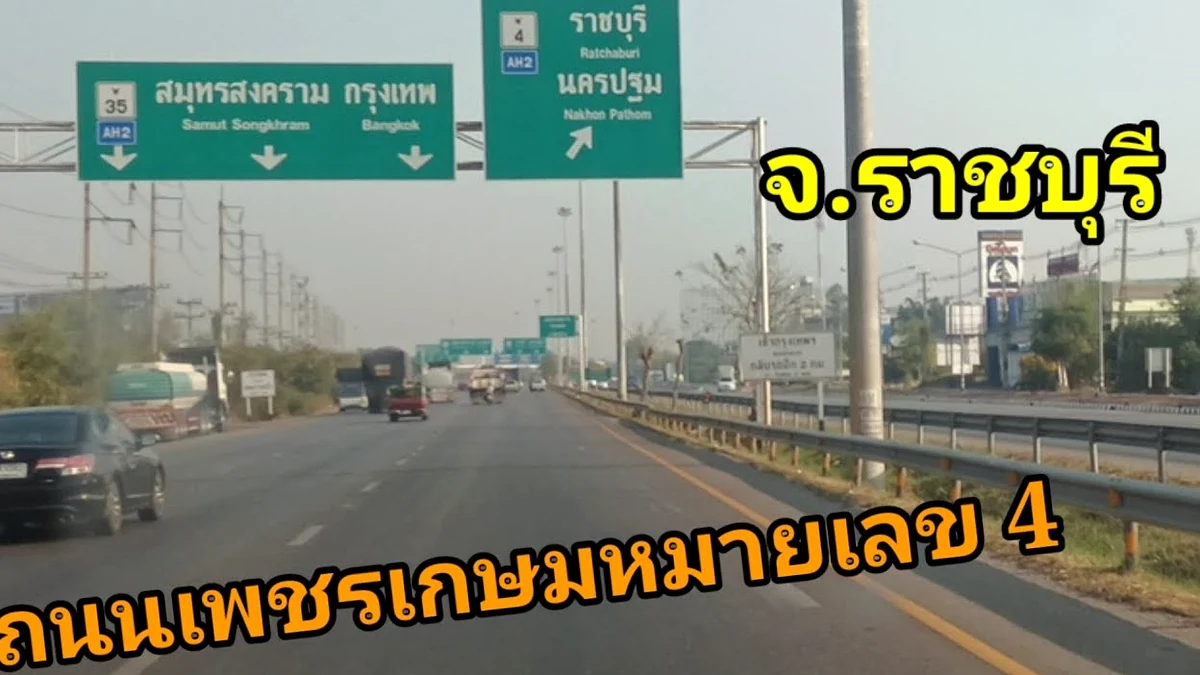
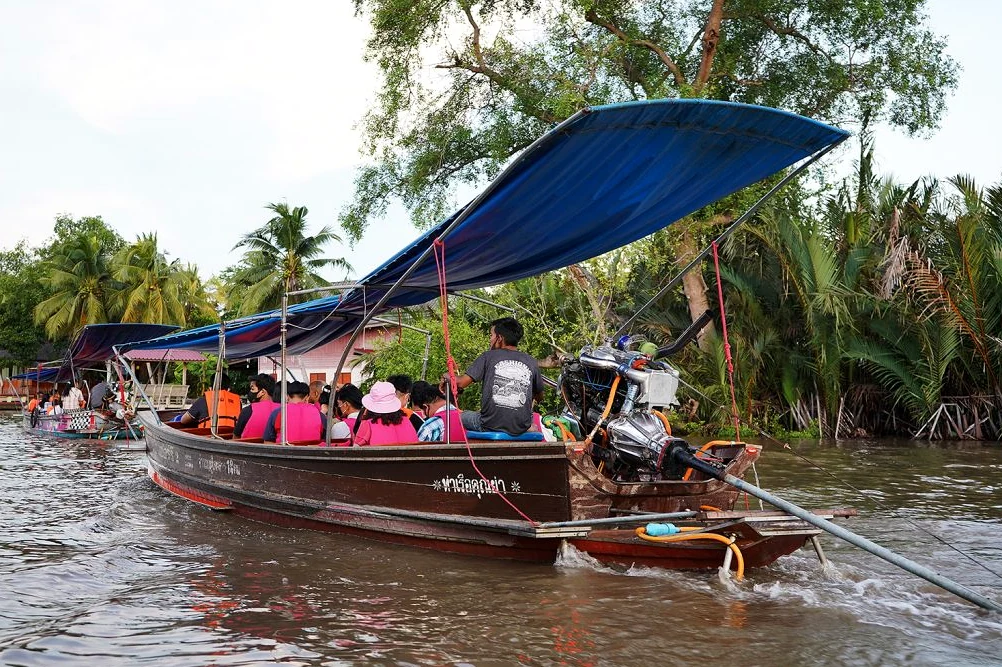
In terms of modern landscape and spatial connectivity, the Damnoen Saduak riverine heritage zone is today cushioned by a complete, multi-tiered transport infrastructure ecosystem. National Highway No. 4, known as Phetkasem Road, alongside the elevated M82 motorway project linking Bang Khun Thian to Ban Phaeo, has dramatically shortened travel time from urban Bangkok to the lower Mae Klong River. Modern Mae Klong River overpass infrastructure allows road vehicles direct access to traditional boat piers. From the central waterway trading hub, travelers can also easily connect via Provincial Route 325 for a 15- to 20-minute drive covering 12 kilometers to visit the famous Mae Klong Railway Market, Talad Rom Hub. The scenery here preserves its timeless charm with rustic wooden stilt houses nestled beneath nipa palms, wisps of blue smoke drifting from artisanal coconut sugar workshops, blending with the gentle rhythm of oars and the lively hum of long-tail boats slicing through the century-old historic canal.
From the standpoint of landscape planning and traditional hydraulic organization, the Damnoen Saduak Floating Market is a quintessential crystallization of nature-taming ingenuity during the illustrious Rattanakosin era. The entire spatial structure of this complex originates from the artificial canal Khlong Damnoen Saduak, a large-scale waterway project initiated in Buddhist Era 2409 (1866) by royal decree of King Rama IV and officially completed in 1868 under the direct supervision of Grand Prime Minister Somdet Chao Phraya Sri Surawongse. Stretching over 30 kilometers to link the two great rivers Tha Chin in Samut Sakhon province and Mae Klong in Samut Songkhram province, this straight canal broke the isolation of the low-lying marshlands, establishing a wide, long main artery that branched into hundreds of smaller canals weaving through the rural settlements of Ratchaburi province. It was precisely this intricate, vein-like canal network that shaped a fascinating amphibious commercial space, with Khlong Ton Khem pier serving as the prosperous heart of all riverine trade.
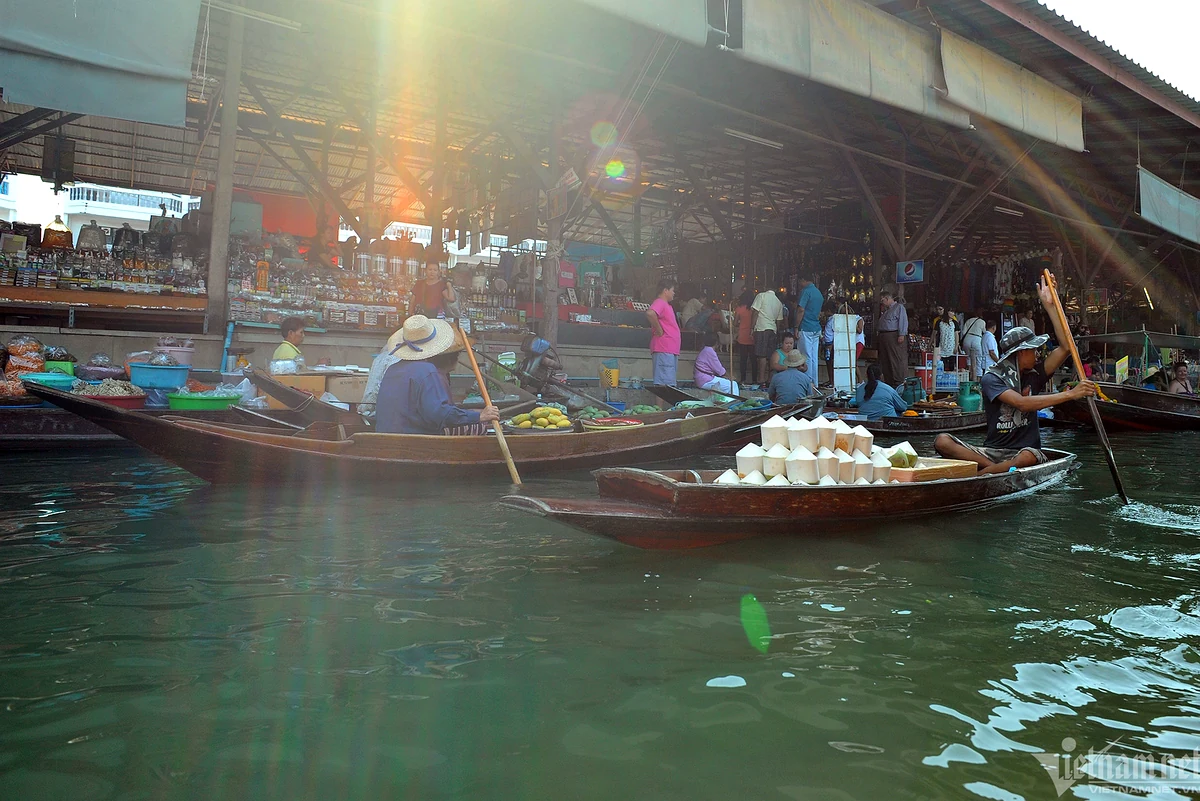
The vernacular architecture surrounding Khlong Damnoen Saduak bears the hallmark of flexible adaptation to the tropical tides of central Thailand. Along both banks, traditional stilt houses built entirely of precious hardwoods like solid teak and dipterocarp stand firmly atop pyinkado timber pilings driven deep into the fertile alluvial soil. The floorboards extend right out over the water, connecting directly to three-tiered wooden landing steps designed to welcome boat gunwales regardless of low or high tide. Steeply pitched nipa-palm thatched roofs or gracefully curved terracotta tiles not only shed rainwater swiftly but also cast cool, continuous shade along the wooden plank walkways. On the water’s surface, traditional boatbuilding artistry showcases the pinnacle of folk carpentry. Sleek, shallow-draft dugout canoes and sampans with gracefully upturned prows and sterns are precision-carved to minimize water resistance, enabling paddlers to weave effortlessly and turn on a dime amidst tightly packed trading bottlenecks without scraping neighboring hulls.
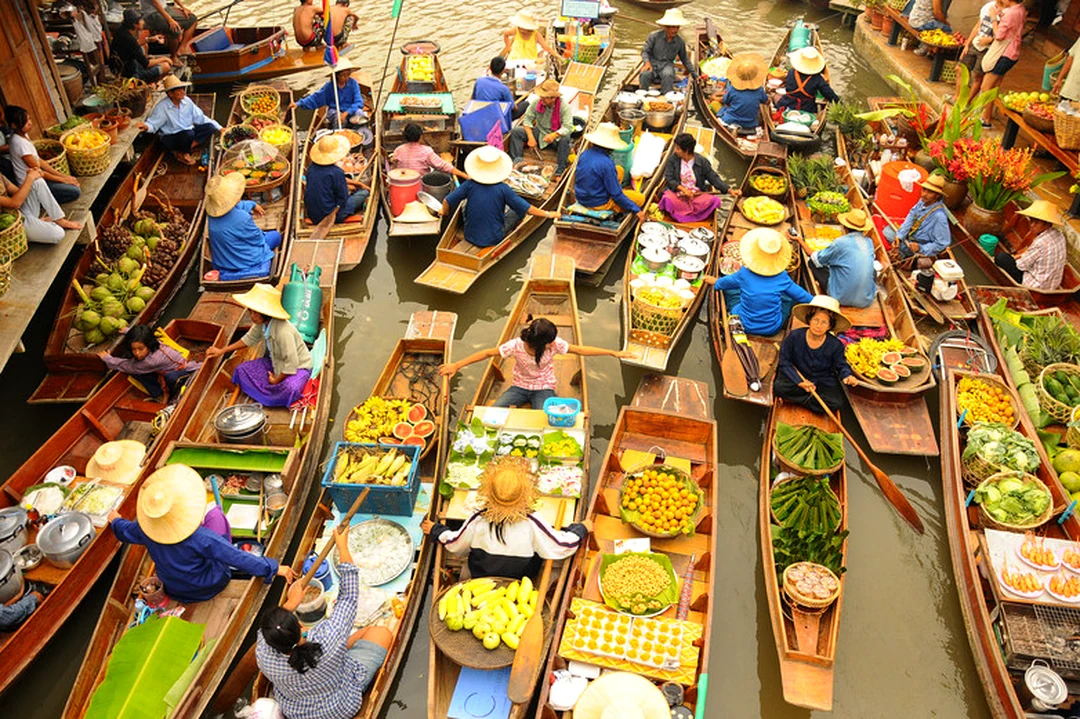
The true scale of the Damnoen Saduak Floating Market is not merely confined to the few dozen meters of water width along the main canal, but extends across an adjacent ecosystem of lush agricultural plantations. Commercial space is organized into a remarkably sophisticated hierarchy: bustling motorized long-tail boats made of afzelia wood cruise the main channel to handle long-distance transport, while a fleet of petite hand-paddled sampans operated by local mothers and village women clusters close to the banks for stationary trading. Inside each narrow hull, merchandise arrangement reaches the height of aesthetic artistry, featuring golden-yellow Nam Dok Mai mangoes, royal bananas, emerald green-skinned pomelos, and snow-white aromatic coconuts trimmed into neat geometric cubes like miniature sculptures. Even more unique are the culinary boats transformed into tiny floating kitchens, where glowing charcoal braziers, bubbling pots of boat noodle broth, and jars of sour, spicy, salty, and sweet condiments are arranged in perfect symmetry within arm’s reach of the cook, creating a vibrant gastronomic theater bobbing gently on the water.
The imposing scale and structural resilience of Damnoen Saduak also reflect the cultural synthesis among indigenous Thai residents, Mon canal excavators, and long-settled Teochew and Hokkien Chinese merchant families. Artisanal palm sugar workshops, wooden boatyards, and vintage corrugated-iron warehouses tucked beneath shady coconut groves form the productive hinterland sustaining riverine commerce across generations. Lying 100 kilometers southwest of Bangkok has never diminished the region’s connectivity; on the contrary, its interconnected waterway network leading straight to the Gulf of Thailand has turned Damnoen Saduak into a living open-air anthropological museum, where hydrological landscape engineering and traditional boatbuilding craftsmanship remain preserved in every authentic detail.
As the crimson sunset slowly sinks behind the sprawling nipa palm groves of the Ratchaburi plains, Khlong Damnoen Saduak sheds the noisy bustle of the morning market to don an entirely different persona. The waterway commissioned under King Rama IV and completed during the transition to King Rama V transforms into a vivid, live-action stage of traditional river life. Beneath a veil of blue mist drifting across the long canal connecting the Tha Chin and Mae Klong rivers, the gentle splash of paddles replaces the roar of motorboats, opening a serene voyage that guides travelers back more than a century into the past. It is the hour when the entire canal basin becomes a living museum, where every afzelia wood stilt house, arched bridge, and moss-covered landing stage serves as a natural backdrop for the everyday drama of local life.
The art of illumination here comes not from modern laser arrays or dazzling mechanical effects, but from the poetic contrast between riverine darkness and the warm glow of traditional culture. Along Khlong Ton Khem pier, tin kerosene wick lanterns and vintage storm lamps are lit at the prows of dugout canoes, casting dancing streaks of golden-orange light across the silt-laden water. Along the canal banks, rows of historic teakwood houses belonging to descendants of the Thai, Teochew Chinese, and Mon families who once excavated the canal light up in unison. Soft light filters through intricately carved teak louvered shutters, illuminating wisps of evening smoke rising from artisanal coconut sugar kitchens and creating a nostalgic, cozy, and enchanting visual realm.
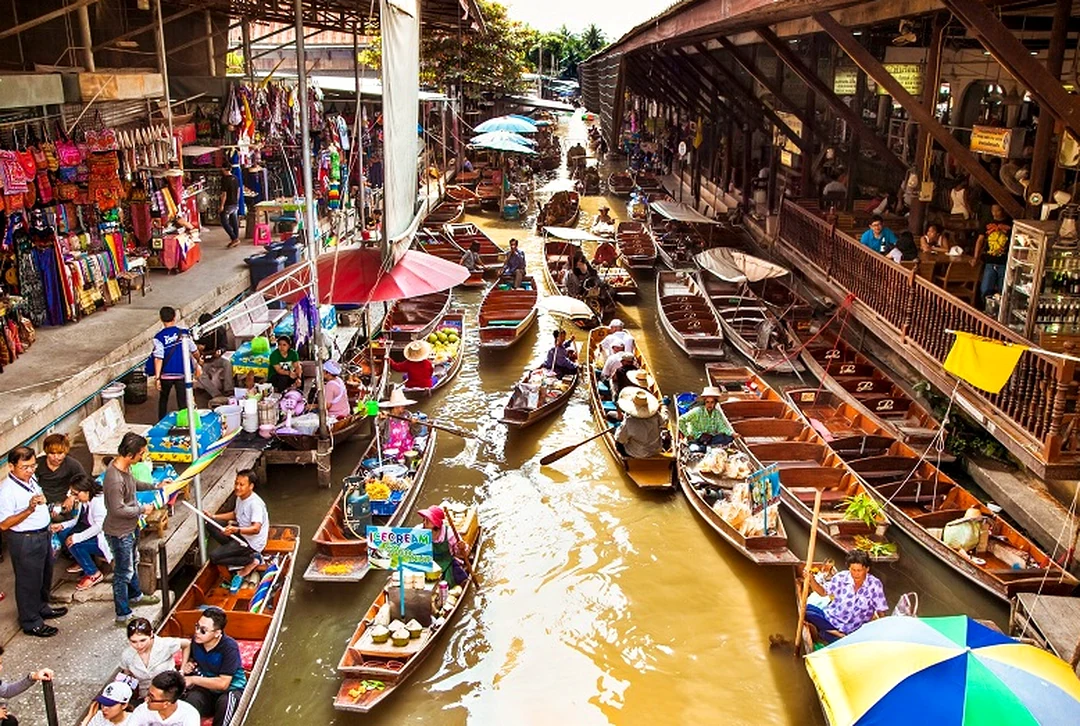
Evening dining along the Damnoen Saduak canals is also an exquisite symphony of local sounds and regional flavors. Amidst the tranquility of the water, the crisp percussion of a traditional Ranat ek xylophone blends with the soaring notes of a Khlui bamboo flute drifting from waterside pavilions, composing a rustic melody that soothes the soul. Small boats loaded with glowing terracotta braziers serving heirloom Kuaitiao Ruea boat noodles pull gently alongside visitors’ vessels. The heady aroma of cassia cinnamon, star anise, rich bone broth, and creamy coconut milk poured over grilled sticky-rice banana desserts mingles with the cool river breeze, awakening every sense in a setting steeped in East Asian poetic charm.
The pinnacle of natural light displays in this region is a wooden boat excursion gliding down the branch canals linking Damnoen Saduak to the Mae Klong estuary late into the night. Along ancient cork trees overhanging the water’s edge, millions of native fireflies flash in unison, blinking synchronously like strings of sparkling jade lanterns suspended beneath the deep night sky. This magnificent ecological light dance intertwines with the weathered silhouettes of fishermen casting late-night nets, creating a sublime visual tableau that no artificial stage could ever replicate, etching the enduring beauty of central Thailand’s river civilization deeply into the traveler’s memory.
As streaks of morning mist over Khlong Damnoen Saduak gradually dissolve in the dawn sunlight, the culinary heartbeat of the century-old floating market truly awakens, unleashing a vibrant fusion of aromas and flavors. Ever since Grand Prime Minister Somdet Chao Phraya Sri Surawongse fulfilled the royal command of King Rama IV and King Rama V to excavate the canal linking the Tha Chin and Mae Klong rivers in the 19th century, this fertile wetland has served as a remarkable culinary crossroads among indigenous Siamese residents, Teochew and Hokkien Chinese communities, and river-savvy Mon migrants. The rich canal banks not only nourished lush plantations of nipa palms, sugarcane, sweet pomelos, and grapevines, but also directly supplied the bountiful ingredients that form the foundation of this one-of-a-kind boat-borne food culture.
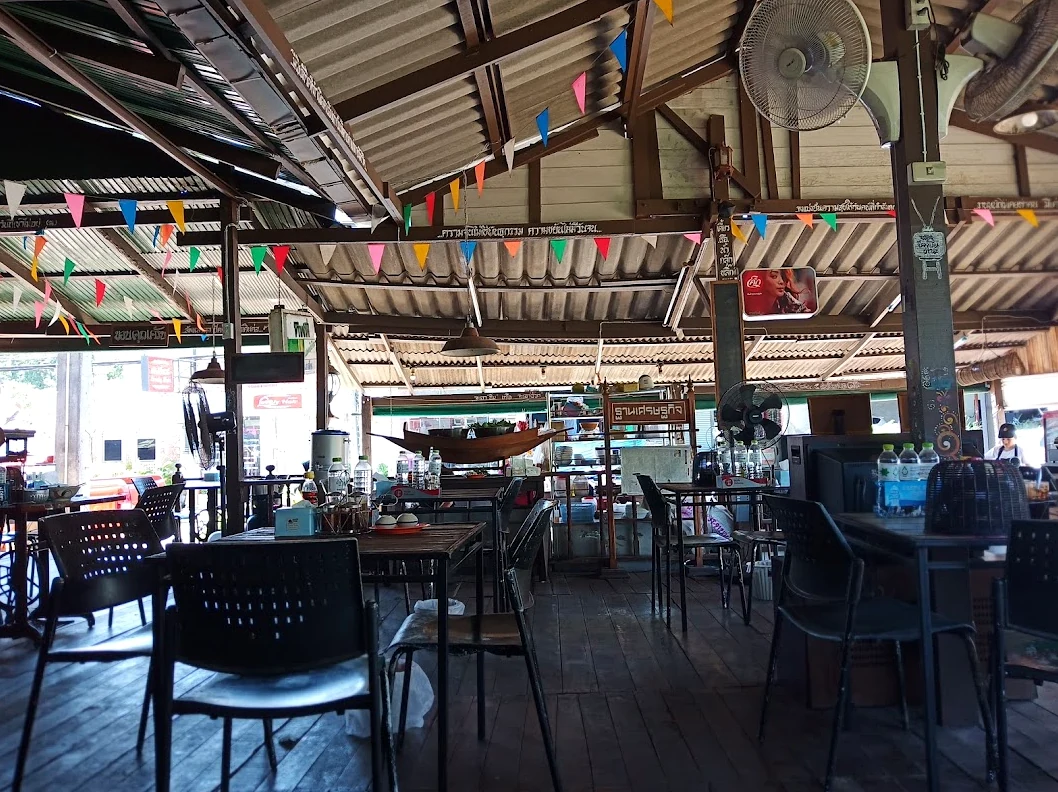
The immortal icon representing the culinary soul of Damnoen Saduak’s waterways is the celebrated boat noodle dish (Kuay Teow Reua). Aboard compact wooden sampans, local cooks sit tucked inside the hull, deftly orchestrating a floating kitchen anchored by a pot of broth perpetually simmering over glowing charcoal. The broth here is steeped in closely guarded family spices, simmered from marrow bones with star anise and cassia bark, enriched with a splash of fresh blood for signature velvety body, and garnished with fragrant fried garlic and crisp water spinach. The moment a small porcelain bowl is passed across the gunwales via a slender wooden pole, diners experience a complete harmony of five flavor layers: bright tang from chili vinegar, fiery heat from roasted chili paste, gentle sweetness from preserved radish, savory depth from anchovy fish sauce, and rich tenderness from broth-soaked meatballs.
Beyond bowls of boat noodles, Damnoen Saduak’s gastronomic map captivates visitors with skillets sizzling with crispy oyster omelets (Hoy Tod) and smoky, aromatic Pad Thai noodles. Its prime geographic location bordering the bountiful estuaries of Samut Sakhon and Samut Songkhram supplies the floating market with seafood of unmatched freshness. Skewers of plump river prawns and fresh squid grilled over hardwood charcoal are brushed generously with tangy tamarind chili sauce, wafting mouthwatering aromas across the water. Local women wearing traditional conical ngop palm-leaf hats deftly flip skewers of tender Moo Ping grilled pork marinated in coconut milk and palm nectar, creating an irresistible visual allure for travelers gliding past by boat.
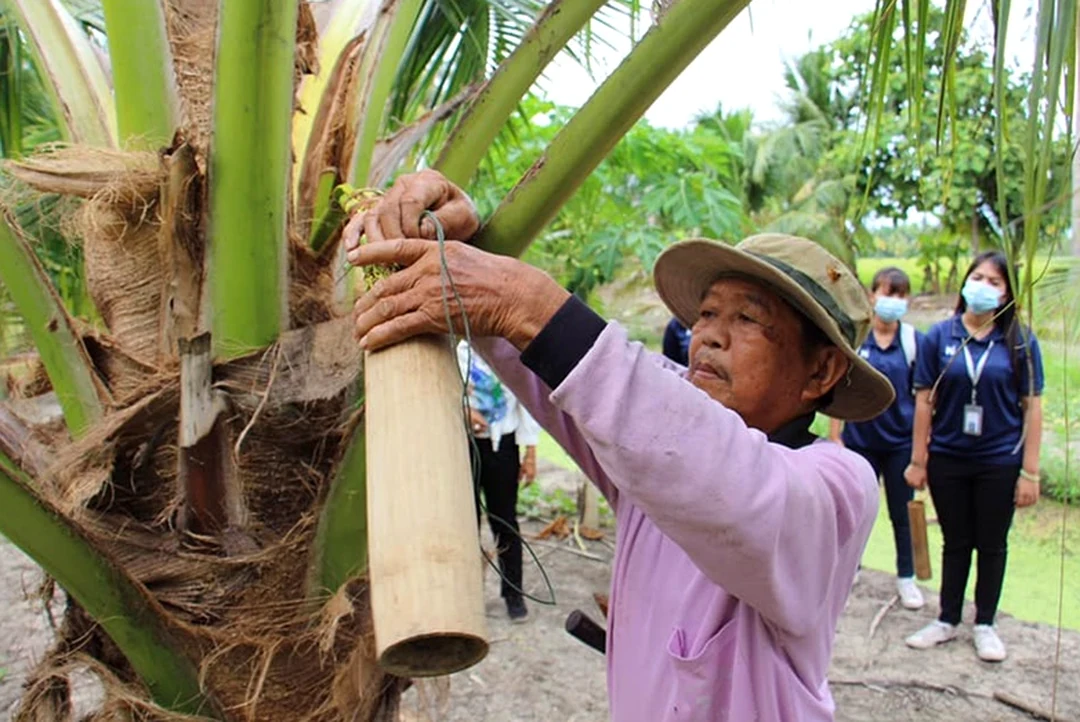
The sweet flavors of the market are also intimately tied to the multi-generational tradition of artisanal coconut sugar production along the canal banks. Fresh coconut flower nectar is harvested and continuously boiled in massive cast-iron woks fueled by dried coconut husks, reducing into golden blocks of sugar redolent with pure caramel notes. This prized sweet nectar elevates the market’s mango sticky rice (Khao Niew Mamuang) to perfection. Fragrant glutinous rice steamed in rich coconut milk, paired with slices of juicy ripe yellow mango and sprinkled with crunchy roasted mung beans, leaves an unforgettable, refined finish. Meanwhile, coconut ice cream served inside a freshly scraped half coconut shell still lined with tender young flesh, topped with chewy palm seeds and roasted peanuts, offers a refreshing cool note to chase away the tropical midday heat.
Savoring food at Damnoen Saduak is far more than simply tasting delicious dishes; it is a journey into a living heritage of riverine hospitality and etiquette. The gesture of steadying a bowl of noodles tilted with the gentle bobbing of the waves, the warm smile of a boat vendor handing over a bag of freshly peeled fruit, or the metallic clink of an aluminum change tin passed between two hulls all reflect the harmonious philosophy of life in southern Siam. Every seasoning standard and fire-tending technique on the water has been passed down intact through matrilineal generations, ensuring this historic stretch of canal forever preserves the authentic spirit of Thailand’s captivating river civilization.
The rhythm of commerce along Khlong Damnoen Saduak—initiated in Buddhist Era 2409 (1866) under King Rama IV and completed under Grand Prime Minister Chuang Bunnag—awakens at daybreak. The floating market is at its liveliest and most authentic between 7:00 AM and 11:30 AM. This is the golden window when morning mist still lingers over the water and early sunbeams filter through coconut palms onto wooden boats brimming with fresh fruit from the orchards of Samut Songkhram and Ratchaburi. Travelers should depart Bangkok before 7:00 AM to arrive when boat traffic is at its most vibrant, beating both the heaviest tour crowds and the sultry tropical heat of midday.
Located in Damnoen Saduak district, Ratchaburi province, approximately 100 kilometers southwest of central Bangkok, the floating market enjoys seamless transport connections. The most popular overland route follows the main artery of National Highway No. 4 through Nakhon Pathom, or connects via the elevated M82 motorway from Bang Khun Thian to Ban Phaeo, cutting travel time by private car or tour van to just over an hour. The primary disembarkation point to board boats is Khlong Ton Khem pier, which offers spacious docking facilities and direct access to the bustling commercial core. Notably, visitors frequently combine this stop with the famous Mae Klong Railway Market, located about 12 kilometers away along Highway 325, creating a unique half-day itinerary exploring both river and railway culture.
Sightseeing costs at Damnoen Saduak depend primarily on the type of watercraft travelers choose. Traditional wooden hand-paddled sampans accommodating four to six passengers are the ideal choice for gliding slowly through narrow side canals and observing river commerce up close, priced between 300 and 500 Baht per person for a one-hour trip. Meanwhile, large families or groups of friends wishing to venture deeper into outer canal branches and visit waterside artisanal coconut sugar workshops can charter a private motorized long-tail boat for 1,500 to 2,000 Baht per vessel. Agreeing clearly on the itinerary, stopover durations, and a fixed price with the boat operator before stepping onto the pier is an essential rule for a smooth excursion.
Shopping and sightseeing etiquette at this historic market also rewards a touch of finesse for a truly fulfilling experience. At souvenir stalls selling hand-carved wooden figurines and handicrafts lining the plank boardwalks, visitors can smile politely and bargain 30 to 50 percent below the initial asking price. Conversely, freshly prepared boat food—such as steaming boat noodles, rich coconut mango sticky rice, or fragrant roasted coconuts—is modestly priced and clearly marked. Travelers should carry a small pouch of 20-, 50-, and 100-Baht notes for convenient transactions amid the bobbing boats. Be sure to bring a waterproof pouch for your phone, apply sunscreen, wear a wide-brimmed hat, and avoid resting your hands on the gunwales when boats bump alongside one another in crowded traffic.
For those eager to immerse themselves fully in the historical flow of Ratchaburi’s waterways without worrying about arranging transfers or negotiating pier fares, joining an all-inclusive tour package is the ideal way to capture radiant memories of the Land of Smiles with every gentle stroke of the oar.