
Nestled along the shores of a natural world heritage site thrice honored by UNESCO, Ha Long is not only an iconic symbol of Vietnam’s majestic geological landscapes but has also evolved into one of the region’s most vibrant and modern coastal tourism hubs. Backed by a comprehensive, fully-connected regional transport infrastructure, the local hospitality sector has undergone dramatic qualitative and quantitative transformations. With a supply scale exceeding 20,000 high-quality rooms spanning from the mainland to the open sea, the Ha Long hotel market is witnessing a profound structural shift: moving from traditional commercial accommodations to multi-experience resort complexes, world-class MICE facilities, hot spring wellness retreats, and fleets of VR-SB standard steel-hulled superyachts acting as luxurious “floating hotels” in the heart of the wonder. The blend of deep indigenous culture and upscale service standards is repositioning Ha Long into a comprehensive accommodation paradise, fully equipped to meet every need ranging from family vacations to elite global super-events.
1. Heritage Foundation & Evolutionary History of the Ha Long Hotel Industry
1.1. From Prehistoric Cultural Footprints to World Natural Heritage Leverage
Unlike many coastal tourism cities built purely from modern master plans, Ha Long boasts a massive cultural and archaeological stratum, serving as an ancient cradle for early Vietnamese people since the Neolithic period. Its historical flow has been continuously enriched through three successive archaeological cultures: Soi Nhu, Cai Beo, and Ha Long, spanning from 18,000 to 3,500 years ago. The priceless sedimentary relics at Soi Nhu Cave, Me Cung Cave, or Tien Ong Cave not only reflect the livelihood transition from hunting and gathering to adapting and conquering the sea, but also establish a unique island and marine culture. This humanistic depth has created the soul and original value, laying a solid foundation for the development of heritage tourism before the very first bricks of modern hospitality services were laid.
The historical milestone that shaped the entire economic structure and modern resort urban landscape of Ha Long consists of international UNESCO honors. Ha Long Bay was first recognized as a World Natural Heritage site in 1994 for its exceptional landscape value, recognized for the second time in 2000 for its geology and geomorphology, and elevated in 2023 when combined inter-provincially with the Cat Ba Archipelago, confirming the region’s unrivaled status on the global tourism map. The world heritage title acts as the most powerful strategic catalyst, triggering massive capital investment into transportation, ports, and accommodation infrastructure, creating the premise to transform a traditional coastal town into a world-class tourism and accommodation growth pole.
1.2. Foundation-Laying Period (1990 – 2010): The “Pioneering Birds”
During the early days of tourism opening and development, accommodation infrastructure in Ha Long began recording significant milestones with the appearance of pioneering commercial accommodations in Bai Chay. In 1992, Vuon Dao Hotel with 67 rooms was established, marking a shift from official guesthouse models to professional commercial tourism services. Following that success, Heritage Ha Long Hotel was born, becoming the first international standard 4-star hotel along the bay with 101 ocean-view rooms and the high-end Octagon restaurant.
The accommodation landscape continued to be elevated with the presence of Saigon Ha Long Hotel—a striking 15-story building amidst the pine forests of Bai Chay hill featuring 23 luxurious villas and the Panorama revolving restaurant capturing the full view of the wonder, alongside Ha Long Plaza and Ha Long Spring Hotel, laying a solid foundation for the high-standard accommodation system during the integration period.
1.3. The Era of 5-Star Boom & International Brands (2011 – 2019)
As regional connectivity infrastructure began to take shape, Ha Long’s hotel industry entered an unprecedented era of scale expansion and a dramatic leap in service standards. A historic turning point took place on December 30, 2013, when Muong Thanh Quang Ninh Hotel officially opened in Bai Chay, becoming the first 5-star standard accommodation locally, completely shattering the 4-star “limit ceiling” that had existed for decades. This event not only established a new accommodation standard but also triggered a massive capital injection race from leading private economic groups. Shortly after, the market quickly welcomed the entry of global management brands, notably Wyndham Legend Ha Long with 374 rooms offering direct views of the Bai Chay Bridge and the heritage bay, bringing strict international service standards into the local tourism market.
Parallel to the emergence of international brands, Ha Long’s resort urban landscape was profoundly reshaped by the appearance of multi-experience complex mega-developments. Vingroup redefined the concept of isolated resort living with the mega-project Vinpearl Resort & Spa Ha Long spanning nearly 50,000 m² on Reu Island, completely connected exclusively by high-speed boats across the bay. In the MICE (Meetings, Incentives, Conferences, and Exhibitions) tourism segment, FLC Group left its mark with the FLC Halong Bay Golf Club & Luxury Resort complex on the peak of Van Nghe hill, integrating an 18-hole golf course overlooking the wonder along with a large-scale international conference center. At the same time, in the Hung Thang peninsula, BIM Group created a breakthrough in coastal urban architecture with the A La Carte Halong Bay tower within the Halong Marina complex. Standing at a height of 157.95m with 41 above-ground floors—the tallest building in the coastal city, providing over 900 resort apartments and top-tier amenities such as a 40th-floor infinity pool and a rooftop bar—the project completed the booming picture of the luxury accommodation segment, turning Ha Long into a premier luxury destination in the North.
1.4. Restructuring, Screening, and In-depth Positioning Cycle (2020 – Present)
The consequences of overheated development along with global economic fluctuations pushed Ha Long’s hotel market into a fierce restructuring and filtering cycle. Hybrid accommodation models that once dominated the previous decade, such as condotels and self-managed boutique shophouses, began to reveal serious bottlenecks regarding legalities and risks from profit-sharing financial commitments. The situation of localized room oversupply, leading to a fierce room rate slashing race and the closure of several thousand-room projects, became a driving force compelling the entire market to filter out, ending the quantity-chasing mindset to move towards the depth of service quality and operational sustainability.
Amidst this cleansing context, capital from strategic developers continued to seek distinct directions, opening up a shift in the accommodation axis from the entertainment center of Bai Chay to the historically rich Hon Gai area. A typical example of this trend is the 35-story Ha Long Bay Marriott Hotel project with a scale of approximately 350 international ultra-luxury standard rooms, located in Hong Gai ward and adjacent to the Hon Hai Ancient People National Archaeological Site. The presence of the world’s leading hotel management brand on the East Bank not only reshapes the landscape of the heritage city but also affirms a new development philosophy for Ha Long’s hospitality industry: honoring millennia-old cultural values, connecting archaeological spaces with luxury resort amenities to deliver in-depth accommodation experiences for elite travelers.
2. Overview of Outstanding Accommodation Types in Ha Long
2.1. High-rise Hotels & High-end Resorts (4 – 5 Stars)
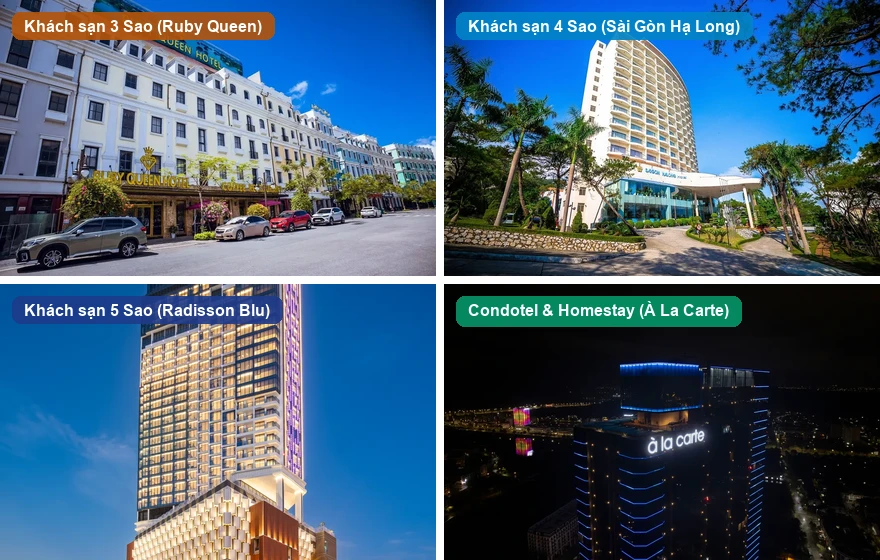
The high-rise hotel and luxury resort segment ranging from 4 to 5 stars plays a pillar role, shaping the modern urban face and elevating the international welcoming capacity of the heritage city of Ha Long. Properties in this segment stand out for their grand architectural scale, located in prime positions along the Bai Chay coastal road, Hung Thang peninsula, or isolated on offshore islands, providing expansive panoramic views encompassing the limestone wonder. The core highlight of this segment lies in its closed internal amenity system, standardized according to strict operational benchmarks: from conference centers and banquet halls spanning thousands of square meters integrated with specialized technology for MICE tourism, sky infinity pools facing the bay, to chains of fine-dining restaurants serving Asian and European culinary elites, alongside specialized healing and energy-rejuvenating spas.
Thanks to the synchronization and meticulousness in facilities and service quality, this group of high-end accommodations has become the top choice for customer segments with strict requirements for service standards. This is the optimal stopping point for business people, senior experts, large corporate groups attending conferences combined with leisure, as well as international tourists seeking peace of mind from reputable brands. At the same time, the comfortable, safe, and all-inclusive spaces at a single destination also turn 4–5 star hotels and resorts into ideal vacation spaces for multi-generational families during long holidays in Ha Long.
2.2. Floating Hotels & VR-SB Standard Superyachts
The overnight marine accommodation sector in Ha Long has witnessed a breakthrough revolution, shifting strongly from traditional wooden-hulled fleets to a generation of steel-hulled superyachts meeting 5 to 6-star standards—likened to luxurious “floating hotels” riding the waves in the heart of the heritage. This maritime technology breakthrough is recognized by the application of the VR-SB (River-Sea) technical grade licensed by the Vietnam Register. With the capacity to withstand waves up to 2.5 meters high and wind speeds up to 24 m/s, VR-SB standard superyachts not only ensure maximum operational safety in complex weather conditions but also break the limits of traditional inland waterways, opening up seamless cross-bay discovery routes between Ha Long Bay, Lan Ha Bay, and Bai Tu Long Bay.
The interior spaces of these next-generation yachts are planned like miniature resorts with an ecosystem of luxury amenities, from large-suite rooms featuring private sea-view balconies, Jacuzzi bathtubs near panoramic glass windows, to fine-dining restaurants, rooftop bars, and wellness spas. Leading this wave of experience enhancement is a fleet of iconic superyachts such as the green yacht duo Essence Grand and Grand Pioneers pioneering VR-SB safety standards, the 90m Catherine Cruise superyacht with supreme resort facilities, alongside established 5-star brands like La Regina Legend, Paradise Peak, and Rosy Cruise. The perfect combination of maritime technical safety and international standard accommodation services has turned the experience of overnight stays on the bay into a unique resort product, fully satisfying the desire of global elite travelers to immerse themselves in the wonder of nature.
2.3. Condotels, Homestays & Self-managed Shophouses
Alongside traditional hotel systems, the boom of condotels, homestays, and self-managed shophouses has brought a fresh breeze, significantly enriching the accommodation picture in Ha Long. The biggest plus of this group of formats lies in extremely competitive rental rates along with spacious, flexible living spaces, usually equipped with full kitchen areas, living rooms, and living amenities like a real home. This is an optimal accommodation choice for groups of young friends, young families traveling independently, or large groups wishing to optimize costs while ensuring convenience, comfort, and private bonding space throughout the trip.
However, along with the cost advantages, this segment also has limitations that travelers should carefully consider before booking. Because most condotels or shophouses are managed by individual owners or small-scale operators, service quality and meticulousness in facility maintenance often experience significant discrepancies and fluctuations, lacking consistency compared to the strict standards of professional hotels. Travelers may encounter certain inconveniences such as the lack of a 24/7 front desk, irregular daily housekeeping services, or extra fees when using internal amenities like swimming pools and gyms. Therefore, proactively checking real user reviews beforehand, as well as clarifying check-in procedures and accompanying service terms, is extremely essential to ensure a smooth accommodation experience.
3. Key Accommodation Area Map in Ha Long: Where to Stay?
3.1. Bai Chay Tourism Center – Vibrant & Convenient
Bai Chay has long affirmed its position as the most vibrant and bustling tourism epicenter of the coastal city of Ha Long, concentrating a dense density of accommodation establishments with full segments from budget to high-end 5-star. The absolute advantage of this area lies in its prime location and perfect entertainment connectivity: travelers staying in Bai Chay take only minutes to access the artificial white-sand beach stretching along the bay, immerse themselves in the bustling culinary atmosphere of the night walking streets, easily play at the Sun World Halong Complex mega-complex, and conveniently travel to the Ha Long International Cruise Port to start sightseeing cruises. The convergence of complete dining, shopping, and entertainment services operating 24/7 turns this place into the number one stop for tourists who love a modern, convenient lifestyle and wish to optimize travel time to key attractions.
However, this immense attraction and rapid urbanization rate also create downsides that travelers should note when choosing to stay in Bai Chay. During peak summer seasons or holidays, this area frequently faces infrastructure overload pressure, high tourist density, and localized traffic congestion on major coastal arteries. Additionally, the massive boom of a series of condotels, homestays, and self-managed shophouses has sparked a fierce room rate competition, leading to inconsistencies in service quality and facility maintenance among accommodation providers. Travelers who fail to research thoroughly and book early can easily encounter rooms that do not match the price or be affected by urban noise during peak periods.
3.2. Hung Thang Peninsula & Halong Marina – Modern Resort Space
Adjacent to Bai Chay but possessing a more peaceful pace of life and synchronized planning, the Hung Thang Peninsula and the Halong Marina urban complex are rising to become the most modern and civilized resort focal point of the coastal city. Positioned as a multi-functional coastal tourism urban area, this region provides an airy accommodation space, just isolated enough from the noise of central entertainment areas while ensuring seamless traffic connectivity. The infrastructure ecosystem here is systematically invested with breezy coastal promenades, vibrant sea squares, internal marinas, and rich shopping malls and culinary complexes, creating a relaxed, trendy vacation style for travelers.
The highlight creating Hung Thang’s distinct appeal lies in the dense concentration of modern condotel products lines and globally renowned hotel management brands. Located at the heart of the peninsula is the A La Carte Halong Bay tower standing proudly by the water, providing luxury resort apartments integrated with a sky infinity pool overlooking the wonder. Alongside this, the presence of upscale international accommodation complexes such as Citadines Marina Halong or the ultra-luxury InterContinental Halong Bay Resort and Residences has established international-standard living and resort benchmarks, turning Hung Thang into an ideal coordinate for travelers seeking a convenient, private vacation rich in aesthetic experiences.
3.3. Hon Gai Area – Cultural Depth, Local Cuisine & New Accommodation Axis
In contrast to the vibrant and bustling pace of Bai Chay on the West Bank, the Hon Gai area (East Bank) carries a peaceful beauty, rich cultural depth, and a distinctly local lifestyle. This is an ideal stopping coordinate for travelers who love a quiet resting space, wanting to separate from the hustle and bustle of commercial entertainment areas to immerse themselves in the daily life of coastal town residents. Staying in Hon Gai, visitors can easily access iconic cultural works and monuments such as the Quang Ninh Museum – Library complex by the bay, Poem Mountain scenic spot, Cua Ong Temple, ancient Long Tien Pagoda, or stroll along the expansive Tran Quoc Nghien coastal road. In particular, this area is also an authentic culinary paradise with the bustling Hon Gai traditional seafood market early in the morning, offering experiences to enjoy fresh seafood prepared with authentic local flavors.
Alongside millennia-old cultural values, Hon Gai is witnessing a strong rise to become a new high-end accommodation axis, reshaping the entire economic and tourism landscape of the East Bank. Resort real estate investment capital is heading strongly towards this area with the appearance of ultra-luxury projects bearing international management brands, typically the Ha Long Bay Marriott Hotel complex located adjacent to the Hon Hai Ancient People National Archaeological Site. The harmonious intersection between global luxury service standards and unique local historical strata not only elevates the urban space of Hon Gai but also creates a luxurious, deep, and distinct resort rendezvous dedicated to elite travelers.
3.4. Tuan Chau Island & Reu Island – Isolated Experience & Absolute Relaxation
Completely detached from the noisy urban life on the mainland, Reu Island and Tuan Chau Island represent the pinnacle of resort spaces where visitors can find privacy, tranquility, and absolute relaxation by the heritage bay. The most luxurious and unique highlight is the Vinpearl Resort & Spa Ha Long complex reigning entirely on Reu Island—a famous 5-star resort with magnificent neoclassical architecture surrounded by four sides of sea waves. Being accessible only by a specialized high-speed boat system not only creates absolute isolation but also gives visitors the feeling of stepping into a private paradise oasis, where every view from room balconies, outdoor pools, or culinary restaurants opens up panoramic 360-degree views of Ha Long Bay.
Alongside Reu Island, Tuan Chau Island affirms its position as a regional-scale marine resort and yacht service capital. It features the modern Tuan Chau International Passenger Port (Tuần Châu Marina) with a capacity of thousands of watercraft, serving as the main departure point for sightseeing fleets and 5-6 star overnight superyachts cruising the bay. Besides the dynamism of the port, Tuan Chau still retains its peaceful resting space thanks to coastal resorts hidden under pine forests, private beaches, a top-tier golf course, and marina streets bearing elegant European architectural breath. The combination of Reu Island’s privacy and Tuan Chau’s convenience and luxury creates a perfect resort destination for affluent families, honeymoon couples, and travelers wishing to recharge amidst the heritage sea and sky.
4. New Resort Trends Shaping the Ha Long Market
4.1. MICE Capital & “Super Wedding” Destination for International Billionaires
Ha Long is firmly affirming its position as the leading MICE (Meetings, Incentives, Conferences, and Exhibitions) tourism capital in Northern Vietnam thanks to its large-scale accommodation ecosystem and comprehensive event organization capabilities. The capacity to welcome and serve thousands of corporate guests and international conferences simultaneously is certified by modern conference centers at FLC Grand Hotel Ha Long or the high-end banquet suite chain of Vinpearl Resort & Spa Ha Long. The perfect combination of 5-star facilities, professional sound and lighting systems, closed banquet services, and exceptional heritage landscapes has turned the coastal city into a priority destination for major economic forums, corporate gratitude events, and international cultural exchange programs.
In particular, the boom of the luxury wedding tourism trend from Indian plutocrats has created a landmark milestone, putting Ha Long’s name on par with world-famous wedding paradises like Bali or Phuket. With a huge budget ranging from 3 to 4 million USD (equivalent to about 70 to 80 billion VND) for each multi-day event, international billionaires are ready to buy out the entire resort space at Reu Island Vinpearl or FLC Ha Long to organize lavish banquets imbued with traditional cultural styles. The presence of ultra-high-net-worth customer segments and unique entertainment activities on the bay not only brings breakthrough revenue for the local hotel industry, but also strongly affirms the operational capacity and upscale service standards of Ha Long’s accommodation system on the global tourism map.
4.2. Wellness Tourism – Overcoming Seasonality
Northern coastal resort tourism has long faced cyclical barriers regarding seasonality, as cold northeast monsoon winds often lead to a significant drop in accommodation demand in coastal areas. To thoroughly resolve this bottleneck, the wellness and energy restoration tourism model (Wellness Tourism) has been introduced as a strategic move, opening up a completely new resort habit and activating high-end tourist flows to Ha Long regardless of weather conditions.
The focal point creating this turning point is the Yoko Onsen Quang Hanh hot spring resort complex—a pioneering project bringing the full essence of Japanese onsen culture into the heart of a pristine limestone valley. Possessing abundant natural hot spring sources with a system of 27 multi-functional mineral baths, combined with isolated traditional Washitsu wooden villas and specialized therapy services, this place creates an authentic meditative space for physical and mental healing. The appearance of the high-end hot spring resort model not only attracts affluent tourists willing to pay high prices to enjoy private spaces, but also directly turns freezing winter days into a peak season of rejuvenation, contributing to eliminating prejudices about seasonality and turning Ha Long into a complete four-season resort destination.
4.3. Night-time Economy & Yacht Night Street
The night-time economy is rising to become one of the strategic growth pillars, fundamentally changing the tourism landscape and directly optimizing revenue for the entire accommodation system in Ha Long. Statistical reports indicate that commercial and night entertainment activities currently contribute up to 70% of total local tourism revenue, while prompting each tourist to spend an additional 300 to 400 USD for services outside office hours. The focal point driving the vibrant nightlife by the bay is the Sun Marina Plaza commercial complex with trendy seaside shophouses, converging a rich chain of culinary restaurants, coastal bars and pubs, and walking streets filled with light, bringing tourists endless shopping and entertainment experiences after sunset.
Alongside onshore activities, the most unique and breakthrough highlight of Ha Long’s night economy is the Yacht Night Street model combined with luxury “Restaurant Cruises” departing from the Ha Long International Cruise Port. With an average service capacity of about 2,500 guests per night, these brilliantly lit restaurant yachts turn the heritage bay into a giant live-action stage on the water, where guests can enjoy top-tier seafood while admiring the magical beauty of the coastal city at night in a lively musical space. The strong development of this service chain not only extends waking hours and keeps tourists staying longer, but also completely eradicates the stereotype of a “early sleeping” tourist city, opening up a complete and vibrant experience space 24/7 in Ha Long.
5. Reference Room Rate Table & Ha Long Hotel Booking Handbook
5.1. Summary Table of Room Rates by Segment (Peak & Off-Peak Seasons)
Below is a summary table of reference room rates in Ha Long by accommodation segment and seasonal tourism periods of the year:
| Accommodation Segment | Weekday Rate (Off-Peak) | Weekend / Summer Rate (Peak) | Suitable Guest Profile |
|---|---|---|---|
| Standard Homestay / Guesthouse | 350,000 – 650,000 VND/night | 600,000 – 1,000,000 VND/night | Groups of young friends, backpackers, budget independent travelers |
| 3-Star Hotel | 600,000 – 1,100,000 VND/night | 900,000 – 1,600,000 VND/night | Families, mid-range tour groups needing central locations |
| 4-Star Hotel | 1,100,000 – 1,800,000 VND/night | 1,600,000 – 2,600,000 VND/night | Corporate guests, families needing pools and standard breakfast buffets |
| International 5-Star Hotel | 1,800,000 – 3,500,000 VND/night | 2,800,000 – 5,500,000 VND/night | Luxury resort guests, MICE groups, international tourists |
| 5-6 Star Overnight Superyacht (All-inclusive) | 2,800,000 – 4,500,000 VND/guest | 3,500,000 – 6,000,000 VND/guest | Honeymoon couples, families wanting full bay experiences |
5.2. Transport Infrastructure Leverage & Impact on Stay Itineraries
The synchronized transport infrastructure system with the Hanoi – Hai Phong – Ha Long – Mong Cai expressway has shortened travel time from the Capital to the coastal city to under 2 hours of driving. This convenience has formed an exploding “Weekend Getaway” short-term travel trend, making Ha Long the number one destination for weekend vacations of residents in the Red River Delta region.
However, this trend also causes room occupancy on Friday and Saturday nights in summer to always hit 95 – 100%. Travelers are recommended to plan and book rooms at least 2 to 3 weeks in advance for 4–5 star beachfront hotels, or choose to stay on weekdays (Sunday to Thursday) to enjoy preferential rates ranging from 25% to 40% alongside a quieter, more relaxed resort space.
5.3. Criteria for Choosing Hotels Suited to Needs
To have a complete vacation in Ha Long, travelers should carefully consider accommodation selection criteria according to the actual needs of the group:
- Family travelers with elderly members and young children: Prioritize hotels or resorts in central Bai Chay with private beaches, four-season swimming pools, kids’ clubs, and diverse culinary buffet restaurants.
- Couples and honeymooners: Isolated resorts like Reu Island Vinpearl, Onsen Quang Hanh, or 5-star overnight superyachts with private balconies are perfect choices to enjoy a romantic private space.
- Business travelers, MICE conference delegations: Choose 5-star hotels with closed conference centers, column-free high-ceiling ballrooms like FLC Ha Long, Muong Thanh Grand, or Wyndham Legend.
